Reverchon Hawthorn (Crataegus reverchonii)
Crataegus reverchonii, known as Reverchon Hawthorn or Reverchon’s haw, is a thorny, small-fruited native shrub or small tree of the south-central prairies and woodland edges. It belongs to the notoriously difficult Crataegus genus — one of the most taxonomically complex groups in North American botany, with hundreds of described species and varieties that intergrade freely — but Reverchon Hawthorn is a well-documented member of the crus-galli group, named for the French-born Texas botanist Julien Reverchon, who collected extensively across North Texas in the late 1800s.
Like most hawthorns, this species forms a dense, broad, rounded crown studded with stout, slightly curved thorns, making it an effective thicket-forming plant for wildlife cover and living hedgerows. In spring it is covered with small white blossoms typical of the rose family, followed by red to orange-red pome fruits (“haws”) that persist into fall and feed a wide range of birds and small mammals.
Because it is adapted to the heavy clay soils, limestone outcrops, and hot summers of the southern Great Plains, Reverchon Hawthorn is an excellent low-maintenance choice for naturalistic hedgerows, wildlife plantings, and restoration projects within its native range, though it is rarely offered by mainstream nurseries and is best sought from specialty native-plant growers.
Identification
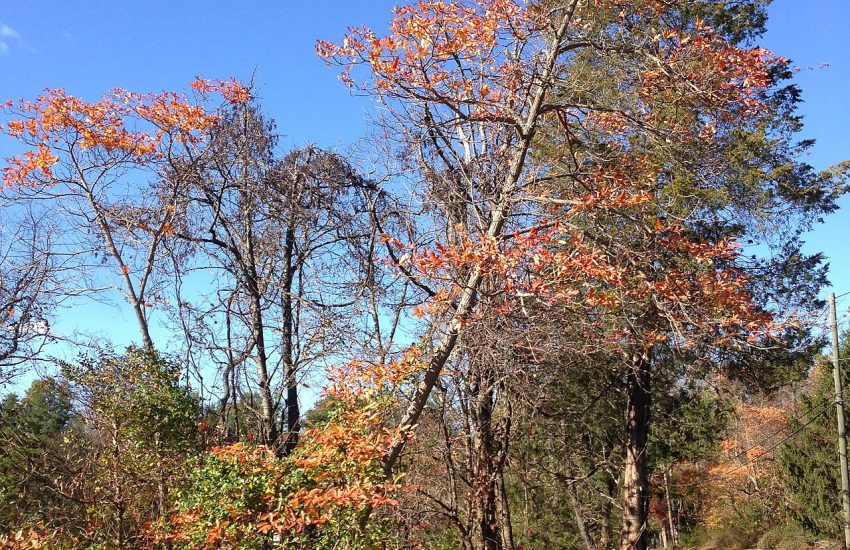
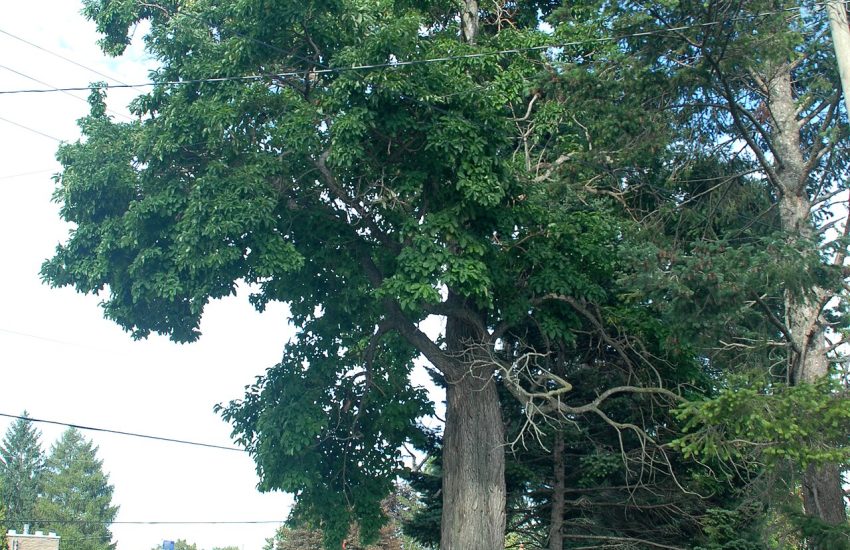
Reverchon Hawthorn is usually seen as a many-branched large shrub or small tree, typically 10 to 20 feet tall (occasionally reported to 25–30 feet in favorable sites) with a trunk rarely exceeding 4 inches in diameter and a rounded, spreading, densely twiggy crown. Like many members of the crus-galli group, it can form broad thickets where root sprouts or seedlings establish nearby.
Bark & Stems
Young twigs are slender and glabrous (hairless), dark gray in their first year and blackish by their second year. The most distinctive feature of the genus is present here in force: slender, straight to slightly reflexed thorns up to 2 to 3 inches long armor the branches, a defense that historically made hawthorn thickets valuable as living fences for livestock.
Leaves
Leaves are simple, alternate, and broadly elliptic to nearly circular in outline, with short petioles (about 2–5 mm, a small fraction of the blade length) and sharply toothed margins typical of the rose family. New growth is hairless. Fall color is not a significant ornamental feature in this species, though foliage often takes on bronze to dull red tones before dropping.
Flowers
Small white flowers, 8 to 12 mm across, open in flat-topped clusters (corymbs) in mid-spring. Each flower has five white petals, 10 to 15 (occasionally up to 20) stamens with cream, rose, or red anthers, and three to five styles — technical details that matter to botanists sorting out Crataegus species but, to the gardener, simply translate into a showy, if slightly unpleasant-smelling, spring bloom typical of hawthorns.
Fruit & Seeds
The fruit is a small, rounded pome about 10 mm (⅜ inch) across, ripening red to orange-red in late summer and fall, with persistent sepals at the tip and three to five hard nutlets (pyrenes) inside. The fruit is technically edible, in the same sense as other hawthorn haws — mildly mealy and often tart — but on this species it is small and seedy enough that it holds far more value as wildlife food than as a foraging crop for people.
Quick Facts
| Scientific Name | Crataegus reverchonii |
| Family | Rosaceae (Rose) |
| Plant Type | Deciduous Shrub / Small Tree |
| Mature Height | 10–20 ft (rarely to 25 ft) |
| Trunk Diameter | Up to 4 in |
| Growth Rate | Slow to moderate |
| Sun Exposure | Full Sun to Part Shade |
| Water Needs | Low to Moderate |
| Soil Type | Clay, limestone, or rocky prairie soils; adaptable |
| Soil pH | Neutral to alkaline |
| Bloom Time | April – May |
| Flower Color | White |
| Fall Color | Bronze to dull red (variable) |
| Fruit | Small red to orange-red pome (“haw”), ~3/8 in |
| Deer Resistant | Yes (dense thorns discourage browsing) |
| USDA Hardiness Zones | 6–8 |
Native Range
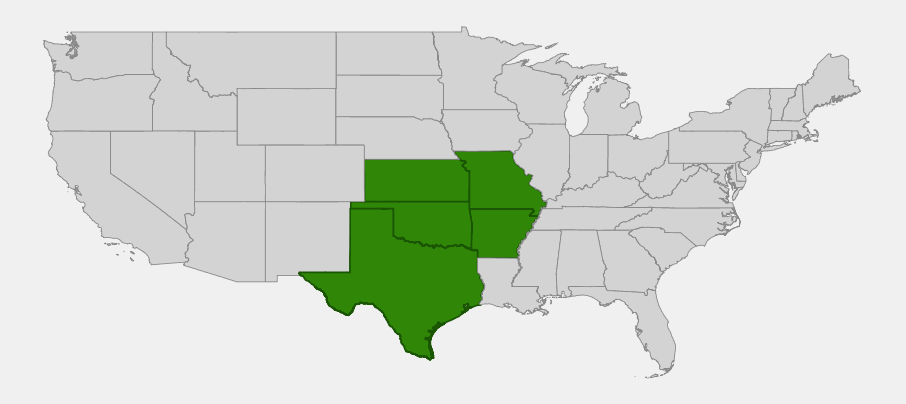
Reverchon Hawthorn is native to the south-central United States, centered on central and eastern Texas and extending north through Oklahoma, southeastern Kansas, southwestern Missouri, and western Arkansas. Within this range it grows scattered through scrubland, prairie margins, open woodland edges, and streamside thickets, generally on the heavier clay or calcareous soils typical of the Blackland Prairie and Cross Timbers regions.
It flowers in April and May and typically fruits from September into October. As with many hawthorns, it is most often found as an understory or edge species rather than growing in closed forest, favoring the sunny margins between prairie and woodland where it can form dense, thorny thickets.
Because the Crataegus genus includes an exceptional number of closely related, hard-to-distinguish species that intergrade across the southern Plains, botanists have sometimes disagreed about the precise boundaries of this species relative to close relatives such as Cockspur Hawthorn. This page follows the treatment in Flora of North America and the Flora of the Southeastern United States, both of which recognize Reverchon Hawthorn as a distinct species within the crus-galli group.
📋 Regional plant lists featuring Reverchon Hawthorn: South and West Texas · Arkansas, Louisiana, Eastern Oklahoma & Eastern Texas · Nebraska, Kansas & Eastern Colorado · Illinois, Iowa & Missouri
Growing & Care Guide
Reverchon Hawthorn is a tough, drought-tolerant plant once established, well suited to the clay soils and hot summers of its native south-central range, though its sharp thorns mean it needs thoughtful placement.
Light
Grows best in full sun, which produces the densest flowering and fruiting, though it will tolerate light to part shade at a woodland edge, as it often does in the wild.
Soil & Water
Adaptable to a wide range of soils, including the heavy clay, limestone-derived, and rocky prairie soils common across its native Texas and Oklahoma range. It is not fussy about pH as long as drainage is reasonable, and established plants tolerate considerable summer drought — an important trait for low-input native landscaping in hot climates. Supplemental water is most useful during the first one to two growing seasons after planting.
Planting Tips
Plant bare-root or container stock in fall or late winter while dormant. Because of its thorns, site it away from walkways, play areas, and spots where it will be brushed against regularly — a property line, hedgerow, or wildlife corner is a better fit than a foundation planting. Seed-grown hawthorns can be slow to establish a strong central form; many gardeners allow the naturally dense, multi-stemmed habit to develop rather than training a single trunk.
Pruning & Maintenance
Minimal pruning is needed beyond removing dead, damaged, or crossing branches in winter. Wear thick gloves and eye protection, since the thorns are stout and can cause painful puncture wounds. Hawthorns in the crus-galli group can be susceptible to the same rust, fire blight, and leaf spot issues common across the genus, though well-sited plants in full sun with good air circulation are generally healthy.
Propagation
Propagate from seed, which typically requires a period of warm then cold stratification to break dormancy and may take a year or more to germinate — a common trait across Crataegus. Root suckers or sprouts from established thickets can sometimes be transplanted as well.
Landscape Uses
- Wildlife hedgerow or living fence, using the thorny branches for natural security — see our guide to native hedgerows for birds
- Thicket or screen planting along property edges
- Prairie restoration and woodland-edge native plantings
- Bird and pollinator gardens within its native Texas-to-Missouri range
- Erosion control on rocky or clay slopes
For other regionally adapted choices to plant alongside it, see our roundup of best Texas native plants for landscaping.
Wildlife & Ecological Value
Reverchon Hawthorn provides classic hawthorn wildlife value: spring nectar and pollen, dense thorny cover, and a fall-into-winter food source in its small red haws.
For Pollinators
The spring flowers attract a wide range of native bees, flies, and beetles, which are the plant’s main pollinators. Like many hawthorns, the blossoms have a somewhat unpleasant, fetid scent that is actually an adaptation to attract carrion-visiting flies and beetles rather than bees exclusively.
For Birds
The persistent fall and winter fruit feeds American robins, cedar waxwings, northern mockingbirds, and numerous other fruit-eating songbirds, especially valuable because the haws often persist on the branch well after other fruit has been stripped elsewhere. The dense, thorny branching also provides excellent, predator-resistant nesting sites for small songbirds.
For Mammals
Small mammals and some larger browsers eat fallen fruit, and the impenetrable thorny thickets this species can form offer secure cover for rabbits and other small wildlife seeking protection from predators.
Ecosystem Role
As an edge and thicket species, Reverchon Hawthorn helps stabilize the transition zone between prairie and woodland, a structurally important niche across the Cross Timbers and Blackland Prairie regions. Its dense branching slows wind and water erosion along streambanks and field margins while its fruit supports the broader food web through fall and winter.
Cultural & Historical Uses
This species is named for Julien Reverchon (1837–1905), a French-born botanist who settled near Dallas, Texas, and became one of the most prolific collectors of Texas plants in the nineteenth century, documenting the flora of North Texas in extraordinary detail for the era. Crataegus specialist Charles Sprague Sargent formally described the species in his honor in the early twentieth century, based on Reverchon’s Texas collections.
Like other native hawthorns, this species has no major documented history of use by Indigenous peoples specific to this exact taxon, though hawthorns in general across North America were used by various tribes for their wood (valued for tool handles and small implements because of its hardness), and the haws were sometimes eaten fresh or dried. No significant medicinal tradition specific to this species is documented, and any historical hawthorn remedies should be understood as folk history rather than guidance for use today.
In the modern landscape, Reverchon Hawthorn remains primarily a plant for native-habitat and restoration plantings rather than ornamental horticulture, valued by prairie and Cross Timbers land managers for its wildlife value and toughness rather than grown as a specimen tree.
Frequently Asked Questions
How is Reverchon Hawthorn different from other native hawthorns?
It belongs to the crus-galli group of hawthorns and is closely related to cockspur hawthorn, differing mainly in subtle, technical traits of the leaves, flowers, and fruit that botanists use to separate Crataegus species. In the garden, the practical differences are minor; both are thorny, white-flowered, small-fruited native hawthorns suited to similar landscape uses.
Can I eat the fruit?
The small red haws are not toxic and have been eaten by people historically, in the same mildly tart, mealy way as other hawthorn fruit, but they are small and seedy. They are best left as a wildlife food source rather than treated as a foraging crop.
Is this a good hedge or privacy plant?
Yes — its dense, thorny, rounded growth habit makes it an effective living barrier or wildlife hedgerow, much like hawthorns have traditionally been used as hedging plants. Just keep it well away from paths and play areas because of the sharp thorns.
Why is it hard to find in nurseries?
Crataegus reverchonii is a regionally specific species within an extremely large and taxonomically complex genus, and it has never been widely commercialized the way ornamental hawthorns like Washington hawthorn have been. It is occasionally available from native-plant specialty nurseries within its Texas-to-Missouri range, or can be grown from locally collected seed. For general planting and care guidance that applies across the genus, see our guide to growing hawthorn trees.
Does it get fire blight or other hawthorn diseases?
Like most Crataegus species, it can be susceptible to fire blight, cedar-hawthorn rust, and leaf spot, especially in humid conditions or when planted near susceptible junipers (for the rust cycle). Good air circulation, full sun, and avoiding overhead irrigation reduce disease pressure.