Feltleaf Willow (Salix alaxensis)
Salix alaxensis, known as Feltleaf Willow (also called Alaska Willow), is the largest and most widespread tree-form willow of the far north, growing from the Aleutians and the Alaskan interior across the Arctic coastal plain to the Canadian Yukon and Northwest Territories. A member of the Salicaceae (willow family), it takes its common name from the dense, velvety, felt-like white hairs that blanket the underside of every leaf — a visible adaptation to the wind, cold, and intense summer sun of the subarctic.
Where conditions allow, Feltleaf Willow grows as the tallest willow in Alaska, reaching 20 to 30 feet as a single- or multi-trunked tree, though in windswept tundra and along the Arctic coast it is often reduced to a sprawling, wind-pruned shrub just a few feet tall. Its thick, woolly stems and leaves are coated with a whitish bloom that gives the whole plant a silvery-gray cast, and its stout catkins — among the first flowers to open on the tundra each spring — are a critical early food source for pollinators and a staple browse for moose.
Because it tolerates permafrost-influenced soils, river gravel, and brutal wind exposure, Feltleaf Willow is one of the most important woody plants for riverbank stabilization and wildlife habitat across interior and arctic Alaska. It is a plant of the far north specifically, not a general-purpose landscape shrub, and gardeners outside Alaska and similar subarctic climates should look to other native willows instead.
Identification
Feltleaf Willow is the tallest-growing willow in arctic and subarctic North America, forming a tree to 30 feet (9 m) in sheltered river valleys, or a low, wind-sheared shrub only 3 to 6 feet tall on exposed tundra and coastal sites. Stems elongate rapidly, up to 5 feet in a single growing season under good conditions.
Bark & Stems
Young twigs are stout and coated with a whitish, waxy bloom or dense wool that rubs off with handling, revealing a reddish-brown stem beneath. Older bark becomes gray-brown and furrowed. The combination of thick, felted twigs and a whitish bloom is one of the most reliable field marks separating this species from other large northern willows.
Leaves
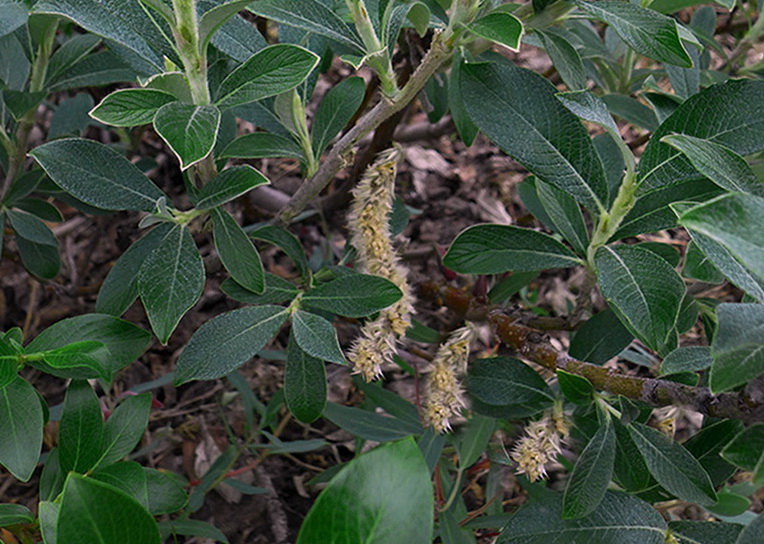
Leaves are alternate, simple, lance-shaped to oblong, 2 to 4 inches (5–10 cm) long, with the upper surface dark green and glossy and the underside densely covered in soft, white, felt-like hairs that persist through the growing season — the feature that gives the species its common name. Margins are entire or very finely toothed, and long, leaf-like stipules often persist at the base of the leaf stalk, another useful identification clue.
Flowers
Feltleaf Willow is dioecious, with male and female catkins on separate plants, opening from April to June depending on latitude and elevation, well before the leaves emerge — among the very earliest flowers on the tundra and taiga each year. Catkins are stout, densely silky-haired, and 1 to 3 inches long, making them conspicuous against bare branches in early spring.
Fruit & Seeds
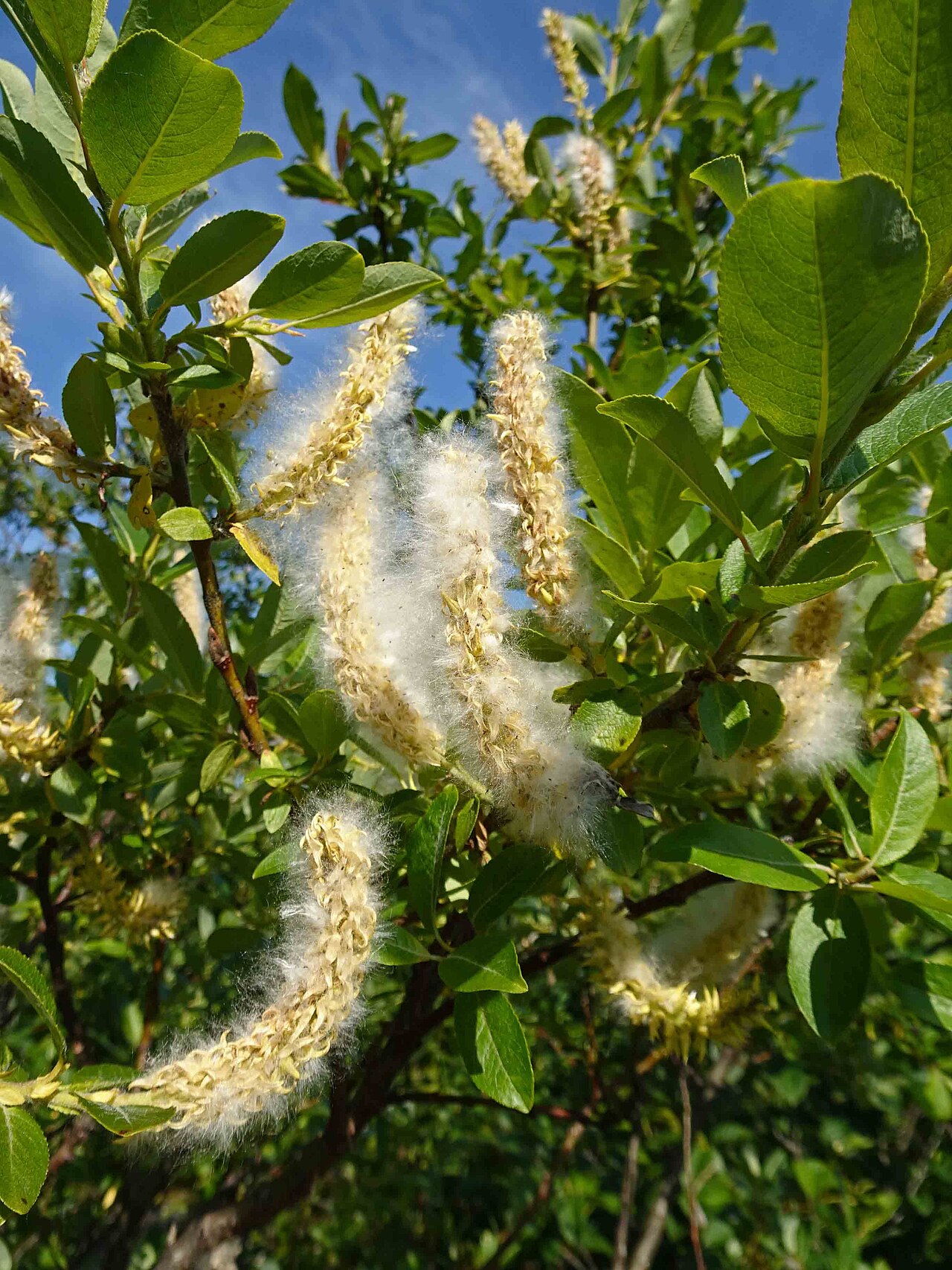
Female catkins ripen into dense clusters of small, hairy capsules that split to release abundant tiny seeds, each attached to a tuft of fine cottony down. Seed release is heavy and visually striking, often blanketing nearby vegetation and water surfaces in drifting white fluff as capsules split through early summer.
Quick Facts
| Scientific Name | Salix alaxensis |
| Family | Salicaceae (Willow) |
| Plant Type | Deciduous Shrub / Small Tree |
| Mature Height | 3–30 ft (shrubby on exposed tundra, tree-form in sheltered valleys) |
| Mature Spread | 10–15 ft |
| Growth Rate | Fast |
| Sun Exposure | Full Sun |
| Water Needs | Moderate to High |
| Soil Type | River gravel, sand, or tundra soils, often near permafrost |
| Soil pH | 5.5–7.5 |
| Bloom Time | April – June |
| Flower Color | Silvery-white to pale yellow catkins |
| Fall Color | Pale yellow |
| Fruit | Small hairy capsules with cottony seeds |
| Deer Resistant | No (a primary moose browse species) |
| USDA Hardiness Zones | 1–5 |
Native Range
Feltleaf Willow is native to Alaska and northwestern Canada, ranging across the Aleutian Islands, the Alaska interior, the Arctic coastal plain, and the Brooks Range, and continuing into Yukon and the Northwest Territories. It is absent from the contiguous 48 states, reaching its southern limits in Alaska’s boreal forest zone.
Within this range it occupies river gravel bars and floodplains, tundra stream corridors, and exposed coastal and montane tundra, from sea level to above treeline. It forms tall gallery-forest stands along major interior rivers such as the Yukon and Tanana, but shrinks to a low, wind-sculpted shrub on exposed Arctic coastal tundra, illustrating an unusually wide range of growth forms for a single willow species. Common associates include balsam poplar and other willows in riverine stands, and dwarf birch and tundra shrubs in exposed sites.
Feltleaf Willow is an important early-successional species on fresh river gravel, often being among the first woody plants to colonize bars newly deposited by glacial and snowmelt-fed rivers, a role it shares with balsam poplar across much of interior Alaska.
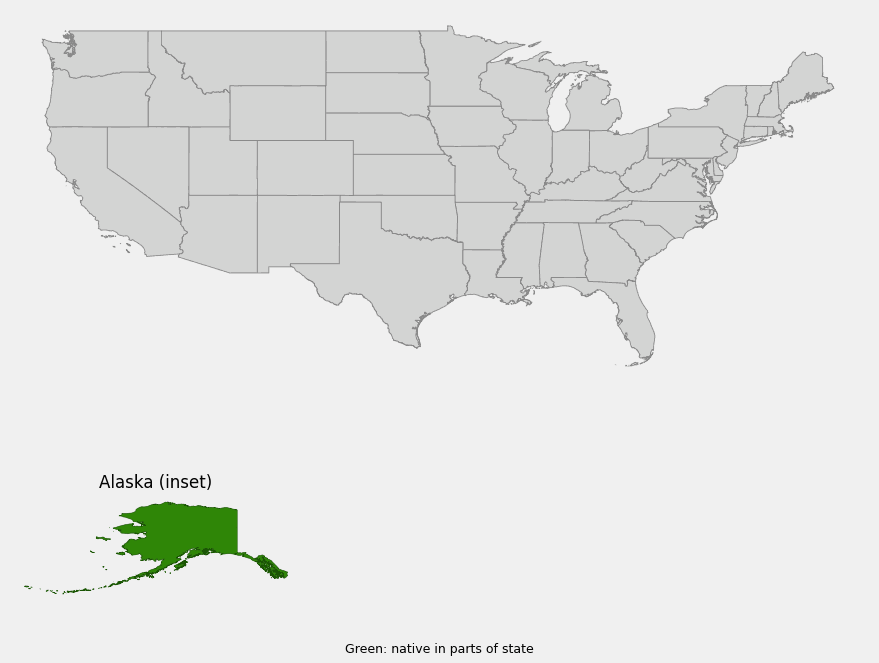
📋 Regional plant lists featuring Feltleaf Willow: Alaska
Growing & Care Guide
Feltleaf Willow is adapted to a narrow but demanding set of conditions: cold winters, a short intense growing season, and often permafrost-influenced soils. It is not a plant for temperate gardens, but within Alaska it is an easy, fast-growing choice for riverbank and wildlife plantings.
Light
Requires full sun. As a pioneer of open gravel bars and tundra, it does not tolerate shade and will not persist under a closing canopy of taller trees.
Soil & Water
Tolerates a wide range of soils from coarse river gravel to tundra peat, and handles seasonal flooding and cold, wet, permafrost-influenced ground better than most woody plants. It is not particular about soil fertility and should not be fertilized heavily, which can produce weak, winter-tender growth.
Planting Tips
Plant dormant bare-root stock or hardwood cuttings in spring as soon as the ground is workable. Like most willows, it roots readily from cuttings pushed directly into moist soil or gravel, which is the standard, low-cost method used in Alaska riverbank and revegetation projects. Space plants 8 to 12 feet apart for a continuous riverside thicket.
Pruning & Maintenance
Minimal pruning is needed. Plants can be cut back hard to rejuvenate old growth, since they resprout vigorously from the base — a useful technique where heavy moose browsing has already shaped the plant. Expect substantial browsing pressure from moose, which can be severe enough to keep young plants shrubby for years.
Landscape Uses
Feltleaf Willow serves specific, important roles in subarctic landscapes:
- River gravel bar and floodplain stabilization
- Subarctic wildlife plantings — a key moose browse species
- Windbreak in exposed interior and coastal Alaska sites
- Revegetation of disturbed tundra and mining sites
- Early-season pollinator planting for the far north
Wildlife & Ecological Value
Feltleaf Willow is one of the most ecologically important woody plants of interior and arctic Alaska, anchoring both plant and animal food webs through the long subarctic winter and short growing season.
For Pollinators
Its early catkins, opening while snow may still linger nearby, are an essential nectar and pollen source for the first native bees and flies active on the tundra and in boreal forest openings each spring.
For Birds
Willow ptarmigan — Alaska’s state bird — rely heavily on willow buds, catkins, and twigs for winter food, and Feltleaf Willow’s stature and abundance make it one of the most important ptarmigan browse species in the state. Dense streamside stands also provide nesting cover for numerous songbirds.
For Mammals
Moose depend on Feltleaf Willow as a primary winter browse species across much of interior and southcentral Alaska; in many areas it is the single most important moose food plant. Snowshoe hares and other small mammals browse the bark and twigs, especially in winter when other forage is buried in snow.
Ecosystem Role
As a dominant early colonizer of fresh river gravel, Feltleaf Willow stabilizes floodplains and initiates the successional sequence that eventually leads to balsam poplar and spruce forest in interior Alaska river valleys. Its dense root systems reduce erosion on actively migrating rivers, and the sheer biomass of browse and catkins it produces makes it a foundation species for herbivores across the boreal and arctic landscape.
Cultural & Historical Uses
Alaska Native peoples, including Athabascan, Iñupiat, and Yup’ik communities, have long used the flexible stems of Feltleaf Willow and other large northern willows for basketry, fish traps, snowshoe frames, and temporary shelter construction, taking advantage of the long, straight shoots produced after cutting or browsing.
The inner bark and cambium layer of willows, including this species, were historically eaten by some Alaska Native groups as an emergency or seasonal food, particularly in early spring when the sweet inner layer is most accessible — a practice recorded in regional ethnobotanical accounts rather than a currently recommended use.
Today, Feltleaf Willow’s primary significance is ecological rather than cultural: it is a foundational food source for moose and ptarmigan, and a standard, inexpensive tool for stabilizing disturbed riverbanks and revegetating mining and construction sites across interior and arctic Alaska. No toxicity concerns are associated with the species, and it carries no legal protection, remaining abundant throughout its range.
Frequently Asked Questions
How tall does Feltleaf Willow really get?
It varies enormously with site conditions — a sheltered river-valley Feltleaf Willow can reach 30 feet as a true tree, while the same species on exposed Arctic tundra may stay under 6 feet, wind-pruned into a low, sprawling shrub.
Can I grow Feltleaf Willow outside Alaska?
It is adapted to very cold, short-season subarctic climates and is rarely grown outside Alaska and similar regions of Canada. Gardeners in the Lower 48 should choose a willow native to their own region instead.
Why do the leaves look whitish underneath?
The dense, felt-like white hairs on the leaf underside — the source of the common name “feltleaf” — reflect intense summer sun and reduce water loss in the dry, windy subarctic environment.
Is Feltleaf Willow important for moose?
Yes — it is one of the most important winter browse plants for moose across much of interior Alaska, and heavy browsing pressure often visibly shapes the growth form of young plants.
Does Feltleaf Willow have any special legal status?
No. It is common and widespread throughout its Alaska and northwestern Canada range and carries no conservation concern or legal protection.
For background on how early-blooming shrubs like this one support emerging pollinators, see our pollinator garden design basics. Riverside willow stands also function as de facto native hedgerows for birds in the species that use them, and for general willow propagation and pruning technique that applies across the genus, see how to care for pussy willow.

Looking for a nursery that carries Feltleaf Willow?
Browse our native plant nursery directory: Alaska