
Moonflower (Ipomoea alba)
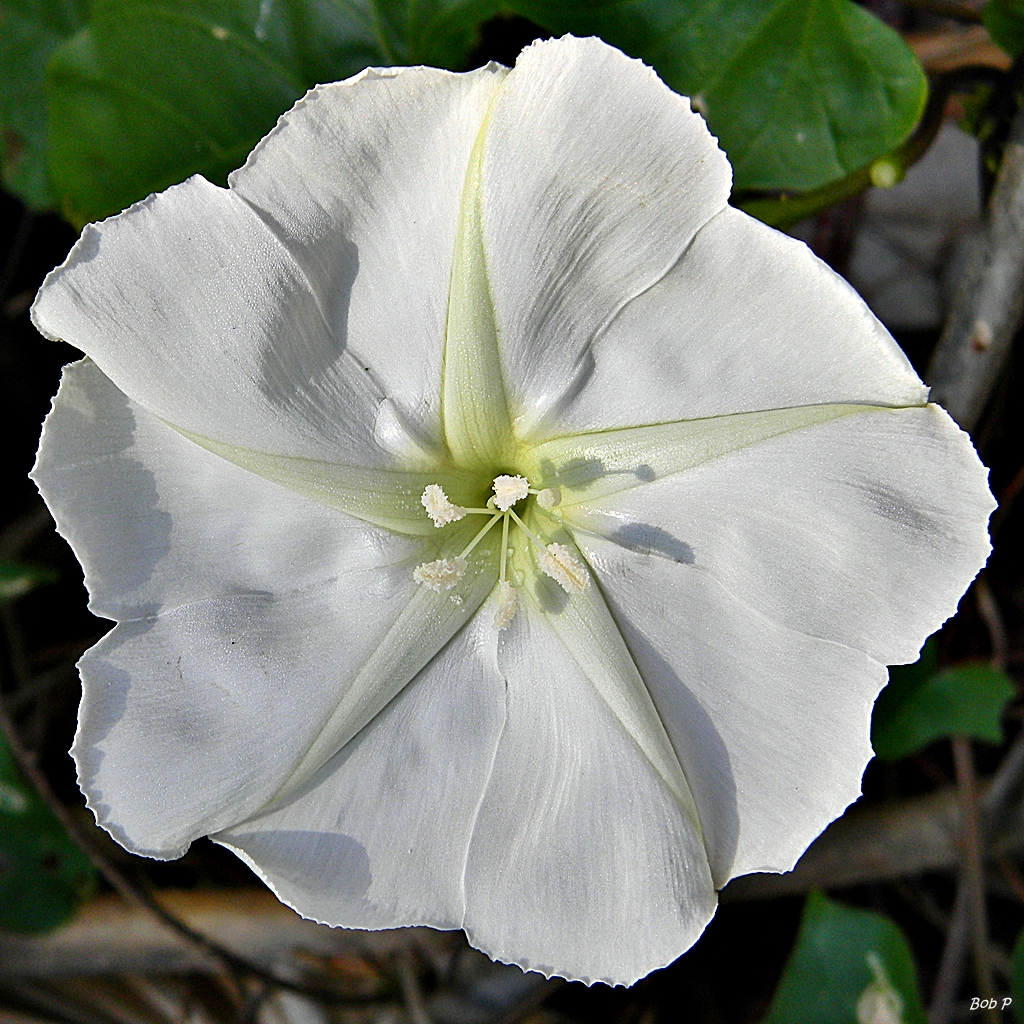
Ipomoea alba, known as Moonflower, moon vine or tropical white morning-glory, is a vigorous, night-blooming morning glory of the American tropics whose range reaches into peninsular Florida. Its pure white, saucer-shaped flowers are 3 to 6 inches across, sit at the end of a slender tube several inches long, and unfold in a minute or two at dusk, releasing a sweet scent that carries across a porch or garden. By the next morning each flower has closed for good.
It belongs to the morning glory family (Convolvulaceae), alongside the native Beach Morning Glory and Wild Potato Vine. USDA PLANTS lists it as native to the lower 48 states, Puerto Rico and the U.S. Virgin Islands, and introduced in Hawaii. Within the continental United States it grows wild mainly in Florida, where it scrambles over shrubs at the edges of hammocks, marshes, lakes and mangrove swamps.
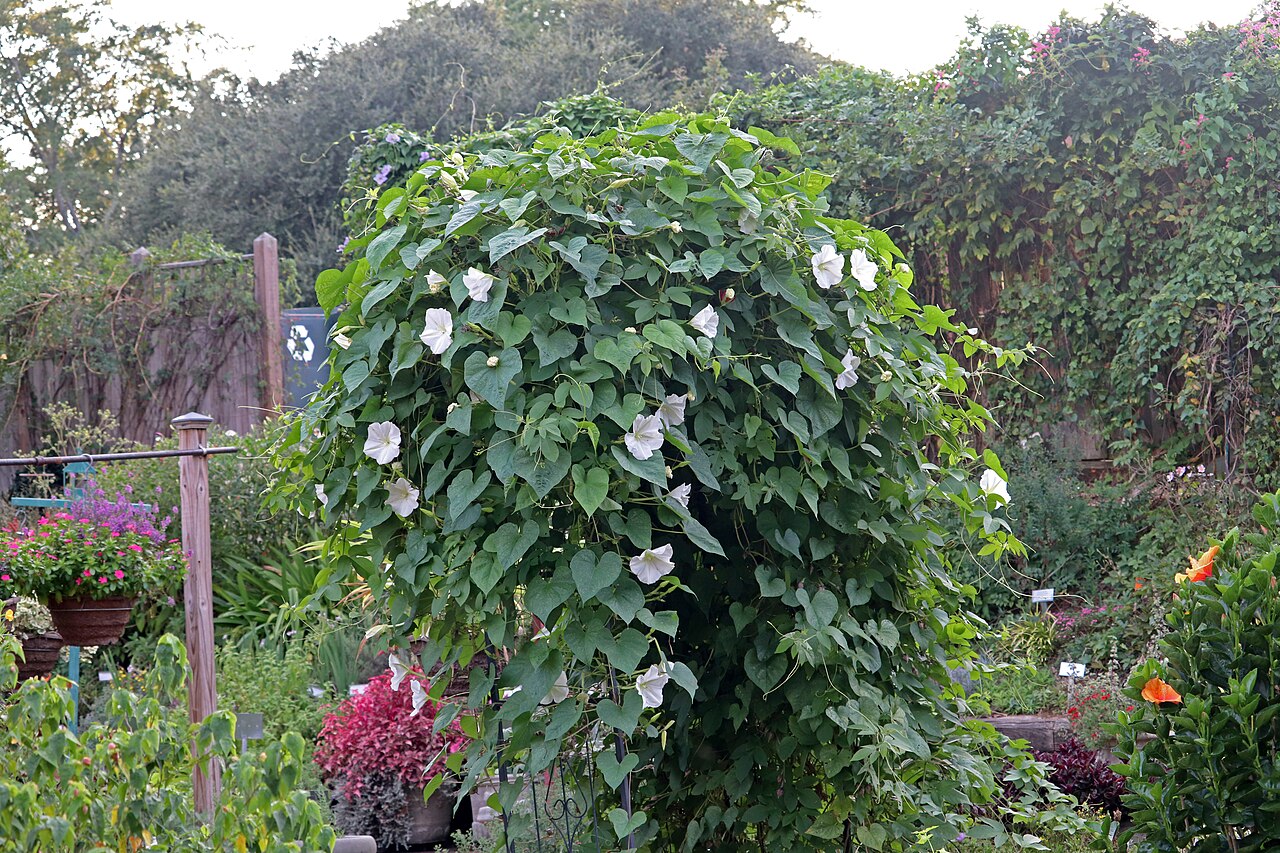
Moonflower is one of the most familiar garden vines in the country, grown from seed as a summer annual far north of its native range for its evening display. In Florida it can be a long-lived perennial that climbs 30 feet or more, so it needs a sturdy support and some room. This guide covers how to recognize it, where it grows wild, how to grow it, and the night-flying moths that pollinate it.
Identification
In flower, moonflower is unmistakable: no other native vine in the Southeast has white trumpets this large that open at night. Out of flower it is a dense tangle of heart-shaped leaves that resembles other morning glories, so look for the stem prickles, the milky sap and the long, swollen flower buds.
Stems & Growth Habit
Moonflower is a twining vine that wraps its stems around anything it can reach. In frost-free areas it is perennial and the base of the stem can become somewhat woody. Stems commonly reach 10 to 30 feet in a season and can run longer in the tropics. Broken stems and leaves leak a milky sap, and older stems are often dotted with small, soft, fleshy prickles. These prickles inspired the old name Calonyction aculeatum, “the prickly beautiful-night.”
Leaves
The leaves are alternate, bright to dark green and mostly heart-shaped, about 2 to 6 inches long, with a pointed tip and a long leaf stalk. On some plants, or on some leaves of the same plant, the blade is shallowly three-lobed. The leaves overlap densely on a support, which is why the vine is often grown to shade a porch or cover a fence.
Flowers
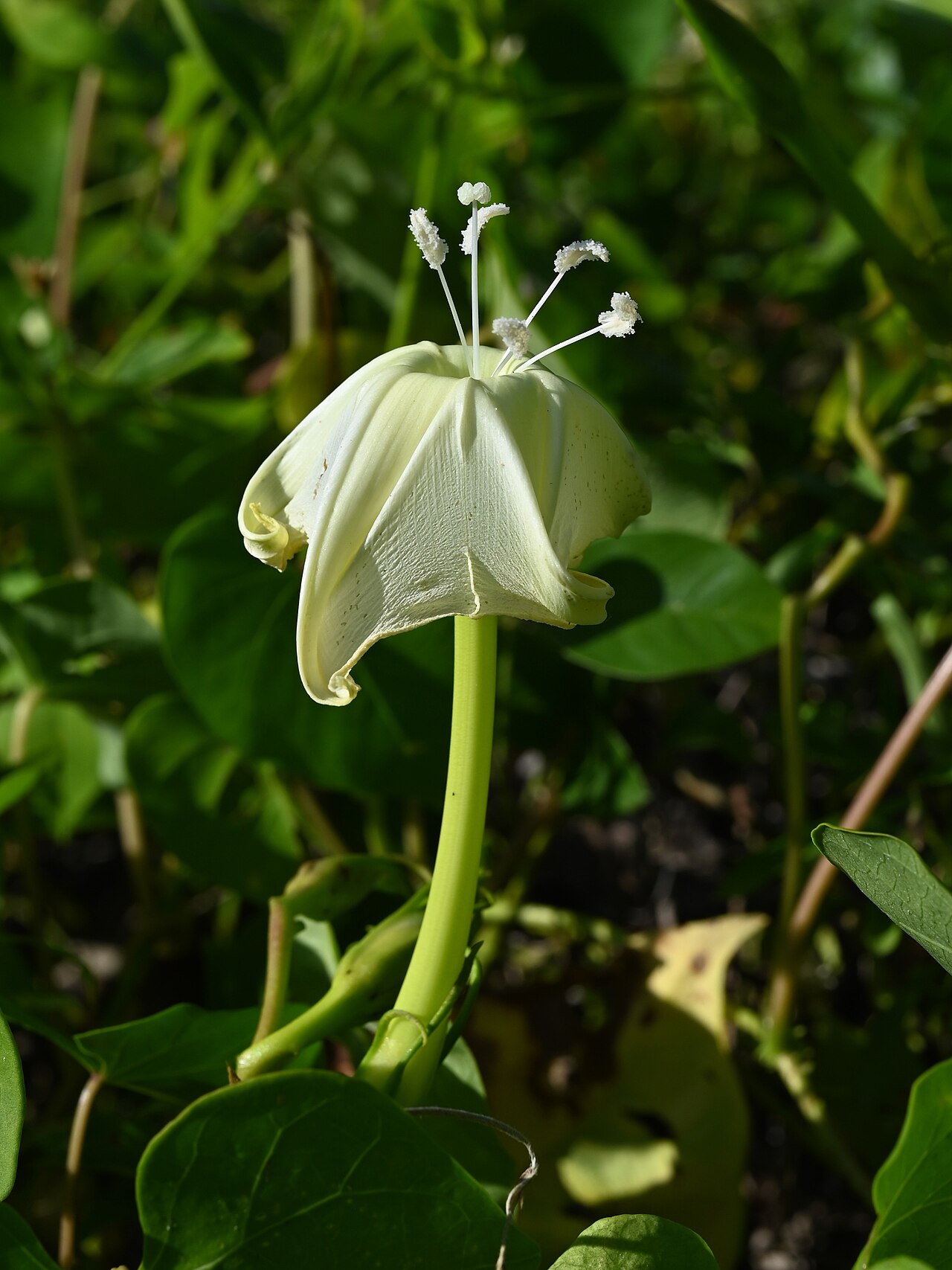
The flower buds are long, slender and twisted like a furled umbrella. They open at dusk, often fast enough to watch, into a flat, nearly circular white limb 3 to 6 inches across at the end of a narrow tube about 3 to 6 inches long. Five pale green bands run from the center to the edge of the limb, forming a faint star. The five stamens and the stigma stand just out of the throat. The sepals have long, tail-like tips. The flowers are strongly fragrant at night and usually close by the following morning, though they may stay open longer on cool or cloudy days.
Moonflower is a short-day plant. In Florida it flowers mostly from late summer through fall and, in the south of the state, into winter. In northern gardens it often does not begin to bloom until late summer or early fall, when the nights grow longer.
Fruit & Seeds
After pollination the flower drops and the green calyx encloses an egg-shaped, pointed capsule about an inch long. It dries brown and splits to release a few large seeds, each about half an inch long and pale brown to nearly black. The seeds have a hard coat and float for many months, which helps the species spread along coasts and waterways.
Quick Facts
| Scientific Name | Ipomoea alba (syn. Calonyction aculeatum, Ipomoea bona-nox) |
| Family | Convolvulaceae (morning glory family) |
| Plant Type | Twining vine; perennial in frost-free areas, grown as an annual elsewhere |
| Mature Height | 10–30 ft of vine (to about 40 ft in Florida) |
| Mature Spread | Covers as much support as it is given; 3–6 ft wide on a trellis |
| Growth Rate | Fast |
| Sun Exposure | Full sun to part sun |
| Water Needs | Moderate to high; moist soil, tolerates occasional flooding |
| Soil Type | Sand or loam; not tolerant of salt |
| Soil pH | Adaptable |
| Bloom Time | Late summer–fall; into winter in South Florida |
| Flower Color | White, with pale green star bands |
| Fall Color | None; freezes to the ground at first frost |
| Fruit | Egg-shaped capsule about 1 in long with a few large seeds |
| Deer Resistant | Not reliably |
| USDA Hardiness Zones | 9–11 as a perennial; annual anywhere |
Native Range
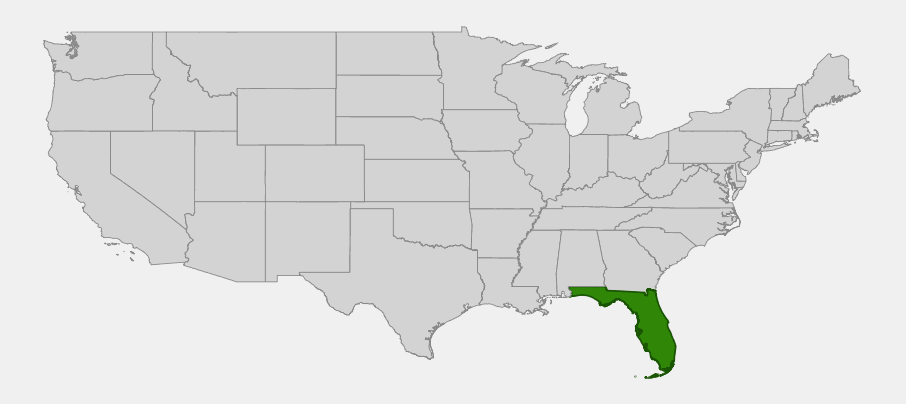
Moonflower is native across the tropical and subtropical Americas, from Mexico through Central America and the West Indies to Argentina. USDA PLANTS lists it as native in the lower 48 states, Puerto Rico and the U.S. Virgin Islands, and as introduced in Hawaii. The Atlas of Florida Plants and the Florida Native Plant Society treat it as a Florida native, and the Flora of the Southeastern United States records it from northeastern Florida south through the peninsula.
Its native status in Florida is not beyond debate. The Flora of the Southeastern United States notes that it is unclear whether the Florida populations are native or long-established escapes, because the vine has been grown in gardens for centuries and its floating seeds travel easily. Scattered records from Texas, Louisiana, Kansas and Washington, D.C., listed by the Lady Bird Johnson Wildflower Center, most likely reflect garden escapes rather than native populations, so the map shows Florida only.
In the wild it grows at the edges of tropical hardwood hammocks, freshwater marshes and lakes, along canals and in disturbed wetlands, and around the inland fringes of mangrove swamps. Commons and herbarium photographs place it in Everglades National Park, the Fakahatchee Strand and the mangroves of Palm Beach County.
📋 Regional plant lists featuring Moonflower: North & South Florida
Growing & Care Guide
Moonflower is one of the easiest vines to grow from seed. The main things to plan for are its size, which can overwhelm a small trellis or nearby shrubs, and its need for warm nights before it really takes off. The Florida Native Plant Society recommends it only where it can be controlled, such as on a trellis, or where expansive growth is welcome.
Light
Give moonflower full sun to part sun. It grows and flowers best with at least six hours of direct sun. In partial shade it still climbs vigorously but produces fewer flowers. Because the flowers open in the evening, place it where you will see it at night: beside a porch, patio, front door or bedroom window.
Soil & Water
In the wild it grows in moist, sandy or loamy soil at the edges of wetlands, and the Florida Native Plant Society lists it for rain gardens and bioswales that flood now and then. In gardens, ordinary well-drained soil that is kept evenly moist is enough. Water during dry spells, especially while it is establishing. It does not tolerate salt spray or brackish water, so keep it back from the beachfront. Very rich, heavily fertilized soil produces lush leaves and fewer flowers, so go easy on fertilizer, particularly nitrogen.
Planting Tips
Sow seeds outdoors after the soil has warmed and all danger of frost has passed, or start them indoors in pots four to six weeks earlier. The seed coat is hard: nick each seed with a nail file or clippers, then soak it overnight in warm water. Most seeds swell and germinate within a week or two. Plant one or two seeds per spot at the base of a strong support such as a fence, arbor, pergola or sturdy trellis. Thin seedlings to about 12 inches apart. Moonflower resents having its roots disturbed, so transplant pot-grown seedlings carefully.
Pruning & Maintenance
Guide young stems onto the support. They twine on their own once they reach it. In Florida, a perennial vine can be cut back hard in late winter to keep it within bounds and to remove stems damaged by cold. Pull wandering stems off nearby shrubs before they smother them. In colder zones the vine dies at the first frost, so simply clear it away. Collect a few ripe capsules first if you want seed for next year.
Propagation
Grow it from seed as above. Seeds can be collected once the capsules turn brown and dry, and they store well in a cool, dry place. The Florida Native Plant Society also suggests layering: pin a long runner to the soil, let it root where it touches the ground, then cut it from the parent plant. In Florida, native-source seed is offered through the Florida Wildflowers Growers Cooperative.
Landscape Uses
- Moon and evening gardens: the centerpiece for a garden designed to be enjoyed after dark
- Porch and patio screens: dense leaves for summer shade and privacy, with fragrance in the evening
- Arbors, pergolas and fences: fast cover for large, sturdy structures
- Moth gardens: a nectar source for night-flying sphinx moths
- Rain gardens and wet edges: in Florida, on the moist margins of rain gardens and bioswales
- Annual vine in cold climates: a summer-to-frost vine anywhere the growing season is long enough to bring it into bloom
Wildlife & Ecological Value
Moonflower is built for the night. Its value to wildlife centers on the moths that pollinate it, along with the cover its dense vines provide.
For Pollinators
The white color, nighttime opening, strong evening scent and long, narrow tube are the classic marks of a flower pollinated by sphinx (hawk) moths. These large moths hover in front of the flower and reach the nectar at the base of the tube with their long tongues, picking up pollen as they feed. The Florida Native Plant Society notes that it is pollinated by moths. Bees and other insects may visit flowers that stay open into the morning. Gardeners who plant moonflower often notice sphinx moths at dusk for the first time.
For Birds
Moonflower has little value as bird food. Its dense tangles of stems and leaves do give small birds cover, and its insect visitors provide food for birds that forage at dawn and dusk.
For Mammals
Moonflower is not a significant food plant for mammals. Morning glory seeds contain alkaloids that make them unpalatable or harmful to many animals. It should not be counted on as a deer-resistant plant, but it is not grown as forage either.
Ecosystem Role
At the edges of hammocks, marshes and mangroves, moonflower is one of several native vines that knit together the shrubby boundary between forest and wetland. Its long-floating seeds let it colonize new shorelines and disturbed wet ground. Outside the Americas it has naturalized in many tropical regions, where it is sometimes treated as a weed, so it is best grown where it is native or in climates where frost kills it each year.
Cultural & Historical Uses
Linnaeus named Ipomoea alba in 1753. Ipomoea comes from Greek words meaning “worm-like,” for the twining stems, and alba means “white.” For much of the 19th and 20th centuries botanists placed it in a separate genus, Calonyction, “beautiful night.” It is now returned to Ipomoea in section Calonyction.
Moonflower has a remarkable place in the history of technology. Long before Europeans arrived, peoples of ancient Mesoamerica mixed the juice of this vine with latex from the Panama rubber tree (Castilla elastica) to make rubber. The sulfur compounds in the moonflower juice cross-linked the latex, making it stronger and bouncier. The process predated Charles Goodyear’s vulcanization by thousands of years and produced the solid rubber balls used in the Mesoamerican ballgame.
Moonflower has been grown in European gardens for a long time; it was illustrated in the Botanical Register in 1825. It is still one of the classic vines for porches and evening gardens, where people gather at dusk to watch the flowers open. Because all parts of the plant, and especially the seeds, contain alkaloids, it should be treated as a garden ornament and never eaten.
Frequently Asked Questions
Is moonflower native to the United States?
USDA PLANTS lists Ipomoea alba as native to the lower 48 states, Puerto Rico and the U.S. Virgin Islands, and Florida botanical authorities treat it as a Florida native. In the continental United States its wild range is essentially Florida. Populations elsewhere are garden escapes, and some botanists question whether even the Florida plants are originally native.
Is moonflower the same as datura?
No. Datura species such as Sacred Datura are also called moonflower, but they are bushy, upright herbs in the nightshade family with prickly seed pods. Ipomoea alba is a twining vine in the morning glory family. Both open white flowers at night and both are poisonous.
When do moonflowers open?
The flowers open at dusk, often within a minute or two, and usually close the next morning. On cool or overcast days they may stay open into the afternoon. Each flower lasts only one night, but a healthy vine produces new flowers night after night.
Why is my moonflower vine not blooming?
Moonflower is a short-day plant, so in northern gardens it often waits until late summer or early fall to bloom, when nights lengthen. Too little sun, too much nitrogen fertilizer, or a late start from seed can also delay flowering. Starting seeds indoors gives it a head start.
Is moonflower poisonous?
Yes. Like other morning glories, it contains alkaloids, especially in the seeds, and eating it can make people and pets sick. Grow it for its flowers and keep the seeds away from children and animals.

Looking for a nursery that carries Moonflower?
Browse our native plant nursery directory: Florida