
Scareweed (Baptisia simplicifolia)
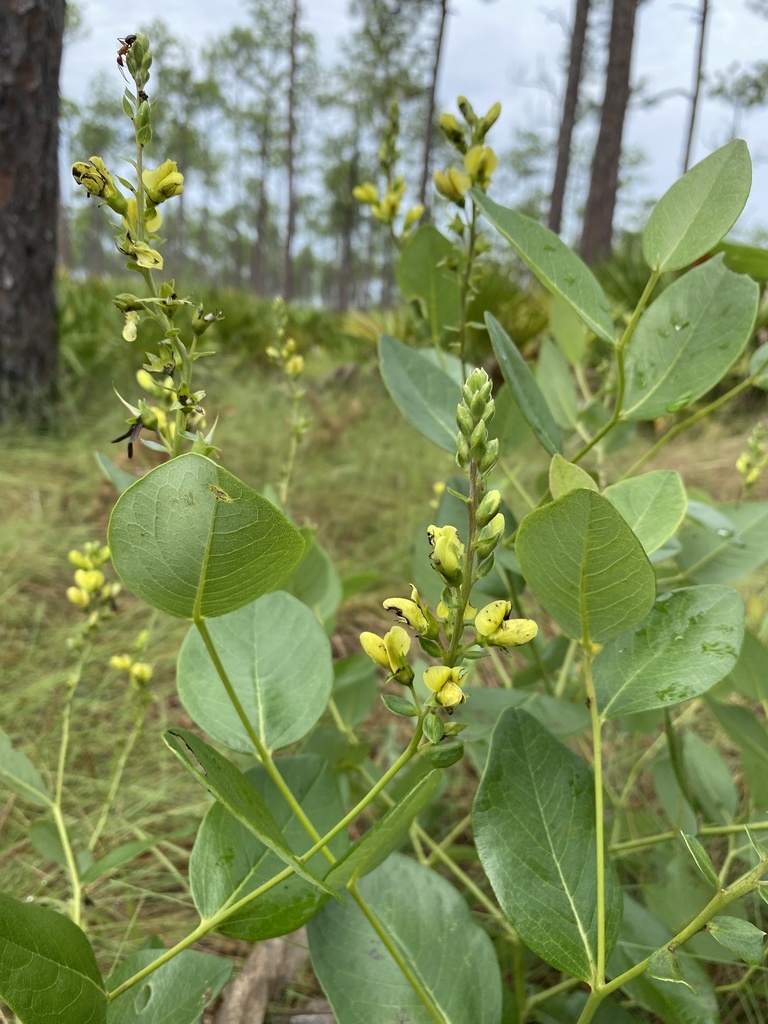
Baptisia simplicifolia, known as Scareweed or Coastal Plain wild indigo, is a bushy wild indigo found only in a small part of the Florida Panhandle. It is endemic to Florida per the Atlas of Florida Plants, and USDA PLANTS also records it only from Florida. It grows 2 to 3 feet tall and has round, blue-green, undivided leaves, unusual in a genus where most species have leaves divided into three leaflets. In summer it produces spikes of bright yellow pea flowers, followed by rounded pods that turn black.
Scareweed is listed as Threatened by the State of Florida (FDACS Regulated Plant Index). It grows in open, fire-maintained longleaf pine flatwoods, savannas and sandy roadsides in a few counties around the Apalachicola National Forest. The origin of the common name is not well documented.
It belongs to the pea family (Fabaceae) and, like other wild indigos, has a deep root system, fixes nitrogen with the help of root bacteria, and resprouts after fire. It is rarely available for gardens. If you find it at a native nursery, buy nursery-propagated plants only and never collect from the wild.
Identification
Only three wild indigos in the Southeast have simple (undivided) leaves, and scareweed is the only one with round, stalkless leaves on a yellow-flowered, bushy plant in the Florida Panhandle. Once you know that feature, it is hard to mistake.
Stems & Habit
Plants grow from a thick, woody rootstock and form a rounded, much-branched clump 2 to 3 feet tall and about as wide. The stems are smooth and often have a pale, waxy bloom. Like other Baptisia, the whole above-ground plant dies back in winter, and the dry stems can break off at the base.
Leaves
The leaves are simple, alternate and nearly round to broadly oval, about 2 to 4 inches long, smooth, thick and blue-green with a waxy surface. They have no leaf stalk or only a very short one, and the small stipules at their base drop early. The leaves often turn dark or blackish when they dry, a trait typical of many wild indigos.
Hairy wild indigo (B. arachnifera) of southeastern Georgia also has simple leaves, but they are covered in cobwebby white hairs. Catbells (B. perfoliata) has round leaves pierced by the stem.
Flowers
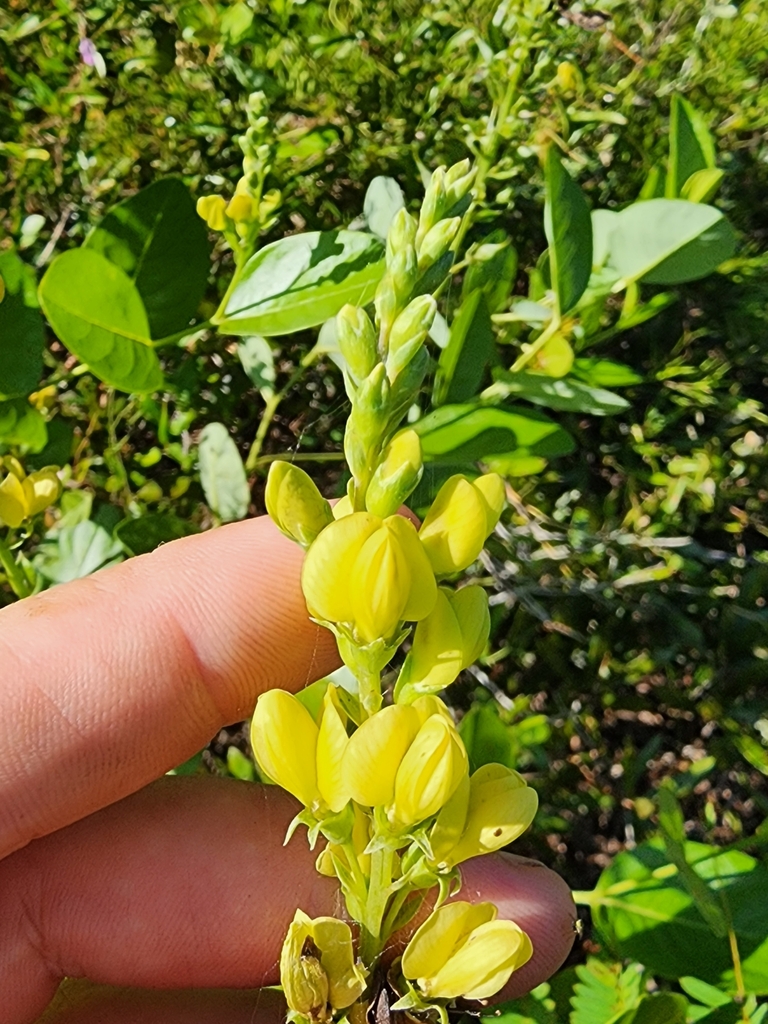
The flowers are typical yellow pea flowers, about ½ inch long, arranged in elongated racemes at the ends of the branches that rise above the foliage. Flowering is mainly June through August.
Fruit & Seeds
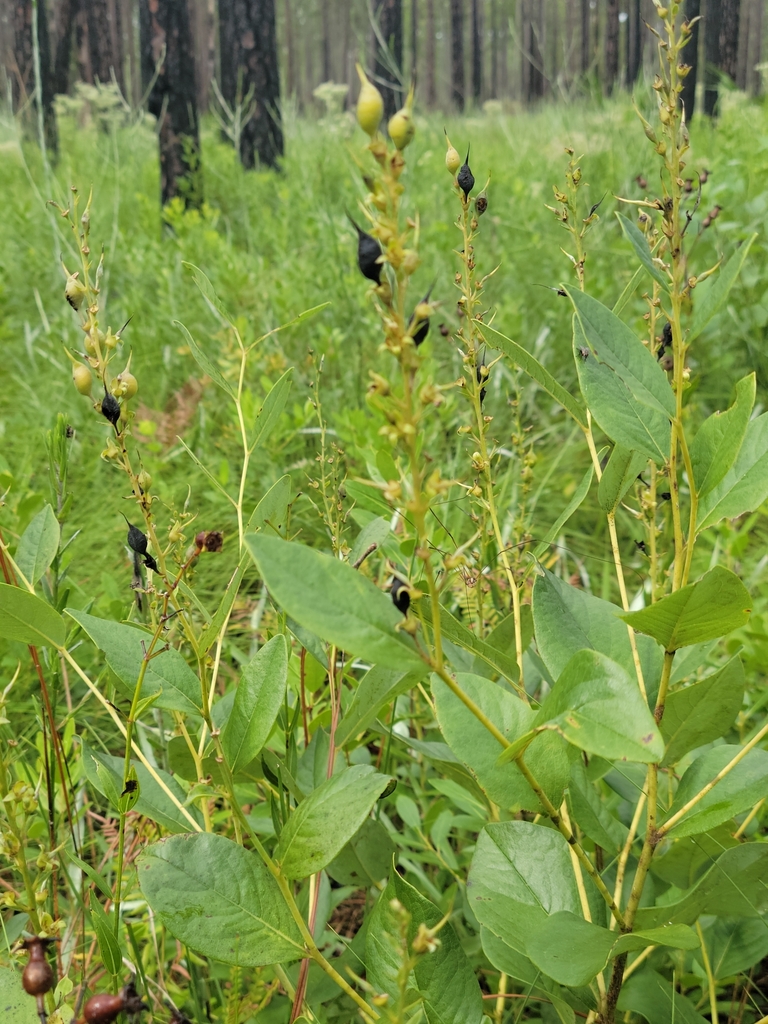
The pods are short, rounded to egg-shaped and somewhat inflated, about ½ inch long, with a short beak. They ripen in late summer and fall, turning dark brown to black, and contain several hard seeds.
Quick Facts
| Scientific Name | Baptisia simplicifolia |
| Family | Fabaceae (pea family) |
| Plant Type | Herbaceous perennial from a woody rootstock |
| Mature Height | 2–3 ft |
| Mature Spread | 2–3 ft |
| Growth Rate | Slow |
| Sun Exposure | Full sun |
| Water Needs | Low; drought tolerant once established |
| Soil Type | Acidic sand and sandy loam |
| Soil pH | About 4.5–6.0 |
| Bloom Time | June–August |
| Flower Color | Bright yellow |
| Fall Color | Leaves turn dark gray to black as they die back |
| Fruit | Short, inflated pods that turn black |
| Deer Resistant | Yes; foliage contains toxic alkaloids |
| USDA Hardiness Zones | 8b–9a |
Native Range
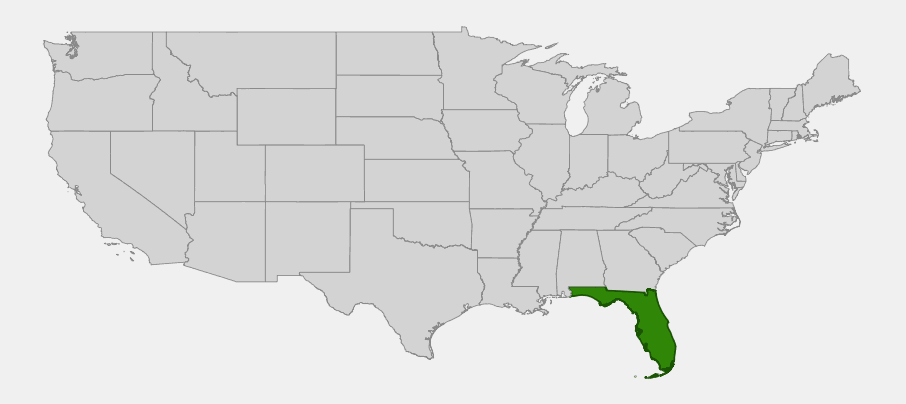
Scareweed is endemic to Florida per the Atlas of Florida Plants, and USDA PLANTS and the Lady Bird Johnson Wildflower Center record it from Florida only. Its range is a small area of the central Panhandle, centered on the Apalachicola National Forest and nearby lands in Liberty, Wakulla and nearby counties, between the Apalachicola and Ochlockonee rivers.
It grows in open longleaf pine flatwoods and savannas, the edges of sandhills, and sunny roadsides and firebreaks through these habitats. The Apalachicola region is one of the richest areas for plant endemism in eastern North America, and scareweed shares it with many other rare species.
It is listed as Threatened by the State of Florida (FDACS Regulated Plant Index). Most of its known populations are on public land, but it depends on frequent fire to keep its open habitat from becoming overgrown, and its small total range leaves it vulnerable to fire suppression, conversion of flatwoods to dense pine plantations, and roadside herbicide use.
📋 Regional plant lists featuring Scareweed: North & South Florida
Growing & Care Guide
Scareweed is very rarely sold, and it is not a quick or easy garden plant. Like other wild indigos it puts most of its early growth into a deep root, and established plants resent being moved. Grow it only from nursery-propagated plants or seed from legal, permitted sources, and never collect plants or seed from the wild; it is a state-listed species.
Light
Give it full sun. In its native flatwoods it grows in open, regularly burned stands with little canopy, and plants in shade become weak and sparse.
Soil & Water
It needs well-drained, acidic, sandy soil of low fertility. Water young plants during their first growing season, then leave them on their own except in extreme droughts. As a nitrogen-fixing legume it does not need fertilizer, and rich or irrigated soil encourages weeds that crowd it.
Planting Tips
Plant small container plants in late winter or early in the rainy season, in a permanent spot where the taproot will not be disturbed. Space plants about 3 feet apart. It looks best in a naturalistic setting with wiregrass, blazing stars and other flatwoods wildflowers, and it is best suited to gardeners within or near its native range in the Panhandle.
Pruning & Maintenance
Leave the stems standing after frost, then cut them back in late winter. In restoration plantings, prescribed fire every 2 to 3 years in the growing or dormant season mimics natural conditions; the plant resprouts from its root crown. Avoid using herbicides near it.
Propagation
Seed is the usual method. The hard seed coat must be scarified (nicked or sanded) or soaked in hot water before sowing. Seedlings develop slowly and may take two or three years to flower. Dividing established plants is difficult because of the deep, woody roots.
Landscape Uses
- Longleaf pine flatwoods restoration: in the central Florida Panhandle, using propagated stock
- Native plant collections: a rare Florida endemic for conservation-minded gardeners and botanical gardens
- Pollinator gardens in the Panhandle: summer nectar and pollen for bumblebees
- Educational plantings: to illustrate Florida endemism and the role of fire in pine ecosystems
Wildlife & Ecological Value
Scareweed is a small part of the rich longleaf pine ecosystem of the Apalachicola region, one of the most biologically diverse landscapes in the eastern United States.
For Pollinators
Like other wild indigos, its flowers are visited mainly by bumblebees and other large bees, which are strong enough to open the closed pea flower and reach the nectar and pollen inside.
For Birds
The hard seeds have limited value for birds. The open, fire-maintained flatwoods where it grows support birds such as Bachman’s sparrow, red-cockaded woodpecker, brown-headed nuthatch and northern bobwhite.
For Mammals
Wild indigos contain quinolizidine alkaloids that are toxic to livestock and make the foliage unpalatable to deer.
Ecosystem Role
As a legume, scareweed works with root-nodule bacteria to fix atmospheric nitrogen, adding nitrogen to the nutrient-poor sands of the flatwoods. Baptisia species are larval host plants for butterflies such as the wild indigo duskywing and are attacked by specialist weevils that develop in the seed pods. Its deep root crown lets it survive frequent fires and resprout quickly, and it often flowers well in the season after a burn.
Cultural & Historical Uses
Scareweed was discovered in the nineteenth century, when botanists such as Hardy Bryan Croom and Alvan Wentworth Chapman explored the Apalachicola region and found many of its endemic plants. Chapman, a physician who lived in Apalachicola for decades, published Flora of the Southern United States in 1860, the first comprehensive flora of the region, and many of the area’s rare plants were first documented in it.
The genus name Baptisia comes from the Greek bapto, to dye, because some species, especially Baptisia tinctoria, were used as a poor substitute for true indigo dye. There is no recorded use of scareweed for dye or medicine, and like other wild indigos it is considered toxic if eaten.
Today scareweed is mainly of interest to botanists and conservationists. It is one of many rare plants that make the Apalachicola National Forest and the surrounding region a priority for longleaf pine restoration and prescribed fire programs.
Frequently Asked Questions
Is scareweed endangered?
It is listed as Threatened by the State of Florida (FDACS Regulated Plant Index). It is not federally listed. It is endemic to Florida per the Atlas of Florida Plants and occurs in only a few Panhandle counties.
Where can I buy scareweed?
It is very rarely available. Check with native plant nurseries in north Florida and the Florida Association of Native Nurseries. Buy only nursery-propagated plants, and never dig plants or collect seed from the wild.
Can I grow it outside the Florida Panhandle?
It may grow in similar sandy, sunny sites elsewhere in north Florida and the nearby Coastal Plain, but it is best planted within or near its native range, and plantings outside it should not be made in natural areas.
Is scareweed poisonous?
Like other wild indigos, it contains alkaloids that are toxic to livestock and people if eaten. It is not dangerous to touch.
How can I tell scareweed from other wild indigos?
Look at the leaves. Scareweed has single, round, blue-green leaves with no leaflets. Most other wild indigos, such as Blue False Indigo, have leaves divided into three leaflets.

Looking for a nursery that carries Scareweed?
Browse our native plant nursery directory: Florida