
Ausubo (Manilkara bidentata)
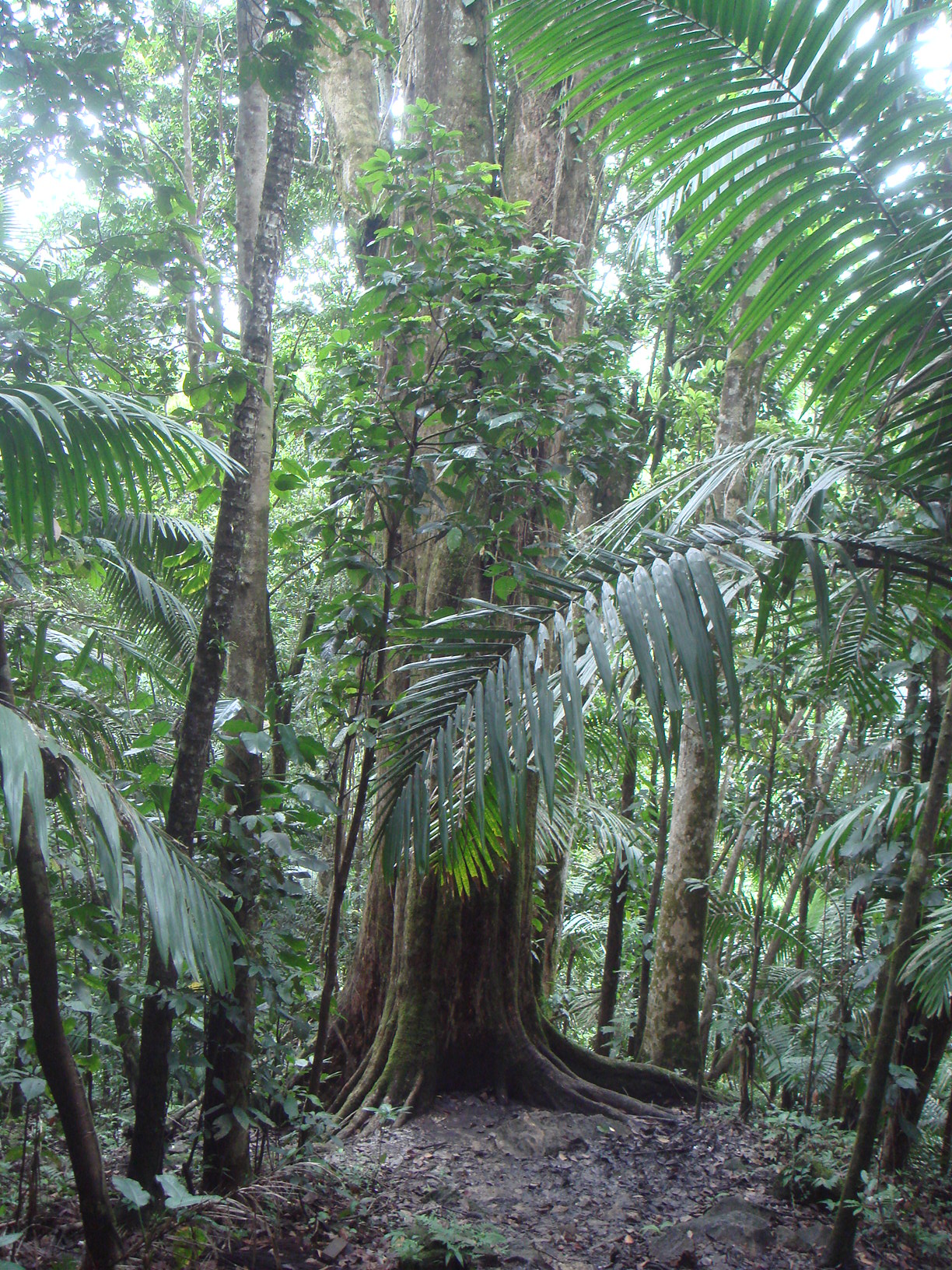
Manilkara bidentata, known in Puerto Rico as Ausubo, is a giant evergreen tree of the sapodilla family (Sapotaceae). USDA PLANTS lists it under the common name bulletwood, and across its wider range it is also called balata, massaranduba and quinilla. In the moist and wet forests of Puerto Rico it can reach about 100 feet tall with a trunk 4 feet thick and broad buttresses at the base, and the USDA Forest Service estimates that individual trees can live 300 to 400 years.
Ausubo was probably the most important timber tree in Puerto Rico’s history. Its dark reddish-brown heartwood is extremely hard, heavy and strong, so dense that it sinks in water, and it resists termites and decay. Those qualities made it prized for beams, posts and heavy construction, and today large old ausubos are found mainly in protected forests. The tree also has a milky latex, the source of balata gum, which was once used for golf ball covers and machine belting.
Today ausubo is a tree of mature forest: El Yunque and the Luquillo Mountains, the moist limestone forests of the northern karst, and lower mountain slopes elsewhere on the island. It is very slow-growing and extremely shade tolerant, which makes it a patient choice for reforestation and large properties rather than a quick shade tree. This guide covers how to identify ausubo, where it grows, and how to raise it from seed.
Identification
Ausubo is a large, dense-crowned forest tree. In the field, look for leathery, dark green leaves crowded at the twig tips, white latex that oozes from a broken leaf or a cut in the bark, and, on old trees, a massive buttressed trunk.
Trunk & Bark
In Puerto Rico ausubo reaches about 100 feet tall and 4 feet in trunk diameter on the best sites, and elsewhere in its range it can grow to about 150 feet. Large trunks are straight and spread at the base into broad, rounded buttresses. The bark is dark reddish-brown to gray and rough, fissured into thick plates on old trees. A cut in the bark releases a white, sticky latex.
Leaves
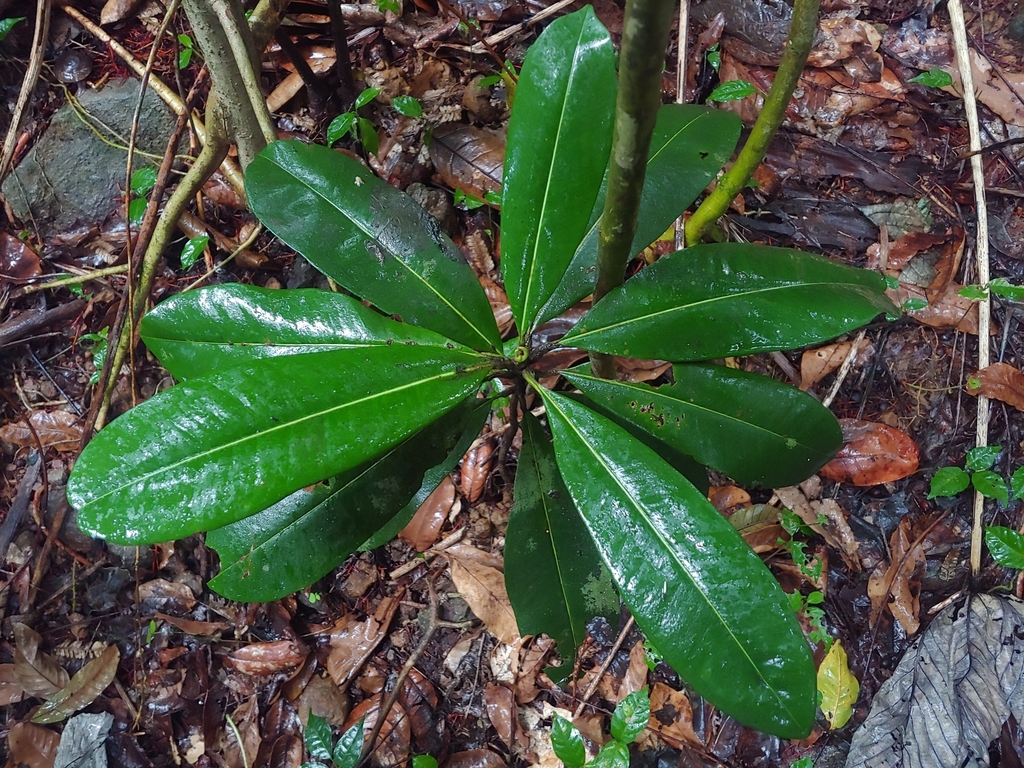
Leaves are alternate, simple and elliptic, about 4 to 8 inches long, with smooth edges and a thick, leathery texture. They are dark glossy green above and paler beneath, with many fine, faint parallel side veins. They are crowded in rosettes at the ends of the twigs, and the branches spread horizontally, which gives the crown a layered look. Broken leaves bleed droplets of white latex. In the shaded understory, leaves are often darkened by a thin film of sooty mold.
Flowers
The flowers are small and white, borne on slender stalks in clusters at the leaf bases near the ends of the twigs. In Puerto Rico they appear at the beginning of the wet season, mainly from May through August, with occasional flowering in late fall. Heavy flowering and fruiting usually come only every 3 to 4 years.
Fruit & Seeds
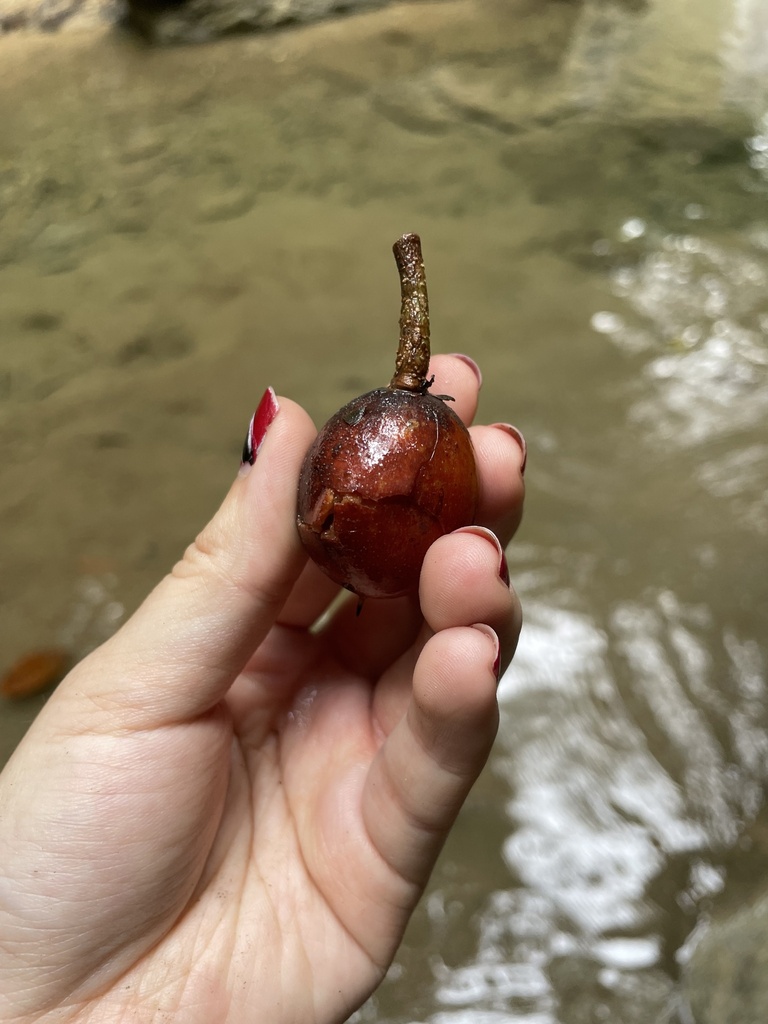
The fruit is a round berry about 1 to 2 inches across, yellowish to reddish-brown when ripe, which develops through the fall and drops mainly in winter and early spring. Inside is usually one shiny black seed (occasionally two) surrounded by a sweet, gummy, edible pulp, similar in flavor to its relative the sapodilla. In Puerto Rico birds carry the fruits away and disperse the seeds; otherwise most fall beneath the parent tree.
Quick Facts
| Scientific Name | Manilkara bidentata; USDA common name: bulletwood |
| Family | Sapotaceae (sapodilla family) |
| Plant Type | Large evergreen canopy tree |
| Mature Height | 50–100 ft in Puerto Rico (to 150 ft elsewhere); much smaller for decades |
| Mature Spread | 30–50 ft; dense crown with horizontal, layered branches |
| Growth Rate | Very slow (about 15 ft in 5 years under good conditions) |
| Sun Exposure | Full sun to deep shade; very shade tolerant when young |
| Water Needs | Moderate to high; young plants are sensitive to drought |
| Soil Type | Deep, moist clay and alluvial soils; also limestone-derived soils |
| Soil pH | Acid to slightly alkaline |
| Bloom Time | May–August in Puerto Rico (beginning of the wet season) |
| Flower Color | White |
| Fall Color | None; evergreen |
| Fruit | Round yellowish to reddish-brown berry, 1–2 in, with sweet edible pulp |
| Deer Resistant | Not applicable in Puerto Rico; seedlings are browsed by animals |
| USDA Hardiness Zones | 11–12 (frost-free tropics only) |
Native Range
Ausubo has a large range in the American tropics. It is native to Puerto Rico, grows widely through the West Indies, including the Lesser Antilles from the Virgin Islands to Grenada and Trinidad, and ranges on the mainland from Mexico through Central America to the Guianas, Venezuela, Colombia, Peru and northern Brazil. In Brazil and the Guianas it is a major commercial timber under the names massaranduba and bulletwood.
In Puerto Rico, the USDA Forest Service describes ausubo as native to the moist coastal and limestone forests and to lower mountain forests, from near sea level to about 2,000 feet. It grows in the subtropical moist, wet and rain forest life zones, where annual rainfall ranges from about 60 to 160 inches. The tree grows best on deep alluvial plains, but most of those lowlands were cleared long ago, so today the largest ausubos survive in the tabonuco forest of the Luquillo Mountains (El Yunque) and in the moist forests of the northern limestone (karst) region.
Ausubo is not native to the U.S. mainland. Because it needs a frost-free, humid tropical climate, it can only be grown outdoors in the warmest parts of South Florida and in Hawaii, and it is too large and slow for container culture.
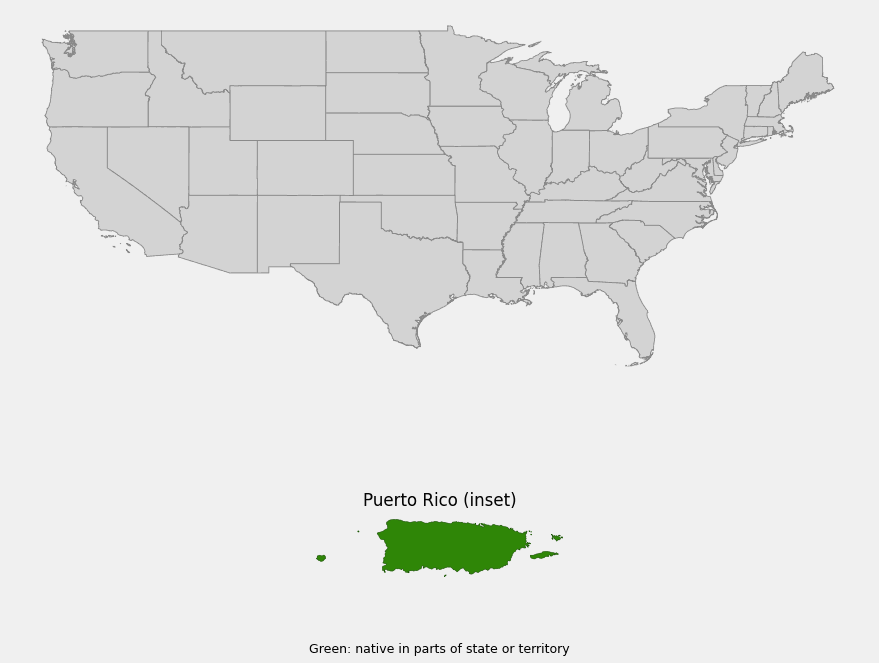
📋 Regional plant lists featuring Ausubo: Puerto Rico
Growing & Care Guide
Ausubo is a tree you plant for future generations. It grows slowly, needs years to reach a meaningful size, and eventually becomes a forest giant, so it suits large properties, parks, watershed buffers and reforestation projects in Puerto Rico rather than small yards. In return it is long-lived, wind-firm, and one of the most valuable native trees for restoring moist forest.
Light
Seedlings are extremely shade tolerant and can survive for years under a forest canopy, which is how ausubo regenerates in nature. They grow faster with more light, though: in USDA Forest Service nursery trials, seedlings in sun were twice as tall after 10 months as those in shade. Underplanting ausubo beneath existing trees or fast-growing pioneers works well in reforestation.
Soil & Water
Give ausubo deep, moist, well-drained soil. It is native to acid clays and alluvial soils and to soils over limestone, and it does best in areas with at least 60 inches of rain a year. Young plants are sensitive to drought; in Forest Service trials in the northern limestone forest, most outplanted seedlings wilted and yellowed during a long dry spell. Water young trees through their first two or three dry seasons. It is not suited to the dry southern coast.
Planting Tips
Plant potted seedlings at the start of the rainy season. Ausubo quickly develops a long taproot, so grow seedlings in deep pots and plant them out before the roots circle, and avoid bare-root transplanting of older seedlings. Allow room for a broad crown and a buttressed trunk; keep it well away from buildings, septic systems and paving.
Pruning & Maintenance
Little pruning is needed. Remove competing leaders on young trees to encourage a single straight trunk, and protect seedlings from grazing animals and weed competition. Once established, ausubo is wind-firm thanks to its strong, moderately deep root system. Its wood resists termites and decay, and the species has few serious pests.
Propagation
Grow ausubo from fresh seed. Seeds lose viability quickly in storage, so sow them as soon as the fruits fall: the USDA Forest Service found 60 percent germination in seed sown right away and almost none after storage. Clean off the pulp and sow on the surface of moist potting mix or in leaf litter, barely covered, because the seedlings have trouble pushing up through soil. Germination is slow and irregular and can continue into the second year. Ausubo does not root from cuttings or sprout from roots.
Landscape Uses
- Forest restoration: a long-lived canopy species for reforesting moist and wet sites in Puerto Rico
- Shade and specimen tree: for parks, campuses, estates and large rural properties with room for a forest giant
- Underplanting: tolerates heavy shade, so it can be planted beneath pioneer trees or secondary forest
- Wildlife plantings: its sweet fruits feed birds and other animals
- Living heritage: a link to Puerto Rico’s timber history in public gardens and school grounds
Wildlife & Ecological Value
As a dominant canopy tree of mature moist forest, ausubo provides food and structure for wildlife over centuries.
For Pollinators
The small white flowers open at the start of the wet season and offer nectar and pollen to insects. Because heavy flowering comes only every few years, mast years are especially important.
For Birds
The USDA Forest Service identifies birds as seed dispersers of ausubo in Puerto Rico. Fruit-eating birds take the sweet berries and carry the seeds away from the parent tree. The tall, dense crown also provides nesting and roosting sites in the forest canopy.
For Mammals
In Trinidad agoutis and other animals eat the fallen fruits, and seedlings are eaten by animals, which slows regeneration.
Ecosystem Role
Ausubo is a late-successional, primary forest species. Its shade tolerance, long life and deep roots let it persist for centuries and gradually rise into the canopy. In long-term plots in the Luquillo Experimental Forest, ausubo roughly doubled its share of stand basal area over several decades, including the years after hurricane damage, and it emerges as one of the canopy trees of the Luquillo Forest.
Cultural & Historical Uses
The USDA Forest Service calls ausubo probably the most important timber tree in Puerto Rico. Its wood is very hard, heavy (specific gravity about 0.85), strong and attractive, with a reddish-brown heartwood that finishes well and resembles mahogany. It resists drywood termites and decay and is very durable in contact with the ground. Across the tropics it has been used for railway sleepers, bridges, heavy construction, flooring, furniture, violin bows and billiard cues.
The tree’s latex, called balata, was tapped commercially, especially in the Guianas and Venezuela. Balata is similar to gutta-percha and was used to cover high-quality golf balls for much of the twentieth century; during wartime rubber rationing in 1943, Major League Baseball even used balata in its baseballs. The latex can be coagulated by fire or sun and molded into small souvenirs.
The species was described by the Swiss botanist Alphonse de Candolle and later placed in Manilkara, the same genus as the sapodilla (M. zapota) and Florida’s Wild Dilly. The trade name bulletwood refers to the bullet-hard wood. In Puerto Rico the tree is simply ausubo, and old ausubo trees in El Yunque and the karst forests are a reminder of the great forests that once covered much of the island. Today the species is valued in reforestation and as a living link to the island’s timber history.
Frequently Asked Questions
Is ausubo the same as bulletwood?
Yes. Bulletwood is the common name USDA PLANTS uses for Manilkara bidentata, and balata and massaranduba are other trade names. In Puerto Rico the tree is called ausubo.
How fast does ausubo grow?
Very slowly. The USDA Forest Service reports about 1 foot of height in the first year and about 15 feet after 5 years under good conditions, then slow to moderate growth for decades. Trees can live 300 to 400 years.
Is ausubo fruit edible?
Yes. The round berries have a sweet, gummy pulp around one or two seeds, similar to the related sapodilla. They are eaten locally but are not a commercial fruit.
Can I grow ausubo in Florida?
Only in the warmest, frost-free parts of South Florida, and it is not native there. It needs a humid tropical climate and room to become a very large tree. In Puerto Rico it grows best in the moist north and the mountains rather than the dry south coast.
Why is ausubo wood so valued?
It is one of the hardest, heaviest and most durable woods in the Caribbean. It sinks in water, resists termites and rot, and finishes beautifully, which is why it was used for beams, posts and fine woodwork and why large old trees became rare.

Looking for a nursery that carries Ausubo?
Our nursery directory does not yet include Puerto Rico. Browse the native plant nursery directory by state: Alabama–Arkansas · California · Colorado–Hawaii · Idaho–Kansas · Kentucky–Montana · Nebraska–Oklahoma · Oregon · Pennsylvania–Virginia · Washington · West Virginia–Wyoming