
Black Olive (Bucida buceras)
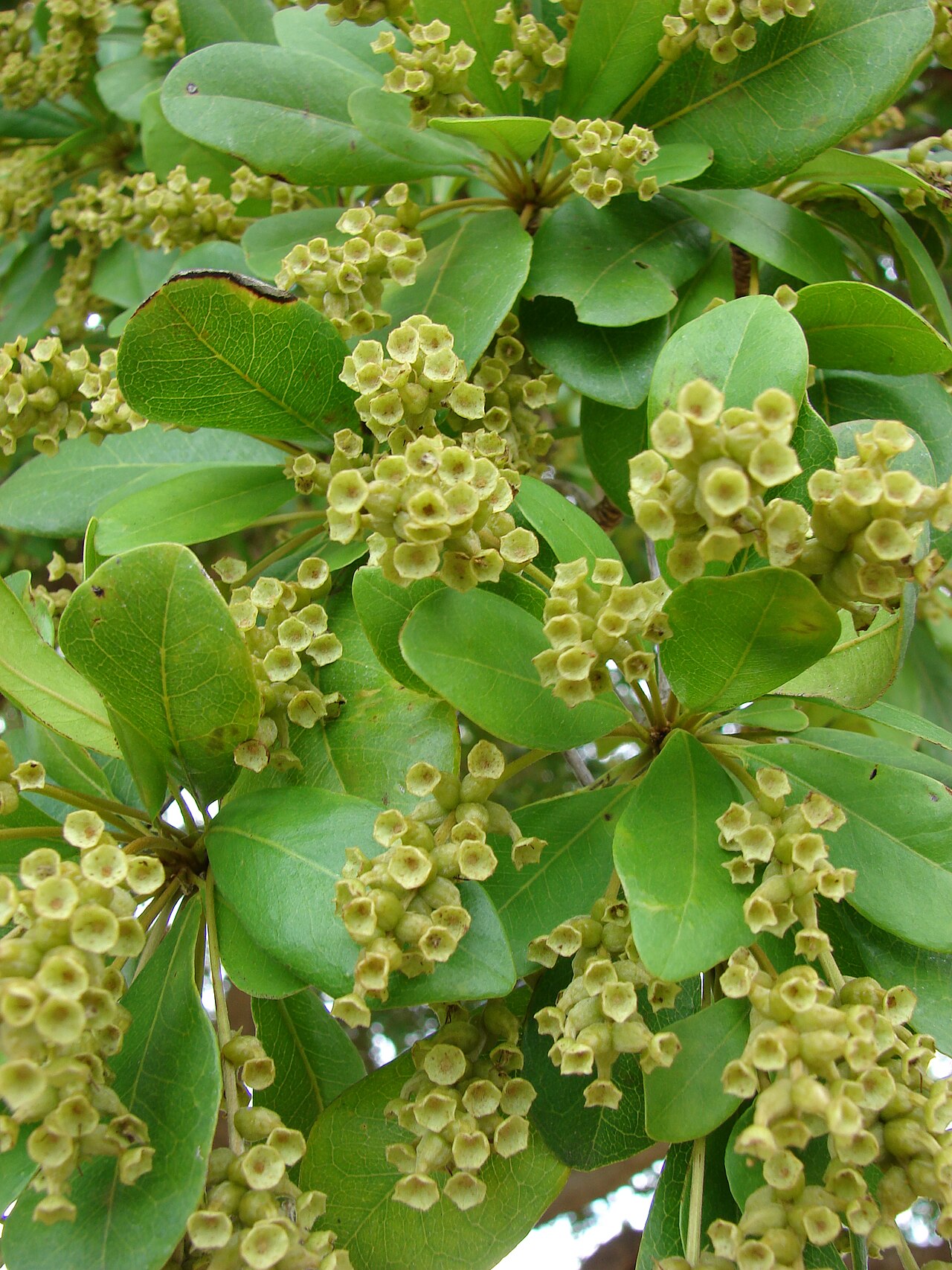
Bucida buceras, the Black Olive, is the tree Puerto Ricans call úcar. USDA PLANTS uses the common name gregorywood, and it is also known as oxhorn bucida, bullet tree and, in Cuba, júcaro. It is a sturdy evergreen to semi-evergreen tree in the combretum family (Combretaceae), the same family as buttonwood and white mangrove, with small leathery leaves clustered at the ends of zigzag branches and a broad, dense crown. Many botanists now place it in the genus Terminalia as Terminalia buceras, the name used by the Atlas of Florida Plants.
In Puerto Rico úcar is a native tree of the dry and moist coastal forests, limestone hills and the edges of swamps and mangroves, and it has become one of the most popular shade trees in towns across the Caribbean. It tolerates salt spray, wind, drought, poor fill soil and air pollution, and selected spineless forms have been planted by the thousands along streets and in parking lots in Puerto Rico and South Florida. The common name black olive does not come from an edible olive: the tree’s small fruits are dry and inedible.
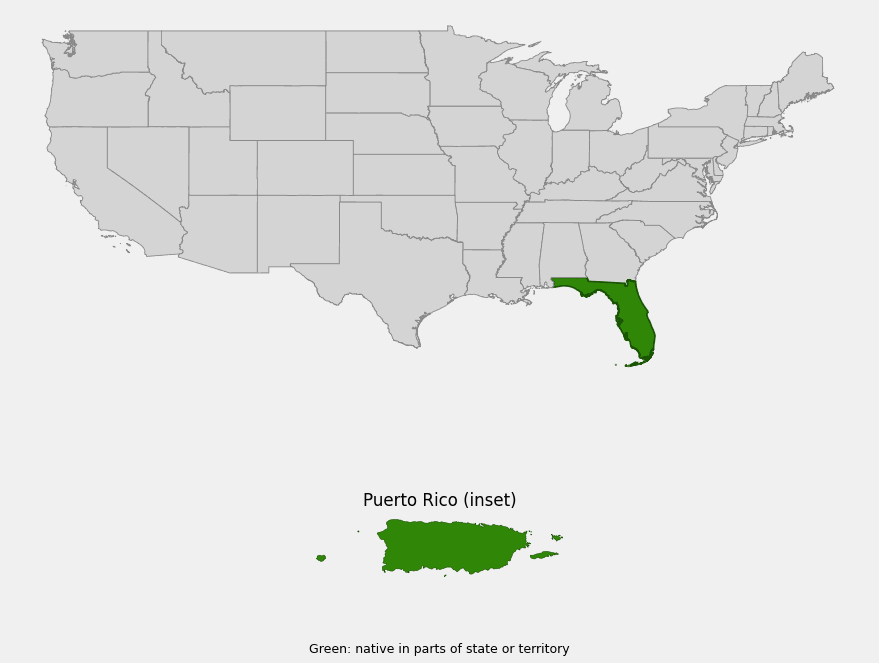
Black olive’s status in Florida is genuinely disputed. USDA PLANTS lists it as native to the lower 48 states, and it was once thought to grow wild in the upper Florida Keys. The USDA Forest Service silvics of úcar notes that it apparently did not occur there before colonial times, the Lady Bird Johnson Wildflower Center calls the Keys claim disputed, and the Atlas of Florida Plants lists it as not native. This page follows USDA in mapping Florida, but Florida gardeners who want an unquestionably native tree should consider alternatives such as gumbo limbo or green buttonwood.
Identification
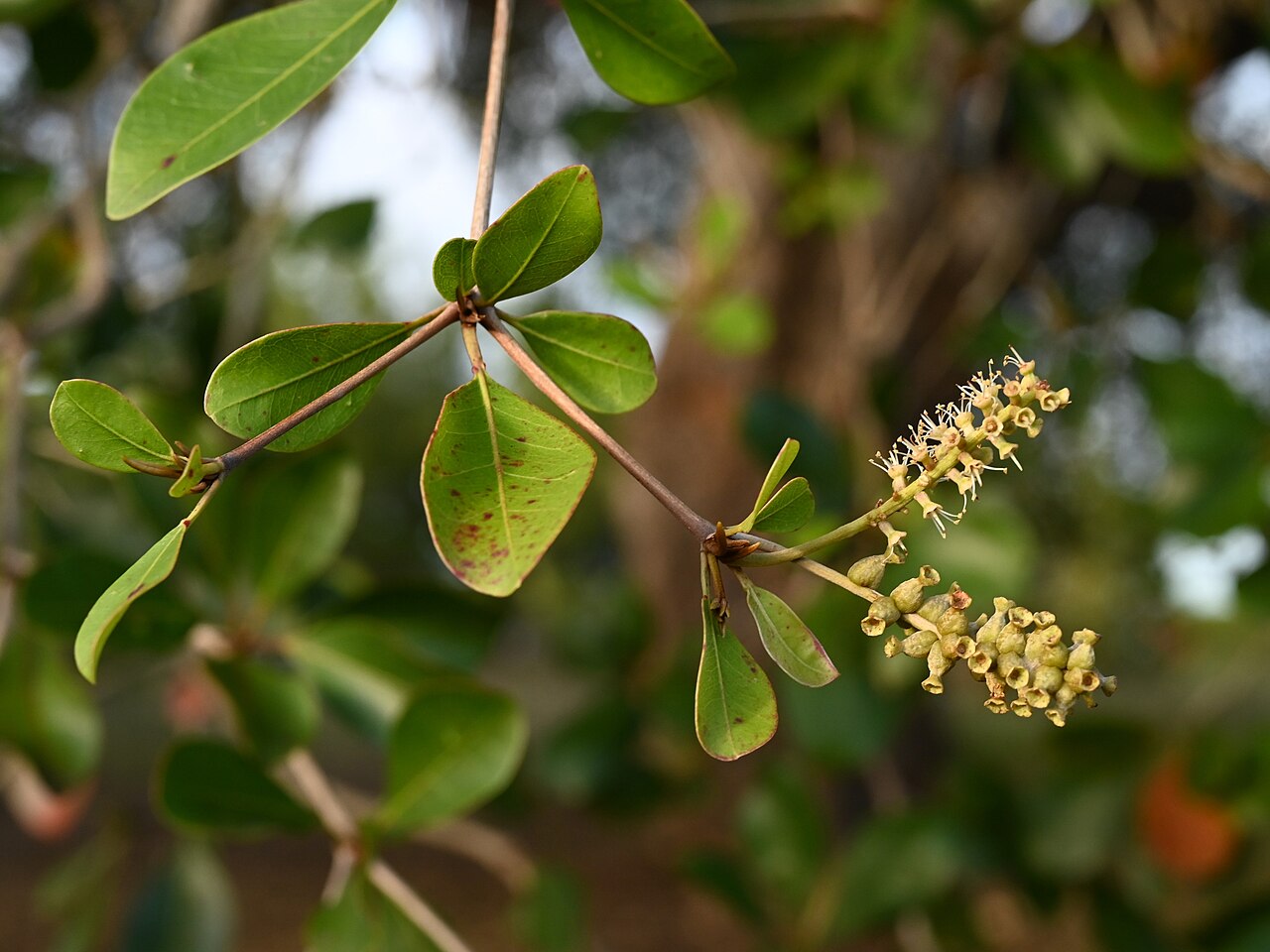
Black olive is distinctive once you know its branching. Short side twigs grow in a zigzag pattern, each ending in a tight rosette of small, rounded leaves, and the branches often grow in horizontal tiers. Wild trees frequently carry sharp spines, while most nursery trees are spineless selections.
Trunk & Bark
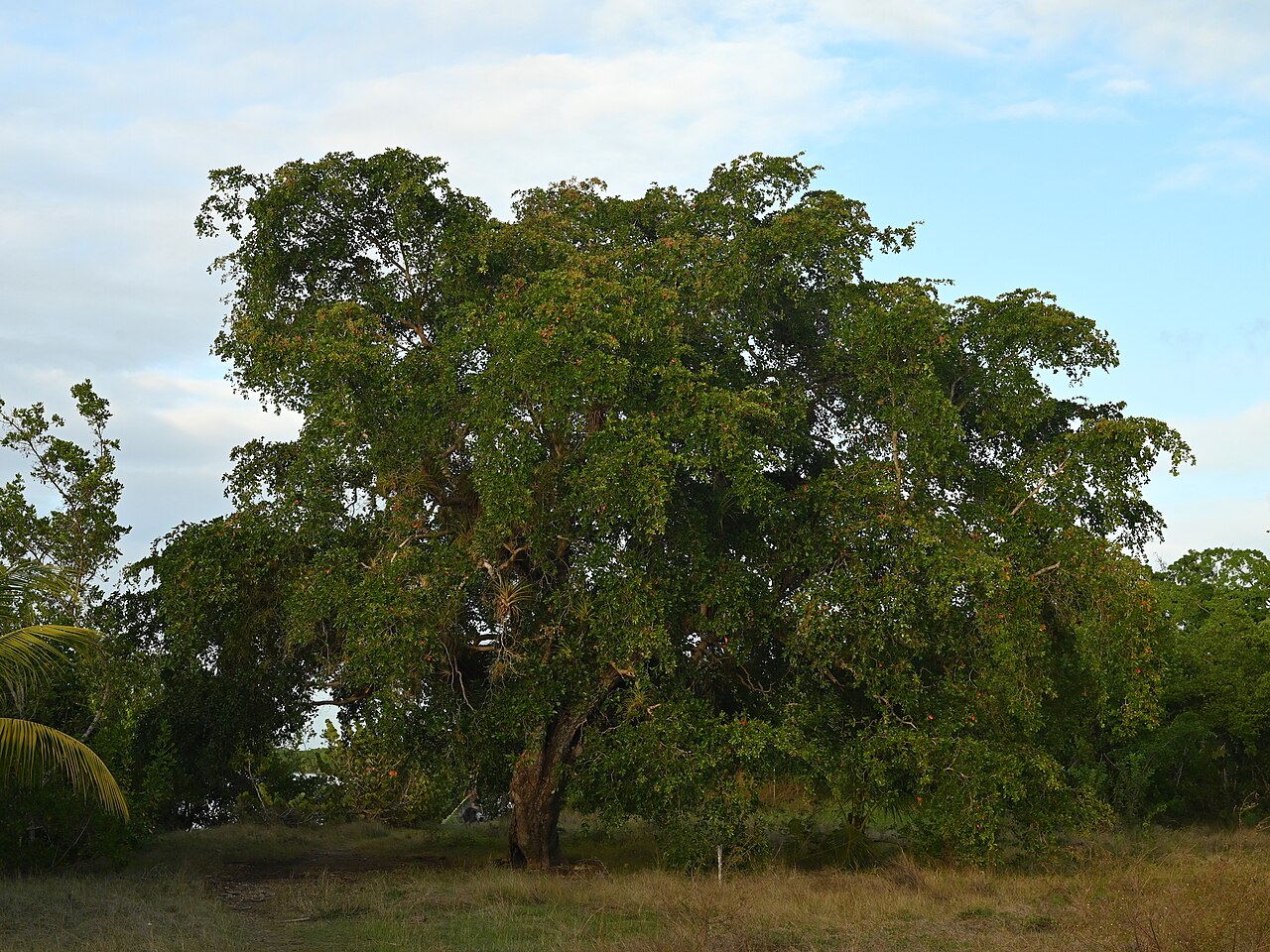
Black olive typically grows 40 to 50 feet tall, with a straight, smooth to slightly fissured gray trunk and strong, spreading branches. Young trees have a narrow, pyramidal shape, and older trees develop a broad, oval to rounded crown that may flatten on top. The bark is thin, only about half an inch to an inch thick, so trees are easily damaged by fire. Old trees develop small buttresses and large surface roots.
Leaves
The leaves are simple, leathery and spoon-shaped (obovate), about 2 to 4 inches long, dark bluish-green and glossy above, and crowded in whorls at the ends of the twigs. Wild trees commonly have short spines at the twig nodes. Some leaves and fruits develop long, curved, horn-like galls caused by a tiny mite; these “ox horns” inspired the species name buceras, which means ox horn.
Flowers
The flowers are tiny, greenish-white to cream, and lack petals. They are packed into slender spikes that rise among the leaves. In Puerto Rico individual trees may bloom at any time of year, while in Florida flowering is mainly in spring. The blooms are not showy, but a tree in full flower looks frosted with pale green.
Fruit & Seeds
Each fertile flower ripens in about three months into a small, dry, one-seeded drupe. The seeds are light and fall singly or with the whole spike; they can float and can be blown short distances by strong winds. Germination is very low, and many seeds are hollow or empty. Mature trees continually drip a dark, sticky residue, which is why black olive is a poor choice over parking spaces.
Quick Facts
| Scientific Name | Bucida buceras (syn. Terminalia buceras); USDA common name: gregorywood |
| Family | Combretaceae (combretum family) |
| Plant Type | Evergreen to semi-evergreen tree |
| Mature Height | 40–50 ft |
| Mature Spread | 30–40 ft; broad, dense crown with age |
| Growth Rate | Moderate; slow on dry, shallow soils |
| Sun Exposure | Full sun |
| Water Needs | Low to moderate; drought tolerant once established, also tolerates seasonal flooding |
| Soil Type | Sand, limestone, clay, saline coastal soils and fill; best in deep, moist, well-drained soil |
| Soil pH | Slightly acid to alkaline |
| Bloom Time | Any time of year in Puerto Rico; mainly spring in Florida |
| Flower Color | Greenish-white to cream |
| Fall Color | None; evergreen to semi-evergreen |
| Fruit | Small, dry, one-seeded drupe |
| Deer Resistant | Not rated; cattle usually avoid browsing it |
| USDA Hardiness Zones | 10b–12 (frost-free) |
Native Range
Black olive is native to the Caribbean and the tropical mainland of the Americas. The USDA Forest Service silvics of úcar describes its natural range as the Bahamas, Cuba, Jamaica, Hispaniola, Puerto Rico and the Lesser Antilles south to Guadeloupe, and on the mainland from southern Mexico (including the Yucatán Peninsula) through Central America to the Guianas. USDA PLANTS lists it as native in Puerto Rico, the U.S. Virgin Islands and the lower 48 states.
In Puerto Rico úcar grows mostly near the coast, in areas with roughly 30 to 55 inches of rain a year and a short winter dry season. It is part of the mature dry forest, including Guánica, where it grows with gumbo limbo and other dry-forest trees on slopes, and it occurs in drier, well-drained spots within moist forest, such as the limestone hills of Cambalache in the northern karst. The best-formed trees grow on low, seasonally flooded ground and along intermittent streams at the foot of dry hills, and úcar also grows on the edges and higher ground of Pterocarpus swamps and mangroves.
Florida is the uncertain part of the range. USDA PLANTS marks it native, and older references, including Elbert Little’s checklist of U.S. trees, reported it from the upper Florida Keys. The USDA Forest Service now notes that it apparently was not there before colonial times, and the Atlas of Florida Plants, the standard reference for the state flora, lists it as not native. It is very widely planted in South Florida as a street and shade tree.
📋 Regional plant lists featuring Black Olive: Puerto Rico · North & South Florida
Growing & Care Guide
Black olive is one of the toughest shade trees for coastal and urban sites in Puerto Rico. It tolerates salt spray, wind, drought, compacted fill and pollution, and it has a reputation for resisting hurricane damage. On the U.S. mainland it can be grown outdoors only in frost-free South Florida and the Keys, where it is a common landscape tree. Before planting, consider its main drawback: a constant drip of dark, sticky residue that stains cars, patios and walkways.
Light
Plant in full sun. Black olive is intolerant of shade; seedlings rarely survive under their parent trees, and in moist forest they need a disturbance such as a treefall gap to reach the canopy.
Soil & Water
Black olive grows best in deep, fertile, moist but well-drained soil, yet it tolerates almost anything: sand, limestone, saline coastal soil, clay and construction fill. Water regularly for the first year. Established trees are very drought tolerant and also handle short periods of flooding, as their swamp-edge habitat suggests.
Planting Tips
Use container-grown trees. USDA Forest Service trials in Puerto Rico found 80 to 100 percent survival for potted seedlings even on harsh sites, but only 10 to 17 percent for bare-root seedlings or transplanted wildlings. Plant at least 15 to 20 feet from sidewalks, driveways and foundations, because older trees develop large surface roots. Do not plant where cars park or over patios and pools, because of the sticky drip and leaf litter.
Pruning & Maintenance
Train young trees to a single central trunk and remove low, crossing or narrow-angled branches. Wild-type trees can have sharp spines, so wear gloves; most nursery trees are spineless selections. Keep turf and dry grass away from the trunk, since the thin bark is easily damaged by fire, string trimmers and mowers, and those wounds let in decay. In Florida, spiraling whitefly and other sap-feeding insects sometimes cause sooty mold on the leaves.
Propagation
Seed germination is very poor (often only a few percent), so nurseries usually propagate black olive from softwood cuttings under mist or by air layering. If you try seed, sow fresh seed on moist sand and expect many to be empty. Young trees cut back near the ground resprout readily.
Landscape Uses
- Shade and street tree: one of the most widely planted shade trees in Caribbean towns and South Florida
- Coastal landscapes: tolerates salt spray, wind and poor, sandy or limestone soils near the shore
- Dry forest restoration: a native canopy tree for restoring coastal dry and moist forest in Puerto Rico
- Windbreaks: a dense, wind-firm crown with a reputation for hurricane resistance
- Bee forage: listed as a honey plant, although its nectar flow varies from year to year
Wildlife & Ecological Value
In Puerto Rico’s dry forests úcar is one of the larger canopy trees, and its dense crown provides shade, shelter and nesting sites in a habitat where tall trees are few.
For Pollinators
The tiny flowers are visited by bees, and black olive is listed among the world’s honey plants, although the USDA Forest Service notes that its nectar flow is unreliable from year to year.
For Birds
The dense, tiered crown gives birds cover and nesting sites, which matters in coastal dry forest. The small dry fruits are of limited food value, but the insects that feed on the foliage and flowers are taken by warblers and other insect-eating birds.
For Mammals
Cattle usually avoid úcar and eat the grasses and shrubs around it. The USDA Forest Service suggests that this is why many úcar stands in Puerto Rico developed on land that was once heavily grazed.
Ecosystem Role
Úcar is part of the climax community of the dry forest and a sub-climax tree on excessively drained sites in moist forest. Its main natural enemy is fire: thin bark makes it vulnerable where grasses build up beneath it. Its tolerance of saline soils lets it grow at the transition between coastal swamps, mangroves and upland forest.
Cultural & Historical Uses
Úcar wood is extremely dense and hard, heavier than water when air-dried, with a dark yellowish-brown to greenish-brown color and a variegated grain that can be polished to a glassy finish. Its high silica content makes it hard on tools, but it has been used for high-quality flooring, furniture, bridge timbers, boat building, posts and railway ties. In 1951 Cuba alone sawed about 2.6 million board feet of úcar. The wood also makes excellent charcoal, and the bark has been used for tanning leather.
The scientific name Bucida buceras was published by Linnaeus in 1759, based on a Jamaican specimen. Buceras means “ox horn” and refers to the long, curved galls a tiny mite causes on some fruits and leaves, which also explains the English name oxhorn bucida.
Today úcar is best known as an urban tree. Its small leaves, tiered branches and tolerance of salt, wind and pollution made it one of the standard shade trees of Caribbean towns and South Florida streets, and nurseries developed spineless, uniform selections. Its tough wood and reputation for standing up to hurricanes add to its appeal in coastal Puerto Rico.
Frequently Asked Questions
Is black olive native to Florida?
It is disputed. USDA PLANTS lists it as native to the lower 48 states, and older references reported it from the upper Florida Keys. The USDA Forest Service now says it apparently did not occur there before colonial times, and the Atlas of Florida Plants lists it as not native. It is certainly native to Puerto Rico and much of the Caribbean.
Does black olive produce edible olives?
No. Black olive is not related to the olive tree. Its fruits are tiny, dry and inedible.
Why does black olive stain cars and patios?
Mature trees continually drop a dark, sticky residue, along with flowers and small fruits. The USDA Forest Service advises against planting úcar where cars park routinely. Sap-feeding insects such as whiteflies can make the problem worse by producing honeydew and sooty mold.
Is black olive good for hurricane areas?
It has a reputation for resisting hurricane damage thanks to its strong wood and wind-firm crown, and it is widely planted in coastal Puerto Rico and South Florida for that reason. As with any tree, good structural pruning when young improves its wind resistance.
How do I recognize black olive?
Look for small, spoon-shaped leaves in tight clusters at the tips of zigzag twigs, branches in horizontal tiers, slender spikes of tiny cream flowers and, on wild trees, short spines. Curved, horn-like galls on some fruits and leaves are another clue.

Looking for a nursery that carries Black Olive?
Our nursery directory does not yet include Puerto Rico. Browse the native plant nursery directory by state: Alabama–Arkansas · California · Colorado–Hawaii · Idaho–Kansas · Kentucky–Montana · Nebraska–Oklahoma · Oregon · Pennsylvania–Virginia · Washington · West Virginia–Wyoming