
Living Vase (Aechmea nudicaulis)
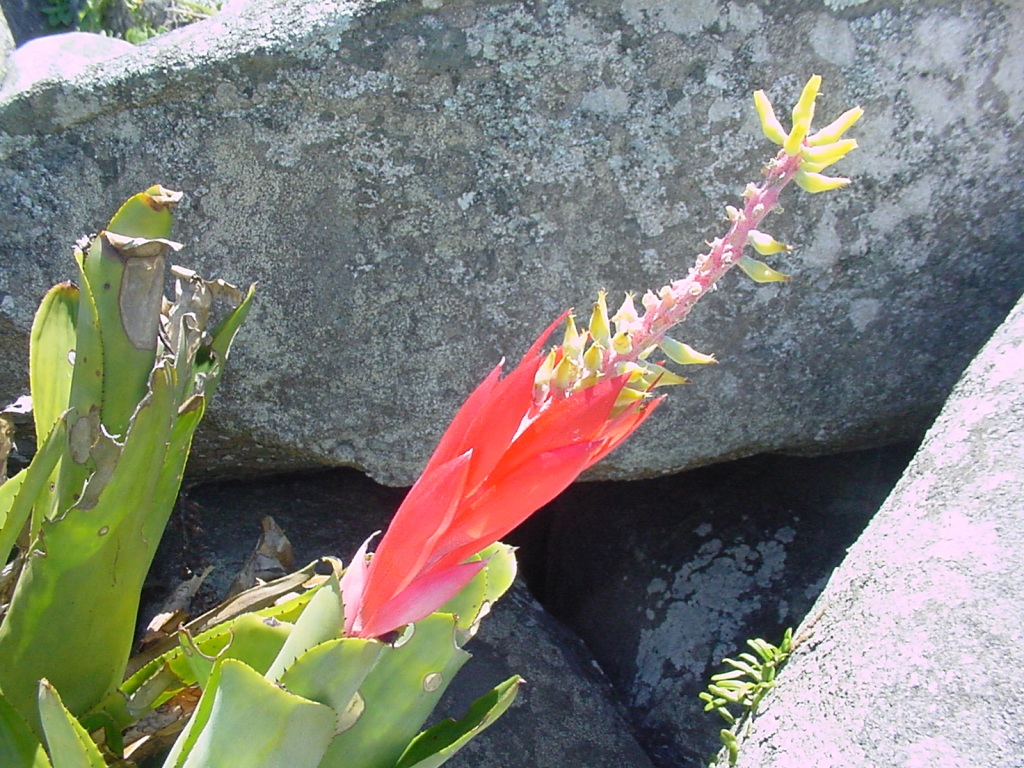
Aechmea nudicaulis, known as Living Vase and by its USDA name, nakedstem livingvase, is a tank bromeliad with a narrow, upright vase of a few stiff, spiny-edged leaves. When it blooms, a spike of bright yellow flowers rises from a ring of scarlet bracts, a combination that makes it one of the most striking bromeliads in the tropical Americas. It is also one of the most widespread Aechmea species, found from southern Mexico through Central America to South America and in the Greater Antilles.
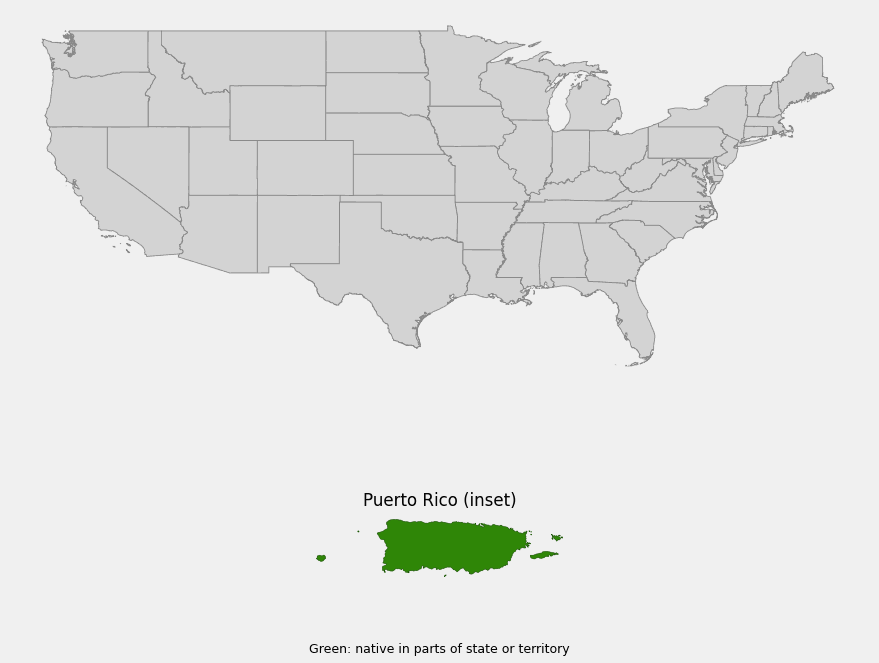
In Puerto Rico, where USDA PLANTS lists it as native, it is a rare plant. The Institute for Regional Conservation (IRC) describes it as a rare epiphyte of eastern Puerto Rico at middle elevations, known from the Sierra de Luquillo, Las Tetas de Cayey and the Cañón San Cristóbal. The Puerto Rico Department of Natural and Environmental Resources (DRNA) tracks it as a critical element, and IRC’s preliminary assessment ranks it critically imperiled on the island. It is not native anywhere in the 50 states.
This guide covers how to recognize the living vase, its history and status in Puerto Rico, and how to grow it in island gardens. It is widely sold as an ornamental, so gardeners can enjoy it without touching wild plants: buy nursery-propagated plants only, and never collect bromeliads from the wild.
Identification
Living vase is easy to recognize: a slender, tubular rosette of only a few broad, stiff leaves with sharp marginal spines, and a flower spike with conspicuous red bracts on the stalk and yellow flowers above.
Rosette & Leaves
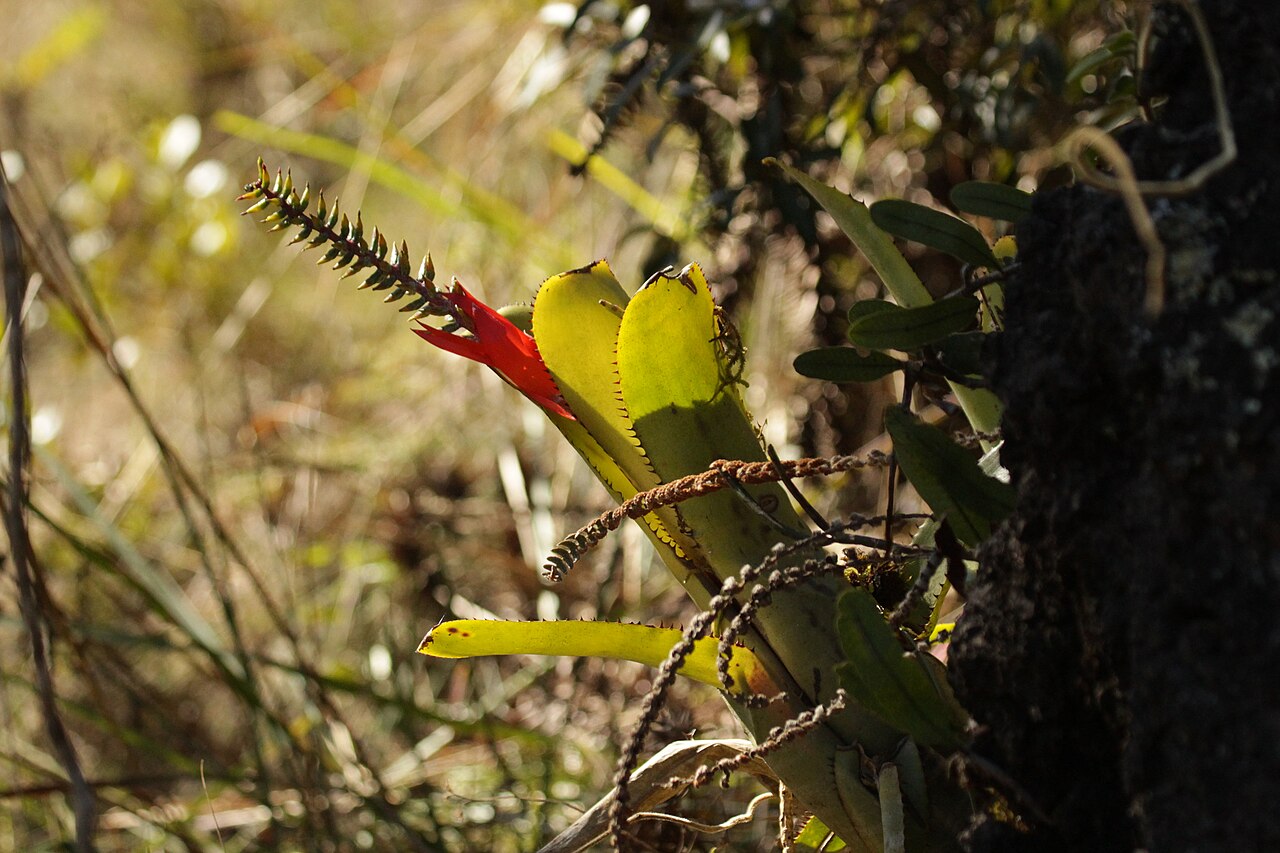
The plant forms a narrow, upright, vase- or tube-shaped rosette of relatively few leaves, usually under 2 feet tall. The leaves are broad, stiff and leathery, green to yellow-green, often with a whitish, scurfy coating on the outside, and lined with dark, sharp, hooked spines along the margins. Many plants show pale or silvery crossbands, and their tips are often abruptly pointed. The overlapping leaf bases hold water.
Flower Stalk & Bracts
The name nudicaulis means “naked stem”: the upper part of the flower stalk is largely bare, while its lower part is wrapped in large, bright red bracts that flare out at the mouth of the vase. The stalk itself is pinkish and dusted with white scurf.
Flowers
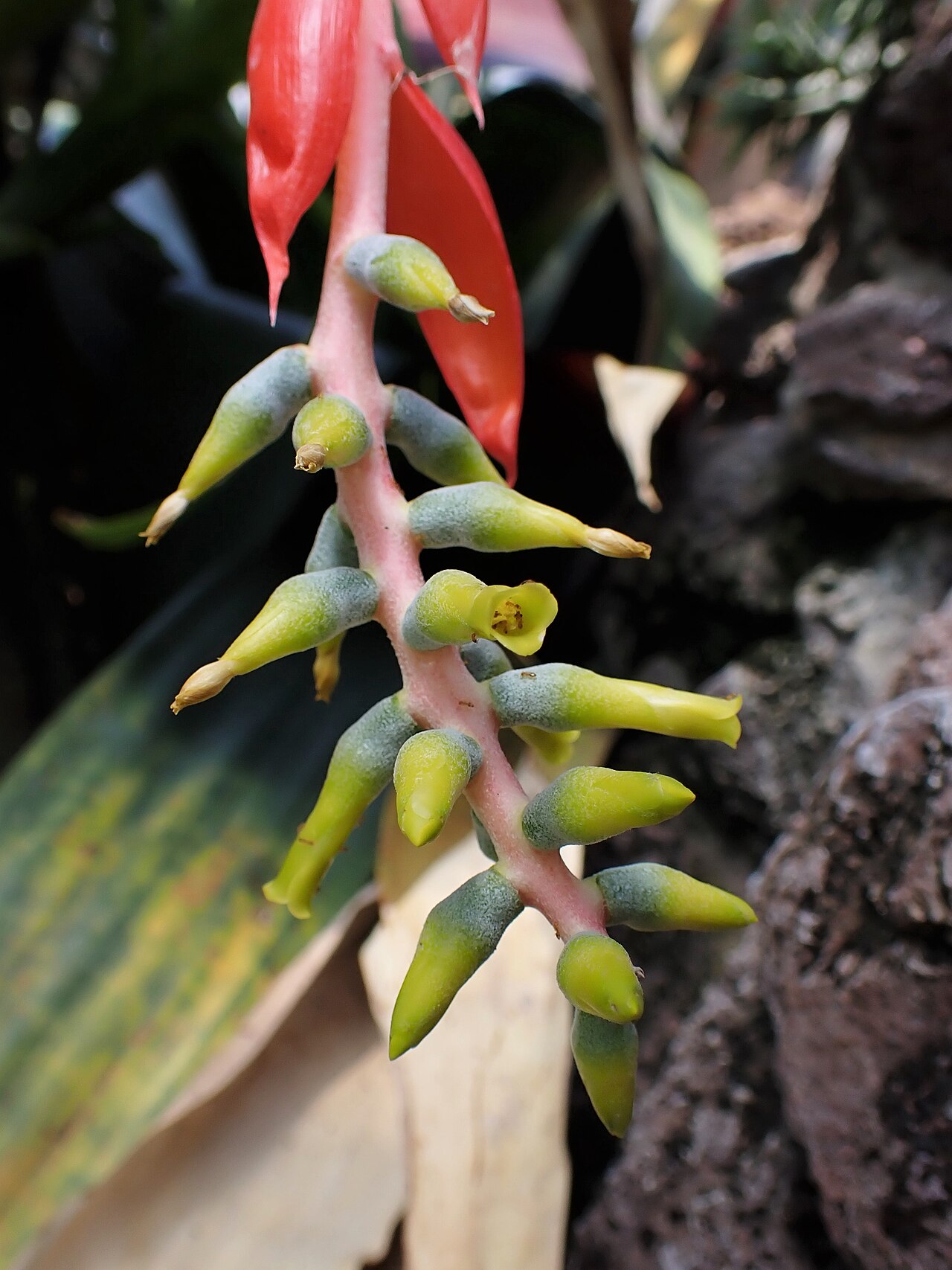
The flowers are tubular and bright yellow, held in a spike above the red bracts. Each has a pale, gray-white, scurfy base (the ovary, which becomes the fruit). Flowers open a few at a time over several weeks.
Fruit & Seeds
The fruits are small berries that develop from the scurfy ovaries after flowering. As in other aechmeas, they contain many small seeds in a soft pulp, which are dispersed by animals that eat the fruit.
Quick Facts
| Scientific Name | Aechmea nudicaulis (L.) Griseb.; USDA common name: nakedstem livingvase |
| Family | Bromeliaceae (bromeliad family) |
| Plant Type | Evergreen epiphytic or rock-dwelling tank bromeliad |
| Mature Height | 1–2 ft; flower spike slightly taller |
| Mature Spread | 6–12 in per rosette; slowly forms clumps |
| Growth Rate | Moderate |
| Sun Exposure | Partial shade to bright filtered light |
| Water Needs | Moderate; keep the cup filled; tolerates short dry spells |
| Soil Type | Epiphytic on bark or rock; or a coarse, fast-draining bromeliad mix |
| Soil pH | Slightly acidic to neutral |
| Bloom Time | Varies; flower spikes last several weeks |
| Flower Color | Bright yellow flowers above scarlet bracts |
| Fall Color | None; evergreen |
| Fruit | Small berries with many seeds |
| Deer Resistant | Yes; spiny leaves, usually grown off the ground |
| USDA Hardiness Zones | 10b–12; frost-tender |
Native Range
Living vase has one of the widest ranges of any Aechmea. IRC gives its native range as the Greater Antilles (Puerto Rico, Hispaniola and Cuba), southern Mexico, Central America and South America, and Wikipedia describes it as native to Central America, the West Indies, central and southern Mexico, and northern and central South America, with several varieties recognized in Brazil and northern South America. Within the area PlantNative covers, USDA PLANTS lists it as native only in Puerto Rico.
In Puerto Rico it has always been rare. IRC summarizes the island’s records: P.E.E. Sintenis collected it in 1886 and 1893 in the Sierra de Naguabo on the south side of the Sierra de Luquillo; R.F. Smith collected it at the El Verde Field Station (Río Grande) in 1965; and George Proctor found it near Cerro Bravo in Río Grande in 1986. It has also been collected several times around Las Tetas de Cayey and the Cañón de San Cristóbal, in Salinas, Aibonito and Barranquitas, and there is a single 1914 record from Arecibo. IRC treats it as presumed extirpated at Arecibo, possibly extirpated in the Sierra de Luquillo, and presumed extant around Cañón San Cristóbal and Las Tetas de Cayey, noting that new surveys are needed to confirm its status.
Woodbury and colleagues first listed it as a rare species in Puerto Rico in 1975, and the DRNA has listed it as a critical element since 1988. It is not on the DRNA’s legal list of protected species and is not federally listed, but every wild plant on the island matters. Gardeners in Puerto Rico should use nursery-propagated plants only.
📋 Regional plant lists featuring Living Vase: Puerto Rico
Growing & Care Guide
Living vase is a tough, rewarding bromeliad for Puerto Rico gardens and is widely available in the nursery trade, including selected forms and hybrids. Because wild plants on the island are so few, buy nursery-propagated plants only and never collect from the wild.
Light
Bright, filtered light brings out the best leaf color and flowering, such as the light under an open tree canopy or on the east side of a building. It tolerates some direct morning sun; harsh midday sun can bleach or burn the leaves, and deep shade makes them long and floppy and reduces flowering.
Soil & Water
Grow it mounted on a tree, log or rock, or in a pot of very coarse, fast-draining mix such as bark chips with some perlite. Keep water in the central cup, flushing it regularly with fresh water, and let the mix dry slightly between waterings. Its stiff leaves and water-holding cup help it ride out short dry spells. Avoid soggy potting soil, which rots the roots.
Planting Tips
To mount it, tie the base snugly to rough bark or a rock with soft wire, fishing line or plant tape, with a little sphagnum, until new roots grip the surface. In the ground, plant it in a raised, rocky or gravelly spot rather than heavy soil. Wear gloves: the marginal spines are sharp.
Pruning & Maintenance
Each rosette flowers once and then slowly declines while producing offsets. Cut off the old rosette once it browns. Remove spent flower spikes and dead leaves to keep the plant tidy. Feed sparingly with a dilute fertilizer sprayed on the leaves.
Propagation
Separate offsets (pups) when they are about one-third the size of the parent, with a few roots of their own, and mount or pot them. Plants can also be grown from fresh seed sown on a moist, sterile surface under high humidity, but seedlings take several years to flower.
Landscape Uses
- Tree and rock gardens: mounted on trunks, logs or boulders
- Containers: a sculptural, spiny vase for patios
- Shade gardens: red and yellow accents among ferns
- Hummingbird gardens: bright red bracts and tubular flowers
- Conservation education: a rare native bromeliad of eastern Puerto Rico
Wildlife & Ecological Value
Like other tank bromeliads, living vase holds water in its leaf bases, creating a small pool that supports wildlife, and its bright flowers and fruits feed animals of the forest.
For Pollinators
The red bracts and yellow tubular flowers match the pattern of many hummingbird-visited bromeliads, and bees and other insects also visit for nectar and pollen.
For Birds
Hummingbirds and other birds sip nectar and drink from the water-filled cup, and small birds eat the berries and spread the seeds.
For Mammals
Its berries may be eaten by small fruit-eating animals, but it is not a significant food plant for mammals in Puerto Rico.
Ecosystem Role
The water-filled tank is a miniature wetland where insect larvae, small crustaceans and tree frogs can live, and where fallen leaves decompose and feed the plant. Bromeliads like this one add water storage and shelter to tree trunks and rock faces.
Cultural & Historical Uses
Linnaeus first described this plant in the 1700s in the genus Bromelia; the German botanist August Grisebach, author of a flora of the British West Indies, later moved it to Aechmea, giving the name used today, Aechmea nudicaulis (L.) Griseb. The genus name comes from the Greek for “spear point,” a reference to the pointed sepals or bracts of many species.
In Puerto Rico its story is one of botanical exploration. Paul Sintenis, the German botanist who collected thousands of plant specimens across the island in the 1880s, found it in the Sierra de Naguabo, and later collectors such as George Proctor and Alain Liogier, both central figures in the study of Puerto Rico’s flora, added records from Río Grande and the Cayey mountains.
Elsewhere it is a well-known garden plant. Wikipedia notes that a number of cultivars are commercially available, either selected forms or hybrids with other species, including ‘Parati’ and ‘Rakete’. In gardens across the tropics its red-and-yellow spike has made it a favorite of bromeliad collectors.
Frequently Asked Questions
Is living vase native to Puerto Rico?
Yes. USDA PLANTS lists Aechmea nudicaulis as native in Puerto Rico, and the Institute for Regional Conservation lists it as native and rare in eastern Puerto Rico.
Is it endangered in Puerto Rico?
It is not on the legal list of protected species, but the DRNA tracks it as a critical element and IRC’s preliminary assessment ranks it critically imperiled on the island. Buy nursery-propagated plants only and never collect wild plants.
Is it native to Florida?
No. It is native to Puerto Rico and tropical America, not to Florida or any other state. It is sometimes grown as an ornamental in South Florida.
Why is it called nakedstem livingvase?
“Living vase” is a common name for Aechmea species, whose leaves form a water-holding vase. “Nakedstem” translates the species name nudicaulis, for its largely bare flower stalk.
Does the plant die after it flowers?
The flowering rosette does, slowly, over several months, but it produces offsets (pups) at its base first. Keep caring for the plant, and remove the old rosette once the pups are established.

Looking for a nursery that carries Living Vase?
Our nursery directory does not yet include Puerto Rico. Browse the native plant nursery directory by state: Alabama–Arkansas · California · Colorado–Hawaii · Idaho–Kansas · Kentucky–Montana · Nebraska–Oklahoma · Oregon · Pennsylvania–Virginia · Washington · West Virginia–Wyoming