
Leafless Vanilla (Vanilla barbellata)
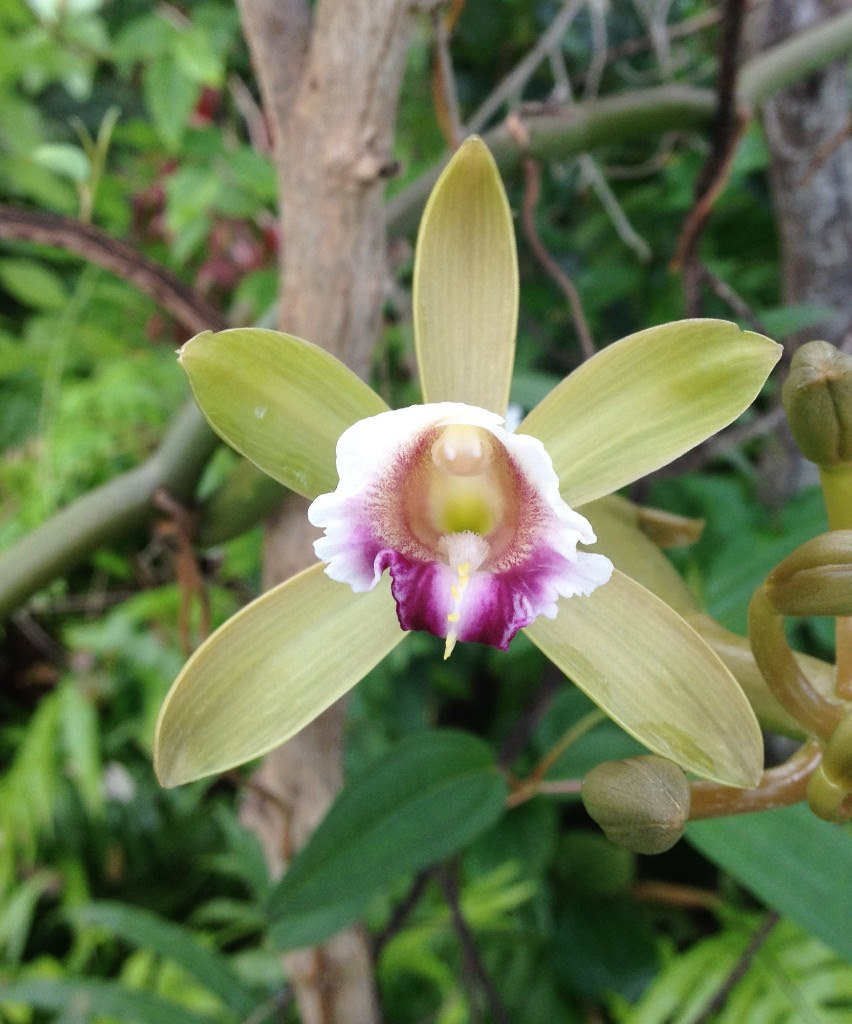
Vanilla barbellata, the Leafless Vanilla, is a climbing orchid that has done away with leaves almost entirely. USDA PLANTS calls it wormvine orchid, a good description of its thick, green, rope-like stems that snake through shrubs and up tree trunks in dry Caribbean forests. In late spring and early summer it opens showy flowers, about 2 inches across, with pale yellow-green sepals and petals and a white lip edged and streaked with magenta-purple. It belongs to the orchid family, Orchidaceae, and is a wild relative of the vanilla orchid (Vanilla planifolia) whose cured pods give us vanilla flavoring. It has also been called Vanilla articulata.
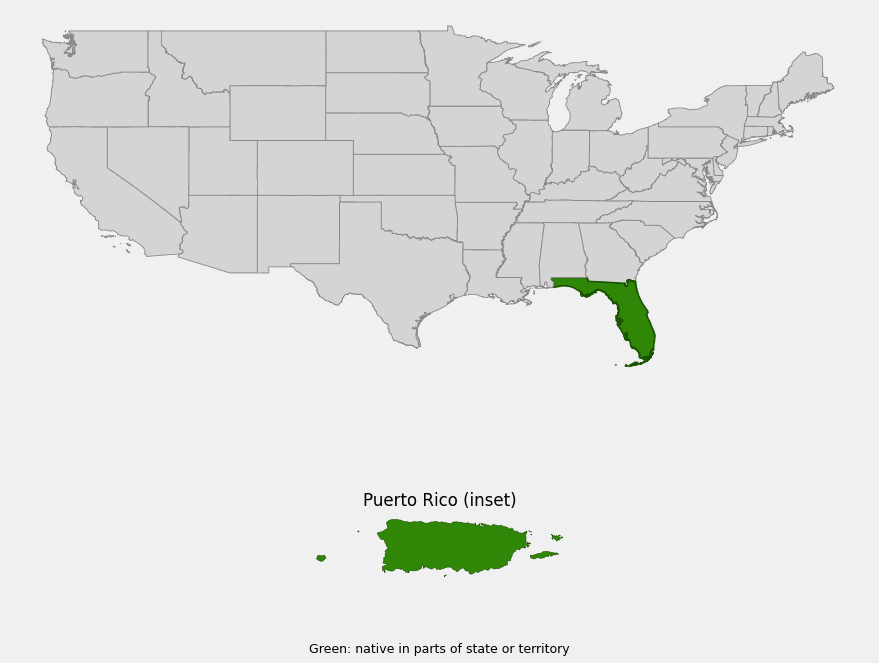
Leafless vanilla is a West Indian species. The Smithsonian’s Flora of the West Indies records it from Cuba, Hispaniola, Puerto Rico (including Mona and Vieques), the Virgin Islands (St. John, St. Thomas and Virgin Gorda), the Bahamas and Florida. In Puerto Rico it is a plant of the dry southwest, from the dry forest of Guánica to the serpentine scrub of the Susúa and Maricao forests. In Florida it grows only in the far south, mainly in the hammocks of the Florida Keys.
In Florida it is listed as Endangered by the state. This guide covers how to identify this unusual orchid, where it grows, how nursery-propagated plants can be grown, and its place in the dry forests of Puerto Rico and the Keys.
Identification
Out of flower, leafless vanilla looks less like an orchid than like a smooth green vine or a stem of cactus. Several other leafless vanillas grow in the Caribbean region, and in Florida Vanilla dilloniana is very similar; the lip of the flower is the most reliable way to tell them apart.
Stems
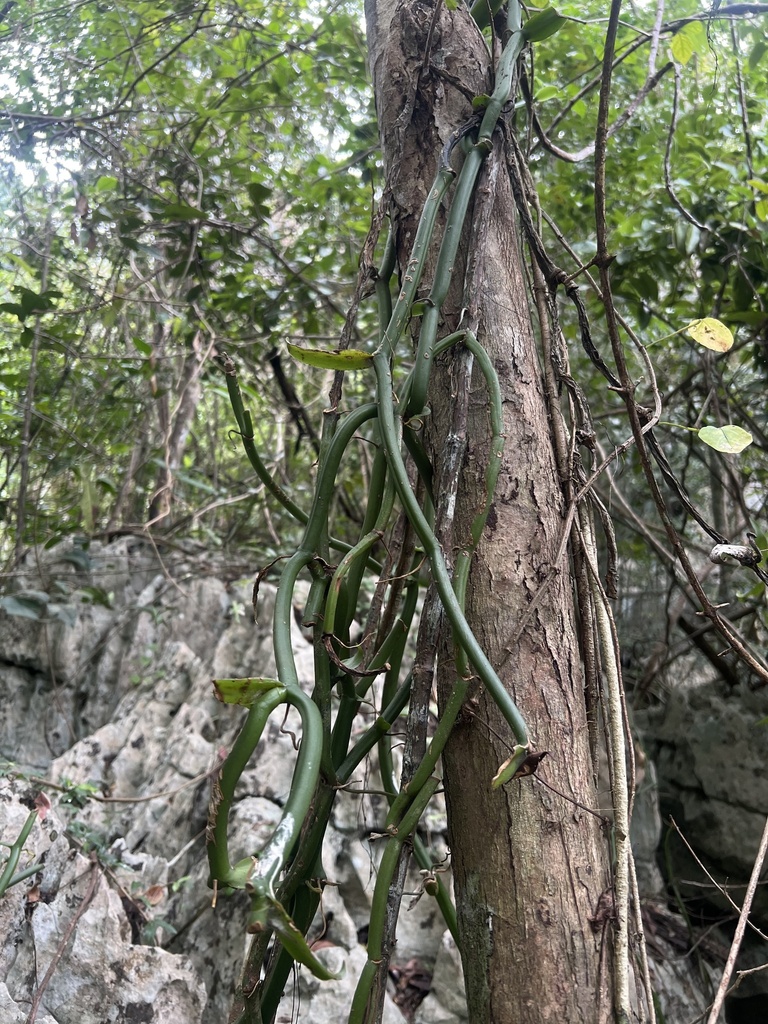
The stems are thick (about half an inch), fleshy, smooth and green, sometimes yellowish or orange-tinged in strong sun. They are jointed, with a node every few inches, and climb or sprawl many feet through shrubs and trees, attaching by aerial roots at the nodes. Older parts of the plant may lose their connection with the ground, so the vine lives as an epiphyte supported by its host. The green stems carry out photosynthesis in place of leaves.
Leaves
Each node bears only a tiny, scale-like leaf, which soon withers and falls. To the casual observer the plant appears completely leafless.
Flowers
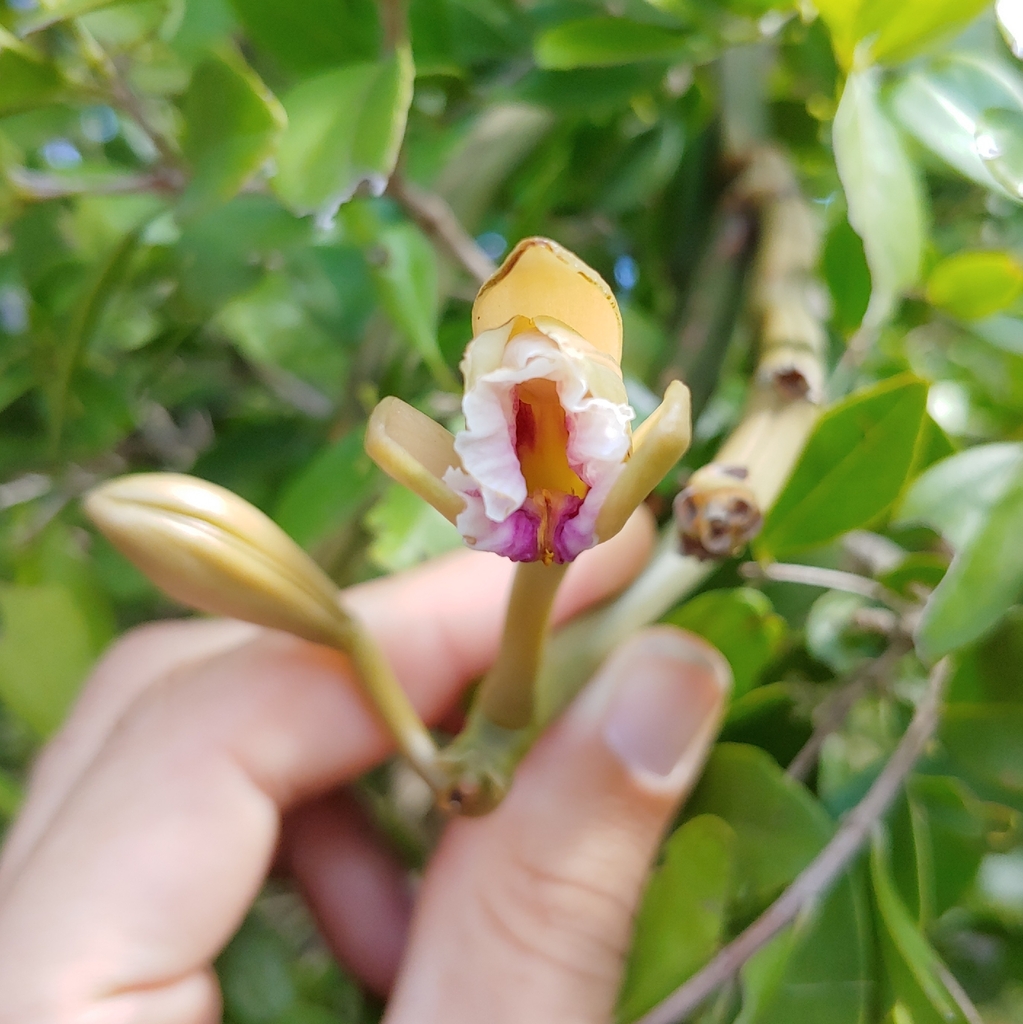
Short clusters of flowers arise at the nodes, and the flowers open one or a few at a time; each lasts only a short time. They are about 2 inches across. The sepals and petals are oblong and pale yellow-green to greenish tan. The lip is wrapped around the column to form a tube; it is white to cream at the edges, flushed with magenta, wine-red or purple toward the ruffled tip, and yellow to orange inside the throat. A tuft of small, bristly hairs in the throat gives the species its name: barbellata means “with a little beard.” Plants usually bloom in late spring and early summer.
Fruit & Seeds
Pollinated flowers develop into long, slender, green capsules (“beans”) a few inches long, which slowly ripen and split. They contain many tiny seeds. Unlike the commercial vanilla, its pods are not used for flavoring.
Quick Facts
| Scientific Name | Vanilla barbellata Rchb. f. (syn. Vanilla articulata) |
| Family | Orchidaceae (orchid family) |
| Plant Type | Leafless climbing (hemiepiphytic) orchid vine; USDA common name “wormvine orchid” |
| Mature Height | Climbs 10–20 ft or more through shrubs and trees |
| Mature Spread | Variable; spreads through supporting vegetation |
| Growth Rate | Slow to moderate |
| Sun Exposure | Part shade to bright filtered light |
| Water Needs | Low to moderate; tolerates seasonal drought |
| Soil Type | Rocky limestone or serpentine soil and leaf litter; often epiphytic |
| Soil pH | Variable (limestone to serpentine) |
| Bloom Time | Late spring to early summer |
| Flower Color | Pale yellow-green; white lip edged magenta-purple |
| Fall Color | None; green stems year-round |
| Fruit | Slender green capsule (bean) with tiny seeds |
| Deer Resistant | Not applicable; climbs into shrubs and trees |
| USDA Hardiness Zones | 10b–12 (frost-free) |
Native Range
Leafless vanilla is native to the northern Caribbean and southern Florida. The Smithsonian’s Flora of the West Indies lists it from Cuba, Hispaniola, Puerto Rico (including Mona and Vieques), the Virgin Islands (St. John, St. Thomas, Virgin Gorda), the Bahamas and Florida, and records summarized by GBIF add Jamaica. USDA PLANTS lists it as native in Florida, Puerto Rico and the U.S. Virgin Islands.
In Florida, herbarium specimens come from Monroe County, especially the Florida Keys (historically as far as Key West), and from a few hammocks in Miami-Dade County, including Brickell Hammock south of Miami. Collectors describe high hardwood hammocks as its habitat. The Atlas of Florida Plants lists it as state Endangered.
In Puerto Rico it is mostly confined to the dry south and southwest. Specimens and observations come from Guánica State Forest, where it climbs in dry thorn-scrub woodland, from the serpentine scrub and low forest of the Susúa forest (Sabana Grande and Yauco) and the lower, drier part of Maricao State Forest, and from Cabo Rojo, Peñuelas, Ponce, Coamo and Salinas, as well as Vieques and Mona islands. Collectors note that it can be locally abundant in serpentine thorn-scrub.
📋 Regional plant lists featuring Leafless Vanilla: Puerto Rico · North & South Florida
Growing & Care Guide
Leafless vanilla is uncommon in cultivation, but specialist orchid growers sometimes offer nursery-propagated plants grown from cuttings. Buy only nursery-propagated plants and never collect from the wild: it is listed as Endangered by the State of Florida, and wild populations in Puerto Rico are confined to a few dry forests. In Puerto Rico and frost-free South Florida it can be grown outdoors on a tree or sturdy support; elsewhere it needs a warm greenhouse, where its long stems can be trained on a post or trellis.
Light
Give it bright, filtered light or part sun, like the broken shade of a dry forest. It tolerates more sun than most orchids, and in strong light its stems may turn yellowish or orange.
Soil & Water
Plant the base in a very well-drained mix of coarse bark, leaf litter and grit, or let it grow along a tree trunk with only a small pad of mulch at its roots. Water regularly during the warm, wet season and much less in the dry season; its fleshy stems store water, and soggy roots will rot.
Planting Tips
Provide something to climb: a rough-barked tree, a post wrapped in coir or a sturdy trellis. Tie the stem loosely at the nodes until the aerial roots grip. In a garden, plant it at the base of an established native shrub or small tree, as it grows in the wild.
Pruning & Maintenance
Little pruning is needed. Guide long stems back onto the support or let them drape. Remove dead or damaged stem sections, cutting just above a node. Feed lightly with a diluted orchid fertilizer in summer.
Propagation
Propagate from stem cuttings with at least two or three nodes, laid on or tied to a moist support until roots form at the nodes. Seed propagation requires laboratory techniques. Take cuttings only from cultivated plants.
Landscape Uses
- Dry forest gardens in Puerto Rico: climbing native shrubs and trees in gardens of the south and southwest
- South Florida hammock gardens: an unusual native orchid for frost-free gardens
- Greenhouse and conservatory collections: for orchid and succulent enthusiasts
- Education: a striking example of a leafless, drought-adapted orchid and a wild relative of vanilla
Wildlife & Ecological Value
Leafless vanilla shows how orchids have adapted to dry tropical forests: it stores water in its stems, makes food with green stems instead of leaves, and relies on host trees for support.
For Pollinators
Vanilla flowers in general are pollinated by bees, which must push into the tubular lip to reach the column. The flowers of leafless vanilla are likely visited by large native bees, but its pollinators have been little studied, and each flower is open only briefly.
For Birds
Birds perch and forage in the shrubs and trees where its stems climb; it offers no important food for them.
For Mammals
Puerto Rico has few native land mammals other than bats, and none are known to depend on this orchid.
Ecosystem Role
As a climber in dry forest and thorn scrub, leafless vanilla adds to the structural diversity of these habitats. Its fleshy stems store water through the long dry season, and like all orchids it depends on symbiotic fungi to germinate, so healthy populations reflect healthy, intact dry forests.
Cultural & Historical Uses
The German orchidologist Heinrich Gustav Reichenbach (Reichenbach filius) described Vanilla barbellata in the 1860s. In the early 1900s the American naturalist Alice Northrop described plants from the Bahamas as Vanilla articulata, a name now treated as the same species.
Leafless vanilla belongs to the same genus as Vanilla planifolia, the Mexican orchid that provides commercial vanilla, which is native to Mexico and Central America and is grown widely in the tropics. Wild relatives such as this one are of interest to scientists and plant breeders because they may carry useful traits, such as tolerance of drought, that the commercial crop lacks.
In Spanish, vanilla orchids are generally called vainilla, but leafless vanilla does not appear to have a widely recorded Puerto Rican name of its own. It is best known to botanists, orchid enthusiasts and hikers in the dry forests of Guánica and Susúa, where the looping green stems are easier to find than the short-lived flowers.
Frequently Asked Questions
Does leafless vanilla produce vanilla?
Its pods are not used for flavoring. Commercial vanilla comes from a different species, Vanilla planifolia.
How can it live without leaves?
Its thick, green stems contain chlorophyll and carry out photosynthesis, and they also store water. Its leaves are reduced to tiny scales that fall early, which helps it conserve water in dry forests.
Is it protected?
It is listed as Endangered by the State of Florida (Atlas of Florida Plants), which makes collecting it from the wild illegal without permission. It is not listed under the U.S. Endangered Species Act. Buy only nursery-propagated plants.
Where can I see it in Puerto Rico?
Look in the dry forests of the southwest, especially Guánica State Forest and the Susúa forest near Sabana Grande, where the green stems climb through shrubs and small trees. Flowers appear mainly in late spring and early summer.
Can I grow it on the U.S. mainland?
Outdoors only in frost-free South Florida; elsewhere it needs a warm greenhouse with something to climb.

Looking for a nursery that carries Leafless Vanilla?
Our nursery directory does not yet include Puerto Rico. Browse the native plant nursery directory by state: Alabama–Arkansas · California · Colorado–Hawaii · Idaho–Kansas · Kentucky–Montana · Nebraska–Oklahoma · Oregon · Pennsylvania–Virginia · Washington · West Virginia–Wyoming