
Spreading Airplant (Tillandsia utriculata)
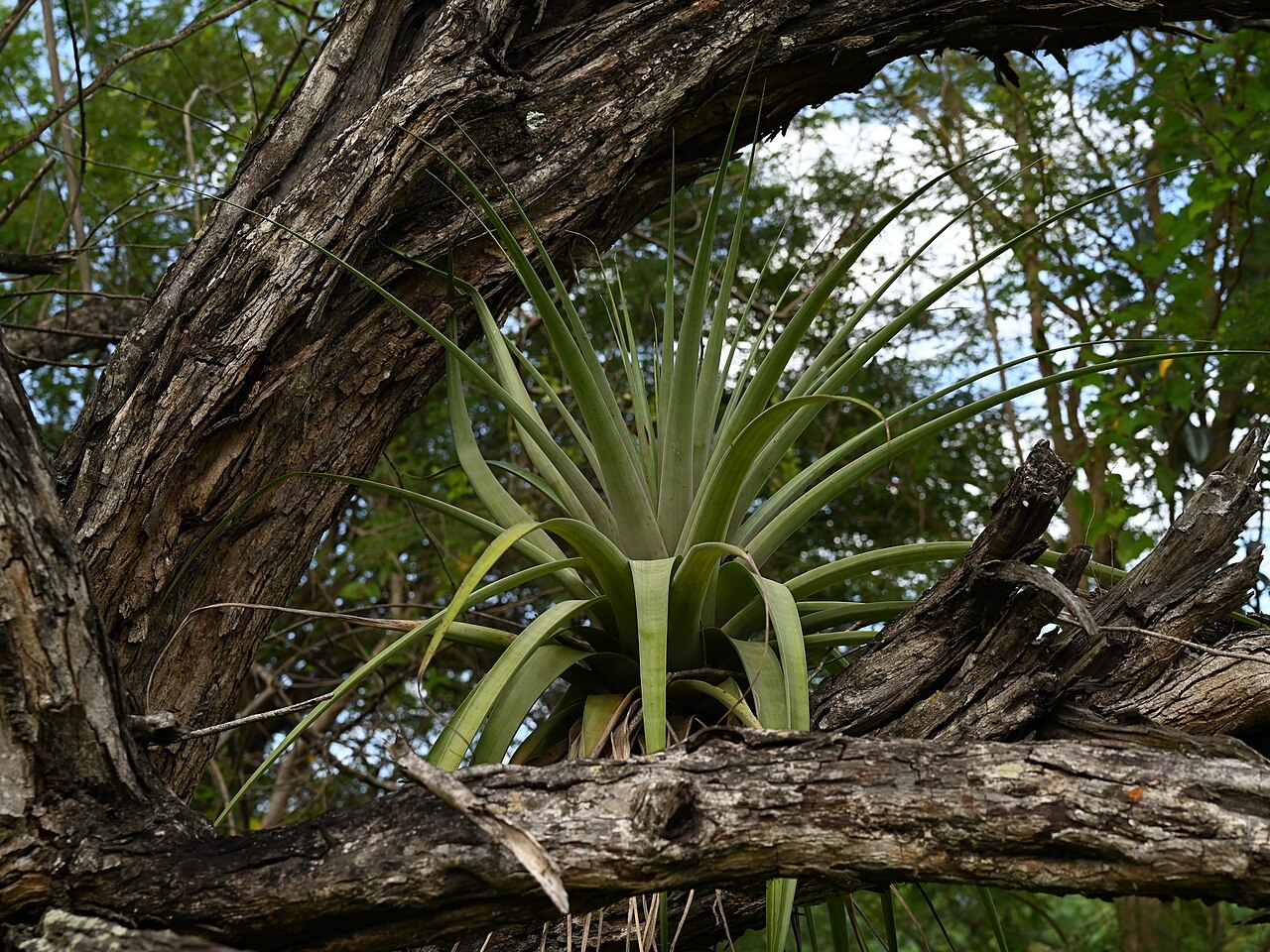
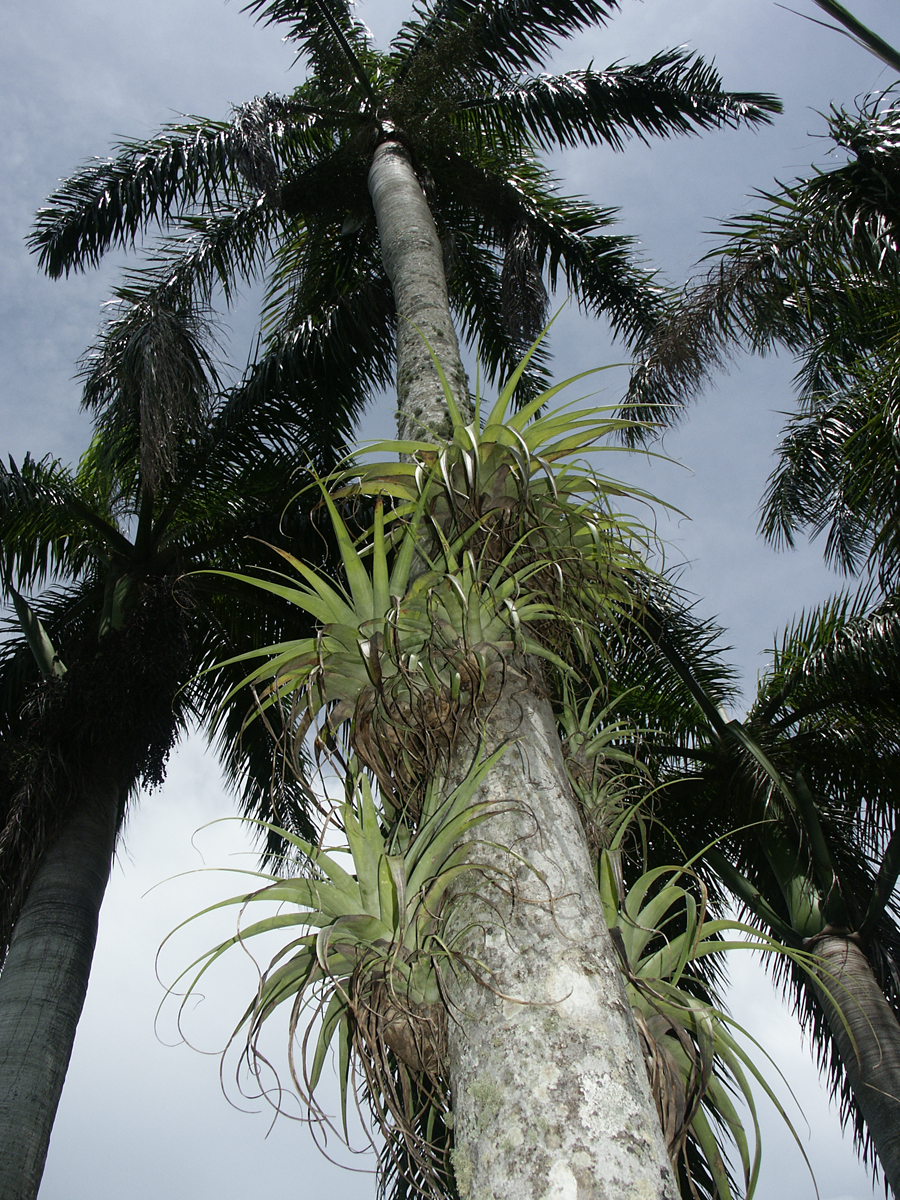
Tillandsia utriculata, the Spreading Airplant, also called giant airplant or giant wild pine, is the largest airplant native to the United States. It forms a vase-shaped rosette of broad-based, gray-green leaves up to about 2 feet long, perched on tree branches, palm trunks and sometimes rocks. When it blooms, it sends up a branched flower stalk that can reach 6 feet, with small white flowers peeking from green bracts. It belongs to the pineapple family (Bromeliaceae).
In Puerto Rico the spreading airplant is a bromeliad of drier and open forests. It grows from the coastal dry forest of Guánica and the southwestern lowlands around Cabo Rojo and the Sierra Bermeja to the Guajataca forest in the northern karst, the serpentine forests of Susúa and Maricao, the Sierra de Cayey, and the outer islands of Vieques, Culebra, Mona and Desecheo, from sea level to about 2,600 feet.
On the mainland it reaches southern Georgia and much of Florida, where it was once common on oaks, cypresses and mangroves. Since the 1990s Florida populations have been devastated by an invasive insect, the Mexican bromeliad weevil, and the state now lists the species as Endangered. This guide covers how to recognize it, where it grows, how to grow it from nursery-raised plants, and the role its water-filled tank plays for wildlife.
Identification
The spreading airplant is a “tank” bromeliad. Its leaves overlap at the base to hold water, which separates it from the slender, gray, scaly airplants such as Spanish moss and ball moss. Its large size and its single, tall, many-branched flower stalk help separate it from other tank bromeliads in its range.
Rosette & Leaves
A mature plant is a loose, spreading rosette 1 to 3 feet across. The leaves are smooth, soft, pale gray-green to yellowish green and covered with tiny gray scales that absorb water. Each leaf has a broad, pale, spoon-shaped base and narrows into a long, tapering, often curling blade up to about 2 feet long. The bases overlap tightly to form a cup, or tank, that holds rainwater. Unlike many bromeliads, the leaves have no spines.
Flowers
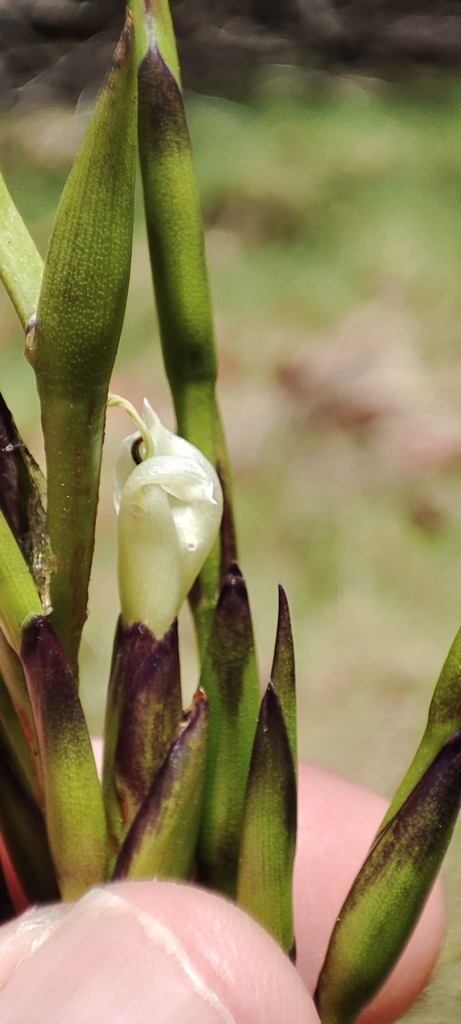
The plant flowers only once, usually after several years of growth. A stout stalk rises from the center of the rosette, typically 3 to 6 feet tall, with many spreading side branches. Along the branches are overlapping green bracts, often tinged purple toward the tips, and small white, tubular flowers with protruding stamens emerge between them. Each flower opens for about a day. In Puerto Rico flowering has been recorded from April to November; in Florida it is mainly summer.
Fruit & Seeds
The flowers are followed by narrow, dark capsules that split open when dry, usually in the following fall and winter, releasing many seeds with tufts of silky hairs. The seeds drift on the wind and stick to rough bark, where they germinate.
Life Cycle
After flowering and setting seed the plant dies. Unlike most bromeliads it usually produces no offsets, or “pups,” so each plant reproduces only once, by seed. This makes populations especially vulnerable when large plants are killed before they flower.
Quick Facts
| Scientific Name | Tillandsia utriculata L. |
| Family | Bromeliaceae (bromeliad or pineapple family) |
| Plant Type | Epiphytic tank bromeliad; flowers once and dies |
| Mature Height | 1–2 ft rosette; flower stalk 3–6 ft |
| Mature Spread | 1–3 ft |
| Growth Rate | Slow |
| Sun Exposure | Full sun to partial shade |
| Water Needs | Low to medium; rain-fed; tolerates dry seasons |
| Soil Type | None; grows on bark, branches, palm trunks or rock |
| Soil pH | Not applicable (epiphyte) |
| Bloom Time | April–November in Puerto Rico; mainly June–September in Florida |
| Flower Color | White, with green to purplish bracts |
| Fall Color | None; evergreen |
| Fruit | Narrow capsule with wind-borne, hair-tufted seeds |
| Deer Resistant | Yes; grows out of reach on trees |
| USDA Hardiness Zones | 9b–11 |
Native Range
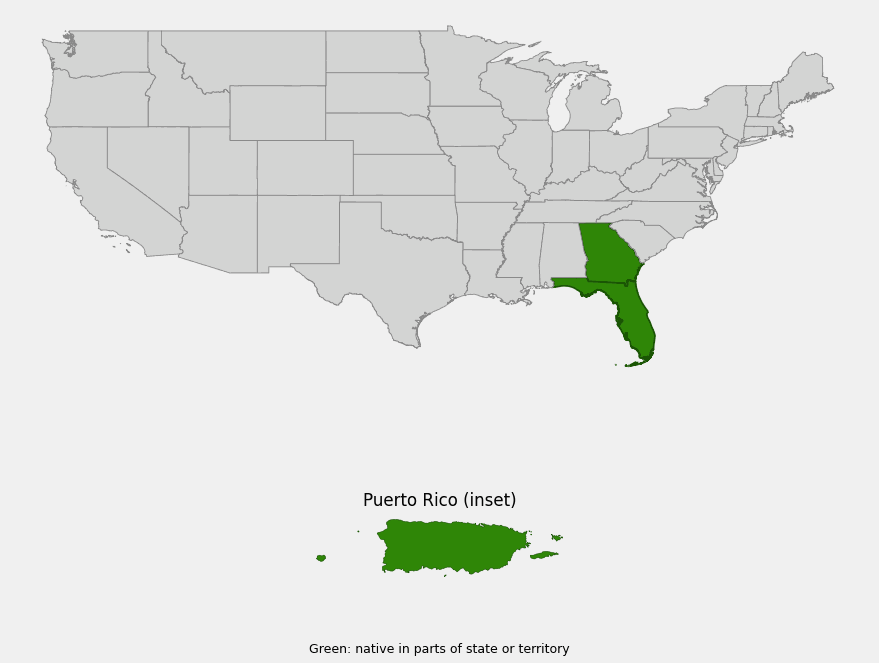
USDA PLANTS lists the spreading airplant as native to Puerto Rico, the U.S. Virgin Islands, Florida and Georgia. Beyond the United States it ranges through the West Indies, including the Bahamas, Cuba, Jamaica, Hispaniola and the Lesser Antilles, and from Tamaulipas in northeastern Mexico through Central America to Venezuela.
In Puerto Rico Axelrod’s Systematic Vademecum to the Vascular Plants of Puerto Rico records it from the northern coastal lowlands and Guajataca Forest Reserve, the eastern coast at Punta Guayanés, the Sierra de Cayey and Las Tetas de Cayey, the southern coastal lowlands and Guánica Forest Reserve, the Susúa and Maricao forest reserves, Cabo Rojo and the Sierra Bermeja, and the islands of Vieques, Culebra, Mona and Desecheo, from sea level to about 800 m. It favors the seasonally dry forests and open woodlands of the south and west, where it perches on trees in bright light.
In Florida, the Atlas of Florida Plants records it in 34 counties, from the Keys and the Everglades north through central Florida, and it reaches its northern limit in southern Georgia. Florida lists it as a state Endangered species. The main cause is the Mexican bromeliad weevil (Metamasius callizona), first found in Florida in 1989. Its larvae tunnel into the stems of large bromeliads and kill them, and because this species does not form pups, each lost adult is a lost chance to reproduce.
📋 Regional plant lists featuring Spreading Airplant: Puerto Rico · North & South Florida · Alabama, Georgia & Mississippi
Growing & Care Guide
The spreading airplant is a striking native epiphyte for gardens in Puerto Rico and frost-free Florida. Buy only nursery-propagated plants grown from seed. In Florida it is a state Endangered species, and it is illegal to collect it from the wild without permission; in Puerto Rico, too, gardeners should leave wild plants in place.
Light
It likes bright light, from full sun to light shade. In the wild it grows on exposed branches in dry forest and open hammocks. Plants in deep shade grow slowly and may rot.
Soil & Water
It needs no soil. Mount it on a rough-barked tree, a palm trunk, a branch or a piece of driftwood, where water drains quickly from the roots. Rain usually provides all the water it needs; in long dry spells mist or hose the leaves and let the tank fill. Keep it out of soggy potting mix, which rots the base. It needs little or no fertilizer.
Planting Tips
Wedge young plants into a branch fork or tie them to bark with soft twine, fishing line or a dab of non-toxic glue placed on the base, never on the leaves. The roots act only as anchors and will grip within a season. Choose a host tree with rough bark and some light, such as oak, buttonwood or gumbo limbo.
Pruning & Maintenance
Little care is needed. In Florida, inspect plants for the Mexican bromeliad weevil: chewed leaf bases, tunnels or a rosette that pulls loose easily are warning signs. Buy plants only from sources that check for weevils, and do not move bromeliads from infested areas. Leave the flower stalk to ripen seed; the mother plant will die afterward.
Propagation
Because it rarely forms offsets, it is propagated from seed. Collect ripe capsules from cultivated plants and scatter the plumed seeds on moist mesh, cork, or rough bark kept in bright shade and misted regularly. Seedlings grow slowly and take several years to reach flowering size.
Landscape Uses
- Tree mounts: on oaks, buttonwood, gumbo limbo and palms in frost-free gardens
- Dry forest and hammock restoration: reintroduction from seed-grown stock within its native range
- Wildlife gardens: its water-filled tank supports frogs, insects and birds
- Bromeliad collections: the largest native airplant of the United States, with a dramatic flower stalk
- Conservation education: an example of how an invasive insect can threaten a native plant
Wildlife & Ecological Value
A large spreading airplant can hold up to a liter of water in its tank, along with fallen leaves and debris. That small pool, high in a tree, is home to a surprising number of animals.
For Pollinators
The small white flowers are short-lived and inconspicuous, and the plant readily sets seed. They are not a significant nectar source for bees or butterflies, but the tall flower stalks attract insects that in turn feed birds and lizards.
For Birds
Birds drink from the tanks, and pick insects and other small animals from the leaf bases. In the dry season, water stored in bromeliads may be one of the few sources of standing water in the canopy.
For Mammals
The plant has little direct value for mammals. Small climbing animals may drink from the tanks.
Ecosystem Role
Its tank is a miniature wetland. In Florida researchers have recorded a wide range of aquatic invertebrates living in spreading airplant tanks, including many kinds of insect larvae; mosquitoes and other insects breed there, and tree frogs and lizards shelter and hunt among the leaves. When the Mexican bromeliad weevil wiped out large airplants in Florida, those tank communities disappeared with them, which is part of why the species is a conservation priority.
Cultural & Historical Uses
Linnaeus named Tillandsia utriculata in 1753. The species name comes from the Latin utriculus, a little bag or bladder, and refers to the swollen, water-holding leaf bases. The genus honors the Swedish-Finnish physician and botanist Elias Tillandz.
In Florida, “wild pine” was a common old name for the large native airplants, probably because their rosettes resemble the top of a pineapple. For generations they were a familiar sight on live oaks and cypress in central and south Florida. Their rapid decline after the weevil arrived in 1989 has made the species a symbol of the damage invasive species can cause.
Researchers in Florida have studied biological control of the weevil, and growers have raised plants from seed to safeguard the species. In Puerto Rico and the rest of the Caribbean the spreading airplant remains widespread, but the Florida experience is a reminder to buy bromeliads from clean nursery stock and never to move plants from places where the weevil is known to occur.
Frequently Asked Questions
Is spreading airplant a parasite on trees?
No. It is an epiphyte: it uses the tree only for support and takes nothing from it. It gets water and nutrients from rain, dust and debris that collect in its tank and on its leaves.
Why is spreading airplant endangered in Florida?
The main cause is the Mexican bromeliad weevil, an invasive insect first found in Florida in 1989. Its larvae bore into large bromeliads and kill them. Because the spreading airplant reproduces only by seed and dies after flowering, populations have collapsed. Florida lists it as a state Endangered species.
Does spreading airplant die after flowering?
Yes. Each rosette flowers once, sets seed and then dies. It usually does not make offsets, so new plants come only from seed.
Can I collect a spreading airplant from a fallen branch?
In Florida it is a listed species, and collecting it without permission is illegal. Wherever you live, buy nursery-raised plants grown from seed. If a branch with a plant falls in your own yard, you can reattach the plant to a nearby tree.
Does it need soil or regular watering?
No soil is needed. Mount it on a tree, palm or branch in bright light. Rain is usually enough; water only in long dry spells, and let it dry between waterings so it does not rot.

Looking for a nursery that carries Spreading Airplant?
Our nursery directory does not yet include Puerto Rico. Browse the native plant nursery directory by state: Alabama–Arkansas · California · Colorado–Hawaii · Idaho–Kansas · Kentucky–Montana · Nebraska–Oklahoma · Oregon · Pennsylvania–Virginia · Washington · West Virginia–Wyoming