
Piña Cortadora (Pitcairnia angustifolia)
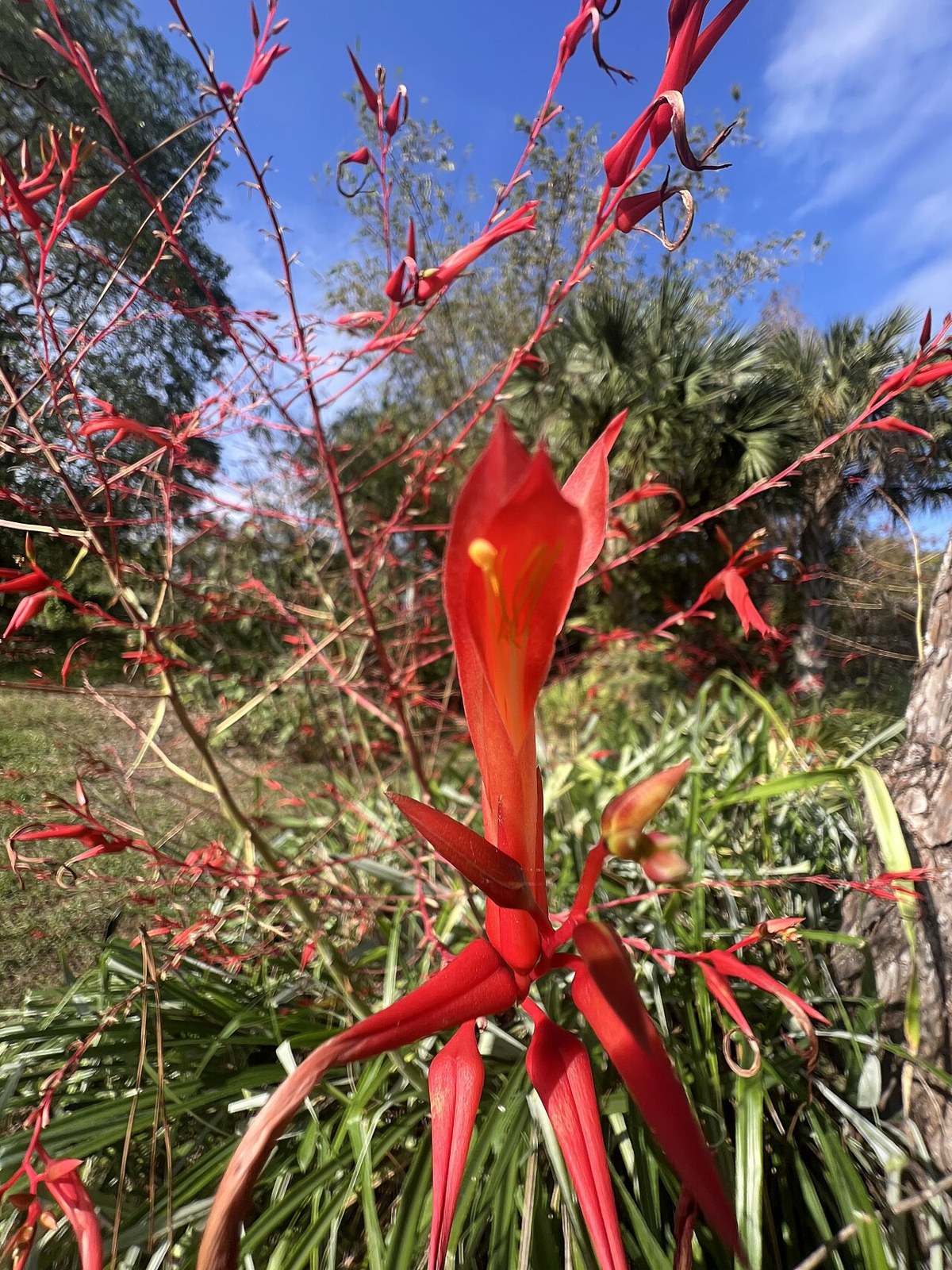
Pitcairnia angustifolia, the Piña Cortadora, is a ground-dwelling bromeliad native to Puerto Rico, the Virgin Islands and the Lesser Antilles. USDA PLANTS lists it as pina cortadora, Spanish for “cutting pineapple,” a warning about its finely spiny leaf edges. The Smithsonian Flora of the West Indies records two other Puerto Rican names: erizo (“hedgehog”) and piña de cuervo (“crow’s pineapple”). Older books call it Pitcairnia latifolia.
Unlike the cup-forming bromeliads that perch in trees, piña cortadora grows on the ground and on rocks, in grassy clumps of long, narrow, arching leaves. Its show comes when it blooms: tall, red stalks carry dozens of slender, bright scarlet tubular flowers that hummingbirds love.
This guide covers how to recognize piña cortadora, where it grows in Puerto Rico and the eastern Caribbean, how to grow it in a sunny, well-drained garden, and its value for hummingbirds.
Identification
At first glance a non-flowering piña cortadora looks like a big clump of grass or a small pineapple top. A closer look at the leaf edges and undersides, and the red flowers, confirms the identification.
Growth Form
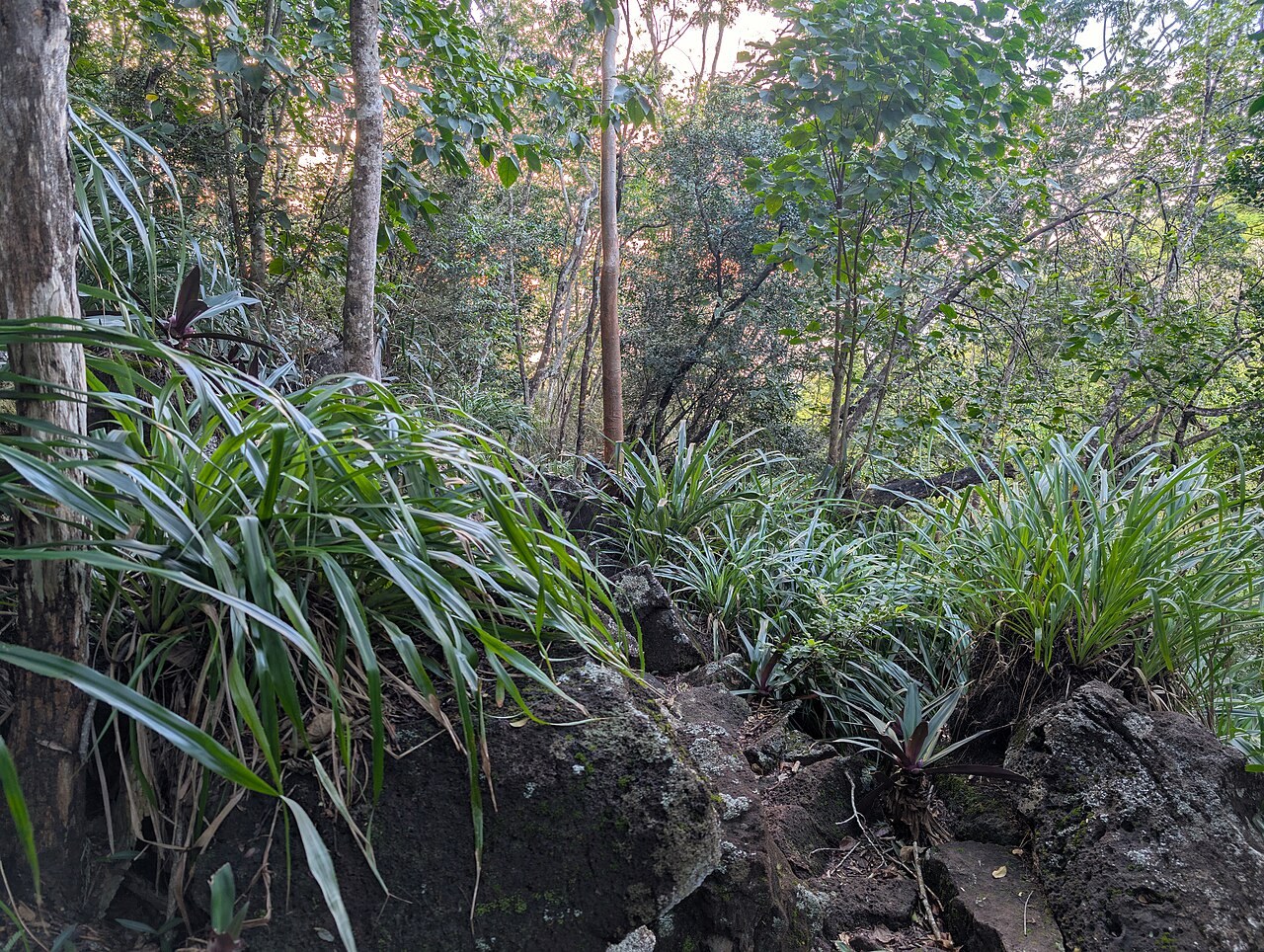
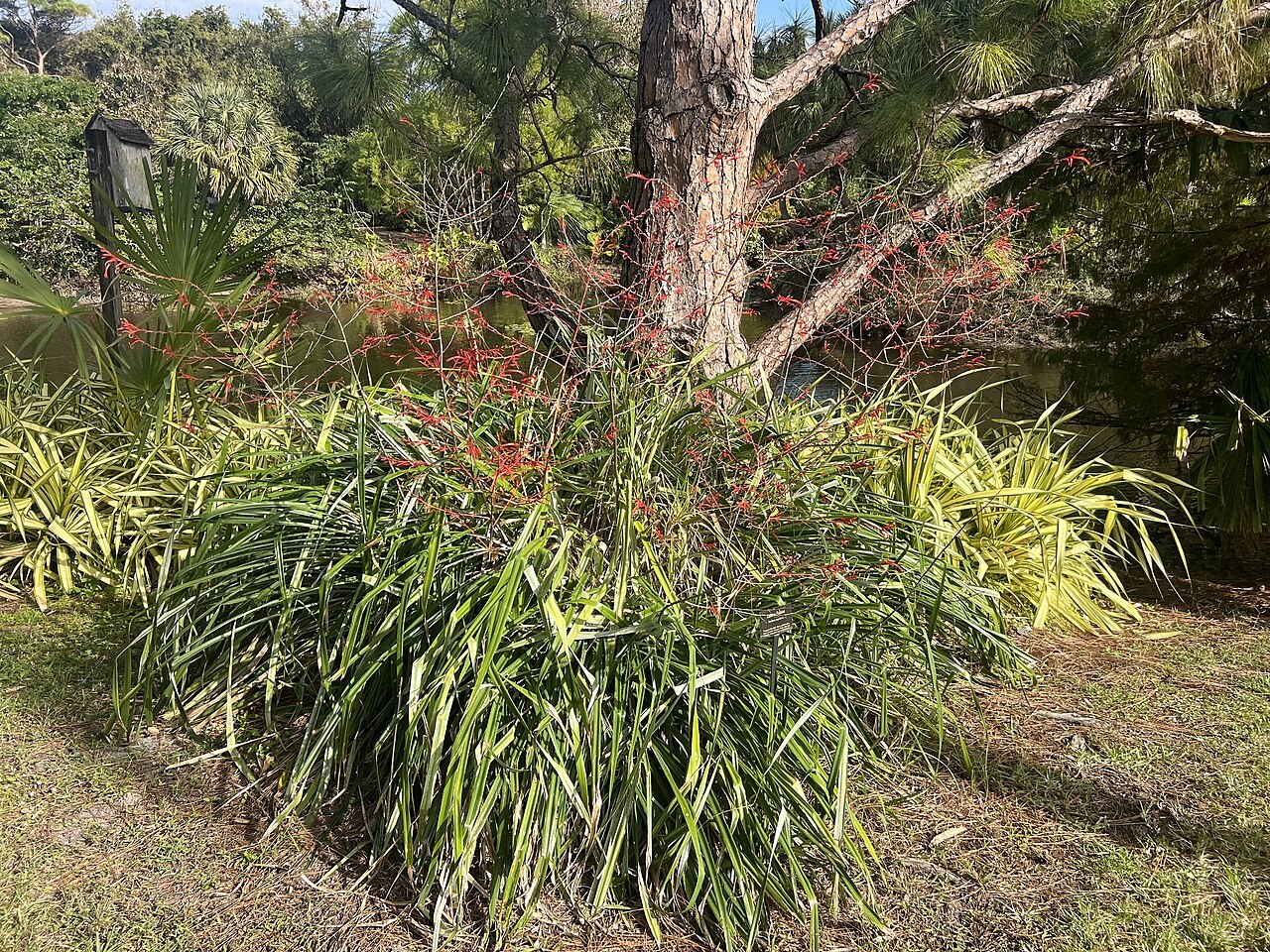
An evergreen perennial bromeliad that grows on the ground or on rocks, forming dense, spreading clumps of rosettes from short rhizomes. The foliage is usually about 2 to 3 feet (60 to 90 cm) tall, and the flower stalks rise above it. Unlike tank bromeliads, the rosettes do not hold water.
Leaves
The leaves are long, narrow and grass-like, tapering to a fine point, and they arch outward. The edges carry small, sharp, forward-pointing spines that can cut skin, as the name “cortadora” warns. The upper surface is green, and the underside is covered with fine, pale scales that give it a whitish or silvery look.
Flowers
The flowering stalk is upright, often red, and dusted with whitish scurf, with the flowers spread along its upper part. Each flower is long and narrowly tubular, about 2 inches (5 cm) long, with bright red petals, and the stamens and style stick out slightly at the tip. The flowers open over a long period, so a clump stays in bloom for weeks.
Fruit
The fruit is a dry capsule that splits to release many small seeds. Unlike air-plant seeds, they lack a feathery parachute of hairs.
Quick Facts
| Scientific Name | Pitcairnia angustifolia Aiton (syn. Pitcairnia latifolia Aiton); USDA common name: pina cortadora |
| Family | Bromeliaceae (bromeliad family) |
| Plant Type | Evergreen terrestrial bromeliad |
| Mature Height | 2–3 ft (taller in flower) |
| Mature Spread | 3–5 ft clumps |
| Growth Rate | Moderate |
| Sun Exposure | Full sun to partial shade |
| Water Needs | Low to moderate; drought tolerant once established |
| Soil Type | Rocky, sandy or loamy well-drained soil |
| Soil pH | Slightly acidic to slightly alkaline |
| Bloom Time | Intermittently through the year |
| Flower Color | Bright red |
| Fall Color | None; evergreen |
| Fruit | Dry capsule with many small seeds |
| Deer Resistant | Not applicable in Puerto Rico |
| USDA Hardiness Zones | 10–12; frost tender |
Native Range
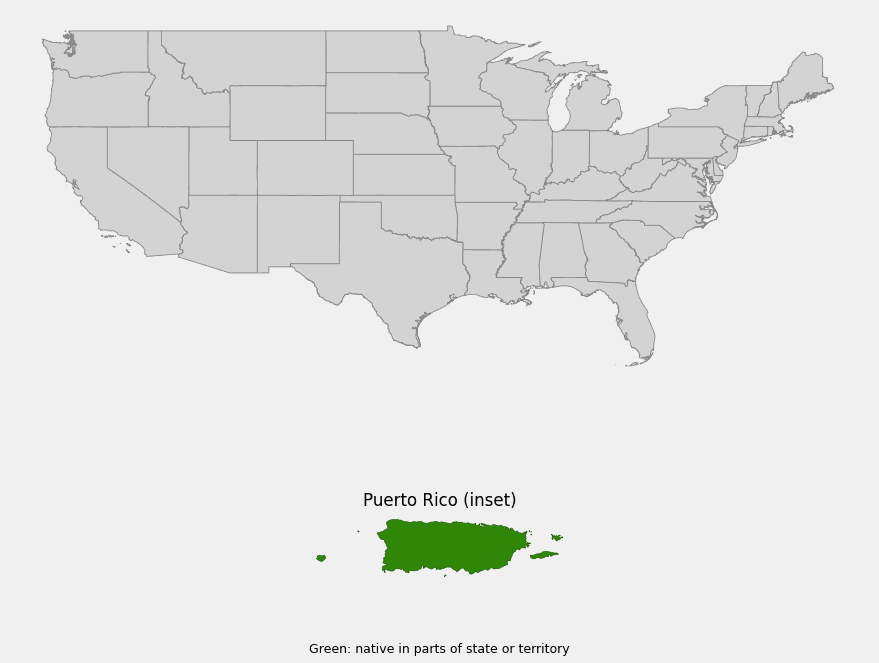
USDA PLANTS lists Pitcairnia angustifolia as native to Puerto Rico and the U.S. Virgin Islands. The Smithsonian Flora of the West Indies (Acevedo-Rodríguez & Strong) treats it as a West Indian endemic, recorded from Puerto Rico (including Vieques), the Virgin Islands (St. Croix, St. John, St. Thomas and Tortola) and the Lesser Antilles, from Saba, St. Eustatius, St. Kitts, Antigua and Montserrat south through Dominica, Martinique, St. Lucia, St. Vincent, the Grenadines, Grenada and Barbados.
It grows on the ground and on rocks, usually in open, well-drained places: rocky slopes, cliffs, banks and roadcuts, and openings and edges in forest. Its spreading clumps can cover steep banks where few other plants hold on.
It is not listed under the U.S. Endangered Species Act. It is easy to propagate by division, so buy plants from nurseries and leave wild clumps in place.
📋 Regional plant lists featuring Piña Cortadora: Puerto Rico
Growing & Care Guide
Piña cortadora is a tough, easy plant for warm gardens. It handles sun, wind and dry spells, grows in rocky or poor soil, and rewards you with red flowers that bring hummingbirds. In Puerto Rico it suits coastal and upland gardens alike; on the mainland it can grow outdoors only in frost-free areas such as South Florida.
Light
Plant in full sun to partial shade. It flowers best with several hours of direct sun. In shade the leaves stay greener and softer, but it blooms less.
Soil & Water
Good drainage is the key: rocky, sandy or gravelly soil, a slope or a raised bed. Water regularly while plants are getting established. After that, it tolerates long dry spells, although it grows faster and looks better with an occasional deep watering during droughts. Avoid soggy soil, which can rot the rhizomes.
Planting Tips
Plant divisions at the same depth they were growing, 2 to 3 feet apart for a groundcover. It is excellent for holding banks and slopes, in rock gardens and along walls. Because of the spiny leaf edges, keep it back from paths and play areas, and wear gloves when handling it.
Pruning & Maintenance
Cut off spent flower stalks and old, dry leaves. Clumps get crowded over time; divide them every few years to keep them vigorous. It needs little or no fertilizer.
Propagation
Divide clumps with a sharp spade or knife, keeping a few rosettes and roots with each piece. It can also be grown from seed sown on the surface of a fine, moist mix, but division is much faster.
Landscape Uses
- Hummingbird gardens: tubular red flowers rich in nectar
- Slopes and banks: dense clumps hold rocky or eroding ground
- Rock gardens: thrives in sharp drainage and poor soil
- Low-water landscapes: drought tolerant once established
- Barrier plantings: spiny leaf edges discourage foot traffic
Wildlife & Ecological Value
Piña cortadora is a classic hummingbird flower, and its dense clumps add cover on bare, rocky ground.
For Pollinators
Its long, red, tubular flowers are typical of plants pollinated by hummingbirds, which hover to reach the nectar at the base of the tube and pick up pollen on their heads. Bees and butterflies may also visit.
For Birds
Hummingbirds feed on the nectar. In Puerto Rico these include the native hummingbirds that visit red tubular flowers in gardens and forest edges. The dense clumps also give cover to ground-feeding birds.
For Mammals
Piña cortadora is not an important food plant for mammals; its spiny leaves discourage browsing.
Ecosystem Role
On steep slopes, cliffs and banks, its rhizomes and dense clumps bind thin soil and help reduce erosion. The clumps shelter lizards, insects and other small animals.
Cultural & Historical Uses
The genus Pitcairnia was named for William Pitcairn (1712–1791), a Scottish physician and plant collector in London. The species name angustifolia means “narrow-leaved.”
William Aiton described this plant in 1789 in Hortus Kewensis, the catalog of plants grown at the Royal Botanic Gardens, Kew. The same work also named Pitcairnia latifolia, which botanists now treat as the same species.
A garden selection, Pitcairnia ‘Borincana’, takes its name from Borinquen, the Taíno name for Puerto Rico.
Frequently Asked Questions
Why is it called “piña cortadora”?
The name means “cutting pineapple” in Spanish. The plant is a relative of the pineapple, and its long leaves have small, sharp teeth along the edges that can cut skin.
Does it hold water in its center like other bromeliads?
No. Piña cortadora is a ground bromeliad with narrow, grassy leaves that do not form a water tank.
How do I attract hummingbirds with it?
Plant it in a sunny spot where the red flower stalks are easy to see. Its tubular red flowers are designed for hummingbirds, and a large clump stays in bloom for weeks.
Is it drought tolerant?
Yes, once established. It grows naturally on rocky slopes and banks and handles long dry spells, although it looks best with an occasional watering during droughts.
Can I grow it outside the tropics?
Only in frost-free areas such as South Florida. Elsewhere, grow it in a large pot in full sun and bring it indoors before frost.

Looking for a nursery that carries Piña Cortadora?
Our nursery directory does not yet include Puerto Rico. Browse the native plant nursery directory by state: Alabama–Arkansas · California · Colorado–Hawaii · Idaho–Kansas · Kentucky–Montana · Nebraska–Oklahoma · Oregon · Pennsylvania–Virginia · Washington · West Virginia–Wyoming