
Snowplant (Sarcodes sanguinea)
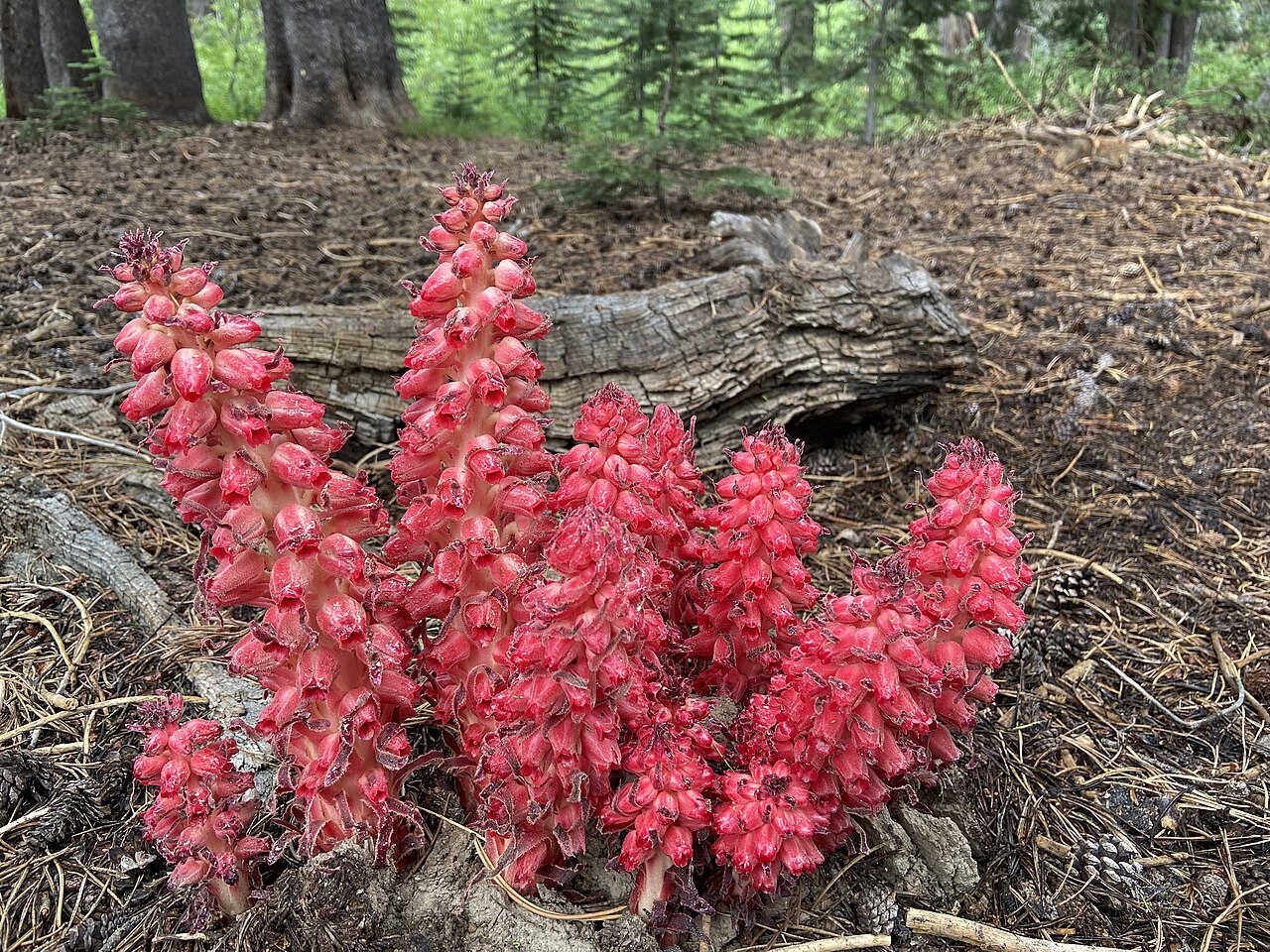
Sarcodes sanguinea, the Snowplant (USDA: snowplant; also written snow plant), is one of the most startling wildflowers in the western mountains. In late spring a thick, fleshy, blood-red spear pushes up through the pine needles of a conifer forest, often while patches of snow still lie nearby. Within a week or two it becomes a stout spike 8 to 12 inches tall, packed with red bell-shaped flowers and curling red bracts. The whole plant, stem, bracts and flowers alike, is the same vivid red, and it has no green leaves at all.
Snowplant has no chlorophyll and cannot make its own food from sunlight. It is a mycoheterotroph: its roots tap into the underground network of a soil fungus that is itself joined to the roots of pines, firs and other conifers. Sugars made by the trees pass through the fungus into the snowplant. It belongs to the heath family (Ericaceae), in the same group as Indian pipe and pinedrops, and it is the only species in its genus. The name comes from Greek sarkodes, “flesh-like”, and Latin sanguinea, “blood-red”.
This is an identification and appreciation page. Snowplant cannot be grown in a garden, cannot be bought from nurseries, and cannot be transplanted, because it depends completely on a living fungus-and-tree partnership in an undisturbed forest floor. Please never pick or dig snowplants. Enjoy them where they grow, photograph them, and leave them to set seed. The sections below cover how to recognize snowplant, where to find it, and the remarkable ecology that keeps it alive.
Identification
No other plant in its range looks quite like a snowplant. Its relatives pinedrops (Pterospora) and pinesap (Hypopitys) are also non-green, but they are taller and thinner, colored brown, tan, yellow or pinkish, and do not have the solid, glowing red of a snowplant.
Stem & Root
Snowplant grows from a compact, brittle mass of fleshy roots buried in the forest humus. These roots are wrapped in fungal threads and connect the plant to its fungal partner. The above-ground stalk is thick and succulent, often an inch or more across at the base, and usually 8 to 12 inches (20 to 30 cm) tall, occasionally taller. It is covered with fine, sticky glandular hairs that give it a slightly sparkling look up close. A plant may produce a single stalk or a clustered group of several.
Leaves & Bracts
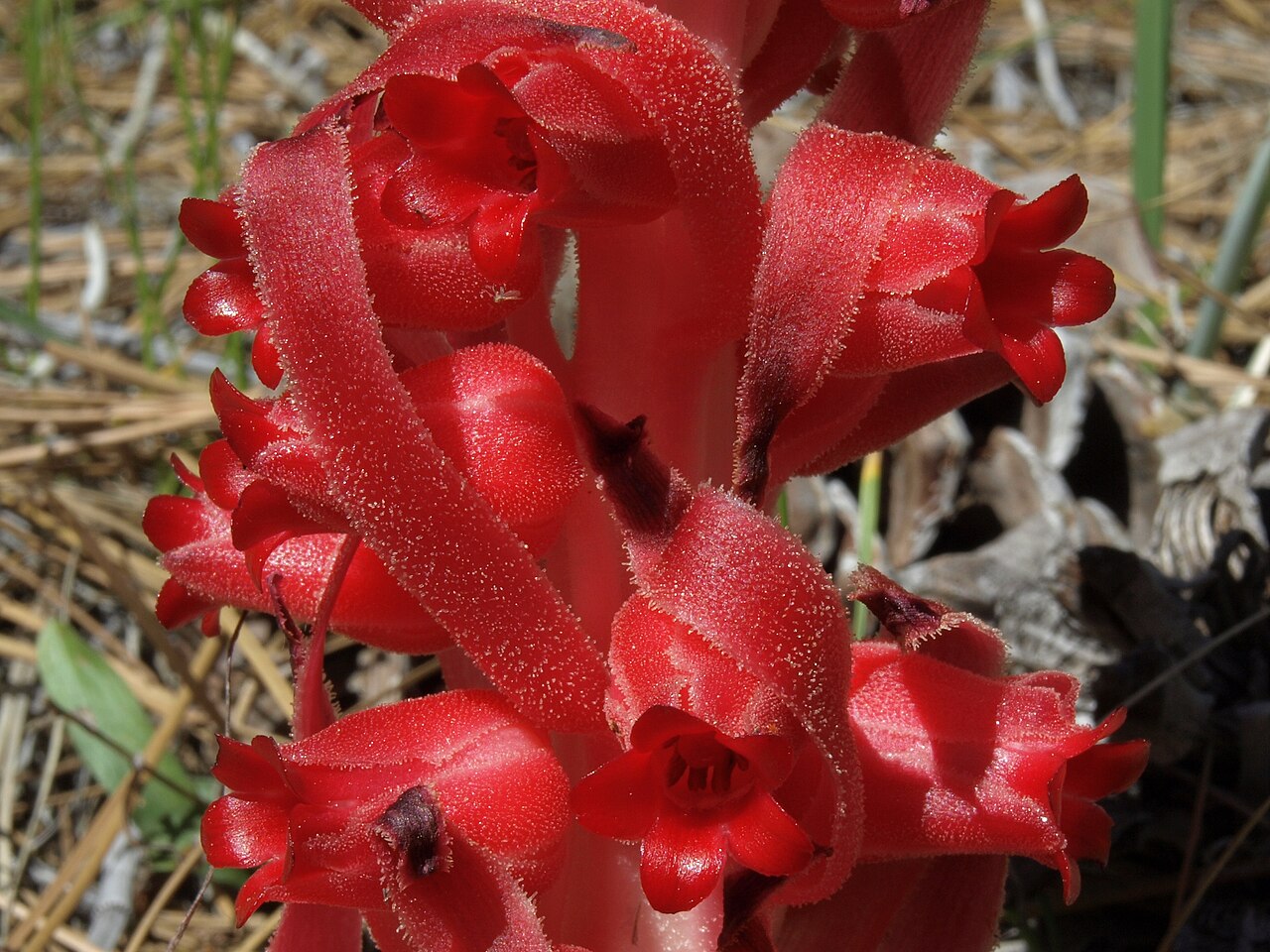
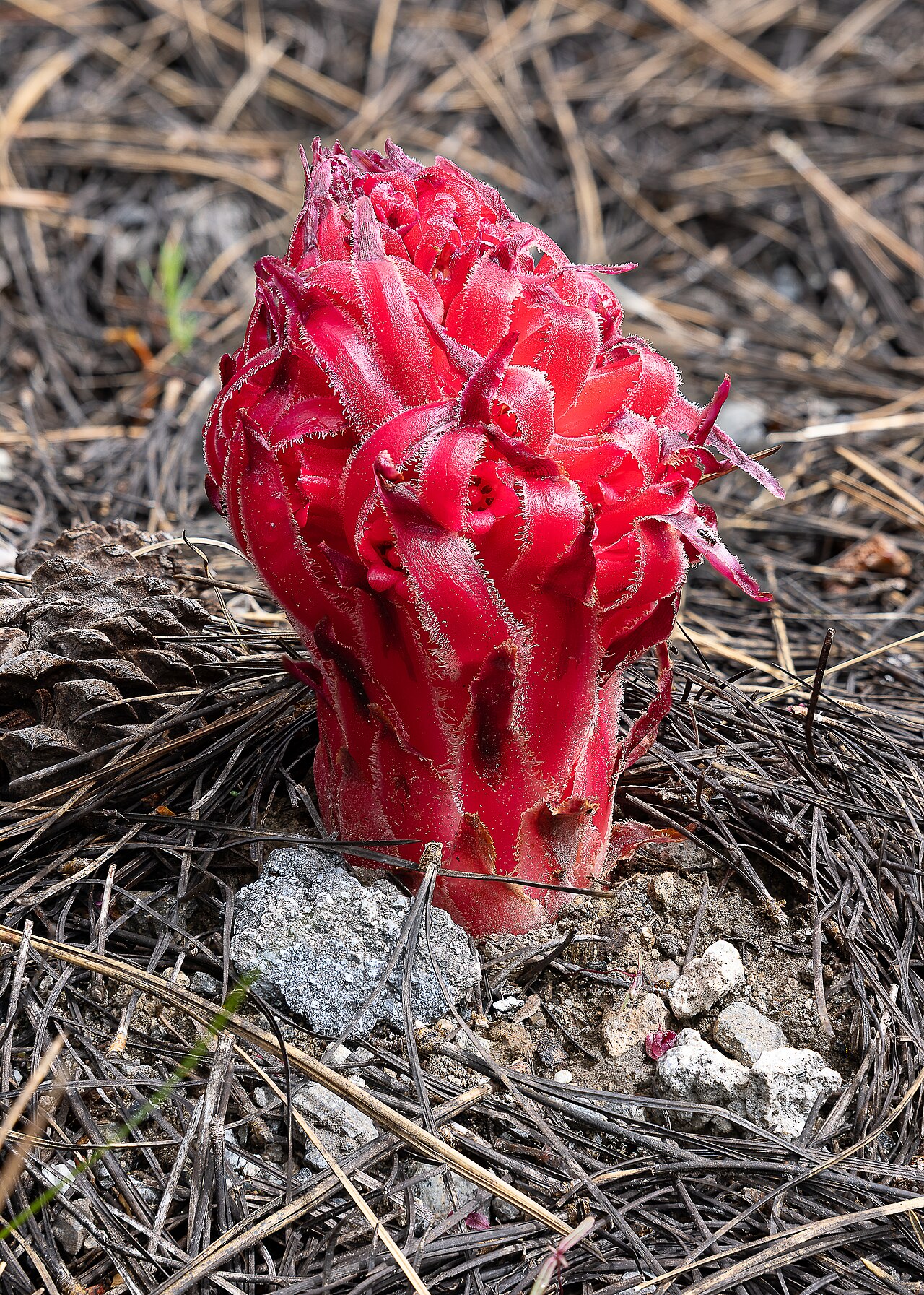
There are no green leaves. Instead the stalk carries many overlapping, scale-like bracts, the remains of leaves, which are red, narrow, fringed with hairs, and often curled at the tips. On a young plant the bracts wrap the stalk tightly, so it looks like a red asparagus spear or a red pine cone pushing out of the ground. As the stalk lengthens, the bracts spread apart and stand among the flowers.
Flowers
The upper part of the stalk is crowded with dozens of flowers, each about half an inch long. They are bell- to urn-shaped with five fused petals, and five sepals, all the same deep scarlet to crimson as the rest of the plant. The flowers open from the bottom of the spike upward over several weeks. Depending on elevation and snowmelt, snowplants bloom from about April at lower elevations to July high in the mountains, typically appearing soon after the snow has gone.
Fruit & Seeds
After flowering, each flower ripens into a rounded, fleshy-walled capsule that dries and releases very large numbers of tiny, dust-like seeds. The old stalk turns dark brown to black and can stand, dry and stiff, through the summer and into the following year, which is a good clue that snowplant grows in that spot. Germination requires the right fungus, so only a tiny fraction of seeds ever produce a plant.
Quick Facts
| Scientific Name | Sarcodes sanguinea |
| Family | Ericaceae (heath family); subfamily Monotropoideae |
| Plant Type | Mycoheterotrophic perennial herb without chlorophyll |
| Mature Height | 8–12 in (occasionally taller) |
| Mature Spread | 2–4 in per stalk; sometimes in clusters |
| Growth Rate | Fast above ground (emerges and flowers within a few weeks); not cultivated |
| Sun Exposure | Shade to filtered sun under conifers |
| Water Needs | Moist forest humus, usually wet from recent snowmelt |
| Soil Type | Deep conifer duff and humus over well-drained mountain soils |
| Soil pH | Acidic forest soils |
| Bloom Time | April–July, soon after snowmelt (later at higher elevations) |
| Flower Color | Deep scarlet to crimson, matching the whole plant |
| Fall Color | None; dried stalks turn dark brown to black |
| Fruit | Rounded capsule releasing dust-like seeds |
| Deer Resistant | Not applicable; wild plants are rarely browsed |
| USDA Hardiness Zones | Not cultivated; grows wild in cold-winter mountain forests |
Native Range
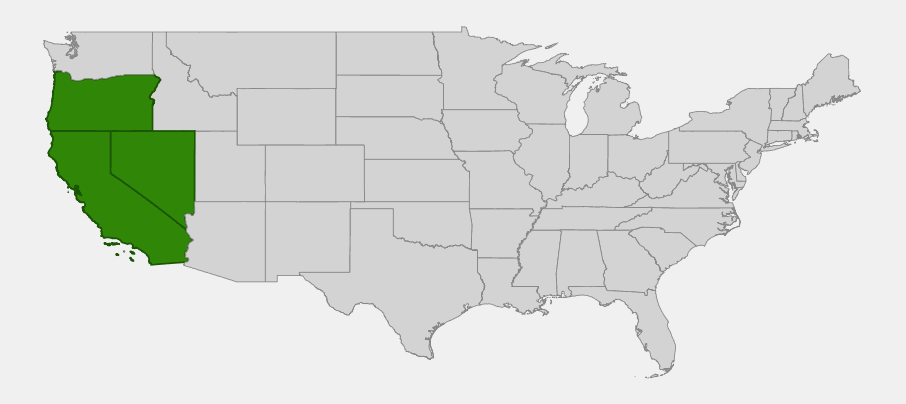
Snowplant is a plant of the mountains of the Far West. USDA PLANTS records it as native in California, Nevada and Oregon. Its heartland is the Sierra Nevada of California, where it is common in mixed-conifer and fir forests from the foothill fringe up to the subalpine zone. It also grows through the southern Cascades (including Lassen Volcanic National Park and the Mount Shasta area), the Klamath and Siskiyou Mountains, the higher parts of the North Coast Ranges, and the Transverse and Peninsular Ranges of southern California. South of the border it reaches the mountains of northern Baja California.
In Oregon, snowplant grows mainly in the southwestern part of the state, in the Siskiyous, the southern Cascades and the mountains around the Rogue and Klamath river drainages. In Nevada it is confined to the western edge of the state, where the eastern slope of the Sierra Nevada and the Carson Range rise above Lake Tahoe and the Carson Valley. It does not grow in the Great Basin ranges farther east, nor in the Rocky Mountains.
Most snowplants grow between roughly 4,000 and 10,000 feet, in forests of Jeffrey pine, ponderosa pine, sugar pine, white fir, red fir, incense-cedar and lodgepole pine. Because it emerges as the snowpack melts, its blooming season moves upslope over the spring and summer: foothill forests may have snowplants in April and May, while high forests have them in June and July.
📋 Regional plant lists featuring Snowplant: Idaho, Eastern Oregon & Eastern Washington
Growing & Care Guide
Snowplant is not a garden plant, and this section explains why rather than how. It cannot be grown from nursery stock, and it is never legitimately sold. Anyone offering snowplant plants or roots is selling wild-collected material that will die. The best way to “grow” snowplant is to protect the forests where it already lives.
Light
In the wild snowplant grows in the shade and filtered light of conifer forests. Because it does not photosynthesize, light matters to it only indirectly: the trees overhead must be healthy enough to supply sugars to the shared fungus. Snowplants are often most numerous in open, mature stands rather than in dense young thickets.
Soil & Water
It needs deep, undisturbed forest duff and humus where its fungal partner, a false-truffle fungus in the genus Rhizopogon, can grow among the tree roots. Spring moisture from snowmelt triggers its emergence, and years with good snowpack often bring more snowplants. Soil compaction, raking away of duff, and heavy disturbance all destroy the habitat.
Planting Tips
Do not try. A dug snowplant is cut off from the fungus that feeds it and will die, usually within days. Seeds will not germinate in a pot or garden bed because they need the right fungus, which in turn needs living conifer roots. If you live in snowplant country and want to support it, keep native conifers, avoid scraping or compacting the forest floor, and leave fallen needles and woody debris in place.
Pruning & Maintenance
Leave flowering and fruiting stalks alone. They need to ripen and release seed, and the dry stalks do no harm. On trails and campgrounds where snowplants come up, simply step around them. Many visitors pick them because they look so unusual, and picking a stalk removes that year’s seed crop.
Propagation
Snowplant reproduces only by seed in the wild, and its seedlings depend on finding a compatible fungus. There is no practical way to propagate it, and no nursery produces it. Collecting plants on national park and other public lands without a permit is prohibited, and it is never appropriate anywhere.
Landscape Uses
- Forest wildflower viewing: one of the most photographed spring sights in Sierra Nevada and Cascade forests
- Nature education: an excellent example of a plant that lives on fungi rather than sunlight
- Indicator of forest health: abundant snowplants point to intact soil, healthy conifers and active fungal networks
- Conservation of conifer forests: protecting duff, mature trees and soil fungi protects snowplant too
- Photography and art: long a favorite subject of western botanical illustrators and nature photographers
Wildlife & Ecological Value
Snowplant is a small part of the forest food web, but it is a window onto the hidden underground connections that link trees, fungi and plants in western conifer forests.
For Pollinators
The red, tubular-to-bell-shaped flowers produce nectar and are visited by bumblebees and by hummingbirds, which are drawn to red flowers and are common in mountain forests in spring. Other bees and insects also visit. Because snowplant blooms so early in the high country, it is one of the first nectar sources for some of these visitors.
For Birds
Hummingbirds feed on the nectar. The plant has no other important food value for birds, though the forests it grows in shelter many species, from mountain chickadees to woodpeckers and owls.
For Mammals
Snowplant is rarely eaten by deer or other mammals. Its fungal partner, however, produces underground truffle-like fruiting bodies of the kind that squirrels, chipmunks and other small mammals dig up and eat, spreading the fungal spores through the forest in their droppings.
Ecosystem Role
Research has shown that snowplant specializes on one fungal partner, Rhizopogon ellenae, which forms mycorrhizae with the roots of pines and other conifers. Carbon flows from the trees to the fungus and on to the snowplant, which gives nothing back that is known. This makes snowplant a kind of “cheater” in the mycorrhizal network. Its presence depends on mature conifers, healthy fungal populations, and forest soils that have not been heavily compacted or disturbed.
Cultural & Historical Uses
Snowplant was described scientifically in 1853 by the American botanist John Torrey, from specimens collected in California in the years when the Sierra Nevada was first being explored by botanists. It remains the only species in the genus Sarcodes.
For Sierra Nevada naturalists, writers and visitors, snowplant has long been a symbol of spring in the mountains. The naturalist John Muir wrote about it in his accounts of the Sierra, calling it a wonderful curiosity that everybody admires but nobody loves the way they love lilies, violets or daisies. Early western botanical artists, including Mary Vaux Walcott and Margaret Neilson Armstrong, painted it as a signature plant of the region.
Today snowplant is a favorite find for hikers in Yosemite, Lassen, Lake Tahoe and the Oregon Siskiyous. It is a reminder that a forest is more than its trees. Much of its life is underground, in the mesh of roots and fungi that ties the forest together. Leaving snowplants unpicked is a small way to protect that system.
Frequently Asked Questions
Can I grow snowplant in my garden?
No. Snowplant has no chlorophyll and lives entirely on sugars supplied through a specific soil fungus connected to conifer roots. It cannot be grown from nursery stock, bought, or transplanted. Dug plants die, and seeds will not germinate without the fungus.
Is snowplant a parasite?
Not directly on another plant. It is a mycoheterotroph: it takes its food from a mycorrhizal fungus, which in turn gets its sugars from the roots of pines and other conifers. Indirectly it lives on the trees, through the fungus.
Is it legal to pick snowplant?
Collecting any plant in national parks is prohibited without a permit, and many other public lands restrict plant collecting too. Wherever you find it, please do not pick or dig snowplant. Picked stalks cannot make seed, and the plant cannot be moved.
When and where can I see snowplant?
Look in conifer forests of the Sierra Nevada, southern Cascades, Klamath-Siskiyou mountains and southern California ranges from about April to July, soon after the snow melts. Lower-elevation forests have them earlier, and high forests later in the summer.
Why is snowplant red?
Its red color comes from pigments in the stem, bracts and flowers. Since the plant does not need chlorophyll, there is no green to mask them. The red flowers also appeal to hummingbirds and bumblebees, which visit them for nectar.

Looking for a nursery that carries Snowplant?
Browse our native plant nursery directory: California · Nevada · Oregon