
American Jumpseed (Polygonum virginianum)
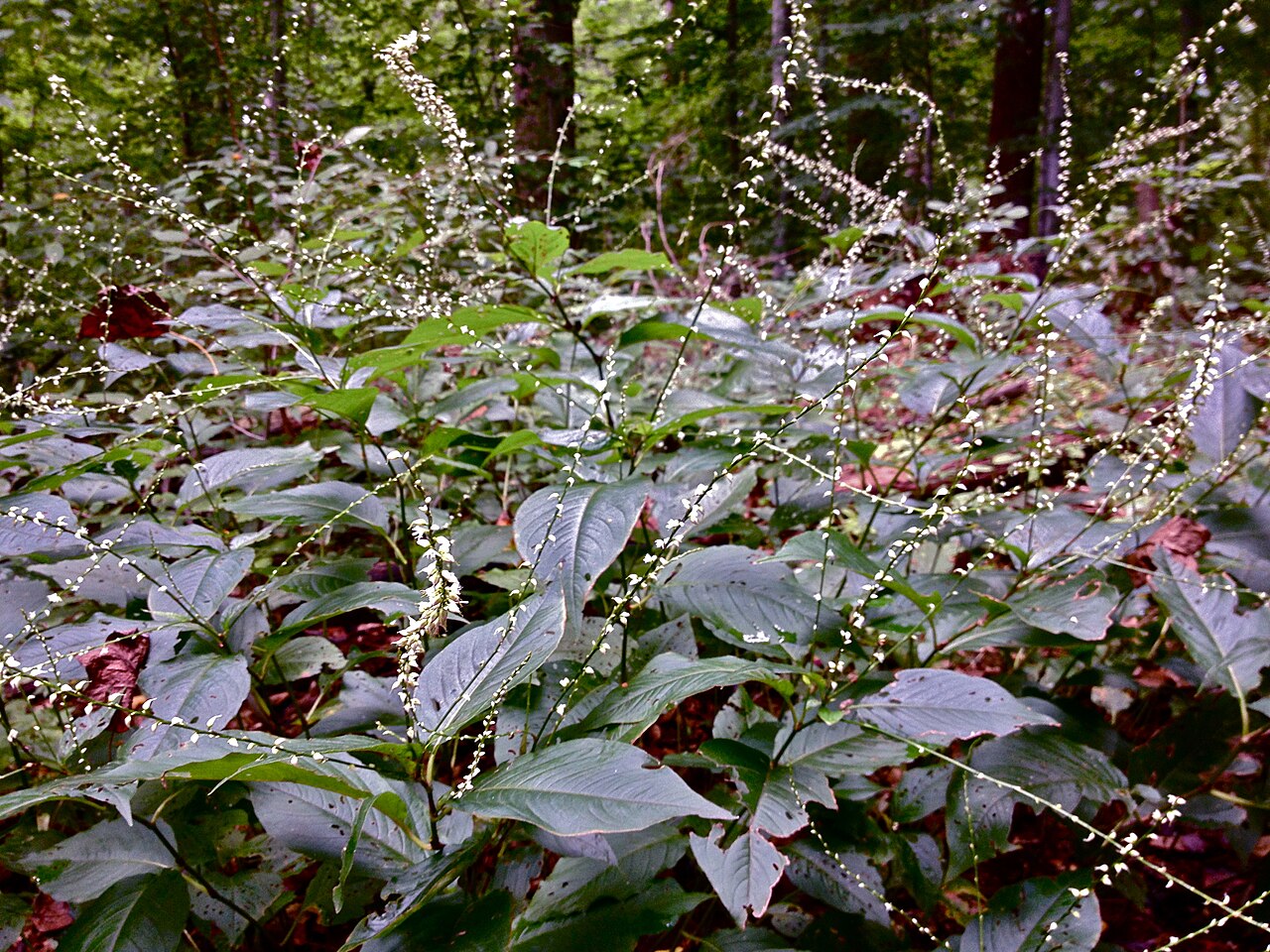
Polygonum virginianum, known as American Jumpseed, jumpseed, woodland knotweed or Virginia knotweed, is a shade-loving perennial of rich eastern woodlands. It belongs to the buckwheat or knotweed family (Polygonaceae) and is closely related to the smartweeds. For most of the summer it is a modest clump of broad, pointed leaves on the forest floor. From mid-summer into fall it sends up remarkably thin, wiry flower spikes, often a foot or more long, dotted with tiny white or greenish flowers spaced well apart like beads on a thread.
The name comes from its seeds. Each ripe fruit is held on a short, springy stalk under tension, and when an animal or a person brushes the spike, the fruit is flung several feet away. A persistent, hooked style on each fruit also lets it catch on fur and clothing. Anyone who has walked a woodland trail in September has probably set off jumpseed without noticing. Many modern floras place it in Persicaria as Persicaria virginiana, and older books sometimes use Tovara virginiana or Antenoron virginianum.
Jumpseed grows across the eastern half of the United States and into southern Ontario and Quebec, in moist deciduous forests, floodplains and along shaded streams. It is one of the few native perennials that flowers in deep summer shade, which makes it useful in woodland gardens and naturalized areas. It is also a vigorous self-sower, so this guide covers where it fits, how to identify it, and how to keep it in bounds.
Identification
Jumpseed is easiest to identify in late summer, when its threadlike spikes of widely spaced flowers stand above the leaves. Earlier in the season, look for the papery sheath around each leaf node, a feature shared by the whole knotweed family, and the dark leaf chevron many plants carry.
Stems & Roots
Plants grow from a thick, knotty rhizome and produce one to several upright or leaning stems, usually 1 to 3 feet tall and occasionally to about 4 feet. The stems are green, slightly swollen at the nodes and often finely hairy. At each node a thin, tubular sheath called an ocrea wraps the stem; in jumpseed it is brown, papery and fringed with short bristles at its top.
Leaves
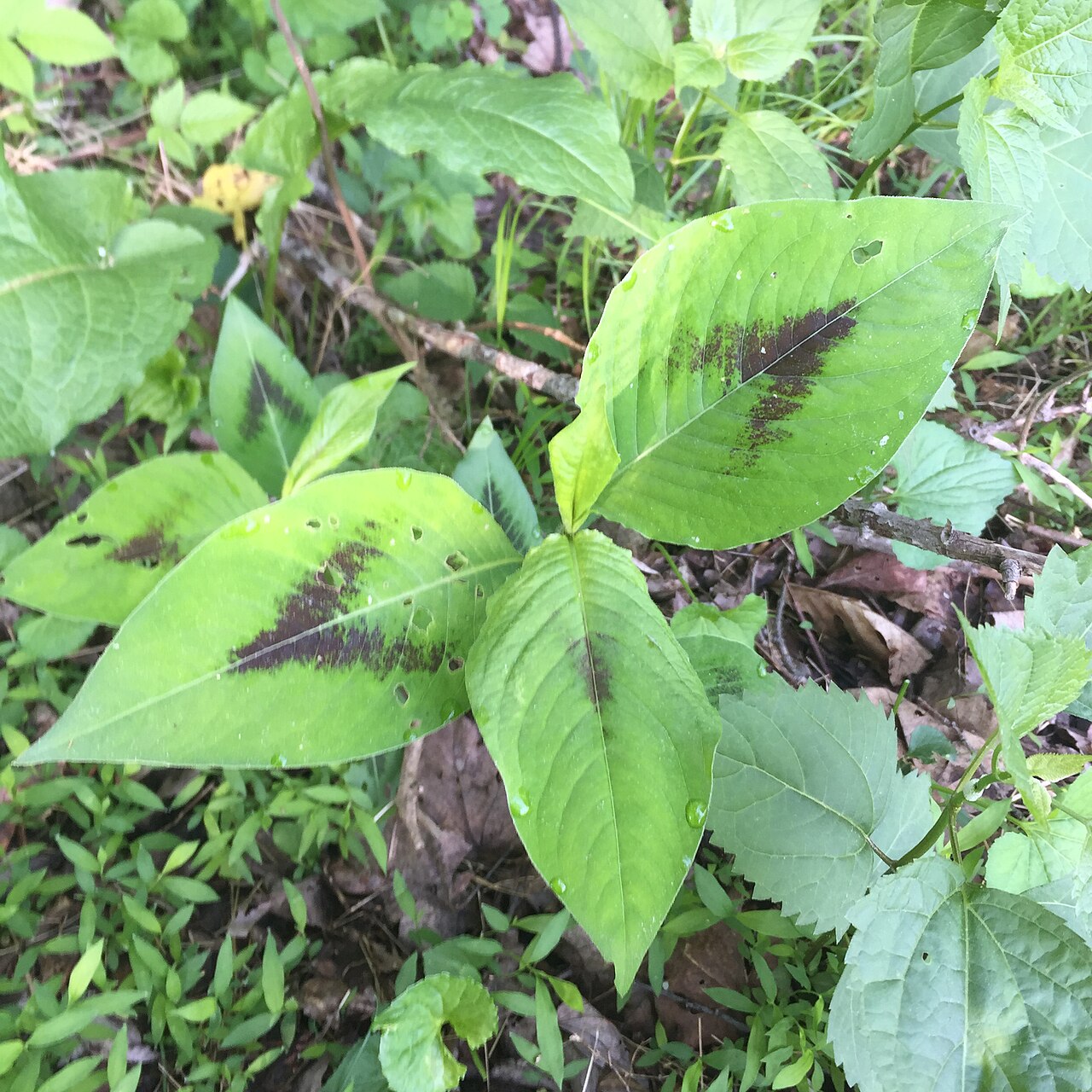
The leaves are alternate, broadly oval to elliptic with a pointed tip, about 3 to 6 inches long (larger on vigorous plants) and up to about 3 inches wide. They have short stalks and slightly rough, hairy surfaces. Many plants show a dark green, brown or purplish chevron across the center of the leaf blade. The mark varies a lot from plant to plant and may be faint or absent, but when present it is a reliable clue, since few other woodland plants have it.
Flowers
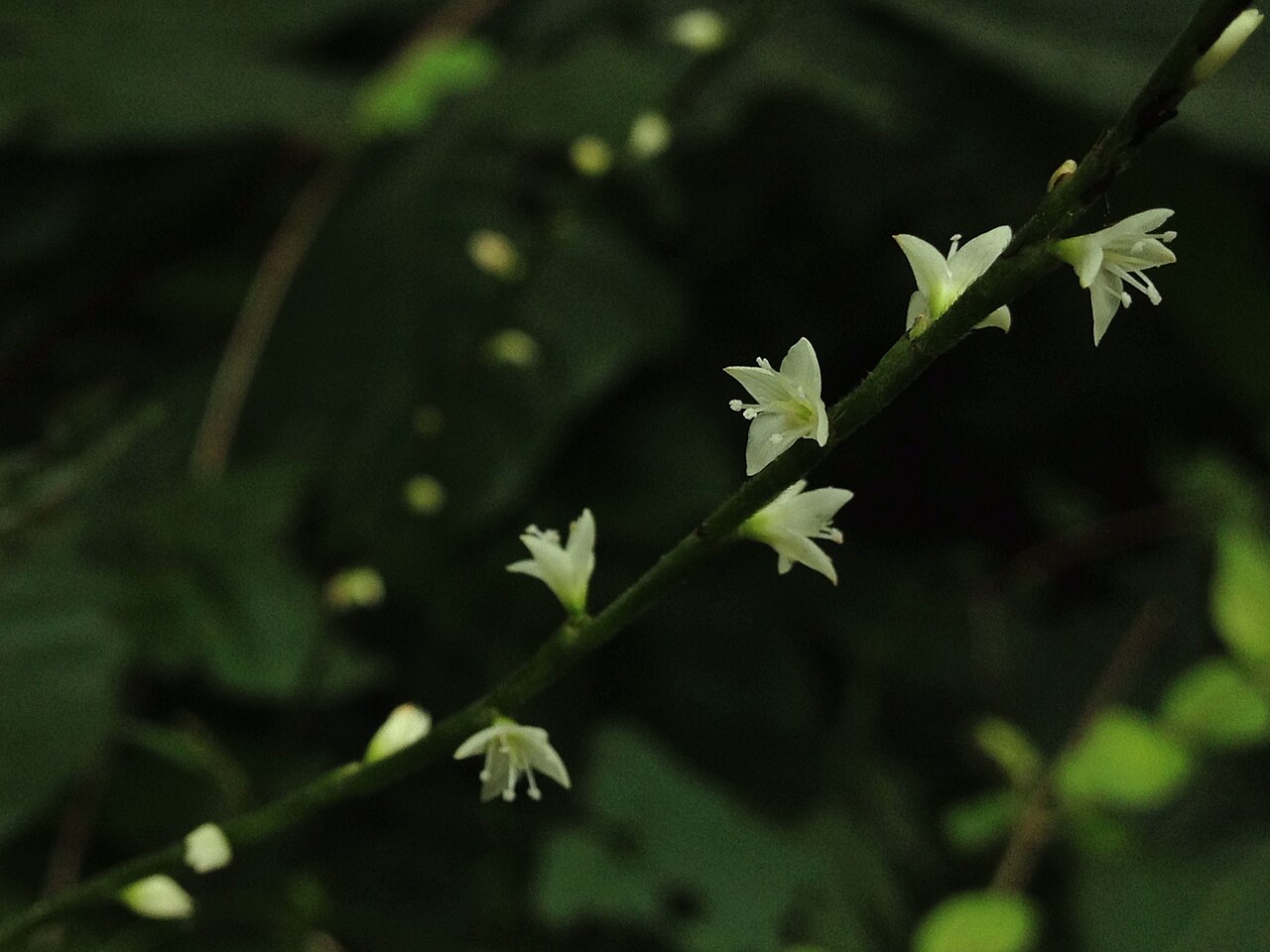
Flowers appear from July into October on slender, unbranched spikes up to about 16 inches long that arise from the upper leaf axils and stem tip. The spikes are so thin and the flowers so widely spaced that they can look like bare wires from a distance. Each flower is about 1/8 inch across with four small tepals, white to greenish white and sometimes tinged pink, and it opens only partway. Flowers open a few at a time along the spike over several weeks.
Fruit & Seeds
Each flower produces a single shiny, dark brown, lens-shaped achene, about 1/8 inch long, tipped with two stiff, hooked styles. As the fruit ripens, the joint at the base of its tiny stalk becomes spring-loaded. A touch releases it, and the seed is thrown up to a few feet. The hooked styles let seeds that land on an animal or a sock hitch a further ride. This two-step dispersal is why jumpseed often appears along trails and in patches well away from the parent plant.
Look-alikes
Smartweeds such as Persicaria pensylvanica and lady’s-thumb have dense, pink, cylindrical flower spikes and grow mostly in sunny, wet or disturbed ground, not in deep shade. The Asian Persicaria filiformis, sold in gardens and sometimes treated as a variety of jumpseed, has similar wiry spikes but red flowers. Variegated garden selections such as ‘Painter’s Palette’ are usually forms of jumpseed or its Asian relative.
Quick Facts
| Scientific Name | Polygonum virginianum (syn. Persicaria virginiana, Tovara virginiana, Antenoron virginianum) |
| Family | Polygonaceae (buckwheat or knotweed family) |
| Plant Type | Herbaceous perennial from a rhizome |
| Mature Height | 1–3 ft (occasionally to about 4 ft) |
| Mature Spread | 1–2 ft per clump; spreads further by self-sowing |
| Growth Rate | Moderate to fast |
| Sun Exposure | Part shade to full shade |
| Water Needs | Medium; prefers evenly moist soil |
| Soil Type | Rich, moist loam; tolerates clay and alluvial soils |
| Soil pH | About 5.5–7.5 |
| Bloom Time | July–October |
| Flower Color | White to greenish white, sometimes tinged pink |
| Fall Color | Leaves turn yellowish to tan before dying back |
| Fruit | Small shiny brown achene with hooked styles, ejected when touched |
| Deer Resistant | Moderate; usually only lightly browsed |
| USDA Hardiness Zones | 4–9 |
Native Range
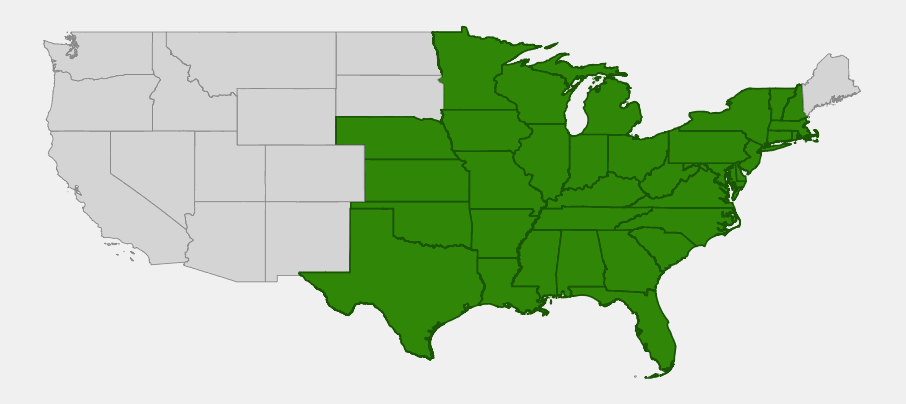
American jumpseed is native across most of the eastern and central United States. USDA PLANTS and the Lady Bird Johnson Wildflower Center record it from 34 states and the District of Columbia, from Minnesota, Michigan, New York and Vermont south to Florida and Texas, and west to Nebraska, Kansas and Oklahoma. In Canada it grows in southern Ontario and southwestern Quebec. It is also known from eastern Asia, where some botanists treat the closely related plants as varieties of the same species.
Within this range it is a common plant of moist, rich deciduous forests, especially floodplain and bottomland woods, ravines, stream banks and the lower slopes of hills, where leaf litter keeps the soil fertile and damp. It also turns up along shaded trails, woodland edges and in disturbed but shady ground such as old logging roads. It becomes scarcer at the dry western and northern edges of its range, where it is limited to river valleys.
Jumpseed is not native to the western United States or to Maine, and garden plants found elsewhere should be checked against local floras.
📋 Regional plant lists featuring American Jumpseed: New York, Pennsylvania & Northern New Jersey · Ohio & Indiana · Michigan, Wisconsin & Eastern Minnesota · Kentucky & Tennessee · Nebraska, Kansas & Eastern Colorado · Connecticut, Massachusetts & Rhode Island · New Hampshire, Maine & Vermont · Maryland, Virginia & West Virginia · Delaware, Southern New Jersey & Long Island · Illinois, Iowa & Missouri · Alabama, Georgia & Mississippi · North & South Florida
Growing & Care Guide
Jumpseed is easy to grow in moist shade and needs almost no care once established. Its main drawback is enthusiasm: it seeds freely and can fill a shady bed in a few years. It is best used where a self-sustaining, informal ground layer is welcome, such as a woodland garden, a shady stream bank or under large trees, rather than in a tidy border.
Light
Plant in part shade to full shade. Jumpseed thrives in dappled light under deciduous trees and flowers even in fairly deep shade. In full sun the leaves tend to scorch and the plants look ragged unless the soil stays moist.
Soil & Water
It prefers rich, humusy, evenly moist soil, such as the leafy loam of a floodplain or a north-facing slope. It tolerates clay and short periods of flooding, and once established it handles moderate dry spells in shade, though it may wilt or drop lower leaves. Leave fallen leaves in place as a natural mulch; they keep the soil cool and moist.
Planting Tips
Set nursery plants or divisions 18 to 24 inches apart in spring or early fall. Choose a spot where its spread is an asset. Pair it with sturdy woodland natives that can hold their ground, such as ferns, wild ginger, Solomon’s seal and woodland asters and goldenrods. Avoid planting it next to small, delicate spring wildflowers that it could crowd out.
Pruning & Maintenance
To limit self-sowing, cut the flower spikes back before the seeds ripen in early fall, or pull unwanted seedlings in spring, when they come up easily. Otherwise leave the stems standing; they die back on their own after frost. No fertilizer is needed. Variegated garden forms are often less vigorous but can still reseed, and seedlings usually revert to plain green leaves.
Propagation
Jumpseed is easily grown from fresh seed sown outdoors in fall; the seeds need a cold, moist winter period to germinate. Clumps can be divided in early spring or fall. In most gardens, though, the plant propagates itself, and transplanting volunteer seedlings is the simplest way to move it.
Landscape Uses
- Woodland gardens: an informal, late-season ground layer under deciduous trees
- Shady stream banks and floodplains: rhizomes and dense growth help hold moist soil
- Naturalized areas: a self-sustaining native filler for shady, hard-to-plant ground
- Late-season interest: delicate flower spikes from midsummer into fall, when few shade plants bloom
- Restoration of moist forests: a native forest-floor perennial for bottomland and ravine plantings within its range
Wildlife & Ecological Value
Jumpseed is not a showy wildlife plant, but it adds late-season flowers and seeds to the forest floor and forms part of the herb layer that shelters insects, amphibians and small animals in moist woods.
For Pollinators
The tiny flowers produce small amounts of nectar and are visited by small bees, flies, wasps and other small insects. Because it blooms from July into fall in shade, it offers a food source when little else is flowering on the forest floor.
For Birds
Seeds of the knotweed and smartweed group are an important food for many songbirds and ground-feeding birds. Jumpseed’s scattered seeds are less abundant than those of wetland smartweeds, but they are eaten by ground-foraging birds in fall. The plant’s dense leafy cover also gives shelter to birds such as thrushes and ovenbirds that forage in the leaf litter.
For Mammals
Small mammals eat the seeds and help spread them, since the hooked styles cling to fur. Deer browse the leaves occasionally, though it is rarely a preferred food.
Ecosystem Role
Jumpseed is a characteristic plant of rich, moist deciduous forests. Its ballistic and hitchhiking seeds let it colonize gaps, trail edges and floodplain deposits, and its rhizomes help stabilize soil along shaded streams. It is a member of the late-summer herb layer alongside jewelweed, wood nettle and white snakeroot, a community that supports many leaf-feeding insects and the predators that eat them.
Cultural & Historical Uses
Linnaeus described the species in 1753 as Polygonum virginianum, from plants collected in Virginia. Since then it has been moved among several genera. Constantine Rafinesque placed it in Tovara, others in Antenoron, and many current floras, including Flora of North America, treat it as Persicaria virginiana. USDA PLANTS keeps the original name, which is why both names appear in field guides and nursery lists. The USDA common name is simply “jumpseed.”
Several Native American groups used jumpseed medicinally. The Cherokee, for example, are recorded as using it in remedies, and the Iroquois used preparations of the plant for various complaints. These are historical uses and not recommendations; the plant should not be used medicinally without expert guidance.
Gardeners in Europe and Asia have grown jumpseed and its Asian relatives for their foliage for many years, and variegated selections with cream, pink and burgundy markings are still sold. In North America the plain native form is valued more for its role in woodland plantings and its curious seed-throwing habit, which never fails to surprise children on a nature walk.
Frequently Asked Questions
Why is it called jumpseed?
Each ripe fruit sits on a spring-loaded stalk. When the flower spike is touched or brushed, the fruit snaps loose and is thrown up to a few feet. Try it in early fall by flicking a spike with your finger.
Is American jumpseed invasive?
It is native across the eastern United States, so it is not invasive there, but it can be aggressive in gardens. It self-sows freely in moist shade. Cut back flower spikes before the seeds ripen if you want to limit its spread.
Is it the same as Persicaria virginiana?
Yes. Persicaria virginiana is the name used in many modern floras, while USDA PLANTS uses Polygonum virginianum. Both refer to the same plant.
Will jumpseed grow in full shade?
Yes. It is one of the few native perennials that flowers well in fairly deep summer shade, as long as the soil stays reasonably moist.
How do I tell jumpseed from other knotweeds?
Look for the very thin, wiry spikes with widely spaced white flowers, the papery fringed sheath at each node, and the dark chevron many plants have on their leaves. It grows in shady woods, while most smartweeds grow in sunny, wet places and have dense pink spikes.

Looking for a nursery that carries American Jumpseed?
Browse our native plant nursery directory: Alabama & Arkansas · Connecticut, Delaware, Florida & Georgia · Illinois, Indiana, Iowa & Kansas · Kentucky, Louisiana, Maryland, Massachusetts, Michigan, Minnesota, Mississippi & Missouri · Nebraska, New Hampshire, New Jersey, New York, North Carolina, Ohio & Oklahoma · Pennsylvania, Rhode Island, South Carolina, Tennessee, Texas, Vermont & Virginia · West Virginia & Wisconsin