
Fringed polygala (Polygala paucifolia)
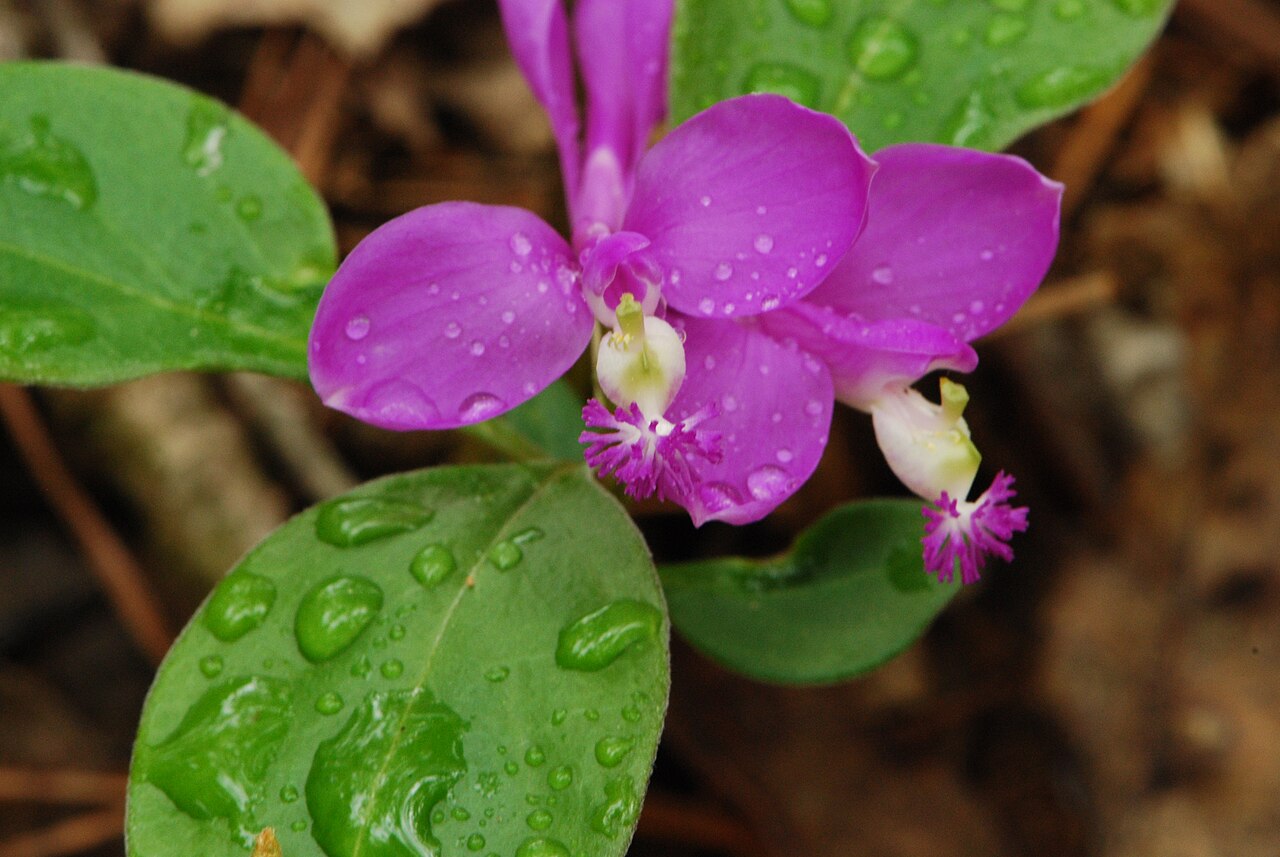
Polygala paucifolia, known as Fringed polygala and as gaywings (the USDA common name), is one of the loveliest small wildflowers of northern and Appalachian forests. In late spring its stems, only 3 to 6 inches tall, carry one to four startling rose-purple flowers, each about ¾ inch long, that look like tiny orchids or birds in flight. Two broad, wing-like sepals spread on either side, and a slender tube projects forward, ending in a feathery fringe. Older names include flowering wintergreen and bird-on-the-wing.
Fringed polygala belongs to the milkwort family (Polygalaceae), not the orchid family, though it is often mistaken for an orchid. It grows on the floor of moist, mossy conifer and mixed forests, often under pines, hemlocks, northern white cedar and birch, where it spreads by slender underground stems to form low carpets. Its leaves are crowded near the top of the stem and stay green, often turning bronze or purplish, through the winter.
Fringed polygala is notoriously difficult to transplant and grow. It depends on soil fungi and specific forest-floor conditions, and dug plants almost always die. Never dig it from the wild. It is best enjoyed in the woods, and gardeners who want to try it should buy only nursery-propagated plants, which are rarely available. This guide covers identification, range, ecology and what is known about its care.
Identification
In flower, fringed polygala is unmistakable. Its color and shape are unlike any other spring wildflower of the northern woods. Out of flower, its small rosettes of oval, evergreen leaves can be mistaken for wintergreen (Gaultheria procumbens) or a young trailing arbutus, but those have tougher, more leathery leaves.
Stems & Rhizomes
Plants grow from slender, creeping underground stems (rhizomes or stolons) that branch through the moss and leaf litter, sending up short, erect stems at intervals. The upright stems are 3 to 6 inches tall, smooth, and bare of normal leaves on the lower part, carrying only a few small, scale-like leaves there. A healthy colony can cover several square feet with closely spaced shoots.
Leaves
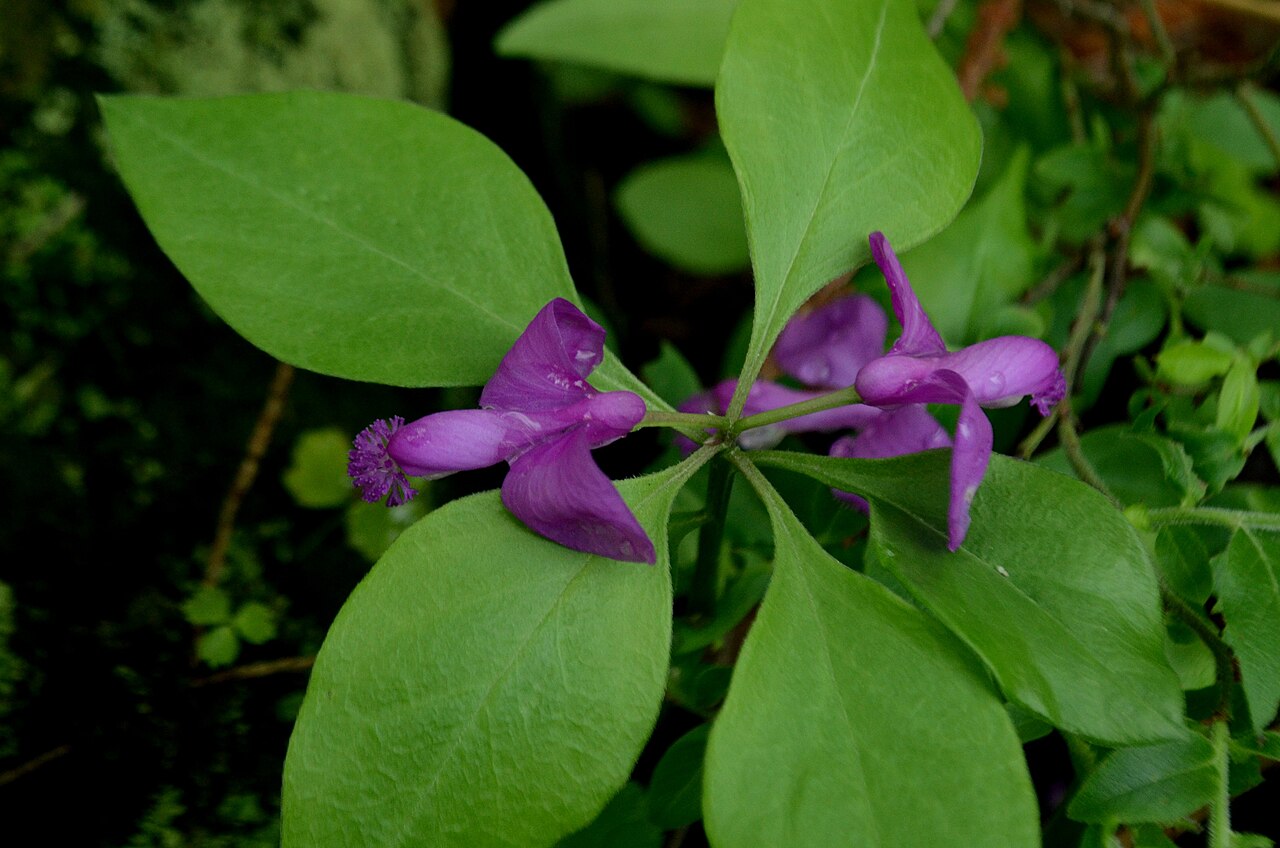
Three to six leaves are crowded near the top of each stem. They are oval to elliptic, about 1 to 1½ inches long, smooth-edged, smooth and slightly glossy. They are evergreen or semi-evergreen, and in fall and winter they often turn bronze, reddish or purple before greening again in spring. The species name paucifolia means “few-leaved”.
Flowers
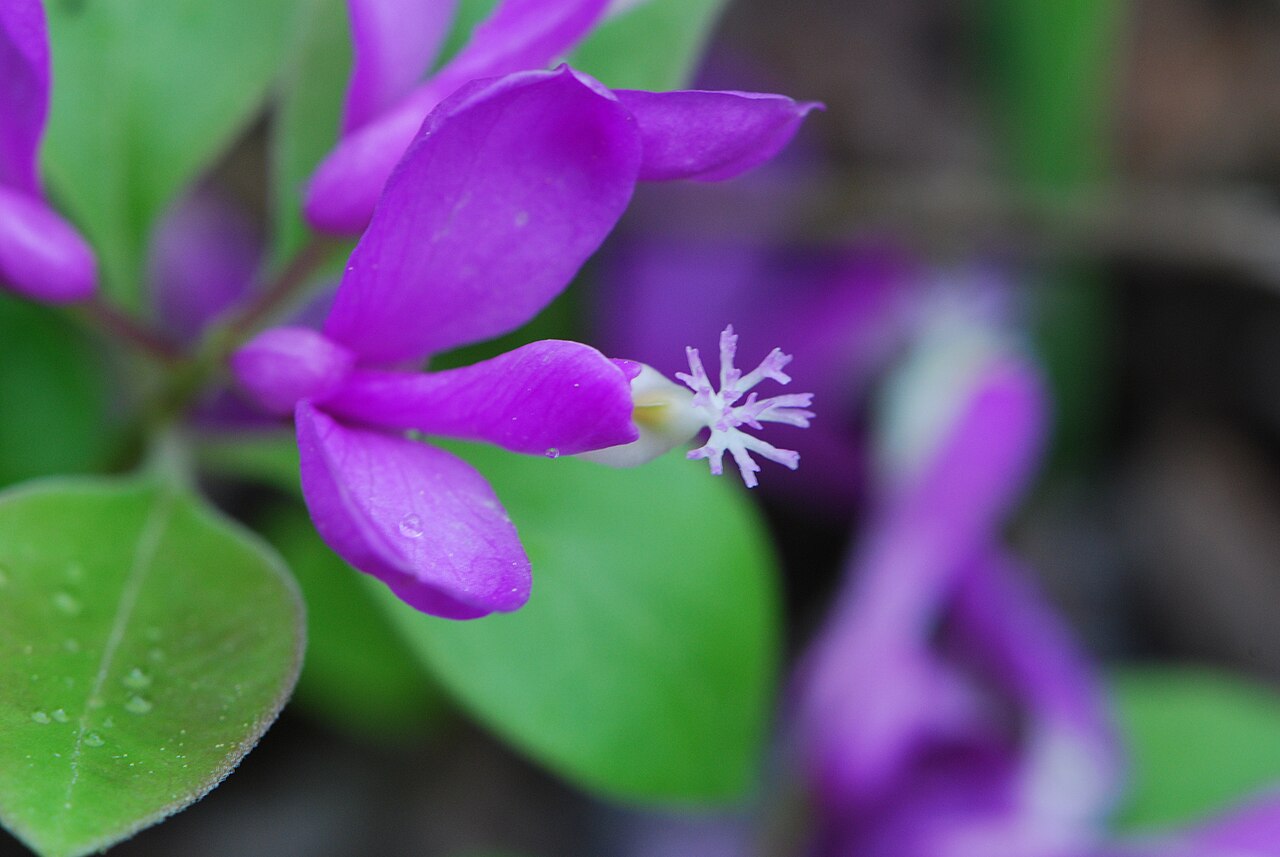
One to four flowers grow on short stalks from the upper leaf axils. Each flower is about ¾ inch long and typically rose-purple to magenta, occasionally pink or white. Two of the five sepals are large and colored like petals, forming the spreading “wings”. The three petals are joined into a tube, and the lower petal, called the keel, ends in a frilly, fringed crest that is often pale pink or white. The flowers bloom from late April to June, depending on latitude and elevation.
Hidden Flowers & Seeds
Besides its showy flowers, fringed polygala produces small, closed flowers near the ground or just beneath the surface on short branches of the rhizome. These cleistogamous flowers never open, pollinate themselves and set seed reliably even when insects are scarce. The fruits are small, flattened capsules. Each seed carries a small fleshy appendage, a feature that in many woodland plants attracts ants, which carry the seeds away.
Quick Facts
| Scientific Name | Polygala paucifolia (syn. Polygaloides paucifolia, Triclisperma paucifolia) |
| Family | Polygalaceae (milkwort family) |
| Plant Type | Low evergreen perennial herb with creeping rhizomes |
| Mature Height | 3–6 in |
| Mature Spread | Individual shoots 2–4 in; colonies spread slowly |
| Growth Rate | Slow |
| Sun Exposure | Partial to full shade |
| Water Needs | Medium; evenly moist but well-drained |
| Soil Type | Acidic humus, mossy forest litter, sandy loam |
| Soil pH | About 4.5–6.0 |
| Bloom Time | Late April–June |
| Flower Color | Rose-purple to magenta; rarely pink or white |
| Fall Color | Leaves turn bronze to purplish over winter |
| Fruit | Small flattened capsule; also self-pollinated underground flowers |
| Deer Resistant | Unknown; rarely browsed |
| USDA Hardiness Zones | 3–7 |
Native Range
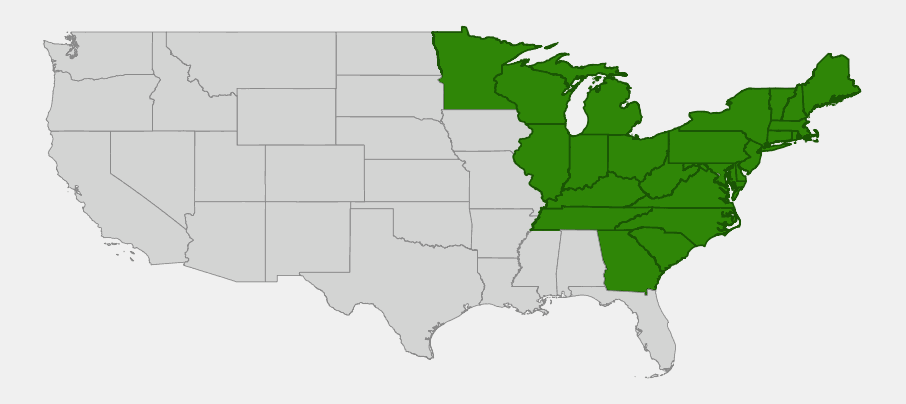
Fringed polygala is a plant of northeastern North America. USDA PLANTS records it as native in 24 states: throughout New England and New York, south through New Jersey, Pennsylvania, Delaware and Maryland, west through Ohio, Indiana and Illinois to Michigan, Wisconsin and Minnesota, and south along the Appalachians through Virginia, West Virginia, Kentucky, Tennessee and North Carolina to South Carolina and northern Georgia. In Canada it ranges widely, from Alberta and Saskatchewan east through Manitoba, Ontario and Quebec to New Brunswick and Newfoundland.
It is most common in the boreal and northern mixed forests of the Great Lakes region, northern New England and southern Canada, where it can carpet the floor of pine, spruce, fir, hemlock, northern white cedar and birch woods. South of New England and the Great Lakes it is more scattered. In the southern Appalachians it is a plant of mountain forests, mostly at higher elevations, and it reaches its southern limit in the mountains of northern Georgia and upstate South Carolina.
Its typical habitats are moist to fairly dry, acidic forest floors with a deep layer of moss and needle or leaf litter. It is often found in rich mixed woods, on mossy hummocks in conifer swamps, under jack and red pine on sandy soils, and in hemlock ravines. It tends to be absent from heavily disturbed forests and from those where the forest floor has been degraded by heavy deer browsing, earthworms or trampling.
📋 Regional plant lists featuring Fringed polygala: New York, Pennsylvania & Northern New Jersey · Ohio & Indiana · Michigan, Wisconsin & Eastern Minnesota · Kentucky & Tennessee · Connecticut, Massachusetts & Rhode Island · New Hampshire, Maine & Vermont · Maryland, Virginia & West Virginia · Delaware, Southern New Jersey & Long Island · Illinois, Iowa & Missouri · Alabama, Georgia & Mississippi
Growing & Care Guide
Fringed polygala is not a beginner’s plant. Its roots associate with soil fungi, and it needs the cool, moist, acidic, undisturbed humus of a northern forest floor. Plants dug from the wild almost always fail and damage wild colonies, so never collect them. If you want to grow it, look for nursery-propagated plants from a reputable native plant nursery, and treat any success as a bonus. Where it already grows on your property, the best care is to protect the forest floor it depends on.
Light
Plant it in partial to full shade, such as under pines, hemlocks or a mixed woodland canopy. It tolerates bright, dappled light in cool northern regions, but it does not like hot afternoon sun.
Soil & Water
It needs acidic, humus-rich soil with plenty of decaying needles, leaves and moss. Sandy loam topped with pine needles or rotted wood works well. The soil should stay evenly moist without being soggy. Do not fertilize or add lime, and avoid disturbing the soil once the plants are in place.
Planting Tips
Plant nursery-grown plants in spring in a sheltered woodland spot, ideally among mosses and low companions such as bunchberry, Canada mayflower, wintergreen and starflower. Bring some of the existing forest-floor litter into the planting area rather than using bare soil or bark mulch. Water during dry spells in the first year.
Pruning & Maintenance
No pruning is needed. Leave fallen leaves and needles in place to protect the shallow rhizomes, keep foot traffic away, and remove invasive plants such as garlic mustard that can crowd it out. In many northern forests, invasive earthworms that consume the leaf litter are a serious threat to fringed polygala and other forest-floor plants.
Propagation
In the wild it spreads by rhizomes and by seed, including seed from its self-pollinating hidden flowers. Propagation in cultivation is difficult. Nurseries usually rely on careful division of nursery stock or on growing from seed, which is slow. Home gardeners should not try to propagate it from wild plants.
Landscape Uses
- Woodland and shade gardens: in cool, acidic, mossy beds under conifers
- Moss gardens: pairs well with native mosses and small woodland plants
- Forest-floor conservation: protecting existing colonies in northern woodlots
- Wildflower viewing: a classic late-spring find on northern and Appalachian trails
- Native plant education: a striking example of a non-orchid that mimics an orchid
Wildlife & Ecological Value
Fringed polygala is small, but it is an important part of the spring forest-floor community, and its two-part reproductive strategy helps it persist in shaded woods.
For Pollinators
The showy flowers are pollinated mainly by bumblebees, especially queens active in spring. A bee landing on the fringed keel presses it down, exposing the stamens and stigma inside, and pollen is placed on the bee’s underside. Because pollinator visits can be unreliable in cool spring woods, the plant also produces closed, self-pollinating flowers that set seed without insects.
For Birds
Fringed polygala has little direct food value for birds. It grows in conifer and mixed forests that are home to many species, including warblers, thrushes and grouse.
For Mammals
It is not an important food plant for mammals. Its low stature and scattered patches make it easy to overlook, though deer may occasionally browse it.
Ecosystem Role
Like many forest-floor plants, fringed polygala depends on a stable, undisturbed layer of humus and moss and on associations with soil fungi. Its seeds bear a small fleshy appendage typical of plants whose seeds are dispersed by ants. Declines in fringed polygala often point to problems in the forest floor, such as invasive earthworms, heavy deer browsing, trampling or logging disturbance.
Cultural & Historical Uses
The genus name Polygala comes from Greek poly, much, and gala, milk, from an old belief that cattle grazing on milkworts produced more milk. Fringed polygala was described by the German botanist Carl Ludwig Willdenow in the early 1800s. Some botanists now place it in the separate genus Polygaloides, and older works used Triclisperma.
Its folk names, including gaywings, flowering wintergreen, bird-on-the-wing and fringed milkwort, reflect the affection that generations of naturalists have had for it. It appears in nearly every classic wildflower guide to the northeastern United States.
For hikers in the Great Lakes, New England and the Appalachians, finding the first gaywings is a sign of late spring in the woods. Because it is hard to grow and easily damaged, its best use is as a reason to protect intact forest floors: the moss, needles, leaves and fungi that support it and many other woodland wildflowers.
Frequently Asked Questions
Is fringed polygala an orchid?
No. Although its flowers look like tiny orchids, it belongs to the milkwort family (Polygalaceae). The “wings” are colored sepals, and the fringed crest is part of the lower petal.
Can I transplant fringed polygala from the woods?
No. Wild plants depend on specific soil and fungal conditions and almost never survive being dug. Digging also harms wild colonies. Enjoy it where it grows, and buy only nursery-propagated plants if you want to try growing it.
When does gaywings bloom?
From late April to June, depending on location. It blooms earlier in the southern Appalachians and later in the northern Great Lakes and Canada.
What pollinates fringed polygala?
Mainly bumblebees, which press down on the fringed keel to reach the pollen. The plant also produces hidden, self-pollinating flowers near the ground that ensure seed production.
Why is it called gaywings?
The name refers to the two bright, spreading sepals that look like wings, giving the flower the appearance of a small, brightly colored bird or butterfly in flight.

Looking for a nursery that carries Fringed polygala?
Browse our native plant nursery directory: Connecticut, Delaware & Georgia · Illinois & Indiana · Kentucky, Maine, Maryland, Massachusetts, Michigan & Minnesota · New Hampshire, New Jersey, New York, North Carolina & Ohio · Pennsylvania, Rhode Island, South Carolina, Tennessee, Vermont & Virginia · West Virginia & Wisconsin