
Candy Flower (Claytonia sibirica)
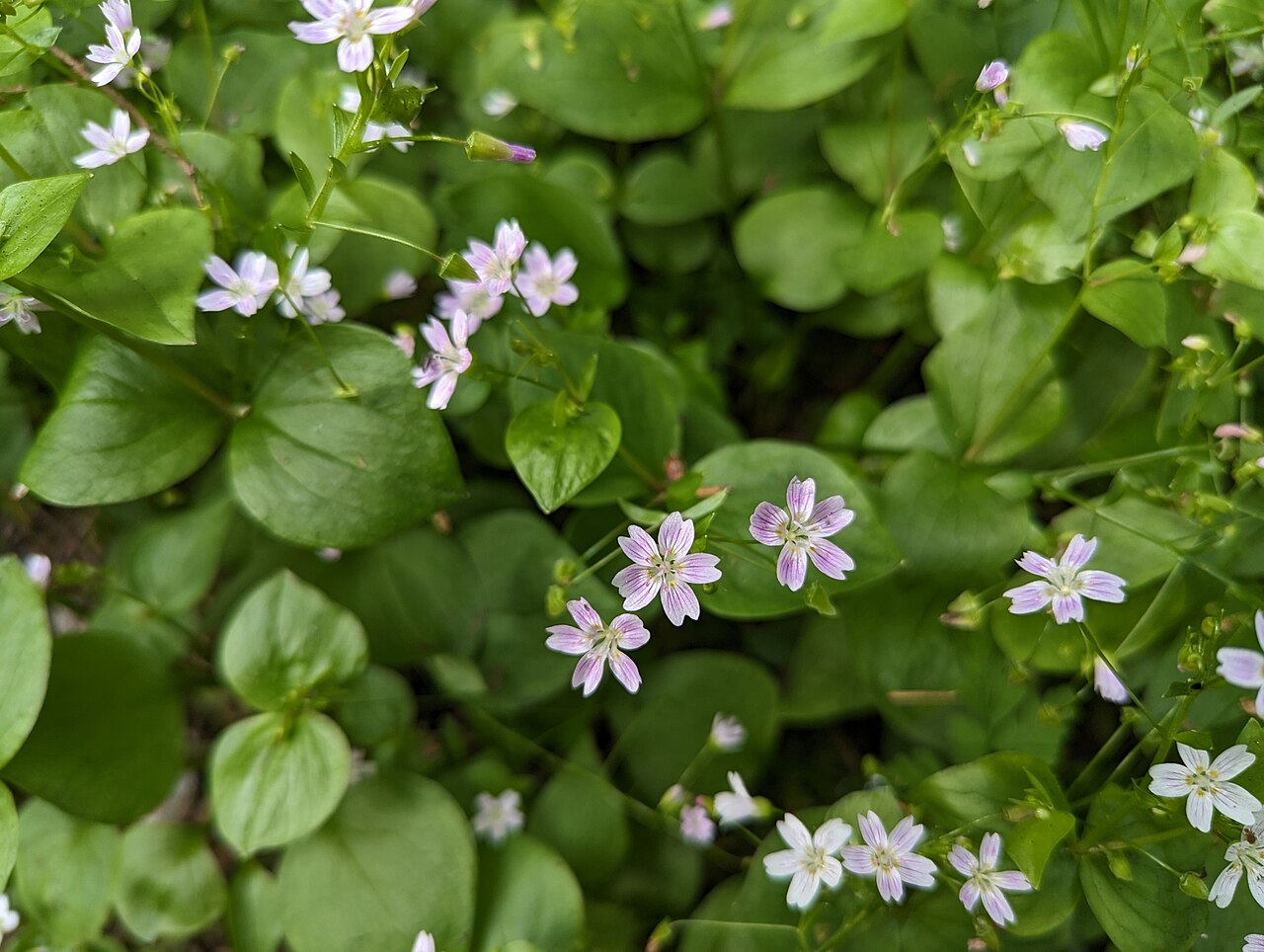
Claytonia sibirica, known as Candy Flower, Siberian spring beauty (USDA PLANTS: Siberian springbeauty), Siberian miner’s lettuce or pink purslane, is a small, fleshy-leaved wildflower of moist forests in western North America. It forms loose clumps of shiny, stalked leaves, and from early spring into summer it produces sprays of five-petaled flowers about half an inch to three-quarters of an inch across. The petals are white to pink, notched at the tip and striped with fine, darker pink veins, which gives the plant its cheerful common name.
Candy flower belongs to the miner’s lettuce family (Montiaceae), which USDA PLANTS still includes in the purslane family (Portulacaceae). It is a close relative of Miner’s Lettuce and the eastern Spring Beauty, and like miner’s lettuce its tender leaves are edible. Some botanists place it in the genus Montia as Montia sibirica.
The species name refers to Siberia, because the plant also grows on the Commander Islands of the Russian Far East, at the western end of the Aleutian chain. In North America it ranges from the Aleutians and coastal Alaska south through British Columbia, Washington and Oregon to the Santa Cruz Mountains of California, with outposts inland in northern Idaho and northwestern Montana. This guide covers identification, range, growing it in shady gardens, and its value for wildlife and people.
Identification
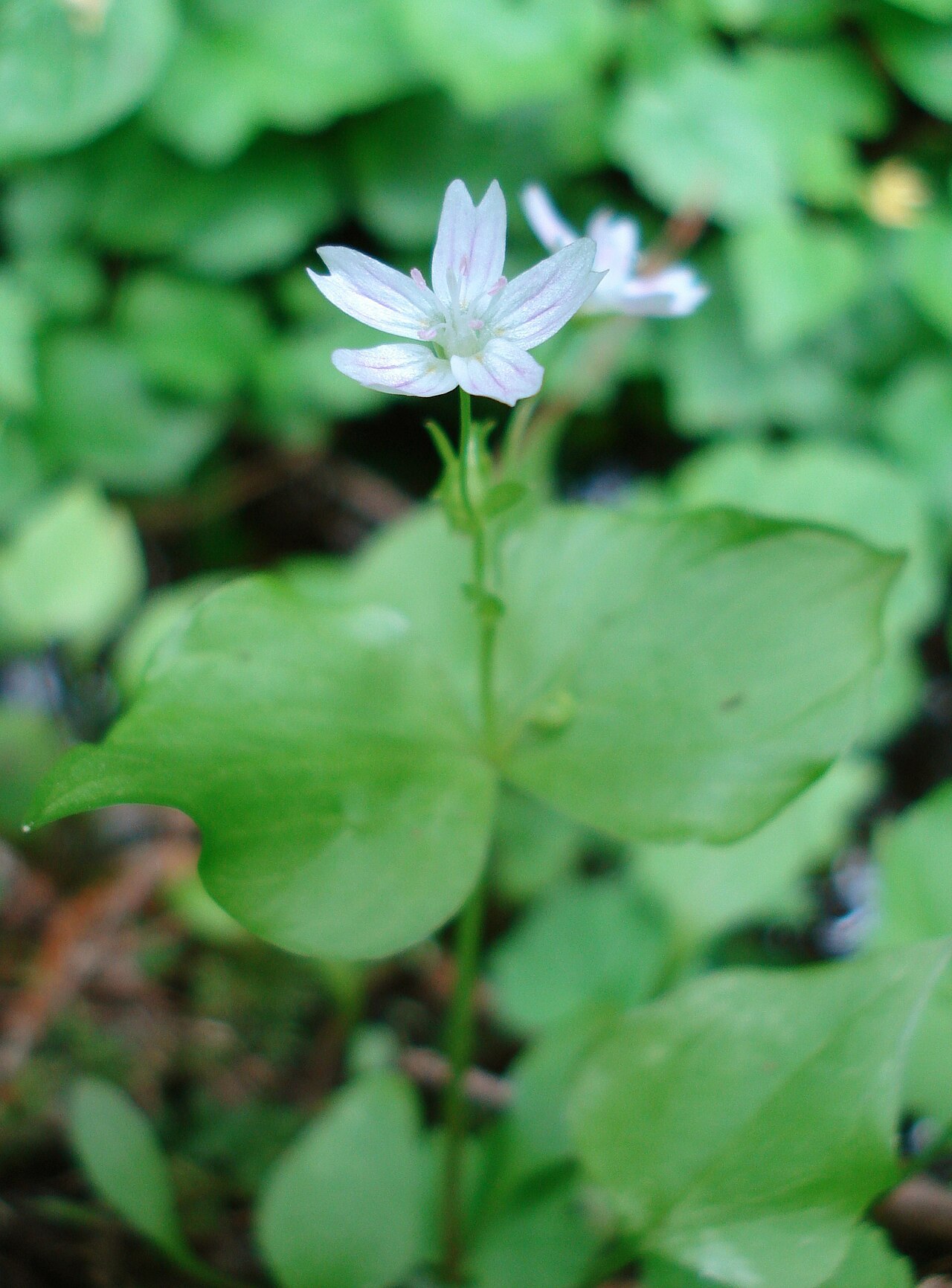
Candy flower is easy to recognize in bloom by its striped petals and the single pair of leaves on each flowering stem. Out of flower, look for clumps of glossy, fleshy, long-stalked leaves in moist shade.
Growth Habit
It is usually an annual or a short-lived perennial, growing from a small, fibrous-rooted base or short rhizome. Plants are 4 to 16 inches tall. In good conditions it also produces small bulb-like plantlets or offsets that root and form new plants, so it can spread into patches. The whole plant is smooth, succulent and somewhat brittle.
Leaves
The basal leaves form a rosette and sit on long stalks. Their blades are oval, diamond-shaped or broadly lance-shaped, about 1 to 3 inches long, with smooth edges and a glossy surface. Each flowering stem bears exactly one pair of stem leaves, opposite each other and stalkless, just below the flowers. These leaves are separate, not joined into a disk around the stem as they are in miner’s lettuce.
Flowers
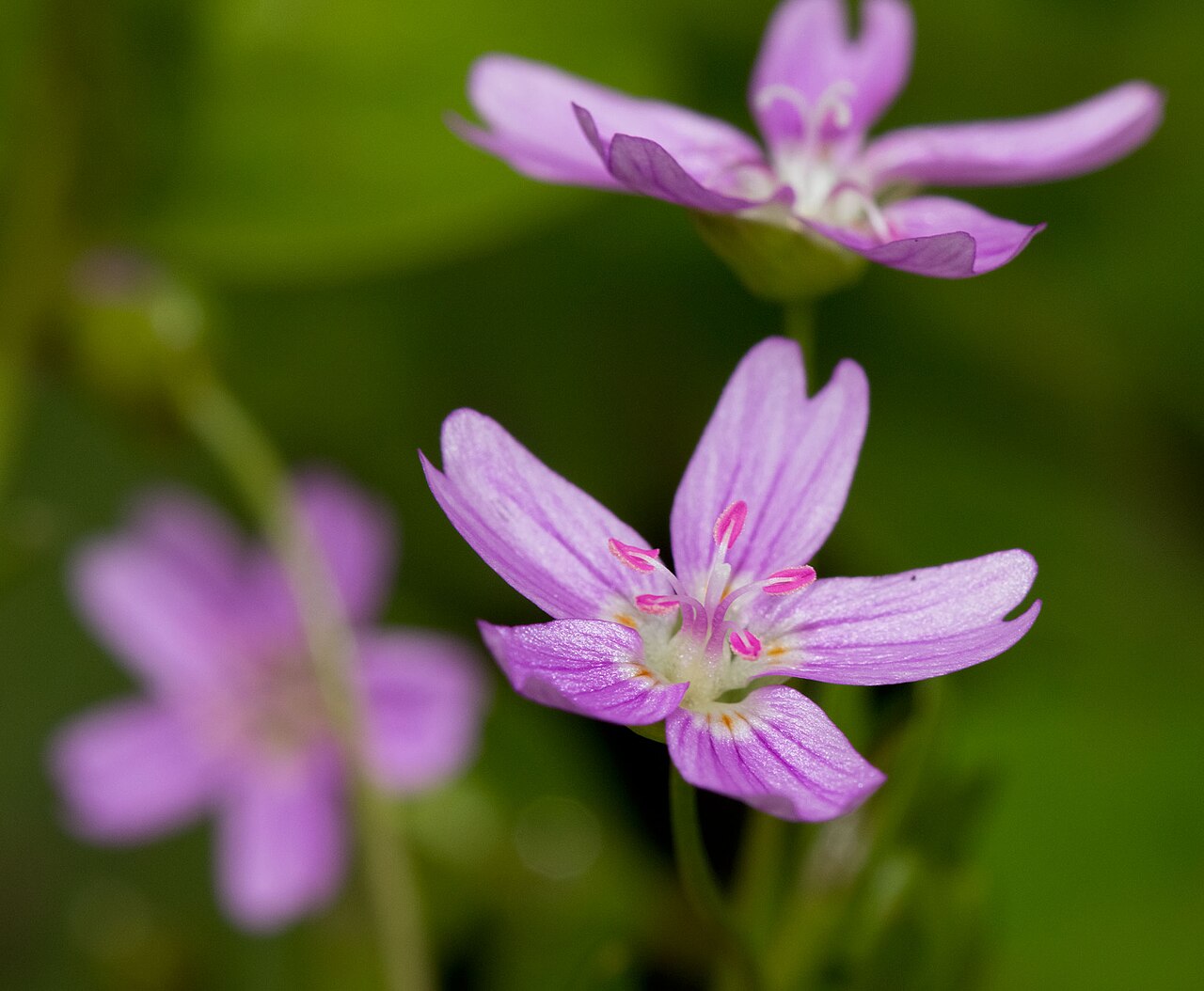
The flowers are borne in loose, one-sided clusters, often with a small leafy bract at the base of each flower stalk. Each flower has two green sepals and five petals, each notched at the tip, white to pale or deep pink with darker pink lines. There are five stamens with pink anthers. The flowers are protandrous: the pollen is released before the stigma becomes receptive in the same flower, which favors cross-pollination, although the plant can also pollinate itself. Bloom time is long, from about February or March near the coast into August in the mountains and the north.
Fruit & Seeds
Each flower produces a small capsule with up to three shiny black seeds. As the capsule dries, its valves curl and press against the seeds, flinging them a short distance from the plant. This, together with offsets, is why candy flower forms such dense patches in favorable spots.
Look-alikes
Miner’s Lettuce (Claytonia perfoliata) has its two stem leaves fused into a round disk around the stem, and smaller white flowers. Western springbeauty (Claytonia lanceolata) of mountain meadows grows from a corm and has narrow leaves. Eastern Spring Beauty has grass-like leaves and does not grow in the Pacific Northwest.
Quick Facts
| Scientific Name | Claytonia sibirica (syn. Montia sibirica); USDA common name Siberian springbeauty |
| Family | Montiaceae (miner’s lettuce family); Portulacaceae in USDA PLANTS |
| Plant Type | Annual or short-lived perennial herb |
| Mature Height | 4–16 in |
| Mature Spread | 6–12 in; spreads by seed and offsets |
| Growth Rate | Fast |
| Sun Exposure | Part shade to full shade |
| Water Needs | Moderate to high; moist soil |
| Soil Type | Moist, humus-rich loam; stream banks and seepy ground |
| Soil pH | About 5.0–7.0 |
| Bloom Time | March–August (from February near the coast) |
| Flower Color | White to pink with darker pink stripes |
| Fall Color | None; plants die back after seeding in dry summers |
| Fruit | Small capsule with up to 3 shiny black seeds |
| Deer Resistant | No; deer and elk eat the tender foliage |
| USDA Hardiness Zones | 4–9 |
Native Range
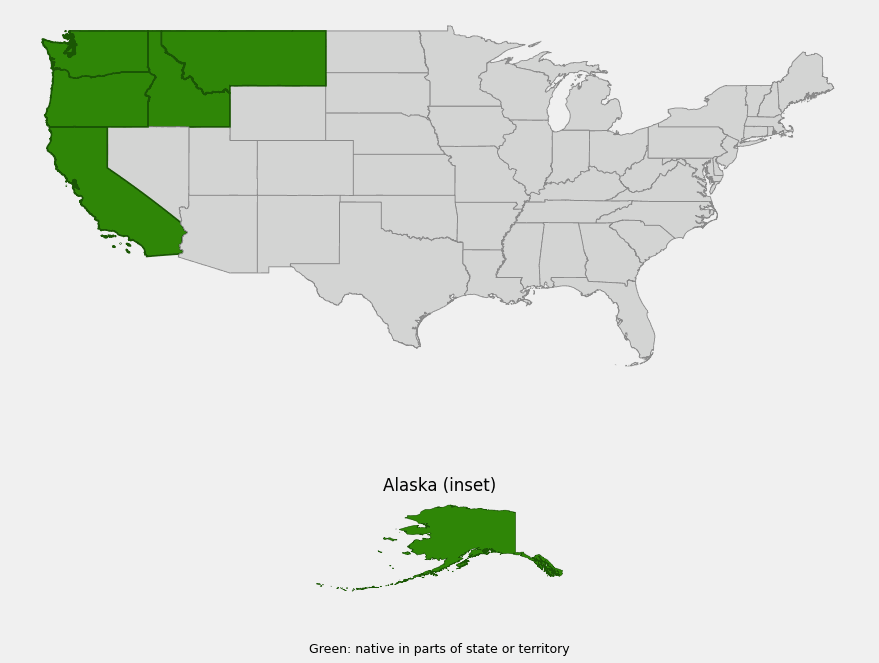
Candy flower is a plant of the North Pacific. USDA PLANTS records it as native in Alaska, Washington, Oregon, California, Idaho and Montana, and in British Columbia. In Alaska it grows along the coast from the southeast panhandle west through south-central Alaska and the Alaska Peninsula to the Aleutian Islands, and it continues across to the Commander Islands of Russia, the source of its name.
Its center of abundance is the coastal forest belt from southern Alaska to northwestern California, including Haida Gwaii, Vancouver Island, the Olympic Peninsula, Puget Sound, the Cascades and the Coast Ranges. It reaches its southern limit in the Santa Cruz Mountains of central California. Inland it has scattered populations in moist forests of the Wallowa Mountains of Oregon, northern Idaho and the Kootenai region of northwestern Montana.
USDA PLANTS also lists candy flower from Massachusetts, but that record is an introduction, not part of its native range, so Massachusetts is not shown on the map. The plant has also been widely introduced in Britain and parts of northern Europe, where it was grown in gardens from the 18th century and has naturalized in damp, shady woods.
📋 Regional plant lists featuring Candy Flower: Idaho, Eastern Oregon & Eastern Washington · Montana & Wyoming · Alaska
Growing & Care Guide
Candy flower is one of the easiest native wildflowers for moist, shady gardens in the Pacific Northwest and northern California. It sows itself freely, blooms for months, and fills the gaps between ferns and shrubs with a light carpet of green and pink.
Light
Plant it in part to full shade. It flowers well under deciduous trees and shrubs and in the bright shade of conifers. Near the coast it tolerates some sun if the soil stays moist, but in hot sun the succulent leaves wilt and burn.
Soil & Water
It needs moist, humus-rich soil, like a forest floor or a stream bank, and is happy in seepy or poorly drained spots. Water during dry spells in spring and early summer to keep it flowering. In dry summers, plants often set seed and die back, then new seedlings appear with the fall rains.
Planting Tips
Start from seed or nursery plants in fall or early spring. Scatter seed on bare, moist soil under shrubs, along shady paths or at the edge of a woodland bed. A few plants are usually enough, because it self-sows. It mixes well with ferns, wild ginger, fringe cups and other woodland perennials.
Pruning & Maintenance
Little care is needed. Pull seedlings where they are not wanted, which is easy because the roots are shallow. Leave some plants to set seed if you want it to persist. Slugs and snails eat the leaves, especially in early spring.
Propagation
Sow fresh seed in late spring or summer, or in fall, on the soil surface in a shady spot. It germinates with the fall and winter rains without special treatment. The small offsets and rooted plantlets can also be dug and moved in fall or early spring.
Landscape Uses
- Woodland and shade gardens: a long-blooming groundcover for moist shade under trees and shrubs
- Stream banks and rain gardens: tolerates wet, seepy soil in shade
- Edible and foraging gardens: the young leaves can be eaten raw or cooked like miner’s lettuce
- Naturalizing: self-sows to fill gaps between ferns and shrubs
- Pollinator gardens: early nectar for flies and small bees in shady places
Wildlife & Ecological Value
Candy flower is one of the first wildflowers to bloom in many Pacific Northwest forests, and its long season makes it a dependable resource for small pollinators.
For Pollinators
The open, striped flowers are visited by hover flies (Syrphidae), bee flies, small native bees and bumblebees. The darker pink stripes act as nectar guides, leading insects toward the center of the flower. Because each flower releases pollen before its stigma is receptive, insect visits help move pollen between plants.
For Birds
Ground-feeding birds such as juncos, towhees, sparrows and grouse eat the seeds and sometimes the tender leaves. The insects drawn to the flowers also feed songbirds raising young in spring.
For Mammals
The succulent leaves are browsed by deer and elk, and rodents and other small mammals eat the seeds and foliage. In coastal forests it is one of many spring greens that help support herbivores after winter.
Ecosystem Role
Candy flower quickly covers moist bare soil along streams, under alders and in small forest openings, holding the soil until longer-lived plants establish. It often grows in the moist, nitrogen-rich soil under red alder and in the disturbed ground of forest edges and trail sides.
Cultural & Historical Uses
The genus Claytonia honors John Clayton, an 18th-century plant collector in colonial Virginia whose specimens were used in early descriptions of many North American plants. Linnaeus named Claytonia sibirica in 1753, based on material from Siberia, and its range across both sides of the North Pacific is reflected in the name.
Candy flower is edible, and its leaves, stems and flowers can be eaten raw in salads or cooked as greens, much like miner’s lettuce. Some people find the older leaves slightly bitter. Ethnobotanical sources record its use as a spring green and in several traditional medicines by Indigenous peoples of the Pacific Northwest Coast. Forage only where it is abundant, and never from protected areas.
In Britain, where it is called pink purslane, it was grown in gardens by the 18th century and is now naturalized across much of the country, especially in the west and north. In Scotland, a white-flowered form has been known for so long near the town of Stewarton that it is locally called the Stewarton flower. In its native range it is mostly valued as an easy, cheerful plant for moist shady gardens.
Frequently Asked Questions
Is candy flower edible?
Yes. The leaves, stems and flowers are edible raw or cooked, much like its relative miner’s lettuce. Young leaves are mildest. As with any wild plant, be sure of your identification and harvest only where it is plentiful.
How is candy flower different from miner’s lettuce?
Both are in the same genus. Miner’s lettuce has two stem leaves fused into a round disk that surrounds the stem, with small white flowers on top. Candy flower has two separate, stalkless stem leaves and larger, pink-striped flowers.
Is candy flower an annual or a perennial?
It can be either. In many places it behaves as an annual or biennial, but in cool, moist sites plants can live for several years. Either way it reseeds freely, so a planting usually persists.
Will candy flower grow in full shade?
Yes. It grows and flowers in full to part shade as long as the soil stays moist. It struggles in hot sun or dry soil.
Is candy flower native to the eastern United States?
No. It is native to western North America and the North Pacific. USDA PLANTS lists a record from Massachusetts, but that population is introduced. The eastern relative is spring beauty, Claytonia virginica.

Looking for a nursery that carries Candy Flower?
Browse our native plant nursery directory: Alaska · California · Idaho · Montana · Oregon · Washington