
Warrior’s Plume (Pedicularis densiflora)
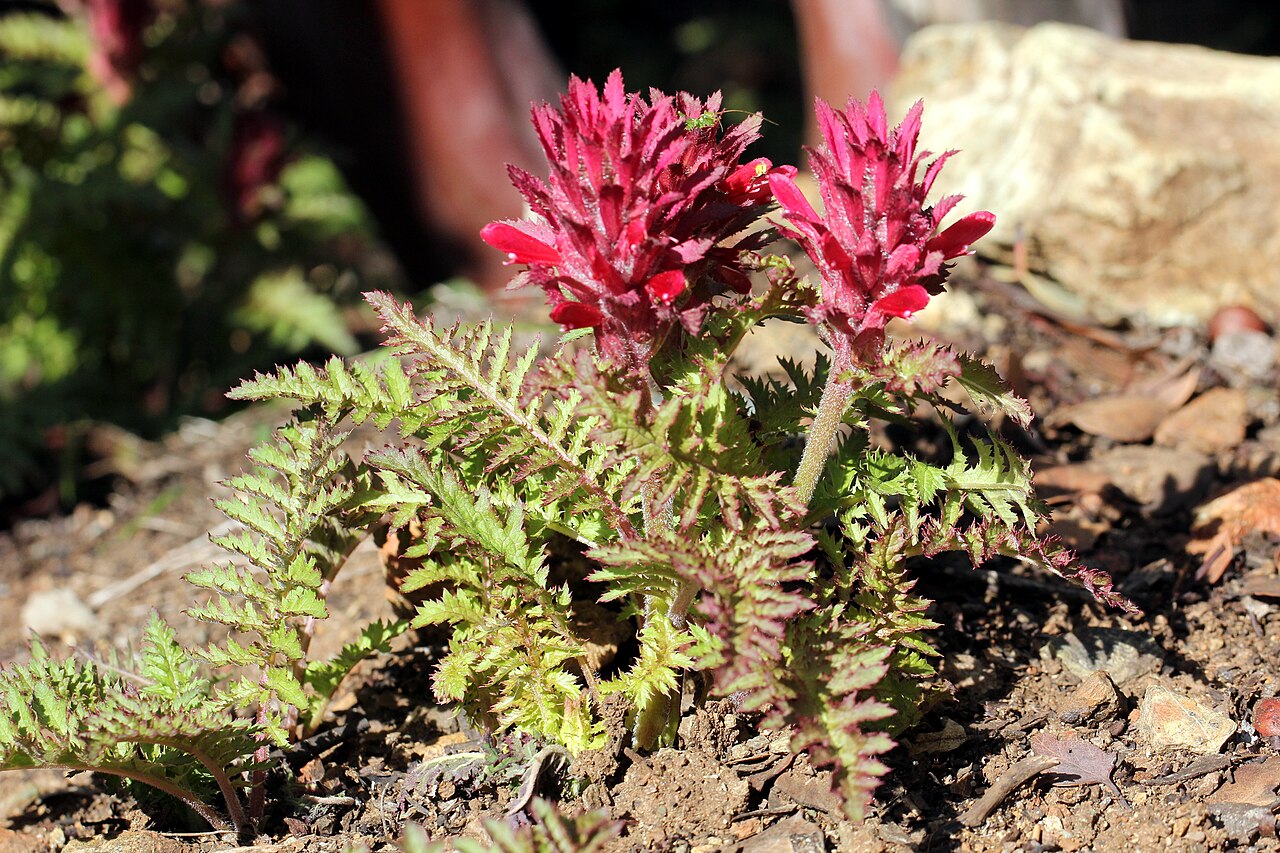
Pedicularis densiflora, known as Warrior’s Plume and listed by USDA as Indian warrior, is one of the most striking early-spring wildflowers of California’s chaparral and oak woodlands. From a clump of fern-like, often reddish leaves it sends up stout spikes 4 to 20 inches tall, densely packed with narrow, beaked, crimson to deep wine-red flowers. It belongs to the broomrape family (Orobanchaceae), which includes many partly or fully parasitic plants.
Warrior’s plume is a root hemiparasite. It has green leaves and makes some of its own food, but its roots attach to the roots of nearby shrubs and trees, especially manzanitas and other woody plants of the chaparral, and draw water and nutrients from them. It blooms from late winter into spring, often beginning in January or February in southern California, when its crimson spikes are among the first bright colors on dry, brushy slopes and a magnet for hummingbirds.
Because it depends on host plants and specialized conditions, warrior’s plume is not a plant for ordinary gardens and is rarely, if ever, available from nurseries. This page is mainly an identification and appreciation guide. It covers how to recognize warrior’s plume, where it grows, why it should never be dug from the wild, and its role in chaparral and woodland ecosystems.
Identification
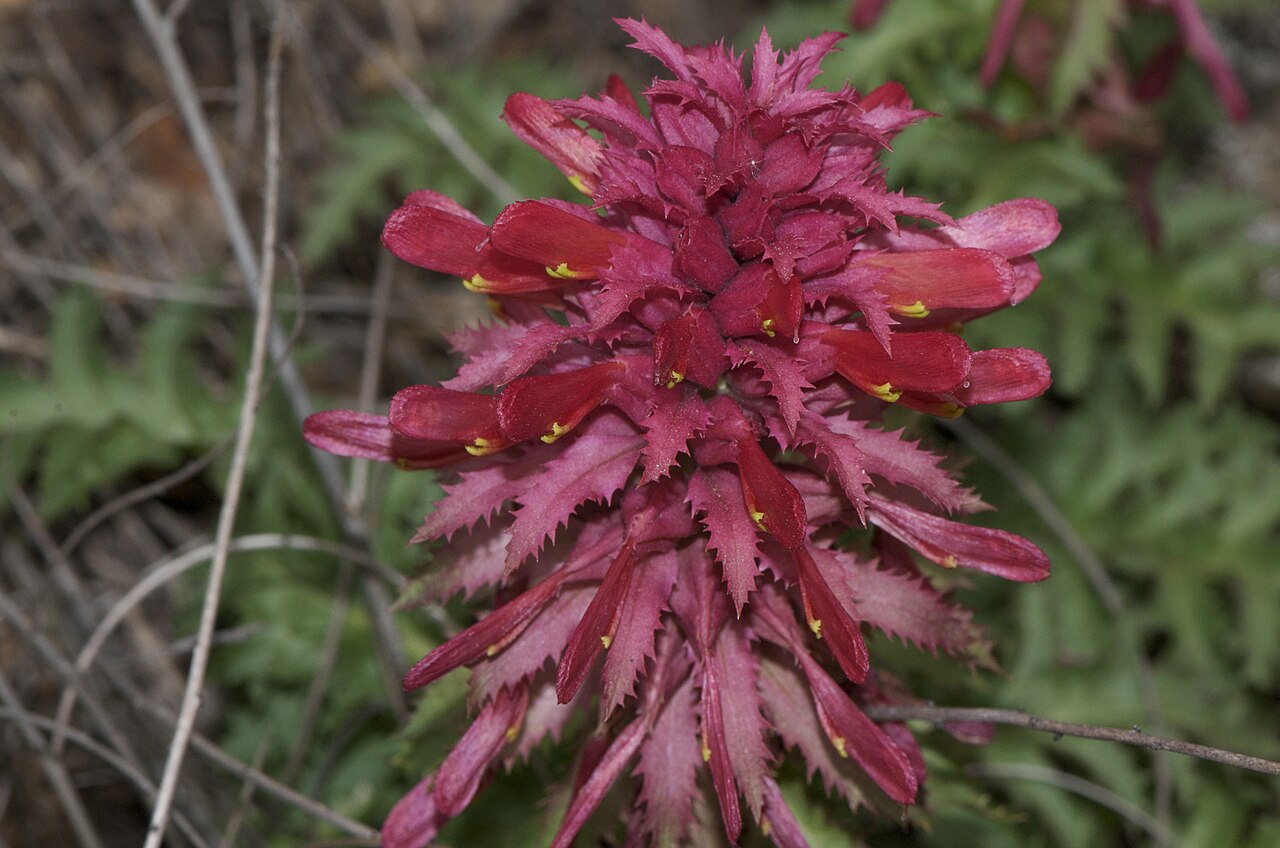
Warrior’s plume is unmistakable in bloom. Out of flower, its fern-like leaves can be confused with a small fern or with other louseworts, but no other plant in its range combines ferny leaves with dense spikes of crimson, beaked flowers in early spring.
Stems & Growth Habit
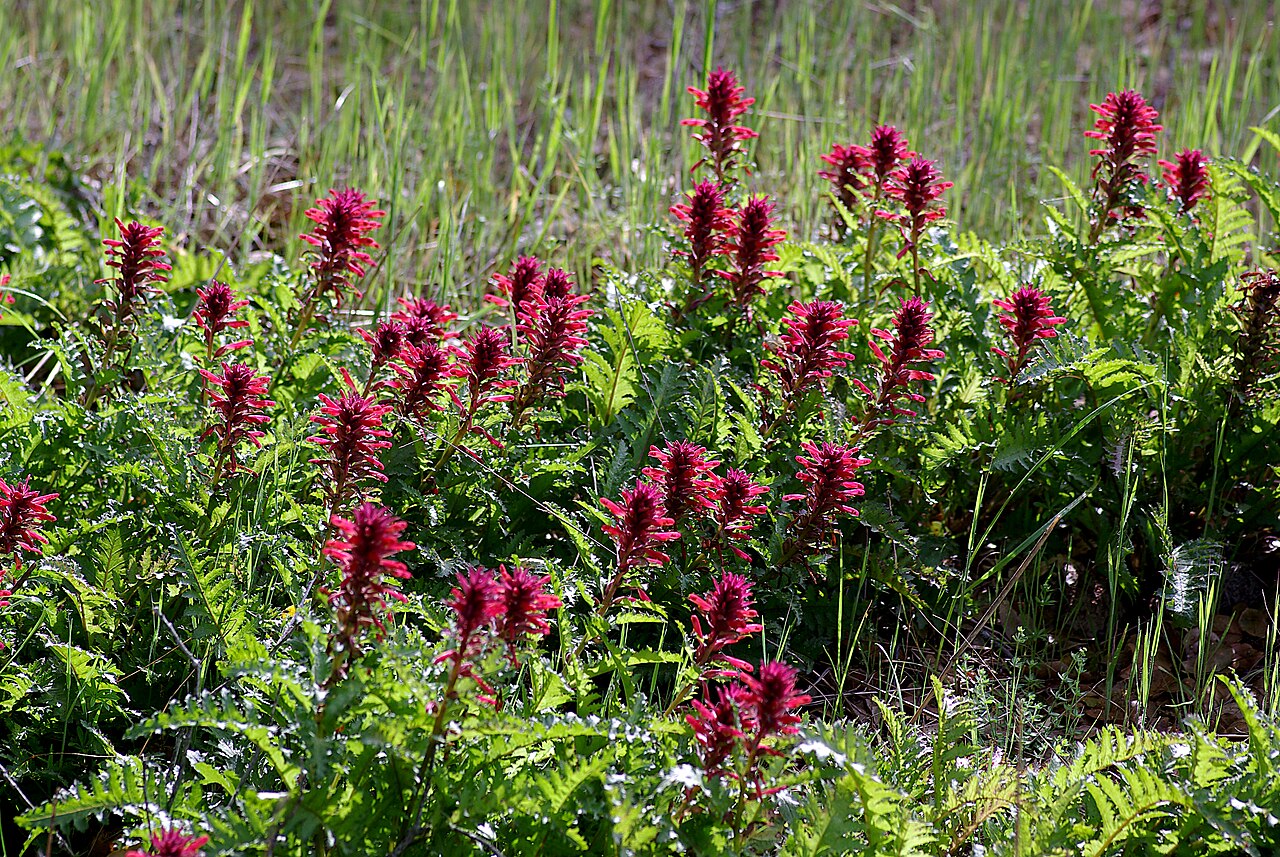
Plants grow from a woody root crown with several thick roots that connect to host plants. Each spring the crown produces a clump of leaves and one to several stout, hairy flowering stems, usually 4 to 20 inches tall. Clumps can grow larger over many years, and plants often occur in loose colonies under or near shrubs.
Leaves
Most leaves are basal and 3 to 10 inches long. They are deeply divided into many toothed, narrow segments, giving them a fern-like look. Young leaves are often dark red, purple or bronze, turning green or remaining reddish as they mature. Smaller leaves also grow along the flowering stems.
Flowers
The flowers are packed into a dense, cylindrical spike at the top of each stem. Each is about 1 inch long, tubular and strongly two-lipped. The upper lip forms a long, narrow, slightly curved beak, and the lower lip is much shorter. The color ranges from bright crimson to dark wine-red, sometimes with a slightly purplish tint. Bloom time is mostly February to May, starting as early as January in the south and lasting into June at higher elevations.
Fruit & Seeds
After flowering, each flower produces a flattened, curved capsule that splits to release several seeds. The seeds fall near the parent plant, and seedlings need to find a suitable host root to survive.
Look-alikes
Indian paintbrushes (Castilleja) are also red and partly parasitic, but their color comes mostly from leafy bracts, and their leaves are not fern-like. Snow plant (Sarcodes sanguinea) is entirely red, with no green leaves, and grows in mountain conifer forests. Other louseworts in the region have white, pink or yellow flowers.
Quick Facts
| Scientific Name | Pedicularis densiflora |
| Family | Orobanchaceae (broomrape family; formerly in Scrophulariaceae) |
| Plant Type | Herbaceous perennial; hemiparasitic on the roots of shrubs and trees |
| Mature Height | 4–20 in in flower |
| Mature Spread | 6–12 in per clump |
| Growth Rate | Slow |
| Sun Exposure | Part shade to full sun (often in the light shade of shrubs) |
| Water Needs | Low; winter rain, dry summers |
| Soil Type | Well-drained rocky, gravelly or sandy soils |
| Soil pH | About 5.5–7.0 |
| Bloom Time | February–May (January–June depending on location) |
| Flower Color | Crimson to dark wine-red |
| Fall Color | None; summer dormant |
| Fruit | Flattened, curved capsule |
| Deer Resistant | Moderate |
| USDA Hardiness Zones | 8–10 (within its native range) |
Native Range
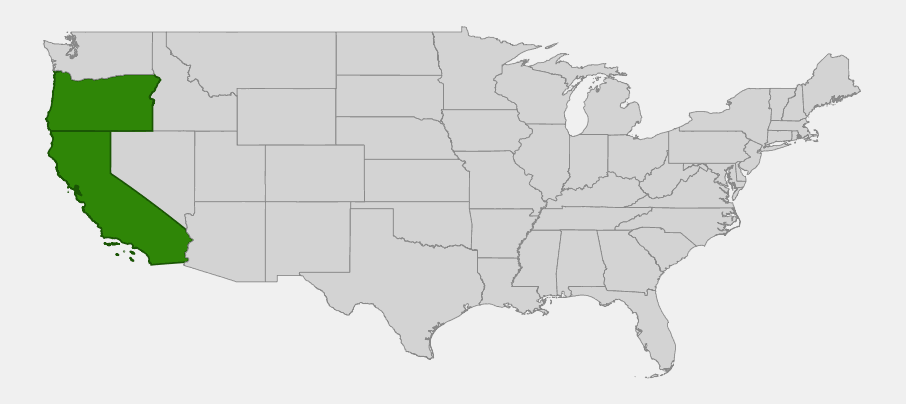
Warrior’s plume grows along the Pacific Coast. USDA PLANTS lists it as native in California and Oregon, and it extends south into northern Baja California, Mexico. In Oregon it is limited to the southwestern part of the state, in the Siskiyou Mountains and nearby valleys.
In California it is widespread in the Coast Ranges, the foothills of the Sierra Nevada and the Cascades, the Transverse and Peninsular Ranges and other mountains of southern California. It grows mostly at low to middle elevations, typically below about 6,000 feet, in chaparral, oak woodland, foothill pine forests and dry mixed conifer forests. It is one of the characteristic spring wildflowers of the chaparral belt.
It usually grows on dry, rocky or gravelly slopes, often under or near manzanitas, oaks, chamise and other shrubs and trees that serve as its hosts. Plants often appear in greater numbers after fires, when the chaparral is opened up and sunlight reaches the ground.
Growing & Care Guide
Warrior’s plume cannot be grown like an ordinary garden perennial. As a hemiparasite it needs living host plants, usually established shrubs such as manzanita, and it depends on the dry summers, winter rains and rocky soils of its native habitat. It is rarely if ever available from nurseries, and wild plants should never be dug: they almost always die when moved, because their roots are attached to their hosts. The best way to enjoy it is to see it in the wild in early spring and to protect the chaparral and woodland where it grows.
Light
In the wild it grows in full sun to the light shade of shrubs and open woodland. It seems to prefer the edges of shrubs, where it can reach both host roots and some sun.
Soil & Water
It grows in dry, well-drained, often rocky or gravelly soils, and it is adapted to California’s Mediterranean climate: wet, cool winters and long, dry summers. Summer watering is harmful, and rich garden soil does not suit it.
Planting Tips
If you own land with existing chaparral or oak woodland, the best approach is to protect any warrior’s plume already present rather than trying to plant it. Avoid clearing shrubs, disturbing the soil or adding irrigation near existing plants, since all of these can kill both the plant and its hosts.
Pruning & Maintenance
No maintenance is needed in natural settings. Let plants flower and set seed, and do not pick the flower spikes. Control invasive annual grasses and weeds, which compete for water and increase fire frequency in chaparral.
Propagation
Propagation is difficult and best left to researchers and restoration specialists. Seed needs a suitable host root near the seedling to establish. Experimental sowing near established manzanitas or other host shrubs in fall has occasionally produced plants. Do not collect seed from small populations, and never dig plants from the wild.
Landscape Uses
- Wildflower viewing: one of the showiest early-spring wildflowers of California chaparral and oak woodland
- Hummingbird watching: a reliable place to watch hummingbirds feeding in late winter and spring
- Habitat protection: a reason to protect existing chaparral and oak woodland on private land
- Nature study: a striking example of a hemiparasitic plant in the broomrape family
- Photography: its crimson spikes and ferny leaves make a dramatic spring subject
Wildlife & Ecological Value
Warrior’s plume is an important early-season food source for hummingbirds and a good example of the hidden root connections that link plants in chaparral and woodland communities.
For Pollinators
The long, red, tubular, beaked flowers are typical of hummingbird-pollinated plants. Anna’s hummingbirds, which nest in late winter, are frequent visitors and rely on early-blooming plants such as warrior’s plume. Bumblebees also visit the flowers, sometimes taking nectar or pollen from the opening of the flower tube.
For Birds
Hummingbirds are the main birds that use it, for nectar. The chaparral and woodland habitats where it grows also support many other birds, such as wrentits, California thrashers and towhees.
For Mammals
Deer and other browsing animals occasionally eat the leaves and flowers, but it is not a major food plant.
Ecosystem Role
As a root hemiparasite, warrior’s plume taps into the roots of shrubs and trees such as manzanitas and oaks. It takes some water and nutrients from its hosts, but in healthy chaparral it does not seriously harm them. It is part of the diverse community of herbs that appears in the years after fire, and it can serve as an indicator of intact, native chaparral and oak woodland.
Cultural & Historical Uses
The genus name Pedicularis comes from the Latin pediculus, “louse,” from an old European belief that livestock grazing on louseworts became infested with lice. The species name densiflora means “densely flowered.” The English names warrior’s plume and Indian warrior refer to the resemblance of the crimson flower spikes to a feathered headdress. Some botanists and native plant groups now prefer “warrior’s plume.”
Some California Native American peoples are reported to have used warrior’s plume medicinally, but records are limited. Like many hemiparasitic plants, it can absorb compounds from its host plants, so its chemistry can vary. It should not be eaten or used as a medicine.
Today warrior’s plume is a favorite of wildflower enthusiasts and photographers in California, and it is often one of the highlights of early-spring hikes in chaparral and oak woodland. It is a reminder that even dry, brushy hillsides hold some of California’s most beautiful and unusual native plants.
Frequently Asked Questions
Can I grow warrior’s plume in my garden?
Generally no. It is a hemiparasite that needs established host shrubs such as manzanita and the dry, rocky conditions of its native habitat. It is rarely available from nurseries. The best way to enjoy it is in the wild, and if it grows on your property, protect it and its host shrubs.
Can I dig up warrior’s plume from the wild?
No. Its roots are attached to host plants, and it almost always dies when moved. Digging it also harms wild populations. Enjoy it where it grows.
Why is it called warrior’s plume or Indian warrior?
The dense crimson flower spikes were thought to resemble a feathered headdress. Many native plant groups now use the name warrior’s plume; USDA lists it as Indian warrior.
When does warrior’s plume bloom?
Mostly from February to May. In southern California it can start in January, and at higher elevations it may bloom into June.
What pollinates warrior’s plume?
Mainly hummingbirds, especially Anna’s hummingbirds, which visit the long red flowers for nectar. Bumblebees also visit.

Looking for a nursery that carries Warrior’s Plume?
Browse our native plant nursery directory: California · Oregon