
Largeflower Bellwort (Uvularia grandiflora)
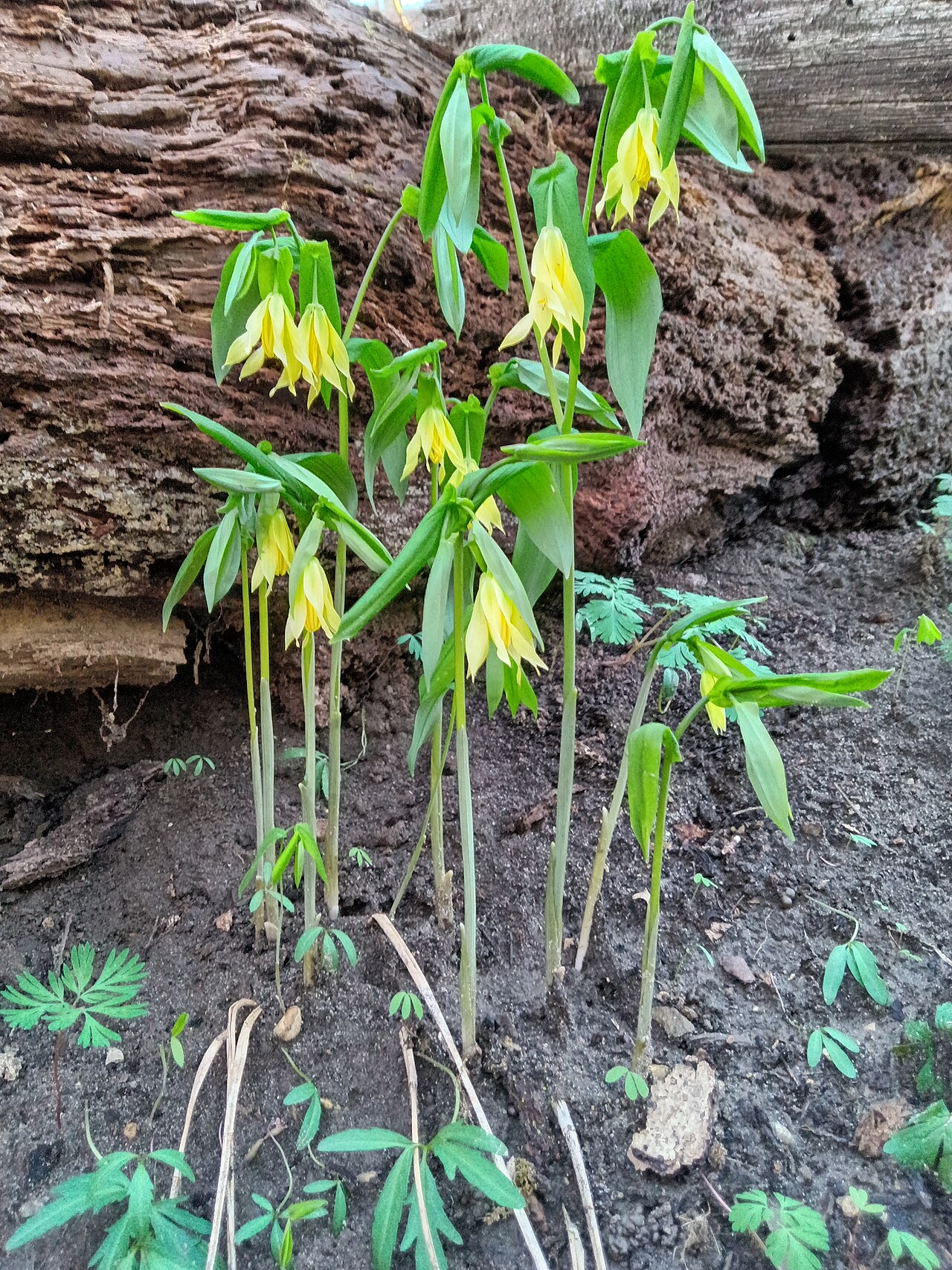
Uvularia grandiflora, the Largeflower Bellwort (also called large-flowered bellwort or merrybells), is one of the most graceful spring wildflowers of the eastern deciduous forest. In April and May its arching stems carry long, nodding, lemon-yellow flowers that hang like little bells beneath drooping leaves. The six tepals are slightly twisted, which gives the flowers a relaxed, wilted look that is part of their charm.
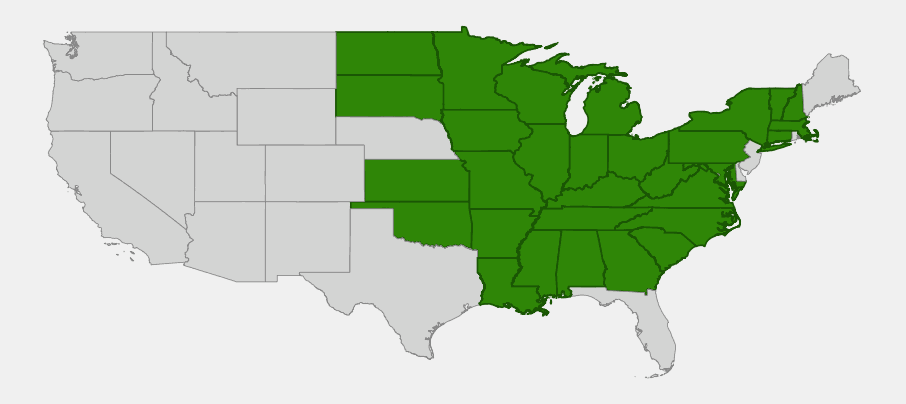
Largeflower bellwort grows in rich, moist woods from southern Quebec and New England west to Minnesota and the eastern Dakotas, and south to Georgia, Louisiana and Oklahoma. It belongs to the autumn crocus family (Colchicaceae), although older books place it in the lily family. A distinctive feature is that the stem appears to pierce the base of each leaf, a leaf arrangement called perfoliate.
Unlike many spring wildflowers, bellwort keeps its leaves through summer, and established clumps slowly expand from spreading rhizomes. It is one of the easiest and most reliable native woodland perennials for shady gardens. Buy nursery-propagated plants and never dig them from the wild.
Identification
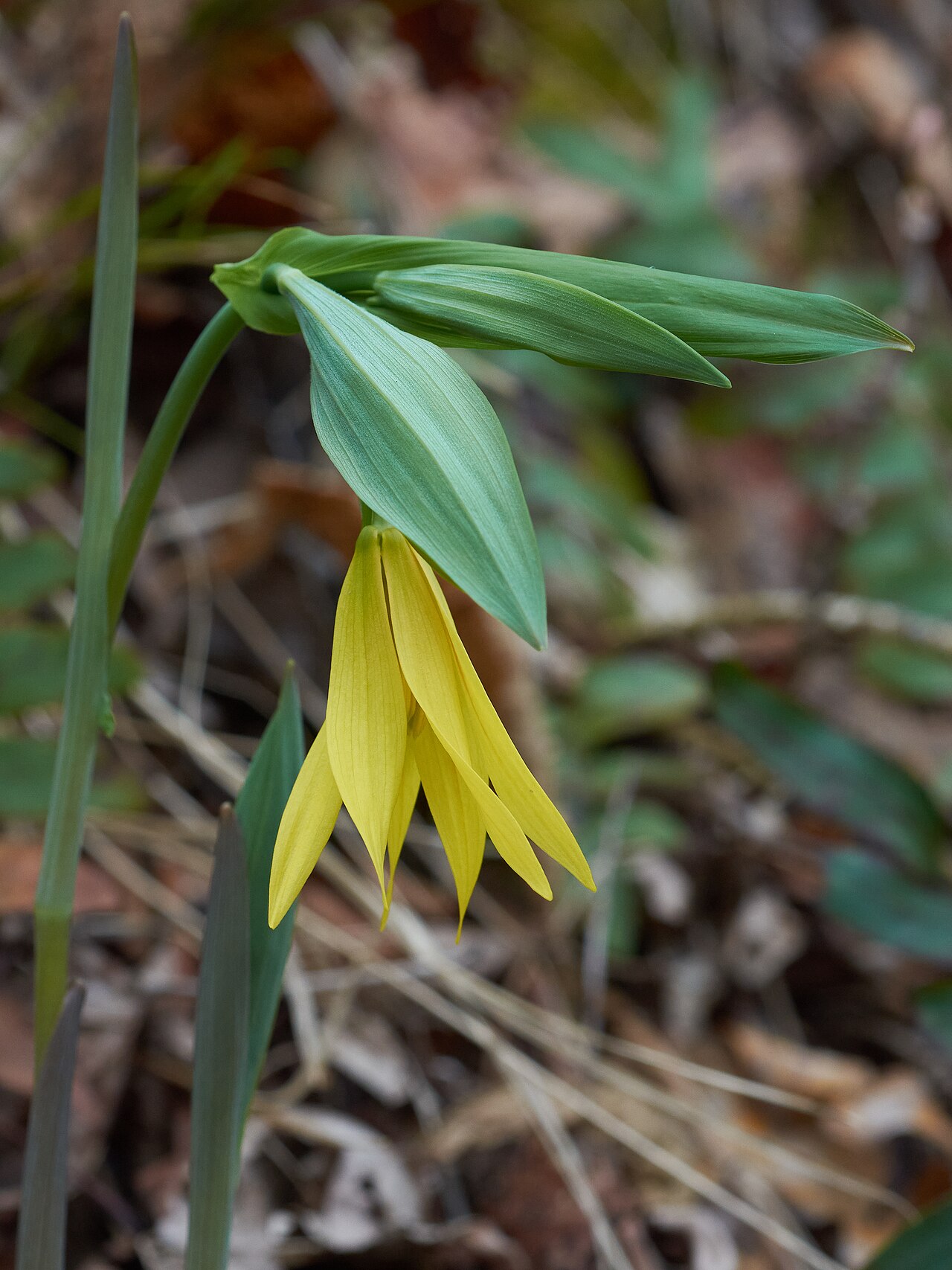
Several bellworts grow in eastern forests. Largeflower bellwort is the largest and showiest, and it can be recognized by its perfoliate leaves that are softly hairy underneath and its long, smooth yellow flowers.
Stems & Rhizomes
Plants grow from short, branching rhizomes and form clumps of several stems. In flower the stems are usually under a foot tall and bend over at the top so the flowers hang. After bloom the stems continue to grow, often forking, and reach 18 to 30 inches tall by summer.
Leaves
The leaves are oval to oblong with pointed tips, 2 to 5 inches long, and appear to be pierced by the stem at their base (perfoliate). When the plant emerges they are rolled tightly around the stem, then unfold and droop as the flowers open. They are medium to pale green above and finely hairy beneath, which helps separate this species from perfoliate bellwort (Uvularia perfoliata), whose leaves are smooth underneath.
Flowers
Each stem carries one or a few nodding flowers, 1 to 2 inches long, at the branch tips. They have six narrow, lemon-yellow to golden tepals that are often slightly twisted and smooth on the inside. Perfoliate bellwort has smaller, paler flowers with tiny orange grains on the inner surface of the tepals. Largeflower bellwort blooms from April to May, at about the same time as many trilliums and Virginia bluebells.
Fruit & Seeds
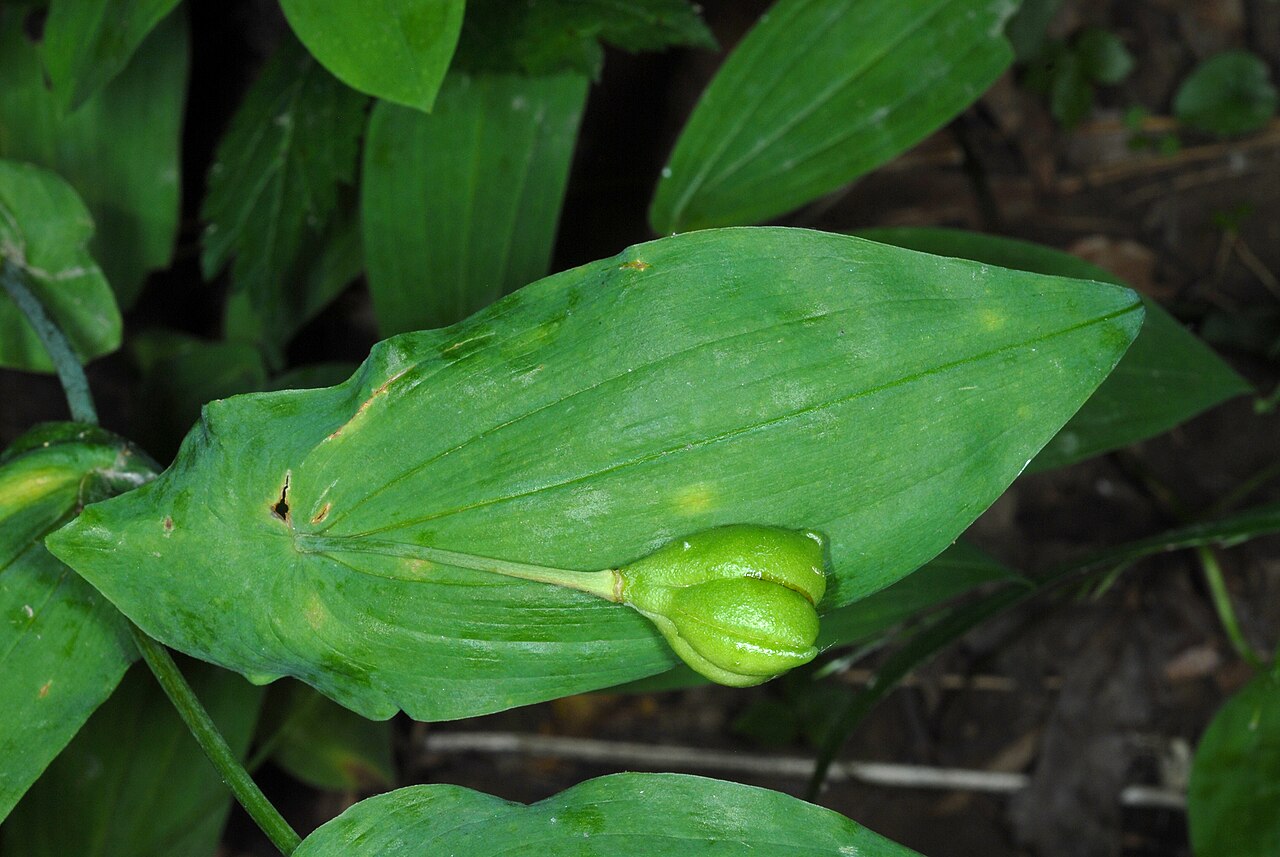
The flower becomes a rounded, three-lobed, green capsule about 1/2 inch across that hangs under the leaves and ripens in early summer. The seeds have fleshy appendages (elaiosomes) that attract ants, which carry them away and disperse them.
Quick Facts
| Scientific Name | Uvularia grandiflora |
| Common Names | Largeflower bellwort (USDA), large-flowered bellwort, merrybells |
| Family | Colchicaceae (autumn crocus family; formerly Liliaceae) |
| Plant Type | Herbaceous perennial from rhizomes |
| Mature Height | 12 in in flower; 18–30 in by summer |
| Mature Spread | 12–18 in; slowly forms clumps |
| Growth Rate | Slow to moderate |
| Sun Exposure | Part shade to full shade |
| Water Needs | Medium; evenly moist soil |
| Soil Type | Rich, humus-rich loam; tolerates clay and limestone |
| Soil pH | About 6.0–7.5 (slightly acid to neutral) |
| Bloom Time | April–May |
| Flower Color | Lemon-yellow to golden yellow |
| Fall Color | Leaves turn yellow in fall |
| Fruit | Three-lobed green capsule; seeds dispersed by ants |
| Deer Resistant | Moderately; occasionally browsed |
| USDA Hardiness Zones | 3–8 |
Native Range
Largeflower bellwort is native to eastern and central North America. USDA PLANTS records it from 30 states, from Vermont, New Hampshire and Massachusetts west through New York, Pennsylvania and the Great Lakes states to Minnesota, North Dakota and South Dakota, south through the Ohio and Mississippi valleys and the Appalachians to Georgia, Alabama, Mississippi and Louisiana, and west to Kansas and Oklahoma. In Canada it grows in southern Quebec, Ontario and Manitoba.
It is most abundant in the Midwest and the Ohio Valley, especially in rich woods over limestone, and in the southern Appalachians. It becomes scarce toward the Atlantic Coast and is largely absent from the Coastal Plain, where its relative, perfoliate bellwort, is more common. At the western edge of its range it grows in wooded river valleys of the Great Plains.
Typical habitats are rich, moist deciduous forests: maple-basswood and beech-maple woods, mixed mesophytic forests, wooded ravines and slopes, and the higher, better-drained parts of floodplain forests. It favors fertile, neutral to slightly alkaline soils, often over limestone or other base-rich rock.
📋 Regional plant lists featuring Largeflower Bellwort: New York, Pennsylvania & Northern New Jersey · Ohio & Indiana · Michigan, Wisconsin & Eastern Minnesota · Kentucky & Tennessee · Nebraska, Kansas & Eastern Colorado · Connecticut, Massachusetts & Rhode Island · New Hampshire, Maine & Vermont · Maryland, Virginia & West Virginia · Delaware, Southern New Jersey & Long Island · Illinois, Iowa & Missouri · Alabama, Georgia & Mississippi
Growing & Care Guide
Largeflower bellwort is one of the most dependable native perennials for a shady garden. It is long-lived, easy to grow in ordinary woodland soil, and it slowly forms handsome clumps. Buy plants from nurseries that propagate them, and never dig bellworts from the wild.
Light
Grow it in part shade to full shade, ideally under deciduous trees where it gets spring sun and summer shade. It tolerates more sun in cool northern gardens if the soil stays moist, but leaves may scorch in hot, sunny sites.
Soil & Water
It prefers rich, moist, well-drained soil with plenty of organic matter, and it is more tolerant of neutral and limy soils than many woodland plants. It handles clay well if the soil is not waterlogged. Water during prolonged summer droughts to keep the leaves from yellowing early, and mulch with shredded leaves.
Planting Tips
Plant rhizomes or potted plants in fall or early spring, setting the rhizomes about 1 to 2 inches deep. Space plants about a foot apart; they will gradually fill in. Combine them with ferns, wild ginger, woodland phlox, trilliums, Solomon’s seal and Virginia bluebells. Because the foliage stays attractive into summer, bellwort helps fill gaps left by spring ephemerals that go dormant.
Pruning & Maintenance
Very little care is needed. Leave the foliage until it yellows in fall, and cut it back in late fall or leave it as winter cover. Clumps rarely need division, but they can be divided every few years if you want more plants.
Propagation
The easiest method is division of established clumps in early spring or fall. Seed should be sown fresh, as soon as the capsules ripen in early summer, since dried seed germinates poorly. Seedlings may take two to three years or more to bloom.
Landscape Uses
- Woodland and shade gardens: graceful yellow flowers in spring and good foliage into summer
- Native wildflower borders: under deciduous trees with ferns and other woodland perennials
- Naturalizing: slowly forms colonies in humus-rich woodland soil
- Spring pollinator gardens: early flowers for queen bumblebees and other bees
- Woodland restoration: rich, moist forests within its native range
Wildlife & Ecological Value
Largeflower bellwort blooms during the spring flush of woodland wildflowers and supports early pollinators and seed-dispersing ants.
For Pollinators
The nodding flowers are visited mainly by bumblebee queens and other early native bees, which hang beneath the flowers to collect pollen and nectar. Small bees and flies also visit them. Bloom comes early in the season, when queens are establishing new colonies and need food.
For Birds
Bellwort has little direct value for birds. It is part of the ground layer of rich forests that many songbirds depend on for nesting and for the insects they feed to their young.
For Mammals
Deer browse it occasionally but generally prefer other woodland plants such as trilliums. Small mammals may eat the seeds.
Ecosystem Role
Bellwort is an ant-dispersed plant: ants carry the seeds back to their nests for the fatty appendages, then discard them in rich soil where they can germinate. This keeps colonies spreading slowly through the forest floor. Its clumps help hold soil on wooded slopes and ravines.
Cultural & Historical Uses
The genus name Uvularia comes from the uvula, the small piece of tissue that hangs at the back of the throat, because the flowers hang in a similar way. According to the old doctrine of signatures, which held that a plant’s appearance showed its medicinal use, bellworts were used for sore throats and mouth ailments.
Several Native American peoples used bellworts in traditional medicine, including as poultices and in remedies for various ailments. The young shoots of some bellworts were also reportedly eaten as a cooked vegetable. Today wild plants should be left alone, since digging destroys slow-growing colonies.
Largeflower bellwort was described by the English botanist James Edward Smith in the early 1800s. It has long been grown in British and European gardens as a hardy woodland plant, and it remains one of the most popular North American woodland perennials in gardens on both sides of the Atlantic.
Frequently Asked Questions
Is largeflower bellwort easy to grow?
Yes. It is one of the easiest native woodland perennials. Give it part to full shade and rich, moist, well-drained soil, and it will slowly form a long-lived clump with little care.
How is largeflower bellwort different from perfoliate bellwort?
Largeflower bellwort has larger, brighter yellow flowers that are smooth inside, and its leaves are hairy underneath. Perfoliate bellwort (Uvularia perfoliata) has smaller, paler flowers with tiny orange grains inside, smooth leaves, and grows in more acid soils.
Does bellwort go dormant in summer?
No. Unlike spring ephemerals such as Virginia bluebells, bellwort keeps its leaves through summer, as long as the soil does not dry out completely. The leaves turn yellow in fall.
Why do bellwort flowers look wilted?
The long, slightly twisted tepals and nodding habit are normal for this species. The flowers are fully open and healthy even though they look droopy.
Can I dig bellwort from the woods?
No. Wild colonies grow slowly, and digging harms native populations. Nursery-propagated plants are widely available and establish easily.

Looking for a nursery that carries Largeflower Bellwort?
Browse our native plant nursery directory: Alabama & Arkansas · Connecticut & Georgia · Illinois, Indiana, Iowa & Kansas · Kentucky, Louisiana, Maryland, Massachusetts, Michigan, Minnesota, Mississippi & Missouri · New Hampshire, New York, North Carolina, North Dakota, Ohio & Oklahoma · Pennsylvania, South Carolina, South Dakota, Tennessee, Vermont & Virginia · West Virginia & Wisconsin