
Flat-top White Aster (Doellingeria umbellata)
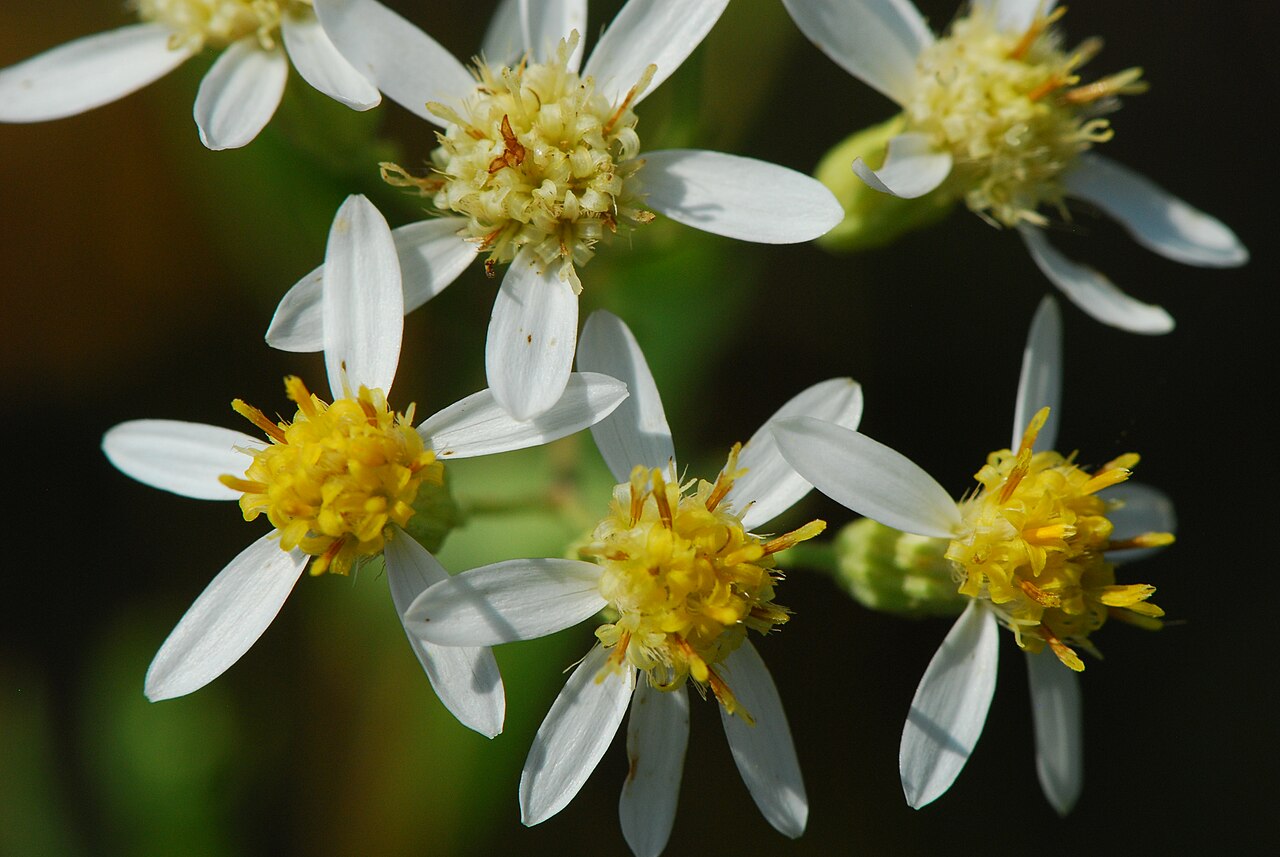
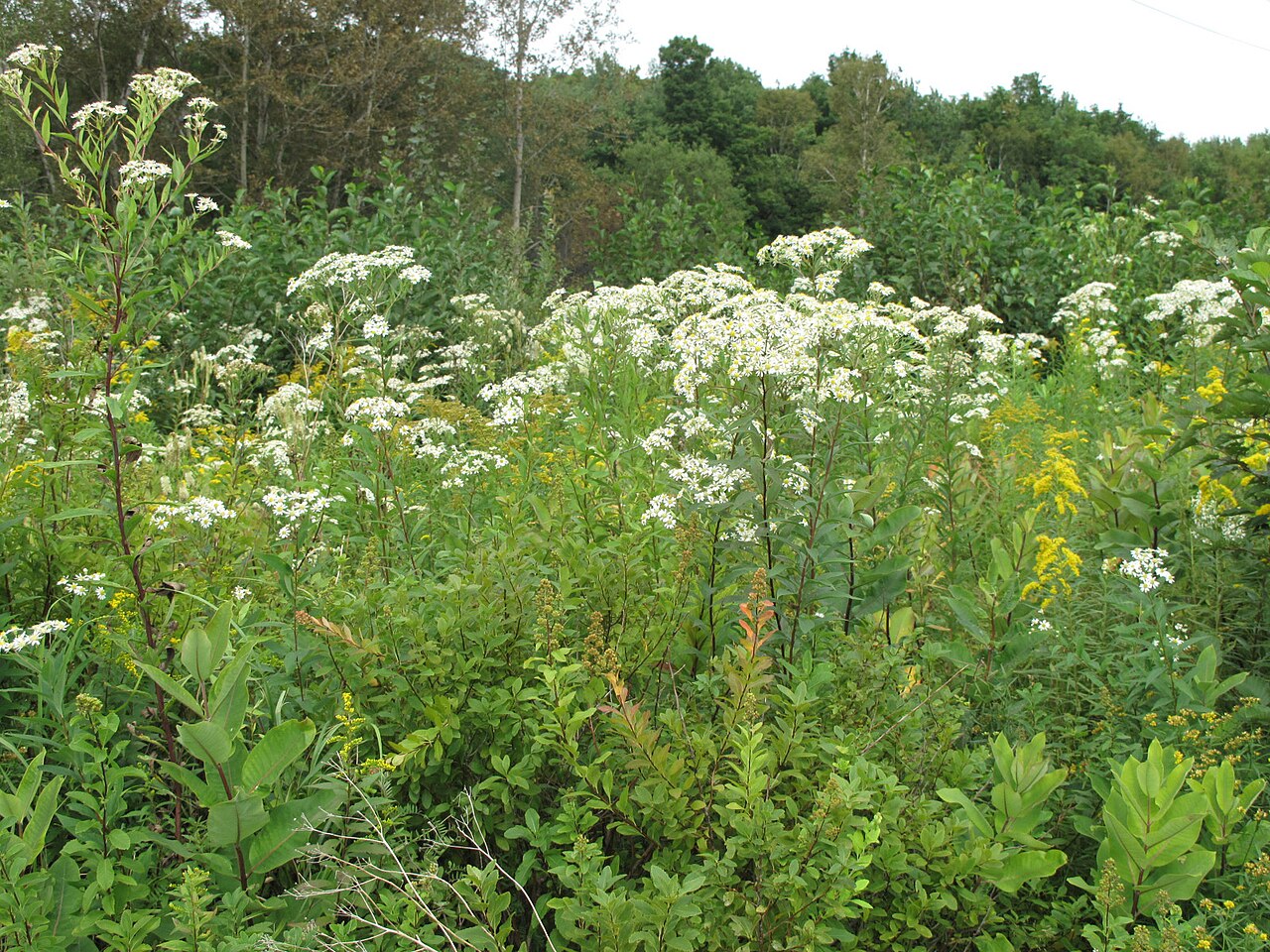
Doellingeria umbellata, known as Flat-top White Aster, parasol whitetop (the USDA name), tall flat-topped white aster or parasol aster, is a tall native perennial of moist meadows, thickets, wood edges and wetland margins across eastern North America. Its sturdy, leafy stems reach 3 to 6 feet, and from midsummer into fall they end in broad, flat clusters of dozens to hundreds of small daisy-like flower heads, each with a few white rays around a yellow disk.
Long known as Aster umbellatus, it was moved, along with most other North American asters, out of the Eurasian genus Aster after genetic studies showed the New World species belong to separate lineages. It is now placed in Doellingeria, a small genus of white-flowered “whitetop asters.” It is a member of the aster family (Asteraceae).
Flat-top white aster is an excellent plant for rain gardens, wet meadows and naturalistic borders. It feeds a wide range of pollinators in late summer, it is the main caterpillar food plant of the Harris’s checkerspot butterfly, and its seeds are eaten by birds in fall. This guide covers how to identify it, where it grows, how to grow it and why it matters to wildlife.
Identification
Flat-top white aster is easy to recognize in late summer: tall, leafy, unbranched stems topped by a wide, flat or slightly domed cluster of small white-rayed flower heads. The sparse rays, often with gaps between them, give each head a slightly ragged look.
Stems & Roots
Plants spread by rhizomes and form clumps or loose colonies. Stems are erect, stiff, usually unbranched below the flower cluster, 2 to 7 feet tall (most often 3 to 5 feet), green to purplish, and smooth or finely hairy. Midwestern plants are often hairier and are sometimes separated as var. pubens.
Leaves
The leaves are numerous, alternate, lance-shaped to narrowly elliptic, 2 to 6 inches long and up to about 1¼ inches wide, with smooth edges and pointed tips. They are stalkless or nearly so, dark green and slightly rough above, paler and smooth or hairy below, with prominent veins. There are no large basal leaves at flowering time; the stems are evenly leafy up to the flower cluster.
Flowers
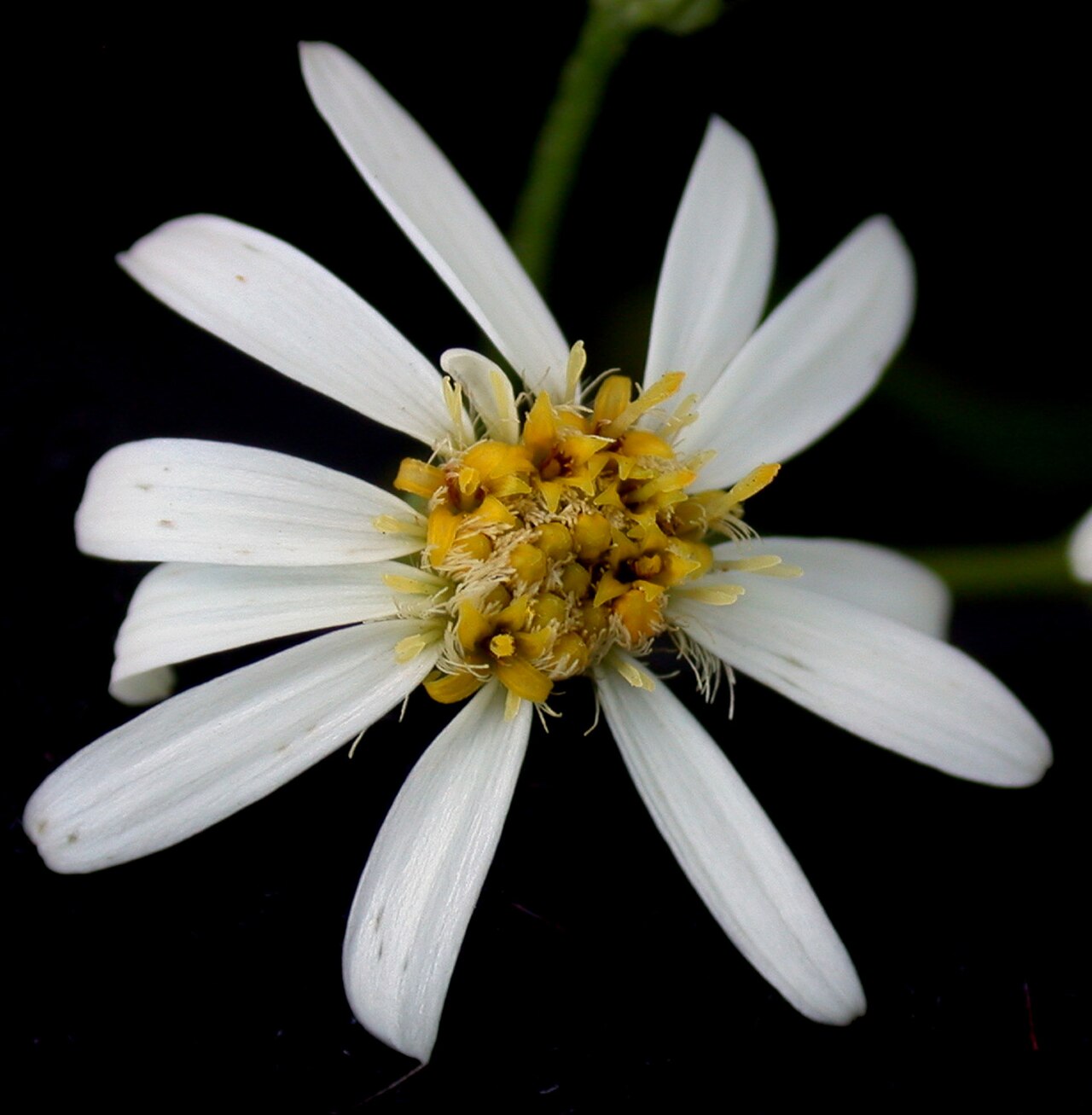
The flower heads are borne in a broad, flat-topped corymb, 3 to 10 inches across, that can hold 50 to more than 300 heads. Each head is about ½ to ¾ inch wide, with usually 7 to 10 (sometimes 2 to 14) white rays and a center of yellow disk florets that turn purplish-brown as they age. Bloom runs from July to September, sometimes into October.
Other white asters, such as frost aster (Symphyotrichum pilosum) and calico aster (S. lateriflorum), have many more rays per head and spread their flowers along arching branches rather than in a single flat-topped cluster.
Fruit & Seeds
Each disk floret produces a small, ribbed achene topped with a tuft of whitish bristles (pappus) in two layers, a short outer ring and long inner bristles, which is a distinctive feature of Doellingeria. The fluffy seed heads ripen in fall, and the seeds are carried away by the wind.
Quick Facts
| Scientific Name | Doellingeria umbellata (syn. Aster umbellatus) |
| Family | Asteraceae (aster family) |
| Plant Type | Herbaceous perennial; spreads by rhizomes |
| Mature Height | 3–6 ft (2–7 ft) |
| Mature Spread | 2–3 ft; forms colonies |
| Growth Rate | Fast |
| Sun Exposure | Full sun to partial shade |
| Water Needs | Moderate to high; moist to wet soil |
| Soil Type | Loam, sandy loam or peaty soil; tolerates clay |
| Soil pH | About 5.0–7.0 |
| Bloom Time | July–September (occasionally October) |
| Flower Color | White rays with a yellow disk |
| Fall Color | Leaves yellow to bronze; fluffy seed heads |
| Fruit | Achene with a two-layered tuft of bristles |
| Deer Resistant | Moderately; occasionally browsed |
| USDA Hardiness Zones | 3–8 |
Native Range
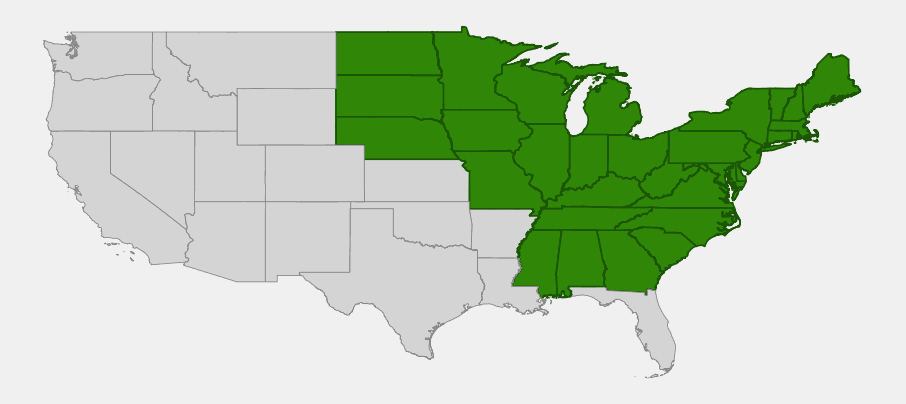
Flat-top white aster is widespread in eastern and central North America. The Lady Bird Johnson Wildflower Center describes its range as Alberta east to Newfoundland, south to Georgia and Alabama, and northwest to Missouri, Nebraska and North Dakota. USDA PLANTS records it in 31 states and the District of Columbia, in nine Canadian provinces, and in the French islands of Saint Pierre and Miquelon.
It is most common in the Northeast, the Great Lakes region and the northern Appalachians, where wet meadows, beaver meadows, shrub swamps and old fields provide plenty of habitat. Southward it follows the Appalachian Mountains and Piedmont to northern Georgia and Alabama, and westward it extends across the Upper Midwest to the eastern Dakotas and Nebraska, where it becomes more local.
Typical habitats include moist meadows and thickets, edges of swamps, marshes and bogs, wet woods and clearings, stream banks, fens, damp roadsides and ditches, and wet old fields. It can also persist in drier openings and power line corridors within forested regions.
📋 Regional plant lists featuring Flat-top White Aster: New York, Pennsylvania & Northern New Jersey · Ohio & Indiana · Michigan, Wisconsin & Eastern Minnesota · Kentucky & Tennessee · Nebraska, Kansas & Eastern Colorado · Connecticut, Massachusetts & Rhode Island · New Hampshire, Maine & Vermont · Maryland, Virginia & West Virginia · Delaware, Southern New Jersey & Long Island · Illinois, Iowa & Missouri · Alabama, Georgia & Mississippi
Growing & Care Guide
Flat-top white aster is vigorous and easy to grow in moist, sunny or partly shaded sites. It is best suited to naturalistic plantings, rain gardens and wet meadows, where its height and spreading habit are assets rather than problems.
Light
Full sun to partial shade. It flowers most heavily in sun, but it tolerates several hours of shade, as at woodland edges, which makes it more versatile than many meadow perennials.
Soil & Water
It prefers consistently moist to wet, acidic to neutral soil, including heavy clay and peaty soils. It tolerates short periods of flooding and does well in rain gardens and along ponds and streams. In average garden soil it grows if watered during dry spells, but it may get shorter and less vigorous. Fertilizer is not needed and can make stems floppy.
Planting Tips
Plant in spring or fall, 18 to 24 inches apart, or sow seed in fall. Because it spreads by rhizomes, give it room or combine it with other strong perennials such as Joe-Pye weed, ironweed, goldenrods and tall grasses. It is too tall and spreading for small, tidy beds but ideal for the back of a border or a wet meadow.
Pruning & Maintenance
Little maintenance is needed. Leave the stems standing through winter for seeds, overwintering insects and winter structure, and cut them back in early spring. If you want shorter, bushier plants, cut stems back by about a third in early June. Divide clumps every few years if they spread beyond their space.
Propagation
Grow from seed sown in fall or after about 60 days of cold, moist stratification in spring; seed needs light to germinate, so press it into the surface. Plants are also easily divided in early spring, and rhizome sections root quickly.
Landscape Uses
- Rain gardens and bioswales: tolerates periodic flooding and moist soil
- Wet meadows and pond edges: tall, late-season white flowers among sedges and wildflowers
- Pollinator and butterfly gardens: abundant late-summer nectar; host plant for Harris’s checkerspot
- Back of the border in naturalistic gardens: height and broad flower clusters
- Wetland and riparian restoration: reliable, fast-establishing native perennial
Wildlife & Ecological Value
Flat-top white aster is an important late-summer resource for insects in eastern wetlands and meadows, and it has a special relationship with one butterfly in particular.
For Pollinators
The broad, flat flower clusters are an easy landing pad for many insects. Native bees, including specialist bees that collect pollen mainly from asters, bumble bees, sweat bees and mining bees, visit along with butterflies, flower flies, wasps and beetles. Flat-top white aster is the primary larval host plant of the Harris’s checkerspot (Chlosyne harrisii), a butterfly of northeastern wet meadows whose caterpillars feed in groups on its leaves. Caterpillars of several moths also feed on it.
For Birds
American goldfinches, sparrows and other small seed-eating birds eat the seeds in fall and early winter. The tall, dense stands provide cover for wetland birds and nesting sites for species that build in meadow vegetation.
For Mammals
Deer and rabbits browse the young foliage occasionally. The dense colonies also provide cover for small mammals in wet meadows.
Ecosystem Role
Its rhizomes and fibrous roots help stabilize wet soils along streams, ponds and ditches. In wet meadows and old fields, it is part of the late-summer bloom that sustains pollinators before winter, and the hollow dead stems provide winter shelter for overwintering insects.
Cultural & Historical Uses
Philip Miller described the species in the eighteenth century as Aster umbellatus, and that name remained in use for more than two centuries. The genus Doellingeria was created in 1832 by the German botanist Christian Gottfried Nees von Esenbeck, who named it for the German physician and botanist Ignaz Döllinger. Recent North American floras have adopted it, though many gardeners still know the plant as an Aster.
Several Indigenous peoples of the Northeast and Great Lakes region used flat-top white aster medicinally, and ethnobotanical records mention its use in preparations for various ailments. These traditional uses are of historical interest and are not recommendations.
In recent decades, interest in flat-top white aster has grown along with interest in butterfly conservation. Because the Harris’s checkerspot depends on it, protecting and planting flat-top white aster in wet meadows is one of the simplest ways to support this local butterfly in the Northeast and Great Lakes states.
Frequently Asked Questions
Is flat-top white aster the same as Aster umbellatus?
Yes. Aster umbellatus is the older name. Most current references use Doellingeria umbellata, after the North American asters were split from the Eurasian genus Aster.
What butterfly uses flat-top white aster?
It is the main larval host plant of the Harris’s checkerspot (Chlosyne harrisii), and its flowers feed many other butterflies, bees and flies in late summer.
Does flat-top white aster need wet soil?
It prefers moist to wet soil and does well in rain gardens and along ponds, but it can grow in average soil with occasional watering. It does not do well in very dry, sandy sites.
Will flat-top white aster spread?
Yes. It spreads by rhizomes and can form colonies over time. Give it room in a meadow or naturalistic garden, or divide it every few years to keep it in check.
How tall does flat-top white aster get?
Usually 3 to 5 feet, sometimes up to 7 feet in rich, moist soil. Cutting the stems back by a third in early summer produces shorter, bushier plants.

Looking for a nursery that carries Flat-top White Aster?
Browse our native plant nursery directory: Alabama · Connecticut, Delaware & Georgia · Illinois, Indiana & Iowa · Kentucky, Maine, Maryland, Massachusetts, Michigan, Minnesota, Mississippi & Missouri · Nebraska, New Hampshire, New Jersey, New York, North Carolina, North Dakota & Ohio · Pennsylvania, Rhode Island, South Carolina, South Dakota, Tennessee, Vermont & Virginia · West Virginia & Wisconsin