
Carolina Crane’s-Bill (Geranium carolinianum)
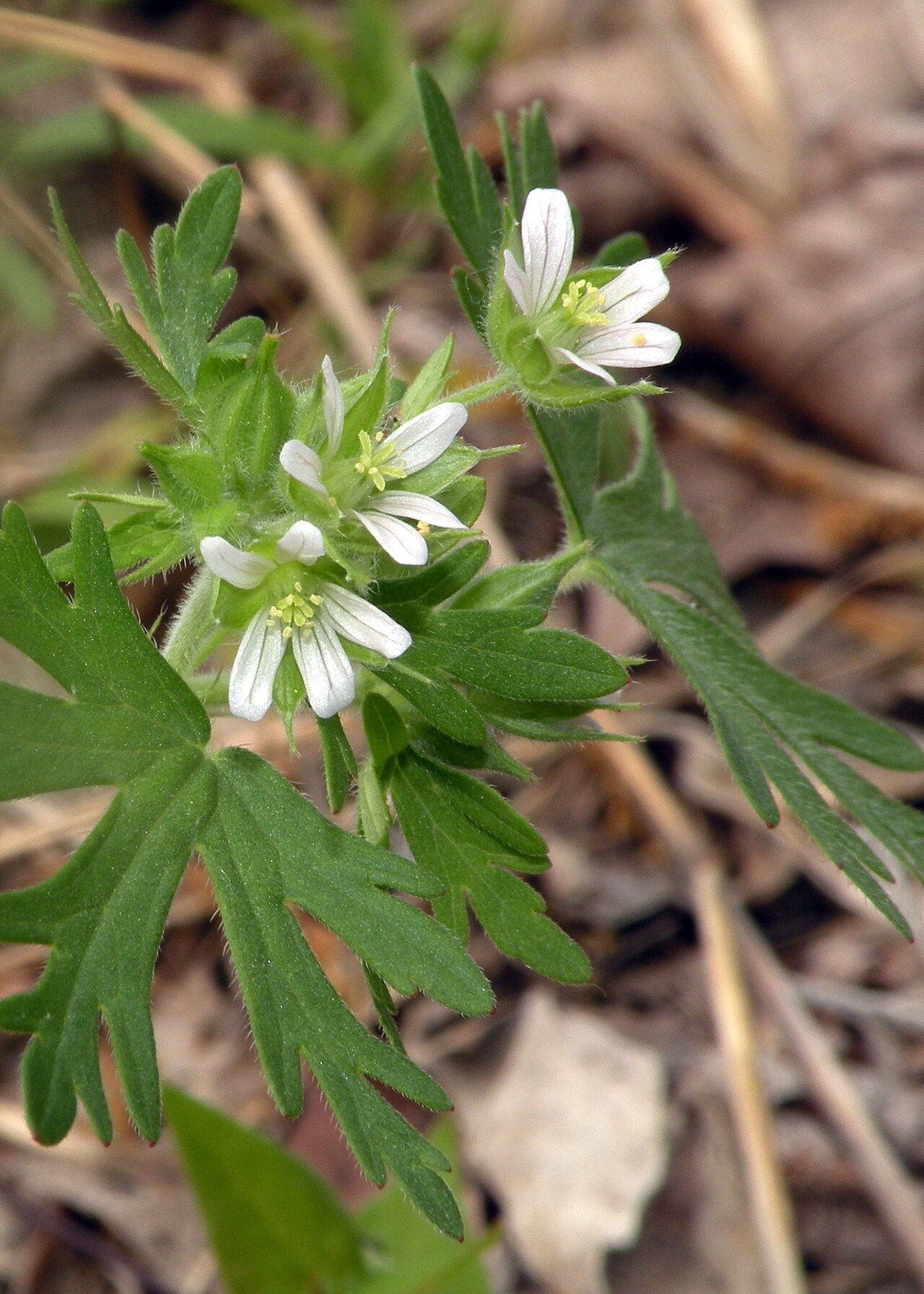
Geranium carolinianum, known as Carolina Crane’s-Bill or Carolina geranium (the USDA common name), is a small, native annual or biennial wild geranium of the geranium family (Geraniaceae). It forms a low, branching, hairy plant usually 6 to 18 inches tall, with deeply divided, palm-shaped leaves and small, pale pink to whitish five-petaled flowers in spring and early summer. The flowers are followed by distinctive long-beaked fruits, the “crane’s bills” of its name.
It is one of the most widespread native wildflowers in North America, recorded from almost every state of the lower 48 and from southern Canada, and it extends south into Mexico. It thrives in dry, open, often disturbed ground: fields, pastures, lawns, roadsides, rocky woods, glades and sandy clearings. Many people know it as a common lawn and garden weed, and few realize it is native.
Carolina crane’s-bill will never be a showy garden plant, but it is a useful early-spring nectar and pollen source for small bees, part of the native flora of disturbed and open habitats, and a fascinating example of explosive seed dispersal. This guide covers how to identify it, how it differs from similar non-native geraniums, and how to manage it.
Identification
Several small crane’s-bills grow in lawns, fields and roadsides, and some of them are non-native. Look at the leaf divisions, the flower clusters and the hairs on the fruit to tell them apart.
Stems & Growth Habit
Plants usually germinate in fall and overwinter as a flat rosette, then send up branching stems in spring. The stems are upright to sprawling, usually 6 to 18 inches tall and occasionally to about 2 feet, often reddish and densely covered with soft, spreading or backward-pointing hairs. The whole plant often turns reddish as the fruits ripen and it begins to die back in early summer.
Leaves
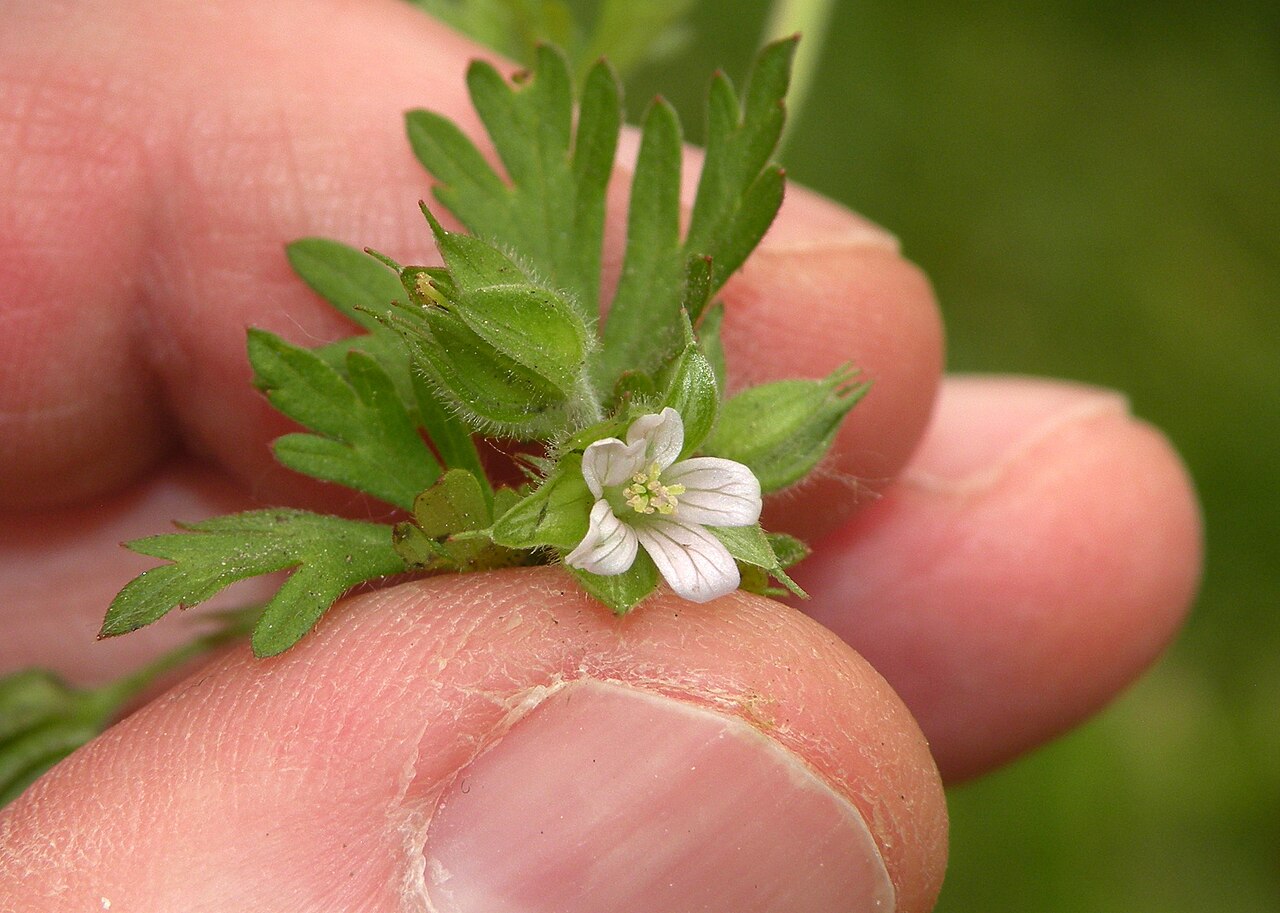
The leaves are about 1 to 3 inches wide, roughly round in outline and deeply palmately divided into five to nine narrow segments, each of which is further lobed or toothed. They are hairy on both surfaces. Lower leaves are long-stalked and alternate; upper leaves are opposite and shorter-stalked.
Flowers
Flowers appear from March to June in the South and from April into July farther north. They are borne in compact clusters at the ends of stems and branches, on short stalks, so the flowers and developing fruits are crowded together. Each flower is about 1/4 to 1/2 inch across, with five pale pink, lavender-pink or nearly white petals, often slightly notched at the tip, and five hairy, pointed sepals.
Fruit & Seeds
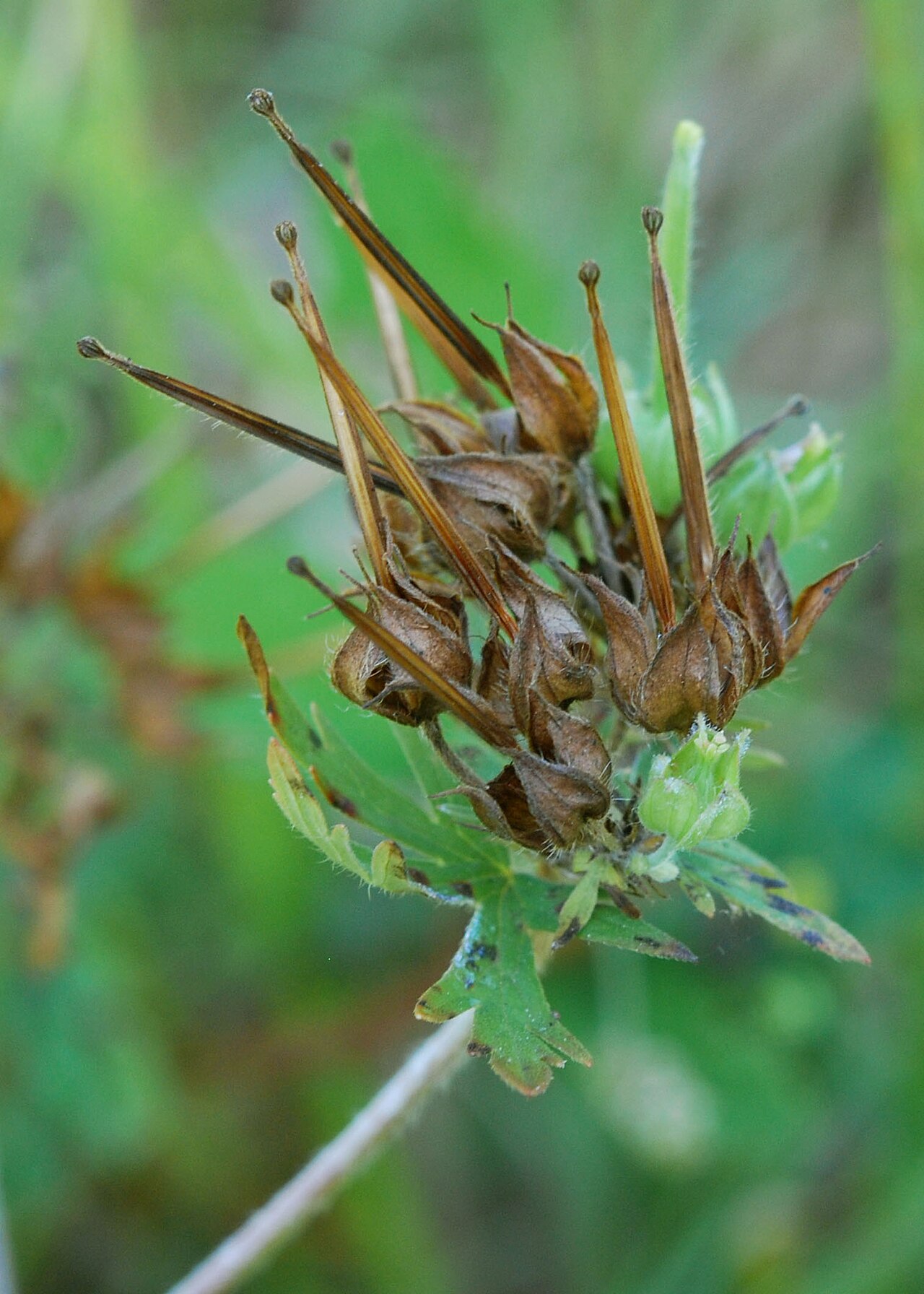
The fruit is the hallmark of the genus. After flowering, the central column elongates into a slender beak about 3/4 to 1 inch long, with five rounded, hairy seed compartments at its base. When the fruit is dry, each compartment separates and its strip of the beak coils suddenly upward, flinging the seed several feet. The seeds are small, oval and finely netted.
Look-alikes
Cut-leaved crane’s-bill (Geranium dissectum), a non-native, has similar leaves but deeper pink to purple flowers on longer, spreading stalks and hairy, glandular fruits. Dove’s-foot crane’s-bill (G. molle), also non-native, has rounded leaves that are shallowly lobed, not deeply divided. The native Bicknell’s crane’s-bill (G. bicknellii) of the North and the mountains has flowers on longer, paired stalks and a longer beak. Wild geranium (G. maculatum) is a much larger perennial with lavender flowers over an inch across.
Quick Facts
| Scientific Name | Geranium carolinianum (incl. var. confertiflorum, var. sphaerospermum) |
| Family | Geraniaceae (geranium family) |
| Plant Type | Winter annual or biennial herb |
| Mature Height | 6–18 in (occasionally to 2 ft) |
| Mature Spread | 6–18 in |
| Growth Rate | Fast |
| Sun Exposure | Full sun to part shade |
| Water Needs | Low to medium; dry to average soil |
| Soil Type | Sandy, gravelly, rocky or clay; tolerates poor, compacted soil |
| Soil pH | About 5.0–8.0 |
| Bloom Time | March–July (earliest in the South) |
| Flower Color | Pale pink, lavender-pink or nearly white |
| Fall Color | Plants turn reddish as they mature and die back in early summer |
| Fruit | Beaked capsule (“crane’s bill”) that flings five seeds |
| Deer Resistant | Moderate; seldom heavily browsed |
| USDA Hardiness Zones | Annual; grows in zones 4–10 |
Native Range
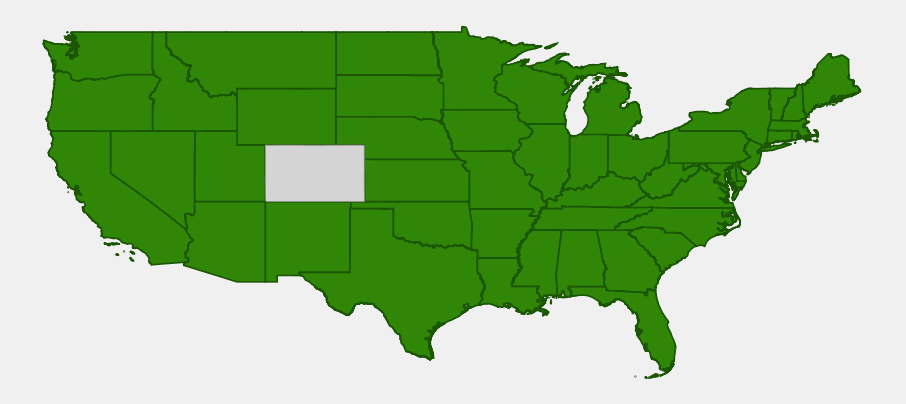
Carolina crane’s-bill is native across most of North America. The Lady Bird Johnson Wildflower Center describes it as scattered from New England to Wisconsin and British Columbia, south across the United States to Florida and on to central Mexico. USDA PLANTS records it from 47 of the lower 48 states and the District of Columbia, and in Canada from British Columbia, Alberta, Saskatchewan, Manitoba, Ontario and Quebec.
It is most abundant in the Southeast and southern Plains, where it is one of the most common spring wildflowers of fields, pastures, lawns and roadsides. Farther north and west it grows in scattered populations in dry, open woods, rocky slopes, glades, sand prairies, river bars and disturbed sites. In the West it grows in grasslands, oak woodlands and open slopes, and in California it is a native annual of grassy and disturbed places.
Because it grows so readily in disturbed soil, it has also spread far beyond its native range. It is naturalized in East Asia, including Japan and China, where it is a common weed of fields and roadsides.
📋 Regional plant lists featuring Carolina Crane’s-Bill: New York, Pennsylvania & Northern New Jersey · Idaho, Eastern Oregon & Eastern Washington · Ohio & Indiana · Montana & Wyoming · Michigan, Wisconsin & Eastern Minnesota · Kentucky & Tennessee · Nebraska, Kansas & Eastern Colorado · Utah & Western Colorado · Connecticut, Massachusetts & Rhode Island · New Hampshire, Maine & Vermont · Maryland, Virginia & West Virginia · Delaware, Southern New Jersey & Long Island · Arizona & New Mexico · Illinois, Iowa & Missouri · Alabama, Georgia & Mississippi · North & South Florida
Growing & Care Guide
Carolina crane’s-bill is rarely planted on purpose, and most gardeners meet it as a volunteer. It does have a place in naturalistic plantings, early-season pollinator meadows and dry, sunny sites where a short-lived native annual can fill gaps. It needs no care, and the main question is usually how much of it to keep.
Light
It grows best in full sun and tolerates light shade. In heavier shade plants are sparse and lanky.
Soil & Water
It grows in almost any soil, including dry, compacted, sandy, gravelly and clay soils, and it does well in poor ground where other plants struggle. It needs no watering or fertilizer. Dense, healthy turf or mulch reduces its numbers.
Planting Tips
If you want it, scatter fresh seed on bare soil in late summer or fall, when it naturally germinates. It is a good companion for spring annuals and early native wildflowers in dry meadows. It disappears by midsummer, so pair it with later-blooming perennials and grasses.
Pruning & Maintenance
No maintenance is needed. To limit self-sowing in lawns and beds, pull or mow plants before the fruits ripen in late spring. Plants are shallow-rooted and easy to pull. In lawns, improving turf density and mowing a little higher reduces it over time.
Propagation
It reproduces only by seed. Seeds germinate in fall after a period of dry summer dormancy, overwinter as small rosettes and flower the next spring. Collect ripe fruits in a paper bag, since they fling their seeds when they dry.
Landscape Uses
- Early pollinator meadows: early-spring flowers for small native bees
- Dry, disturbed sites: a native annual cover for bare, poor soil
- Naturalistic lawns: a native “lawn weed” that supports pollinators
- Nature education: its explosive seed dispersal is easy to demonstrate
- Restoration of open habitats: part of the native annual flora of glades, sand prairies and fields
Wildlife & Ecological Value
Carolina crane’s-bill is small, but because it is so common and blooms early in spring, it adds up to a meaningful food source in many landscapes.
For Pollinators
The small flowers produce nectar and pollen and are visited by small bees, such as sweat bees and mining bees, as well as flies and small butterflies. The flowers can also self-pollinate, which helps the plant set seed reliably even when insects are scarce.
For Birds
Ground-feeding birds such as mourning doves, bobwhite quail and sparrows eat crane’s-bill seeds, although they are small and scattered. The plants also host small insects that birds feed to their young in spring.
For Mammals
Rabbits and deer occasionally browse the foliage, but the hairy, tannin-rich leaves are seldom a preferred food. Small rodents eat the seeds.
Ecosystem Role
Carolina crane’s-bill is a pioneer of bare and disturbed ground. Its fall-germinating rosettes help hold soil through winter, and its ballistic seed dispersal lets it spread into nearby gaps. In glades, sand prairies and rocky barrens it is part of a rich community of small native annuals.
Cultural & Historical Uses
Linnaeus named Geranium carolinianum in 1753, from specimens collected in the Carolinas. The genus name comes from the Greek geranos, “crane,” because of the long, beak-like fruits. The plants sold as “geraniums” in garden centers belong to a different genus, Pelargonium, from southern Africa.
Like other true geraniums, Carolina crane’s-bill is rich in tannins. Several Native American peoples used crane’s-bills as astringents, applied to wounds and sores or taken for digestive complaints, and the related wild geranium was once an official remedy in American pharmacy. These are historical uses, not recommendations.
In recent years Carolina crane’s-bill has attracted research interest, particularly in Asia, where it is a widespread introduced weed and has been studied for its tannins and other compounds. In its native North America it remains a modest, overlooked wildflower of spring lawns and fields.
Frequently Asked Questions
Is Carolina crane’s-bill a weed?
It is a native plant, though it often grows as a weed in lawns, gardens and fields. It is an annual that dies by early summer, and it can be pulled easily or tolerated as an early-season pollinator plant.
Why is it called crane’s-bill?
After flowering, each fruit forms a long, slender beak that looks like the bill of a crane. The genus name Geranium comes from the Greek word for crane.
How do the seeds spread?
When the fruit dries, the five seed compartments separate, and each one is flung outward as its strip of the beak coils suddenly upward. Seeds can travel several feet from the parent plant.
Is it related to garden geraniums?
It is a true Geranium, related to perennial garden crane’s-bills. The common potted “geraniums” belong to a different genus, Pelargonium, in the same family.
How do I tell it from other small crane’s-bills?
Look for deeply divided leaves, small pale pink flowers in compact clusters at the stem tips, and short flower stalks. The non-native cut-leaved crane’s-bill has deeper pink to purple flowers on longer stalks, and dove’s-foot crane’s-bill has rounded, shallowly lobed leaves.

Looking for a nursery that carries Carolina Crane’s-Bill?
Browse our native plant nursery directory: Alabama, Arizona & Arkansas · California · Connecticut, Delaware, Florida & Georgia · Idaho, Illinois, Indiana, Iowa & Kansas · Kentucky, Louisiana, Maine, Maryland, Massachusetts, Michigan, Minnesota, Mississippi, Missouri & Montana · Nebraska, Nevada, New Hampshire, New Jersey, New Mexico, New York, North Carolina, North Dakota, Ohio & Oklahoma · Oregon · Pennsylvania, Rhode Island, South Carolina, South Dakota, Tennessee, Texas, Utah, Vermont & Virginia · Washington · West Virginia, Wisconsin & Wyoming