
Emory’s Rockdaisy (Perityle emoryi)
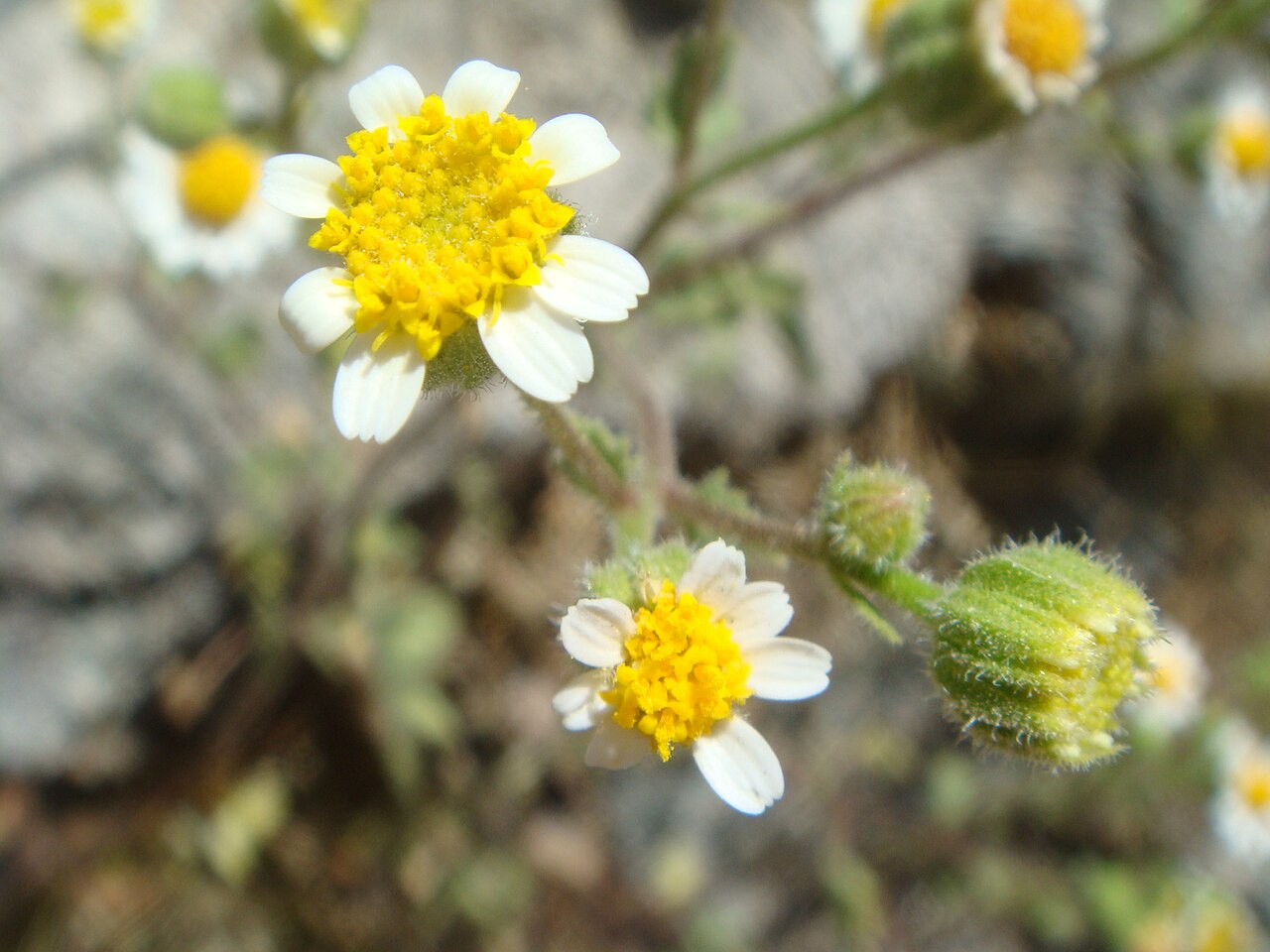
Perityle emoryi, Emory’s Rockdaisy, is a small annual wildflower of the Sonoran and Mojave deserts. It belongs to the aster family (Asteraceae) and produces cheerful little daisies, each with a ring of short white rays around a golden-yellow button of disk flowers. It grows among rocks, in canyon crevices, along washes and on gravelly slopes, and it is one of the most common spring wildflowers in many desert parks and cities from southern California to central Arizona.
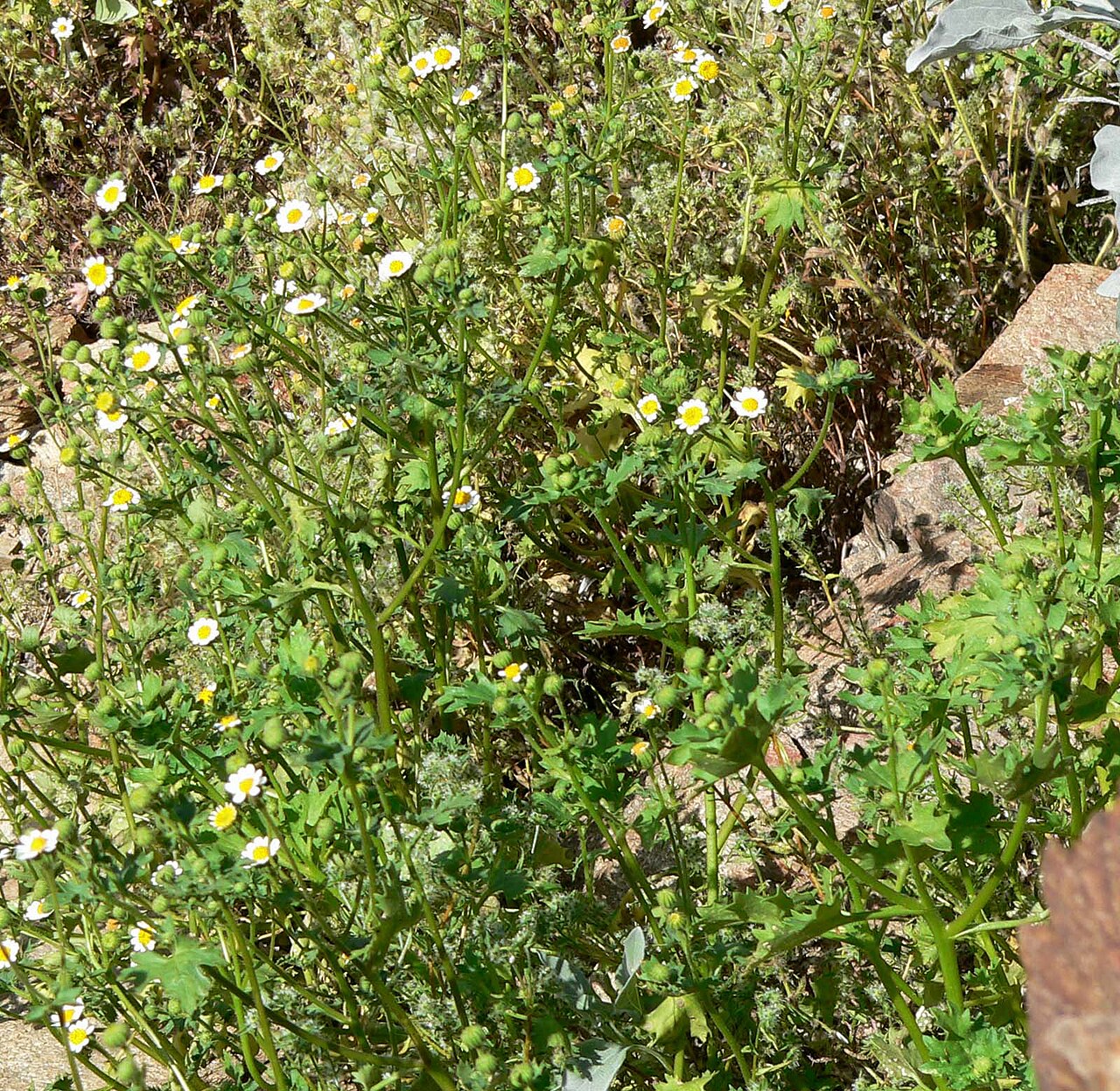
Rockdaisy is a plant of contrasts. In a dry year a plant may be only an inch or two tall with a single flower head tucked into a crack in a boulder. After good winter rains the same species can form a lush, branching mound a foot or more across, covered in flowers. Its stems and leaves are soft, often sticky with glandular hairs, and its leaves are scalloped or lobed, giving the plant a slightly fernlike, parsley-like look.
This guide covers how to recognize Emory’s rockdaisy, where it grows, how to encourage it in a desert garden from seed, and what role it plays among the spring annuals of the Southwest.
Identification
The genus Perityle includes many rockdaisies, most of them perennial and many restricted to cliffs in a few mountain ranges. Emory’s rockdaisy is the most widespread and is distinguished by being an annual with white rays, broad, toothed or lobed leaves on stalks, and a preference for low desert elevations.
Growth Form
Emory’s rockdaisy is an annual that germinates after cool-season rains. Its size depends heavily on moisture. Plants range from about an inch to 2 feet tall, with stems that may be single and delicate or thick, freely branched and sprawling. The whole plant is usually hairy and glandular, and it can feel slightly sticky.
Leaves
The leaves are alternate and borne on stalks. The blades are roughly triangular to round or heart-shaped in outline, about ½ to 2 inches long, and are coarsely toothed or cut into shallow to deep lobes. They are soft, bright to grayish green, and covered in short hairs. The variability of the leaves is one reason the plant has been described under several names.
Flowers
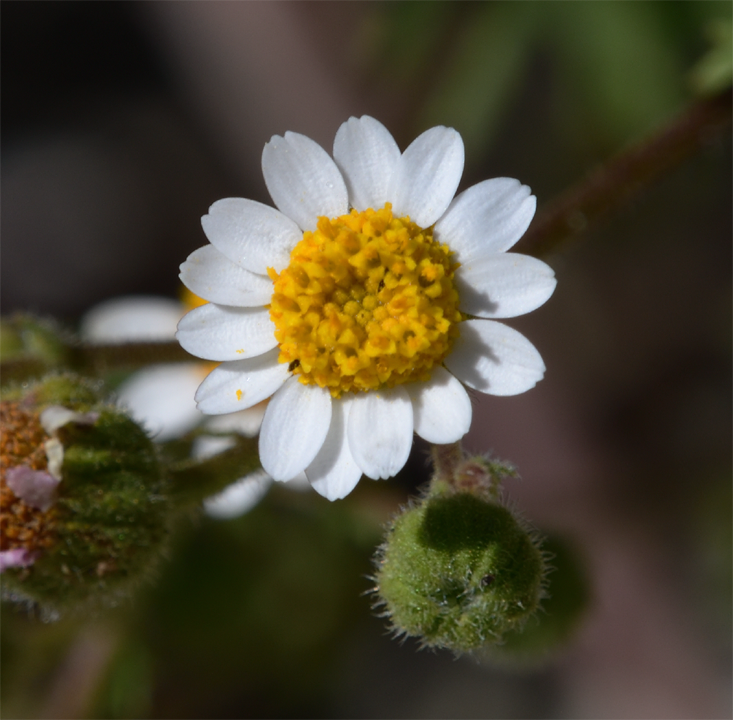
The flower heads are small, usually less than ½ inch wide, borne singly or in small clusters at the ends of the branches. Each head has a bell-shaped to hemispherical base of narrow, hairy bracts, a central disk of numerous golden-yellow tubular florets, and about 8 to 12 short, white ray florets. The rays are only a few millimeters long, so the flower looks like a miniature daisy. The main bloom is in spring, but where water is available plants can flower in almost any month.
Seeds & Look-alikes
The seeds (cypselae) are flat and dark, with thickened, hairy margins, and are often tipped with a small crown of scales and sometimes a single bristle. The genus name Perityle refers to this callused rim around the seed. Other small white-rayed desert daisies, such as fleabanes (Erigeron), have many more, very thin rays. Rock daisies of the Perityle genus that are perennial and cliff-dwelling usually have smaller, often entire or narrowly lobed leaves and may have yellow rays or none.
Quick Facts
| Scientific Name | Perityle emoryi (syn. P. emoryi var. nuda) |
| Family | Asteraceae (aster family) |
| Plant Type | Annual herb (cool-season desert annual) |
| Mature Height | 1 in–2 ft, depending on rainfall |
| Mature Spread | 2–18 in |
| Growth Rate | Fast |
| Sun Exposure | Full sun to light shade |
| Water Needs | Low; grows on winter rain and dies back in summer drought |
| Soil Type | Rocky, gravelly or sandy, well-drained soil; rock crevices |
| Soil pH | About 6.5–8.5 |
| Bloom Time | Mainly February–May; sporadically year-round with moisture |
| Flower Color | White rays around a golden-yellow disk |
| Fall Color | None; annual |
| Fruit | Small flat seed (cypsela) with a callused, hairy rim |
| Deer Resistant | Not usually browsed |
| USDA Hardiness Zones | Annual; suited to frost-light desert climates (about zones 8–11) |
Native Range
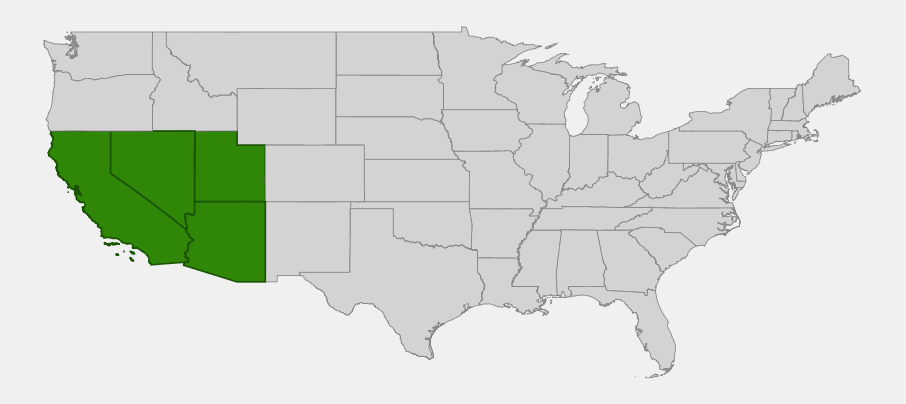
Emory’s rockdaisy is native to the deserts of the American Southwest and northwestern Mexico. USDA PLANTS records it as native in California, Nevada, Utah and Arizona. It is common throughout the Sonoran Desert of southern Arizona and southeastern California and extends into the Mojave Desert of southern Nevada and the far southwestern corner of Utah. In Mexico it grows in Baja California, Baja California Sur, Sonora and Sinaloa and on Guadalupe Island.
In southern California it is mostly a desert plant, but it also turns up occasionally near the coast and in the Peninsular Ranges, and it becomes widespread through much of the Baja California peninsula. It is common in urban desert parks and on disturbed ground, and botanists note that its range appears to be expanding. Remarkably, the same species also occurs in coastal deserts of western South America, an example of the “amphitropical” distributions shared by several desert plants of North and South America.
Outside its native range it has been introduced to Hawaii, where it grows in disturbed, dry places on some islands. Within the Southwest it is a natural and welcome part of the spring wildflower display, often appearing alongside poppies, lupines and brittlebush.
📋 Regional plant lists featuring Emory’s Rockdaisy: Idaho, Eastern Oregon & Eastern Washington · Utah & Western Colorado · Arizona & New Mexico · California & Nevada
Growing & Care Guide
Emory’s rockdaisy is rarely sold as a nursery plant, but it is easy to establish from seed in a desert garden and often arrives on its own. Once it has set seed in a garden, it usually returns in good rain years without further effort.
Light
Grow it in full sun or light shade. In the low desert it does well with some afternoon shade from rocks or shrubs, which is where it often grows in the wild.
Soil & Water
Rockdaisy needs well-drained, rocky, gravelly or sandy soil. It is ideal for rock gardens, gravel mulch, boulder plantings and the cracks of retaining walls. Natural winter rain is usually enough. In dry winters, an occasional deep watering from late fall into spring extends flowering and produces larger plants. Stop watering once plants begin to dry in late spring. No fertilizer is needed.
Planting Tips
Scatter seed in fall (October to December) on bare, raked soil or among rocks and press it into the surface. Do not bury it deeply. Germination follows the first good rains, and plants bloom in late winter and spring. Combine it with other desert annuals such as poppies, lupines and desert bluebells for a natural wildflower display.
Pruning & Maintenance
There is little to do. Let the plants go to seed before pulling the dried stems, or leave them in place to scatter seed naturally. Because it can be somewhat weedy in irrigated beds, thin seedlings where they are not wanted.
Propagation
Propagation is by seed only. Collect seeds from dry heads in late spring and store them dry until fall sowing. Seeds germinate readily without special treatment when sown into cool, moist soil.
Landscape Uses
- Desert wildflower gardens: an easy spring annual for naturalistic desert plantings
- Rock gardens and walls: thrives in crevices, boulder piles and gravel mulch
- Revegetation of disturbed desert ground: a fast colonizer of washes, road cuts and bare soil within its native range
- Pollinator gardens: small flowers for native bees, flies and other small insects
- Containers and troughs: a delicate seasonal filler in dry, gritty container mixes
Wildlife & Ecological Value
Desert annuals such as Emory’s rockdaisy form the base of the spring food web in the Sonoran and Mojave deserts. In good years they briefly carpet rocky slopes and washes with flowers and later supply huge numbers of seeds.
For Pollinators
The small daisies are open and easy to reach, and they are visited by a range of small native bees, flies, beetles and other insects that forage on desert composites. Because rockdaisy can bloom early in the year and keep flowering after other annuals finish where moisture lingers, it extends the flowering season in rocky habitats.
For Birds
Seed-eating desert birds such as sparrows, finches and quail feed on the seeds of many small desert annuals, and rockdaisy contributes to this seed supply in good years.
For Mammals
Desert rodents, including pocket mice and kangaroo rats, collect and cache seeds of desert annuals. The soft foliage may be eaten by rabbits and other small herbivores.
Ecosystem Role
As a cool-season annual, rockdaisy survives the long dry season as seed in the soil seed bank. It rapidly covers bare ground after rain, holding soil in washes and on disturbed slopes, and its tendency to colonize disturbed sites helps it persist in urban desert areas.
Cultural & Historical Uses
The species was described by John Torrey from specimens collected during William H. Emory’s military reconnaissance across the Southwest in the 1840s. Emory, an army engineer, later led the U.S.–Mexican Boundary Survey, and many desert plants collected on those expeditions carry his name.
The genus name Perityle comes from Greek words meaning “around” and “callus” or “swelling,” referring to the thickened rim around the margin of each seed. Botanists have long studied Perityle emoryi because of its variability: it occurs as several different chromosome races (it is polyploid), and its size and leaf shape change dramatically with growing conditions.
We have not found documented traditional uses of Emory’s rockdaisy. Its appeal today is simple: it is one of the cheerful small daisies that greet hikers in desert canyons and city parks each spring, and a good example of how desert annuals wait as seed for the right rains.
Frequently Asked Questions
Is Emory’s rockdaisy an annual or a perennial?
It is an annual. Seeds germinate after cool-season rains, plants flower in late winter and spring (or whenever moisture allows), set seed and die. Most other rockdaisies in the genus are perennials.
Where can I see Emory’s rockdaisy?
Look on rocky slopes, canyon walls, washes and roadsides in the Sonoran and Mojave deserts, including desert parks around Phoenix, Tucson and Palm Springs. It blooms most heavily from February to May after a wet winter.
Can I grow Emory’s rockdaisy in my garden?
Yes, in desert regions. Sow seed in fall on bare, well-drained gravelly soil or among rocks. Natural winter rain is usually enough, and plants will reseed in later years.
Is Emory’s rockdaisy weedy?
It colonizes disturbed ground and can seed into irrigated beds, but it is a native annual that is easy to pull. Within its native range it is a welcome wildflower. It has been introduced to Hawaii, where it grows in disturbed dry sites.
Why does it look so different from place to place?
Its size depends on water. In dry years plants may be tiny and single-flowered, while in wet years they become branching mounds with dozens of heads. The species also includes several genetic races, which adds to the variation.

Looking for a nursery that carries Emory’s Rockdaisy?
Browse our native plant nursery directory: Arizona · California · Nevada · Utah