
Woolly Mule’s Ears (Wyethia mollis)
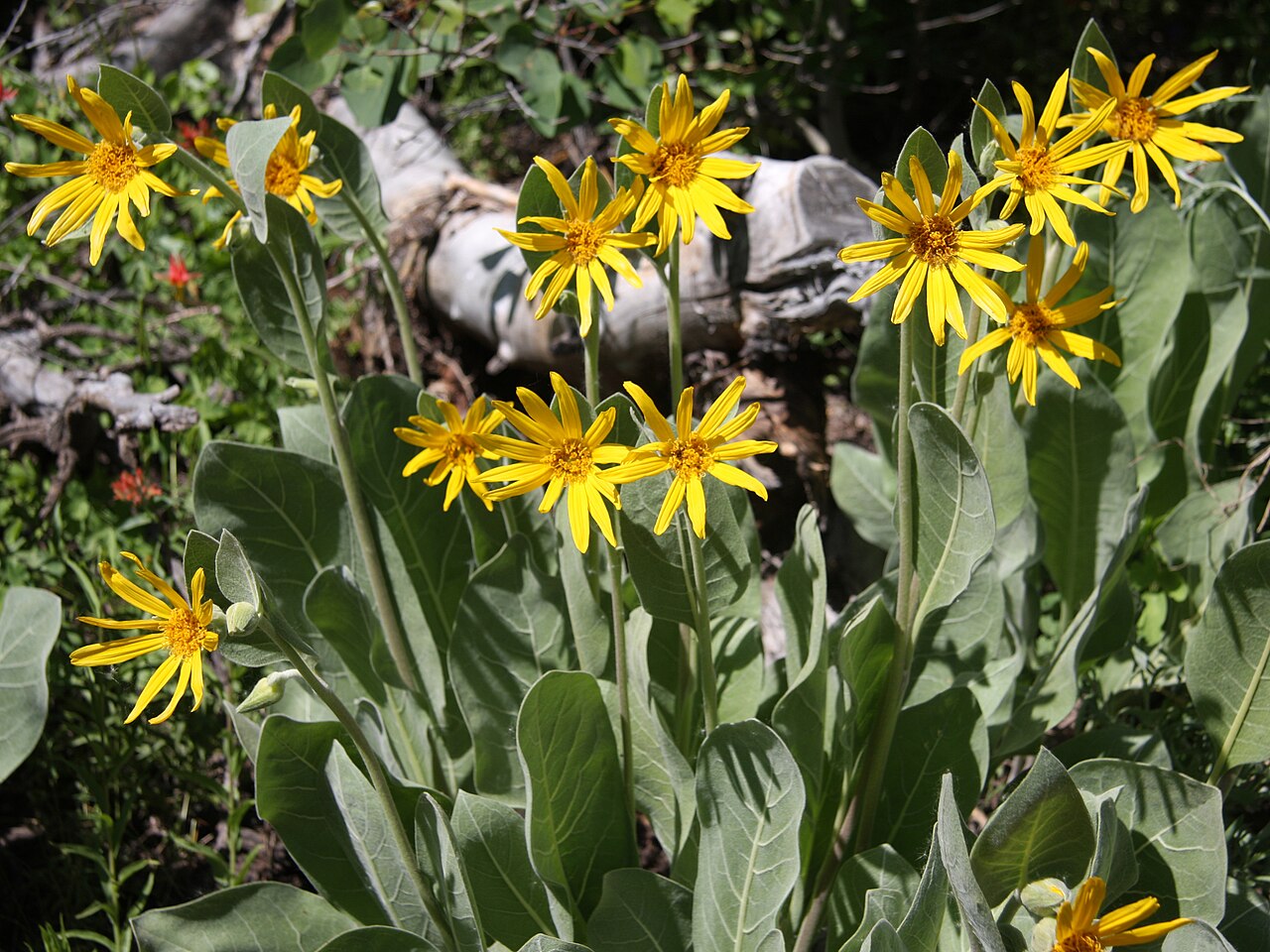
Wyethia mollis, known as Woolly Mule’s Ears (USDA: woolly mule-ears), is a big, bold perennial sunflower relative of the mountains of California, western Nevada and southern Oregon. It belongs to the aster family (Asteraceae). In early summer it forms clumps of huge, upright, gray-green leaves up to about 16 inches long, thickly covered with soft white wool, and sends up stems 1 to 3 feet tall topped with bright yellow, sunflower-like flower heads 2 to 4 inches across.
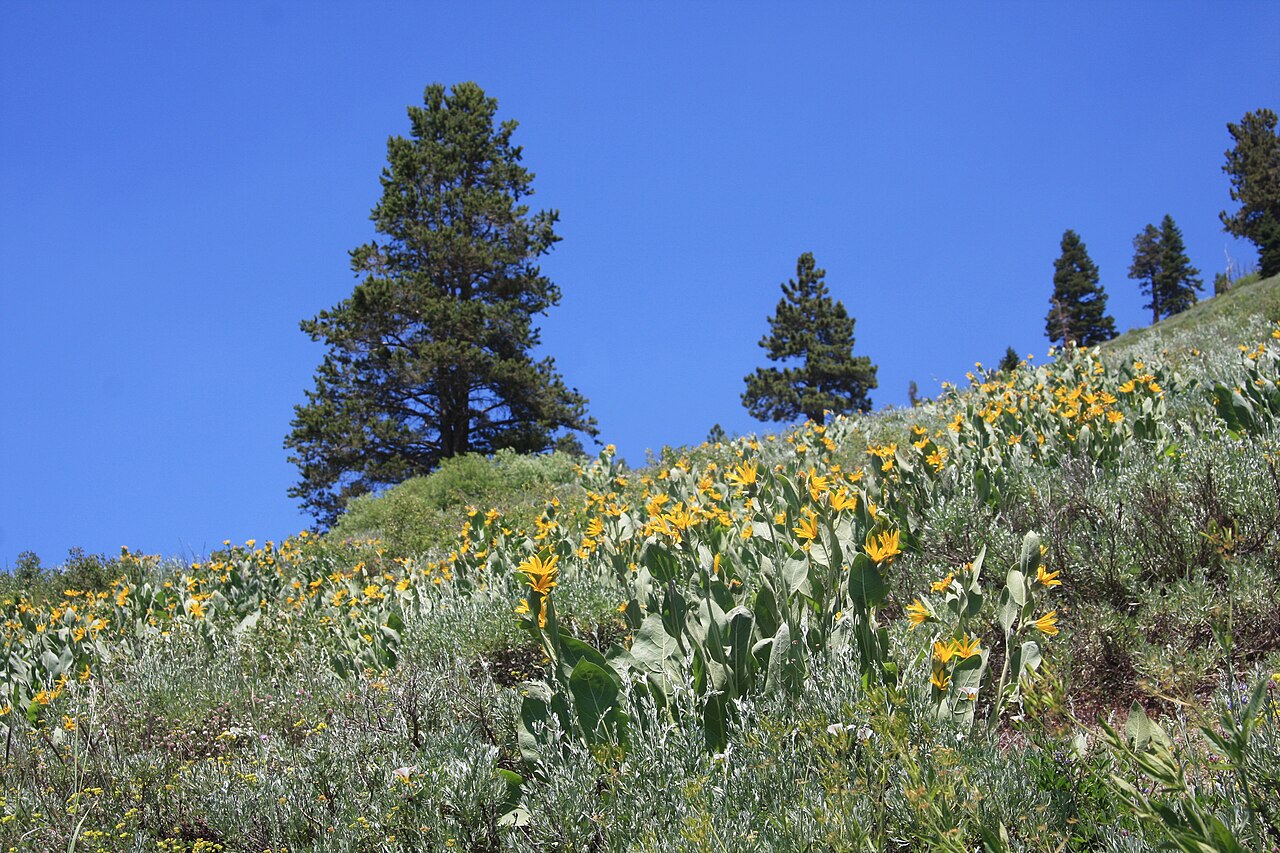
The name comes from the leaves, which stand up in a clump like a mule’s long, furry ears. The species name mollis means “soft,” for the velvety hairs. In the Sierra Nevada and southern Cascades it often grows in great colonies, turning dry, open slopes, sagebrush flats and pine-forest openings gold for a few weeks in late spring and summer.
Woolly mule’s ears is long-lived and very drought-tolerant once established, thanks to a thick, deep taproot. By late summer the leaves dry to a crisp tan and the plant goes dormant until the snow melts the next year. It is a fine plant for dry mountain and high-desert gardens and an important early-summer food source for native bees.
Identification
Woolly mule’s ears is easy to recognize: large, upright, densely woolly leaves in clumps, and big yellow daisy-like heads on short, leafy stems. The gray, felted look of the whole plant sets it apart from other mule’s ears.
Growth Habit
Each plant grows from a thick, woody taproot that can reach deep into rocky soil. It produces a clump of basal leaves and several stems 1 to 3 feet tall. Older plants form large clumps, and plants often grow so densely that they cover entire slopes.
Leaves
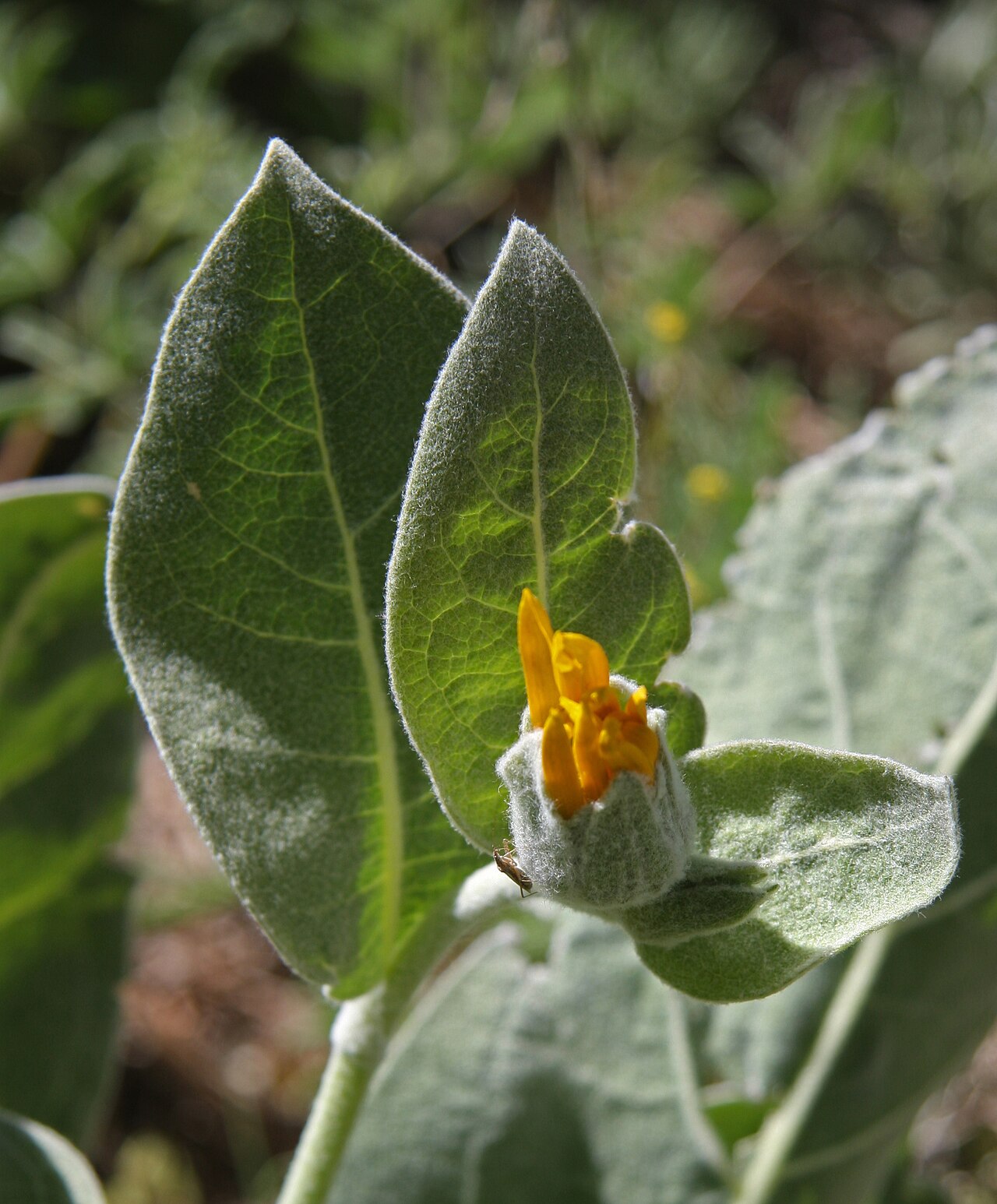
The basal leaves are elliptic to lance-shaped, 8 to 16 inches long and 2 to 6 inches wide, with smooth edges and long stalks. They stand upright or angle outward. Both sides are covered with dense, white to gray, felt-like hairs when young; some leaves become greener and less hairy as summer goes on. The stem leaves are smaller. When dry in late summer, the leaves turn tan and rustle in the wind.
Flowers
Each stem carries one to a few large flower heads, the largest at the top. A head has a ring of bright yellow ray flowers, each about 1 to 2 inches long, around a broad yellow center of disk flowers. The green bracts under the head are woolly, like the leaves. Flowering runs from May at lower elevations to August near timberline.
Fruit & Seeds
The flowers produce four-sided, oblong seeds (cypselae, often called achenes) about 1/3 inch long, usually with a small crown of scales at the top. They ripen in mid to late summer and drop near the parent plant, where many are taken by rodents and birds.
Look-alikes
Narrowleaf Mule’s Ears (W. angustifolia) has narrower, rough, mostly green leaves and grows mostly at lower elevations, in foothill and valley grasslands. Gray Mule’s Ears (W. helenioides) of the foothills has woolly young leaves too, but much larger flower heads and leaves that turn green with age. Mountain mule’s ears (W. amplexicaulis) has shiny, sticky, resin-scented green leaves. Arrowleaf Balsamroot has silvery, arrowhead-shaped leaves instead of long, oval ones. Mule’s ears species also hybridize where they meet.
Safety
Woolly mule’s ears is not known to be toxic to people or pets. As with any wild plant, do not eat it unless you are certain of its identity and safety, and leave wild plants in place.
Quick Facts
| Scientific Name | Wyethia mollis |
| Family | Asteraceae (aster family) |
| Plant Type | Long-lived herbaceous perennial with a deep taproot |
| Mature Height | 1–3 ft |
| Mature Spread | 2–3 ft |
| Growth Rate | Slow |
| Sun Exposure | Full sun to light shade |
| Water Needs | Low; moist in spring, dry in summer |
| Soil Type | Well-drained, rocky, gravelly, sandy or volcanic soil |
| Soil pH | About 5.5–7.5 |
| Bloom Time | May–August, depending on elevation |
| Flower Color | Bright yellow |
| Fall Color | Leaves dry to tan by late summer |
| Fruit | Four-sided seeds (achenes) |
| Deer Resistant | Yes, generally |
| USDA Hardiness Zones | 4–8 |
Native Range
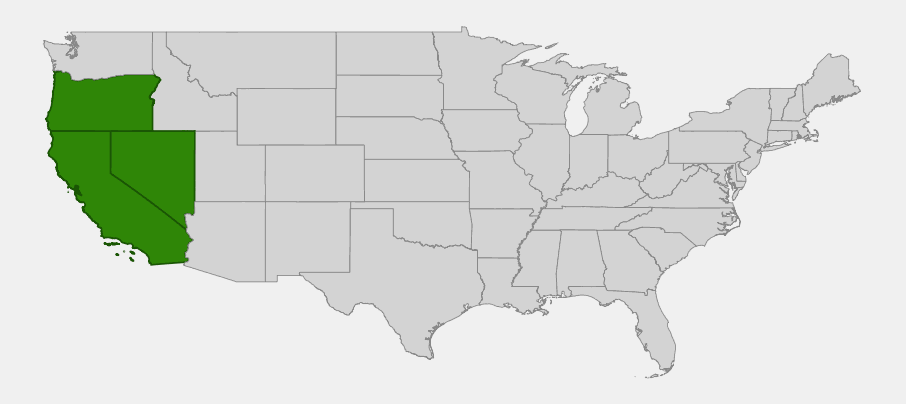
Woolly mule’s ears is native to the far western United States. USDA PLANTS lists it as native in the lower 48 states and records it from three states: California, Nevada and Oregon. It is not recorded from Canada.
Its main range is the Sierra Nevada of California and Nevada, including the Lake Tahoe basin and the Carson Range, north through the Modoc Plateau and Warner Mountains to the southern Cascades. In Oregon it grows in the south-central part of the state, mostly on the east side of the Cascades. It also reaches the high ranges along the western edge of the Great Basin in Nevada.
It grows on dry, open slopes, sagebrush flats, meadow edges and openings in Jeffrey pine, ponderosa pine, lodgepole pine and red fir forests, usually on well-drained volcanic or granitic soils, from about 4,000 feet up to near timberline. It often increases after fire, logging or grazing, when competing plants are thinned.
📋 Regional plant lists featuring Woolly Mule’s Ears: Idaho, Eastern Oregon & Eastern Washington · California & Nevada
Growing & Care Guide
Woolly mule’s ears is a striking plant for dry, sunny gardens in its home region and similar mountain and high-desert climates. It is offered by some native nurseries and seed suppliers in California and Nevada. It is slow to establish and does not like being moved, so start with seed or small container plants and choose a permanent spot.
Light
Full sun gives the most flowers and the most compact clumps. It tolerates light shade at the edge of open pine woodland.
Soil & Water
Plant it in lean, fast-draining soil: rocky, gravelly, sandy or volcanic soil is ideal. It needs moisture in spring and then a dry summer. Water young plants occasionally during their first summer; once the taproot is established, stop summer watering, which can cause rot. Avoid heavy, wet clay and rich, fertilized soil.
Planting Tips
Plant small container plants in fall or early spring, disturbing the roots as little as possible. Space them 2 to 3 feet apart. It looks best in drifts with sagebrush, bitterbrush, buckwheats, penstemons and bunchgrasses, in a dry meadow, rock garden or fire-wise mountain landscape.
Pruning & Maintenance
Little care is needed. Remove the dried leaves and stems in fall or leave them until spring for winter interest and wildlife cover. Expect the plant to look tan and dormant by late summer; this is normal. Established plants rarely need dividing and resent disturbance.
Propagation
Grow it from seed. Sow seed outdoors in fall, or give it a cold, moist stratification of about two to three months before sowing in spring. Seedlings grow a deep taproot first and may take several years to bloom. Transplant seedlings while they are young, using deep pots.
Landscape Uses
- Dry mountain gardens: bold foliage and big yellow flowers in early summer
- High-desert and sagebrush landscapes: a long-lived, drought-tolerant perennial
- Pollinator gardens: abundant nectar and pollen for native bees
- Fire-adapted landscapes: resprouts from its deep taproot after fire
- Erosion control and restoration: holds dry, rocky slopes with its deep roots
Wildlife & Ecological Value
Woolly mule’s ears is a dominant plant in many Sierra Nevada and southern Cascade landscapes, and its flowers and seeds feed many animals.
For Pollinators
The large flower heads attract many native bees, including bumblebees, leafcutter bees and mining bees, as well as butterflies, flies and beetles. Its mass bloom in late spring and early summer is a major food source in the mountains.
For Birds
Finches, juncos and other seed-eating birds eat the seeds, and the dense clumps give cover to ground-feeding birds.
For Mammals
Chipmunks, ground squirrels and mice collect the seeds. Deer and livestock generally eat little of it because of its woolly, aromatic leaves, which is one reason mule’s ears often increases in heavily grazed areas.
Ecosystem Role
The deep taproots let woolly mule’s ears survive drought, fire and grazing and resprout quickly, so it holds soil on slopes after disturbance. Dense stands can compete strongly with tree seedlings and other plants, especially on cleared or burned sites.
Cultural & Historical Uses
The genus Wyethia is named for Nathaniel Jarvis Wyeth, a Massachusetts businessman who led trading expeditions to Oregon in the 1830s. Botanist Thomas Nuttall traveled with him in 1834 and named the genus in his honor. Woolly mule’s ears was later described by Asa Gray.
Native peoples of California and the Great Basin used several species of mule’s ears. The oily seeds were gathered and eaten, the roots were cooked, and the plants were used in traditional medicine. As with all wild foods, these uses relied on detailed traditional knowledge.
For hikers around Lake Tahoe, Yosemite and Mammoth Lakes, woolly mule’s ears is one of the signature wildflowers of early summer. The gold slopes of blooming mule’s ears, followed by the rustling tan leaves of late summer, are part of the seasonal rhythm of the Sierra Nevada.
Frequently Asked Questions
Why is it called woolly mule’s ears?
Its large, upright leaves look like a mule’s long ears, and they are covered in soft, woolly hairs. The species name mollis means soft.
Is woolly mule’s ears easy to grow?
It is easy in the right conditions: full sun, fast-draining soil and dry summers. It grows slowly from seed, may take several years to bloom, and does not tolerate being transplanted once established.
When does it bloom?
From May at lower elevations to August near timberline, usually peaking in June and July.
Why does it look dead in late summer?
It goes dormant after setting seed. The leaves dry to tan, and the plant regrows from its deep taproot after the snow melts.
How is it different from other mule’s ears?
Its leaves are densely gray-woolly rather than green and rough (narrowleaf mule’s ears) or shiny and sticky (mountain mule’s ears), and it grows mainly in the high Sierra Nevada and southern Cascades.

Looking for a nursery that carries Woolly Mule’s Ears?
Browse our native plant nursery directory: California · Nevada · Oregon