
Nuttall’s Snapdragon (Sairocarpus nuttallianus)
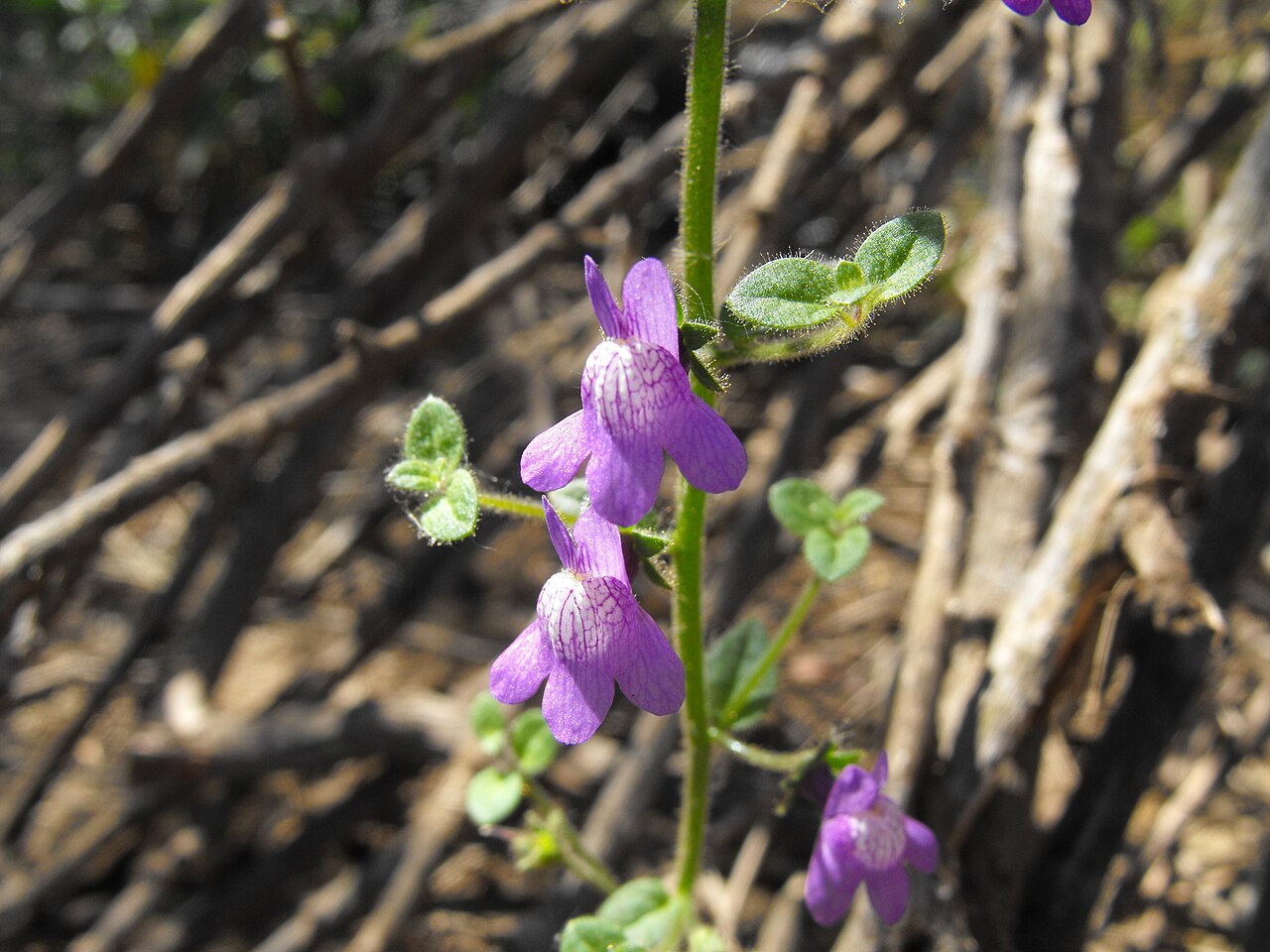
Sairocarpus nuttallianus, known as Nuttall’s Snapdragon or violet snapdragon, is a small native snapdragon of southern California, Arizona and Baja California. It belongs to the plantain family (Plantaginaceae), which now includes the snapdragons. USDA PLANTS accepts the name Sairocarpus nuttallianus; many field guides and older floras list it as Antirrhinum nuttallianum.
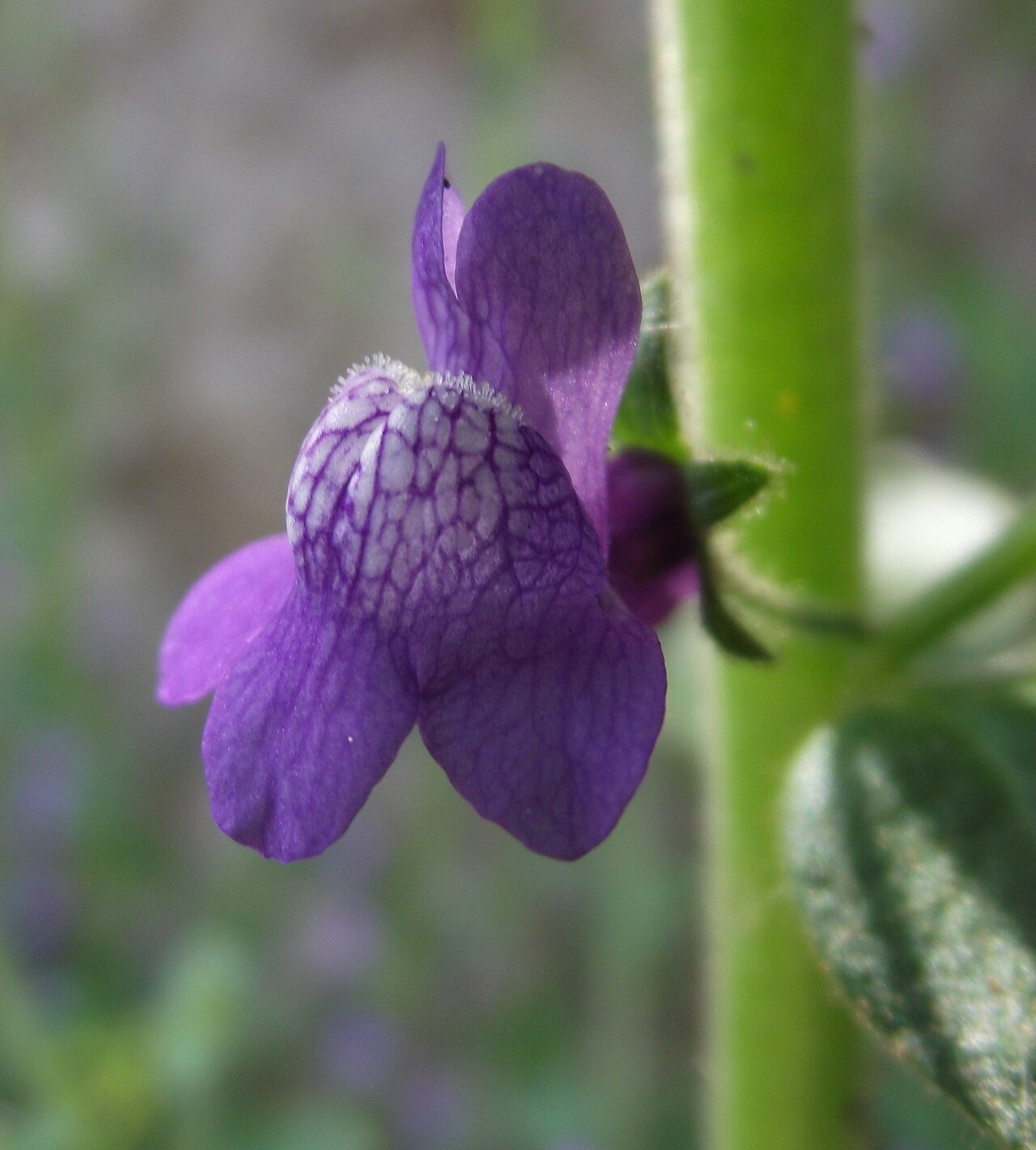
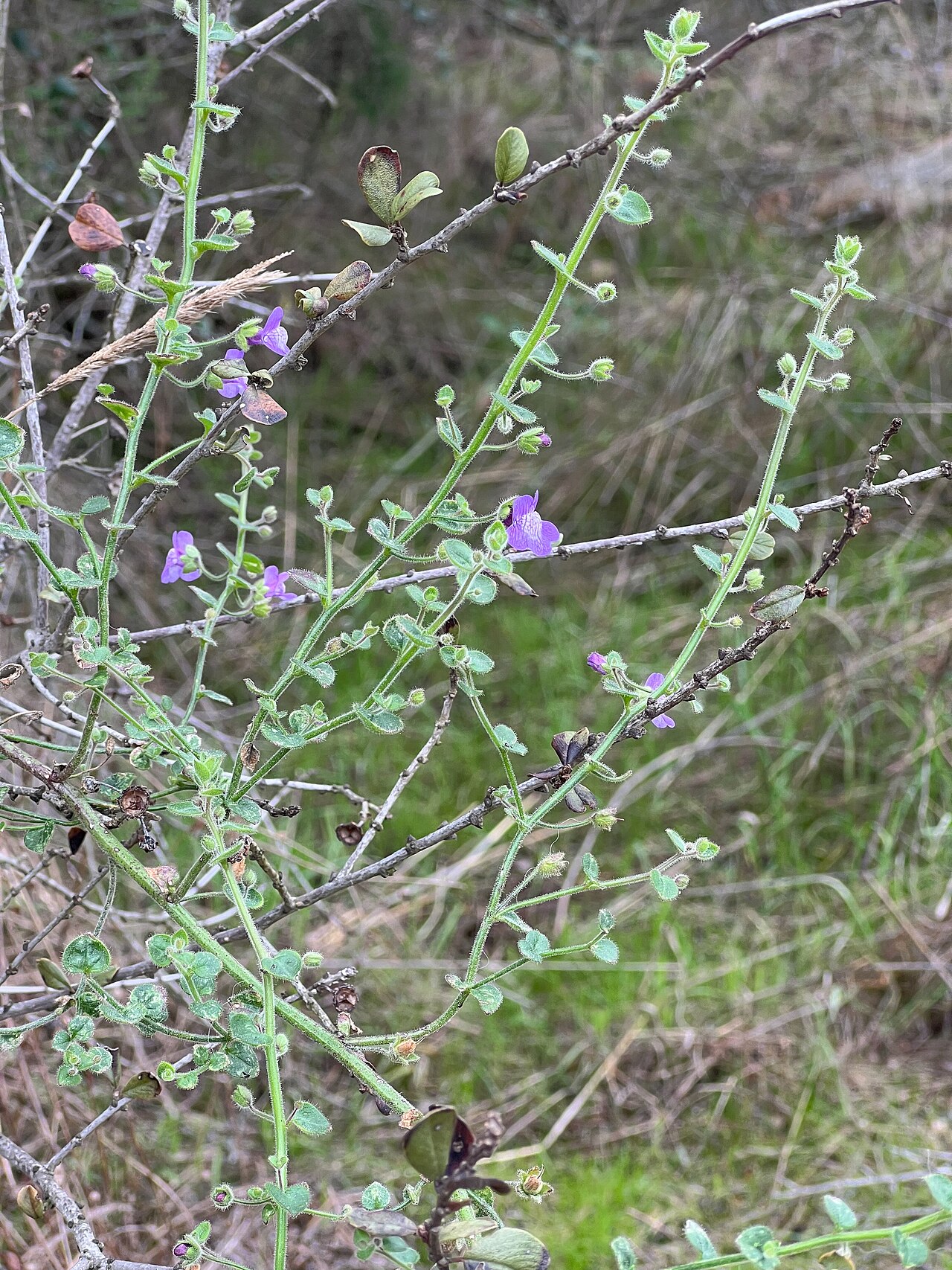
It is an annual or short-lived biennial with slender, glandular-hairy stems that grow upright or scramble up through shrubs, sometimes clinging loosely with small twisting branchlets. In spring it bears small, two-lipped flowers about 1/2 inch long, light violet with darker veins and white patches, on short stalks in the leaf axils. They look like tiny versions of the garden snapdragon.
Nuttall’s snapdragon is common in coastal sage scrub and chaparral, especially on rocky slopes, sandstone bluffs and in openings after fire or disturbance. It is easy to grow from seed in dry, sunny gardens and attracts small native bees.
Identification
Look for a slender, sticky-hairy annual scrambling through dry shrubs in spring, with small, violet, veined snapdragon-like flowers on short stalks.
Growth Habit
This is an annual or biennial herb, usually 1 to 3 feet tall. Stems are thin and often branched, growing upright or leaning on nearby shrubs for support. Unlike some related snapdragons it does not twine tightly; it holds on loosely with small, twisting side branches. The whole plant is covered in sticky, glandular hairs.
Leaves
The leaves are small, oval to egg-shaped, about 1/2 to 1 1/2 inches long, soft and hairy, with short stalks. Lower leaves are usually opposite and upper ones alternate.
Flowers
Flowers bloom mainly from March to June, sometimes later. Each is about 1/2 inch long, with a two-lipped corolla: an upper lip of two lobes and a lower lip of three lobes with a raised, pale palate that closes the throat. The color is light violet to lavender with darker purple veins and white patches. Flowers are borne singly on short stalks in the upper leaf axils.
Fruit & Seeds
The fruit is a small, rounded capsule that opens by pores near the top, scattering many tiny, dark, ridged seeds.
Look-alikes
White snapdragon (Sairocarpus coulterianus) has white to pale lavender flowers in a dense, spike-like cluster at the top of the stem. Twining snapdragons such as Antirrhinum kelloggii wrap tightly around supports with thread-like stalks. Blue toadflax has narrow, linear leaves and flowers with a long, slender spur. Nuttall’s snapdragon has oval leaves, sticky hairs and violet flowers spaced along the stems.
Safety Notes
Nuttall’s snapdragon is not known to be toxic. The sticky hairs can feel unpleasant but are harmless.
Quick Facts
| Scientific Name | Sairocarpus nuttallianus (syn. Antirrhinum nuttallianum) |
| Family | Plantaginaceae (plantain family) |
| Plant Type | Annual or short-lived biennial wildflower |
| Mature Height | 1–3 ft |
| Mature Spread | 1–3 ft (sprawling) |
| Growth Rate | Fast |
| Sun Exposure | Full sun to light shade |
| Water Needs | Very low; winter rain only |
| Soil Type | Sandy, rocky or gravelly, well-drained |
| Soil pH | About 6.0–8.0 |
| Bloom Time | March–June (sometimes later) |
| Flower Color | Light violet with darker veins and white patches |
| Fall Color | None; annual |
| Fruit | Small round capsules with tiny seeds |
| Deer Resistant | Moderately; sticky-hairy foliage |
| USDA Hardiness Zones | Grown as a cool-season annual; zones 9–11 |
Native Range
Nuttall’s snapdragon is native to southern California, Arizona and Baja California, Mexico. USDA PLANTS lists it as native in Arizona and California. Most populations are in southern California, from the immediate coast to the inland Coast, Transverse and Peninsular Ranges, especially in Los Angeles, Orange, Riverside and San Diego counties. Records in Arizona are at the eastern edge of its range.
It is especially common in coastal sage scrub and chaparral of San Diego County and the Peninsular Ranges, and it extends south through the coastal hills of northern Baja California.
Calscape lists its natural settings as sandstone bluffs, openings in coastal sage scrub or chaparral, dunes, rocky slopes, roadsides and disturbed places. It often appears in large numbers in the first spring or two after a wildfire.
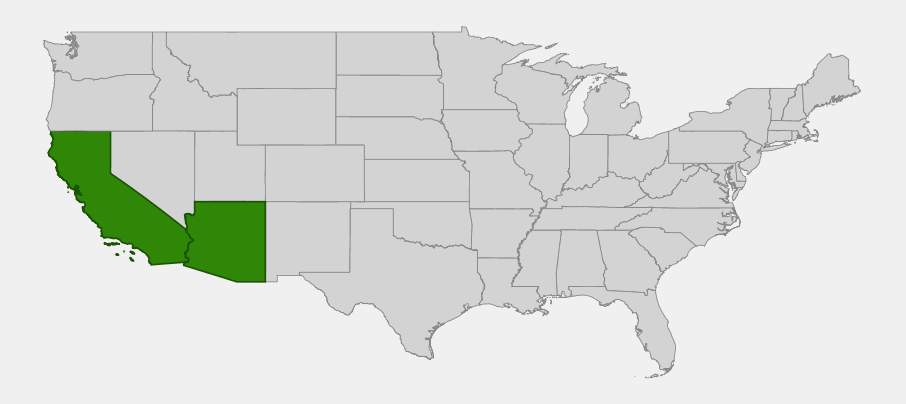
📋 Regional plant lists featuring Nuttall’s Snapdragon: Arizona & New Mexico · California & Nevada
Growing & Care Guide
Nuttall’s snapdragon is grown from seed, which is sometimes offered by native seed suppliers in southern California. It is a cool-season annual for dry, sunny gardens.
Light
Full sun is best; it also grows in the light shade of shrubs, where it can climb up through the branches.
Soil & Water
Give it well-drained sandy, rocky or gravelly soil. Winter rain is usually enough. In a dry winter, water occasionally until it flowers. No summer water is needed, since the plants die after setting seed.
Planting Tips
Scatter seed in fall on bare, raked soil where it will get winter rain. Plant it among low shrubs such as California sagebrush or buckwheat so the stems have something to lean on, or let it ramble over a sunny slope.
Pruning & Maintenance
No pruning is needed. Leave plants in place until the capsules ripen and drop seed, then pull the dry stems. With open, undisturbed soil it reseeds in following years.
Propagation
Grow it from seed sown in fall. The seeds are tiny; press them onto the soil surface rather than burying them. Germination is usually best after cool, wet weather.
Landscape Uses
- Native wildflower gardens: delicate violet flowers among coastal sage scrub shrubs
- Post-fire and slope plantings: quick, temporary cover on disturbed, sunny ground
- Pollinator gardens: small native bees visit the flowers
- Habitat restoration: part of the annual flora of coastal sage scrub and chaparral
- Natural, low-water landscapes: grows on winter rain alone
Wildlife & Ecological Value
Nuttall’s snapdragon is a small plant, but it is part of the burst of annual wildflowers that feeds pollinators in southern California each spring.
For Pollinators
Like other snapdragons, the closed throat must be pushed open by a visiting insect, so bees strong enough to open it, such as bumble bees and other native bees, are the main pollinators.
For Birds
Small seed-eating birds may glean the tiny seeds from the ground after the capsules open.
For Mammals
The sticky, hairy foliage is not a favored food, though rabbits may nibble young plants.
Ecosystem Role
As a fire-follower and colonizer of open ground, it helps cover bare soil after fire or disturbance and adds flowers and seeds to the habitat before the shrubs grow back.
Cultural & Historical Uses
The plant was first described by George Bentham as Antirrhinum nuttallianum, honoring the naturalist Thomas Nuttall, who collected plants in southern California in the 1830s. In 1988 botanist David A. Sutton, in his study of the snapdragon tribe, separated the New World snapdragons from the Old World Antirrhinum and placed this species in the genus Sairocarpus.
USDA PLANTS uses the name Sairocarpus nuttallianus, while some other sources keep the New World species in Antirrhinum. Both names refer to the same plant.
Plants with nearly stalkless flowers were once named Antirrhinum subsessile, and the small-flowered Antirrhinum pusillum (Sairocarpus pusillus) of Baja California is also now included in this species; both names are listed as synonyms.
Frequently Asked Questions
Is Nuttall’s snapdragon the same as Antirrhinum nuttallianum?
Yes. USDA PLANTS accepts the name Sairocarpus nuttallianus, and Antirrhinum nuttallianum is the older, widely used synonym.
Is Nuttall’s snapdragon an annual?
It is usually an annual, sometimes living a second year as a biennial. It sprouts with winter rains and blooms in spring.
Where does it grow?
In coastal sage scrub, chaparral openings, bluffs, dunes and rocky slopes of southern California and Baja California, with records also in Arizona.
Does it climb?
It leans on and scrambles through shrubs, holding on loosely with twisting side branches, but it does not twine tightly like some other native snapdragons.
How do I grow it?
Scatter seed in fall on bare, well-drained soil in full sun. Winter rain is usually enough, and plants will reseed if left to drop their seeds.

Looking for a nursery that carries Nuttall’s Snapdragon?
Browse our native plant nursery directory: Arizona · California

