
Valley Tassels (Castilleja attenuata)
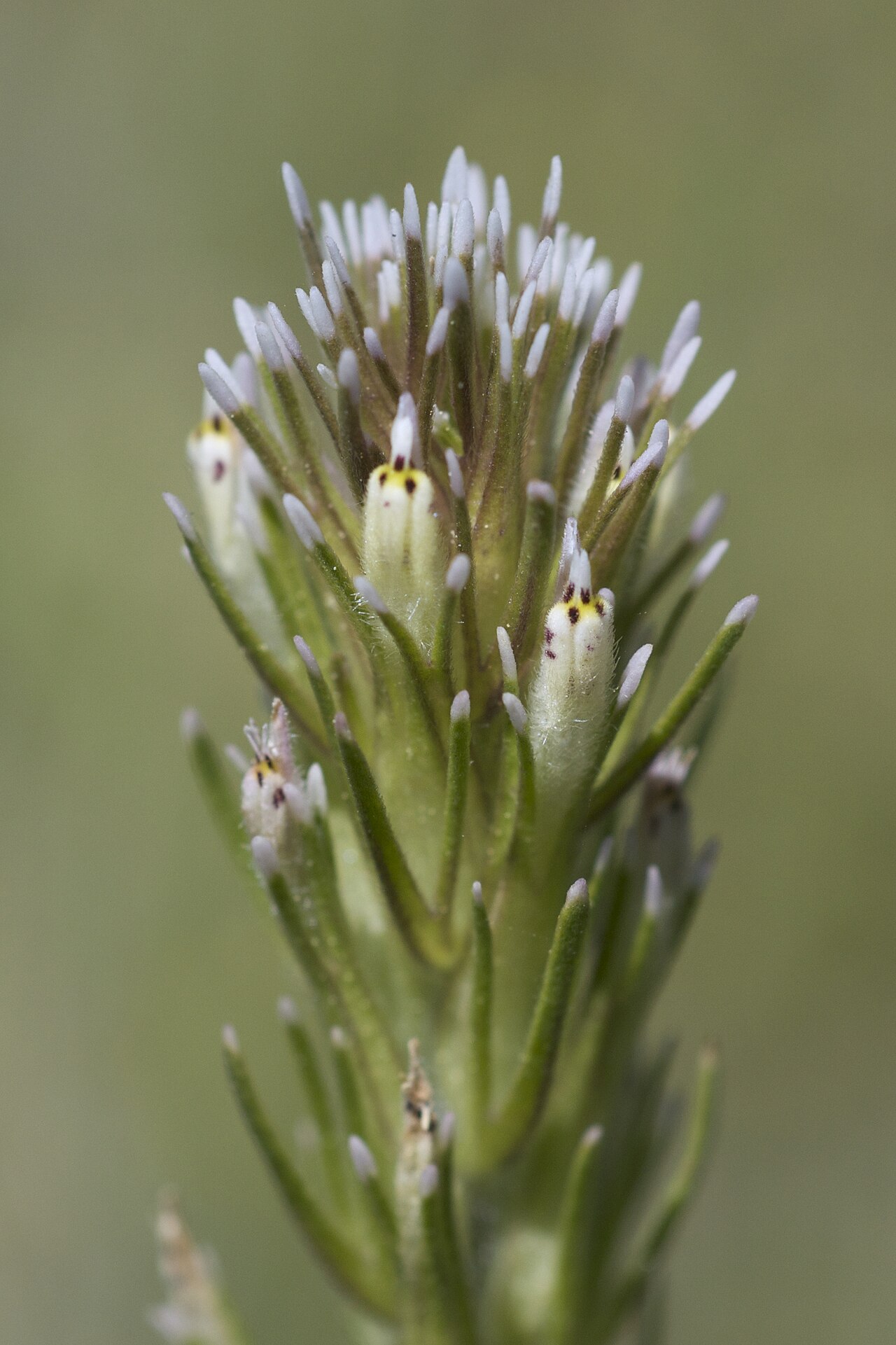
Castilleja attenuata, known as Valley Tassels, is a slender annual wildflower of the grasslands and open oak woodlands of the Pacific Coast. USDA PLANTS calls it attenuate Indian paintbrush, and it is also known as narrowleaf owl’s-clover. For many years it was called Orthocarpus attenuatus, and it was moved to the paintbrush genus Castilleja in the 1990s. It belongs to the broomrape family (Orobanchaceae), the family that now holds the paintbrushes, owl’s-clovers and louseworts.
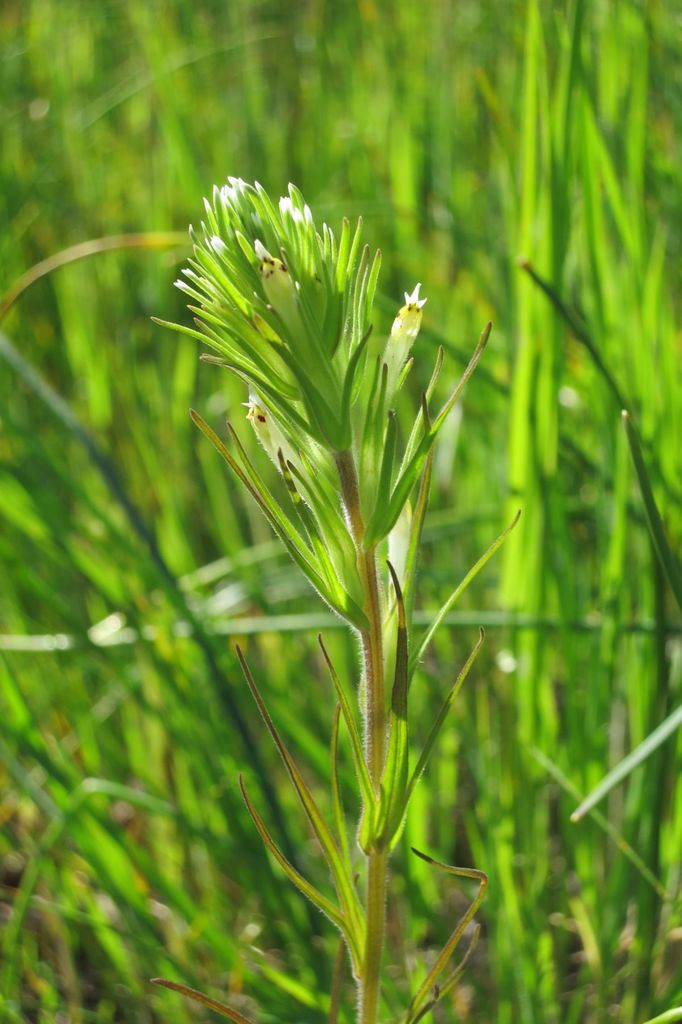
In spring it sends up thin, wiry stems 4 to 18 inches tall, topped by a narrow spike of white-tipped bracts and tiny white to pale yellow flowers dotted with purple. Seen in a meadow, the pale spikes look like small tassels or paintbrushes dipped in white paint, scattered through the grass among goldfields, lupines and brodiaeas.
Like other paintbrushes, valley tassels is a root hemiparasite. It makes its own food with green leaves, but it also attaches to the roots of nearby grasses and wildflowers to take water and nutrients. That makes it hard to grow from nursery stock: potted plants rarely survive transplanting. The honest way to grow it is to sow seed directly into an established native grassland or a meadow planting that already has host plants.
Identification
Look for a slender, mostly unbranched annual in spring grassland, with very narrow leaves and a dense, pale spike of white-tipped bracts and tiny pouched flowers with purple dots.
Growth Habit
Valley tassels is an erect annual, usually 4 to 18 inches tall (rarely to about 20 inches), with one stem or a few branches from the base. The stems are thin, often reddish and finely hairy. Plants grow scattered through the grass rather than in clumps, and they can be easy to miss until they flower.
Leaves
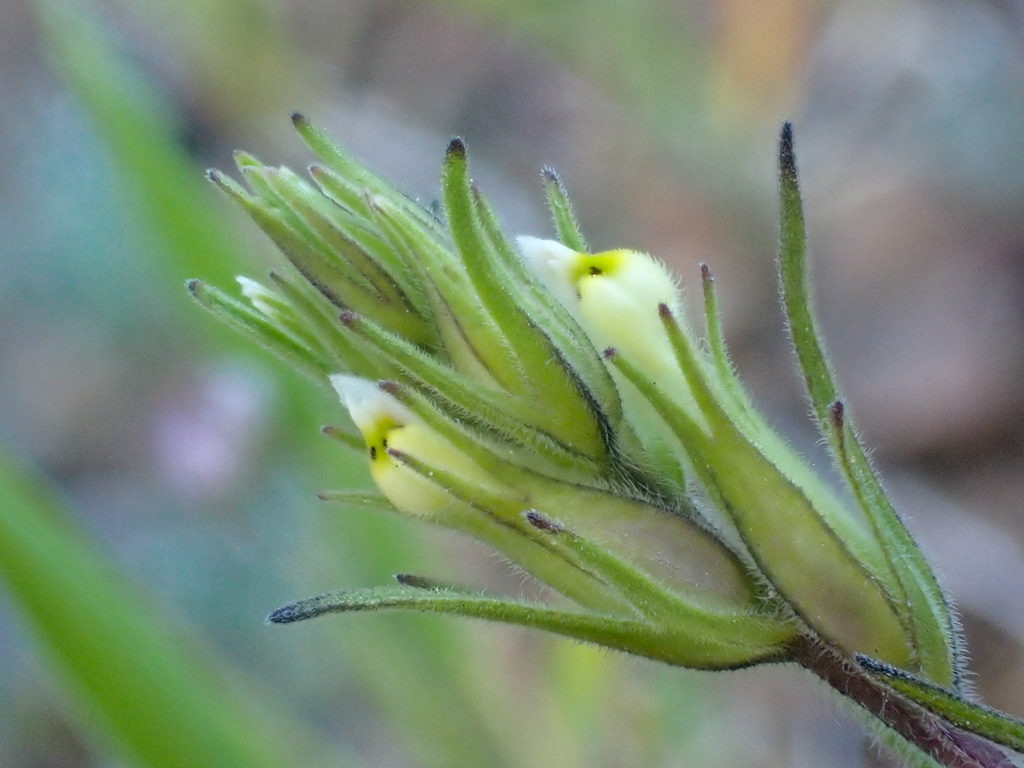
The leaves are alternate, very narrow and linear, about 1 to 4 inches long, and often have one or two pairs of thread-like side lobes near the tip on upper leaves. They are green to purplish and often curl or wither as the plant flowers in late spring.
Flowers & Bracts
The flowers grow in a dense spike, 1 to 6 inches long, at the top of the stem. Each flower sits in the axil of a narrow, three-lobed bract whose lobe tips are white or pale yellow, sometimes flushed pink. The flowers themselves are tubular, about 1/2 to 3/4 inch long, with a beak-like upper lip and a small, inflated, three-pouched lower lip that is white to pale yellow with tiny purple or maroon dots. Bloom time is mainly March to May, into June in the north and at higher elevations.
Fruit & Seeds
The fruit is a small, oblong capsule that splits to release many tiny seeds with a net-like coat. Plants dry to straw color by early summer, and the seed spends the hot, dry season in the soil before germinating with fall and winter rains.
Look-alikes
Other owl’s-clovers, such as purple owl’s-clover (Castilleja exserta), have bright pink to purple bracts and flowers. Cream sacs (Castilleja rubicunda ssp. lithospermoides) and butter-and-eggs (Triphysaria eriantha) have larger, bright yellow or cream pouches. Perennial paintbrushes such as scarlet paintbrush are larger, clump-forming plants with red bracts.
Quick Facts
| Scientific Name | Castilleja attenuata (syn. Orthocarpus attenuatus) |
| Family | Orobanchaceae (broomrape family) |
| Plant Type | Annual wildflower; root hemiparasite |
| Mature Height | 4–18 in |
| Mature Spread | 2–4 in |
| Growth Rate | Fast (completes its life cycle in one season) |
| Sun Exposure | Full sun |
| Water Needs | Moist in winter and spring, dry in summer |
| Soil Type | Grassland clay, loam, gravelly and serpentine soils |
| Soil pH | Slightly acidic to neutral (about 5.5–7.5) |
| Bloom Time | March–May (to June in the north) |
| Flower Color | White to pale yellow with purple dots; white-tipped bracts |
| Fall Color | None; dies back by early summer |
| Fruit | Small capsule with many tiny seeds |
| Deer Resistant | Moderately; small and often overlooked |
| USDA Hardiness Zones | Annual; grows in zones 7–10 within its range |
Native Range
Valley tassels grows along the Pacific side of North America from southern British Columbia to northern Baja California. USDA PLANTS lists it as native in California, Oregon, Washington and Arizona, and in British Columbia. California is its stronghold: it is common in the grasslands and oak savannas of the Coast Ranges, the Central Valley edges, the Sierra Nevada foothills and the Klamath region. USDA also records it from Arizona, where it is far less common.
In Oregon it grows in the Rogue and Umpqua valleys of the southwest, in the Willamette Valley prairies and oak savannas, and east to the Columbia River Gorge, where it reaches the dry, open slopes near Mosier and the Rowena Plateau. In Washington it is found in the Puget Trough, including prairie remnants on Whidbey Island, and in the eastern Gorge near Lyle and Dallesport in Klickitat County. In British Columbia it is limited to rare Garry oak meadows on southeastern Vancouver Island and nearby islands.
Its habitat is open grassland, oak savanna, meadows and grassy openings in chaparral and woodland, from near sea level to about 6,600 feet. It often grows on heavy clay or thin, rocky and serpentine soils that are wet in winter and dry out by summer, sometimes around the edges of vernal pools.
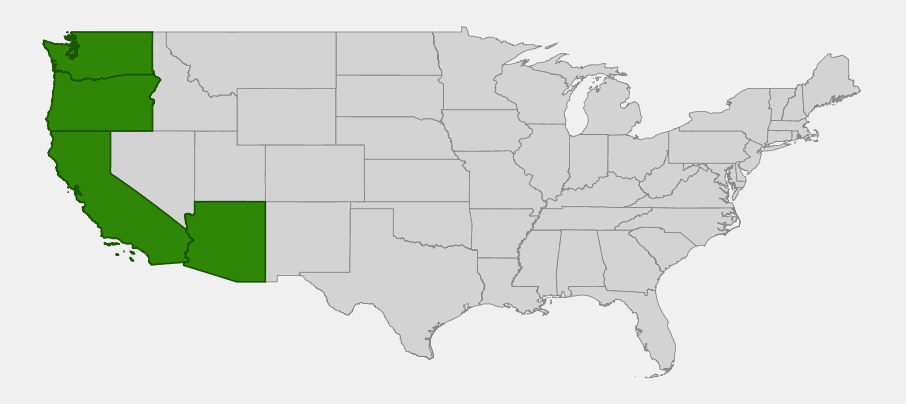
📋 Regional plant lists featuring Valley Tassels: Arizona & New Mexico · Western Oregon & Western Washington · California & Nevada
Can You Grow It?
Valley tassels is not a plant you can buy in a pot and plant out. As a root hemiparasite and an annual, it lives only one season and depends on connections to the roots of neighboring plants. Gardeners and restoration crews who succeed with it sow seed into existing native grassland or meadow plantings and let it find its own hosts.
Light
Full sun. It grows in open grassland and savanna and fades out under shrubs or trees.
Soil & Water
It needs the Mediterranean-climate pattern of its native grasslands: soil that is moist from fall through spring and dry in summer. Clay, loam and rocky or serpentine soils all work. Do not water it in summer; the plants are finished by then and the seed rests in dry soil.
Planting Tips
Sow fresh seed in fall, just before or with the first rains, by scattering it on the surface of a meadow or grassland that already has native bunchgrasses and annual wildflowers such as goldfields, lupines and clovers. Press it in lightly but do not bury it deeply; the seeds are tiny. Seedlings that do not reach a host root soon after germinating usually die, so sowing into bare, host-free soil rarely works. Seed is occasionally available from native seed companies and restoration suppliers in California and Oregon.
Pruning & Maintenance
Leave plants to set seed and dry in place, and delay mowing until after seed has dropped in late spring or early summer. Control aggressive non-native grasses, which shade out small annual wildflowers. Avoid fertilizer, which favors weedy grasses.
Propagation
Grow it from seed only. Collect ripe capsules from plants in your own planting in late spring, or buy seed from a reputable supplier. Never dig plants from the wild; the parasitic root connections break, and transplanted plants almost always die.
Where to See It
- Spring grasslands: look for it in March to May in the oak savannas and grassy hills of the Coast Ranges and Sierra foothills
- Oregon and Washington prairies: it blooms in Willamette Valley and Puget Trough prairie remnants and on the open slopes of the Columbia River Gorge
- Serpentine and vernal pool areas: it is often common in serpentine grasslands and around vernal pools in California
- Meadow restoration: sown with host grasses and wildflowers, it adds diversity to native grassland projects
- Butterfly gardens: in large meadow plantings it supports checkerspot caterpillars
Wildlife & Ecological Value
Valley tassels is a small plant, but it plays several parts in the native grasslands where it grows.
For Pollinators
The small, pouched flowers are visited mainly by bees, especially bumble bees and other native bees that can push into the lower lip to reach nectar and pollen.
For Birds
Seed-eating birds such as sparrows and finches forage in the grasslands where it grows, and the tiny seeds become part of the seed bank they feed on.
For Mammals
It is too small and scattered to be an important food for mammals, though deer and rodents may nibble it while grazing in spring grassland.
Ecosystem Role
Calflora lists it as a larval host for the Chalcedon checkerspot (Euphydryas chalcedona) and the Leanira checkerspot (Chlosyne leanira). As a hemiparasite, it draws resources from grasses and other host plants, which can slightly reduce the vigor of dominant grasses and leave room for other wildflowers, adding to grassland diversity.
Cultural & Historical Uses
The genus Castilleja honors the Spanish botanist Domingo Castillejo. The species name attenuata means “tapering” or “drawn out,” likely a reference to its very narrow leaves and slender, tapering flower spikes.
The name “valley tassels” comes from its pale, tassel-like spikes scattered through the grasslands of California’s valleys and foothills. It was long known as an owl’s-clover in the genus Orthocarpus. DNA studies showed that many owl’s-clovers are closely related to the paintbrushes, and in the 1990s botanists moved it to Castilleja.
Because it grows only in open grassland and savanna, valley tassels is a good indicator of intact native prairie. In the Pacific Northwest and British Columbia, where most of the original prairies and Garry oak meadows have been lost to farming, development and invasion by trees and shrubs, it has become uncommon and is a focus of prairie conservation.
Frequently Asked Questions
Can I buy valley tassels plants at a nursery?
Rarely, and potted plants usually fail. It is an annual root hemiparasite that needs host roots nearby, so the reliable method is to sow seed in fall into an existing native grassland or meadow.
Is valley tassels a parasite?
It is a hemiparasite. It has green leaves and makes its own sugars, but it attaches to the roots of nearby grasses and wildflowers to take water and minerals. It does not kill its hosts.
Is valley tassels the same as Orthocarpus attenuatus?
Yes. Orthocarpus attenuatus is an older name for the same species, now called Castilleja attenuata.
When does valley tassels bloom?
Mainly from March to May, and into June in the Pacific Northwest and at higher elevations. Plants dry up by early summer.
Does valley tassels support butterflies?
Yes. Calflora lists it as a caterpillar host for the Chalcedon checkerspot and the Leanira checkerspot, and bees visit its flowers.

Looking for a nursery that carries Valley Tassels?
Browse our native plant nursery directory: Arizona · California · Oregon · Washington

