
Scouler’s Corydalis (Corydalis scouleri)
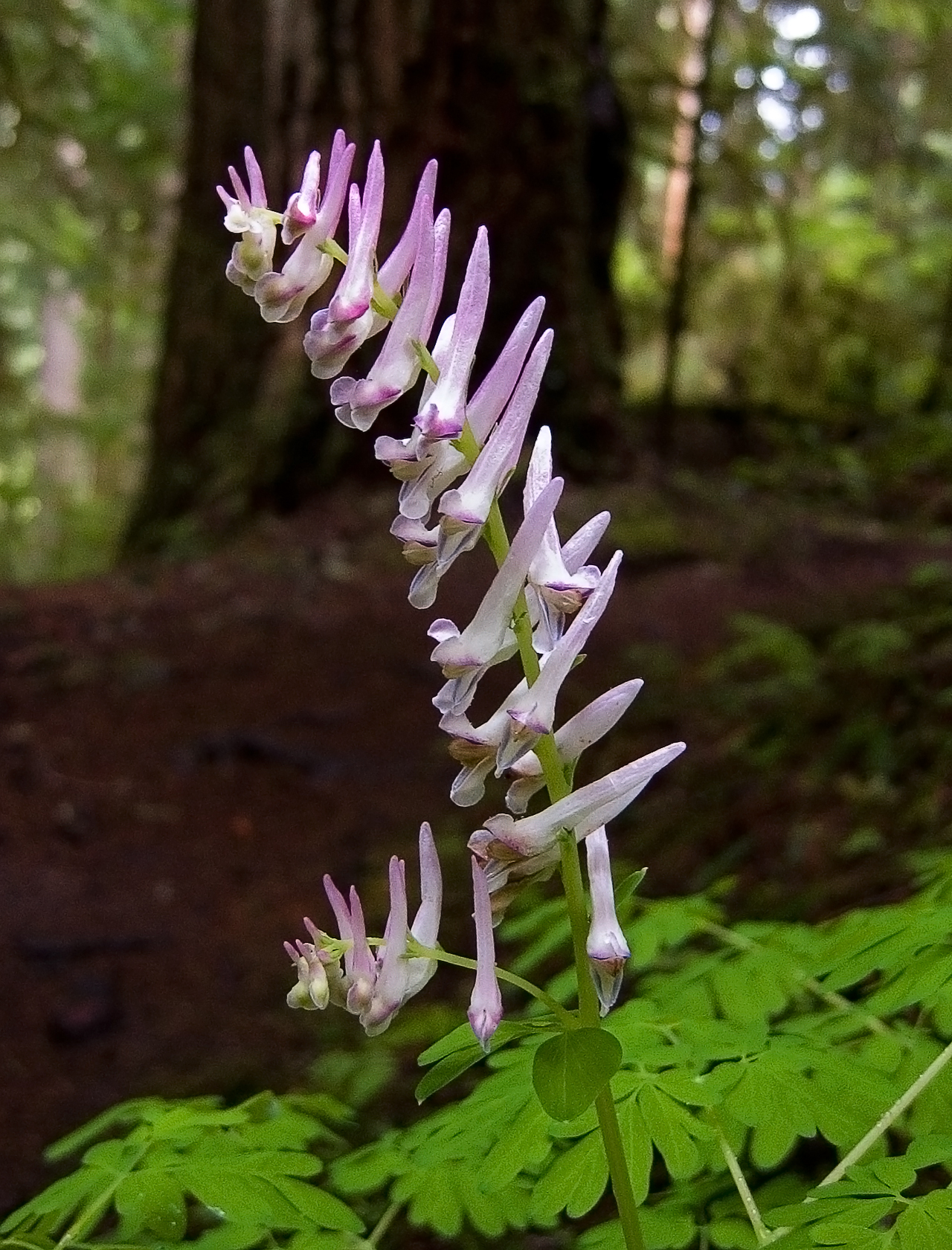
Corydalis scouleri, known as Scouler’s Corydalis or Scouler’s fumewort (the name USDA uses), is a lush woodland perennial of the Pacific Northwest. In spring it raises spikes 2 to 4 feet tall of narrow, pink to rose-purple flowers, each with a long backward-pointing spur, above large, deeply divided leaves that look almost like a fern or a giant bleeding heart. Where it is happy it forms sweeping colonies along shady streams and moist forest floors.
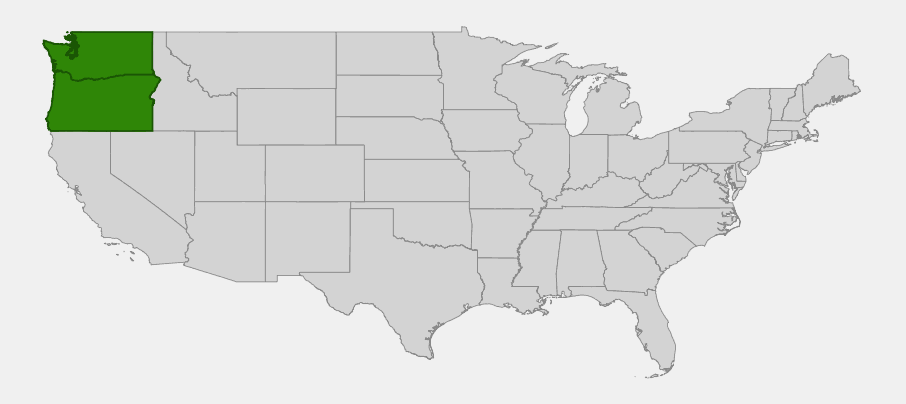
It belongs to the poppy family (Papaveraceae), in the group once separated as the fumitory family, together with bleeding hearts and Dutchman’s breeches. Scouler’s corydalis is a true regional specialty: it grows only in southwestern British Columbia, western Washington and western Oregon, mostly west of the Cascade crest.
For Northwest gardeners it is an excellent native for moist shade, filling the space between ferns and shrubs with soft, blue-green foliage and spring color. It spreads by underground stems, so it is best given room in a woodland garden or along a shady creek.
Identification
Scouler’s corydalis is the largest corydalis in the Pacific Northwest. Its height, its big, much-divided leaves and its long-spurred pink flowers in an elongated spike make it easy to recognize in bloom.
Growth Habit
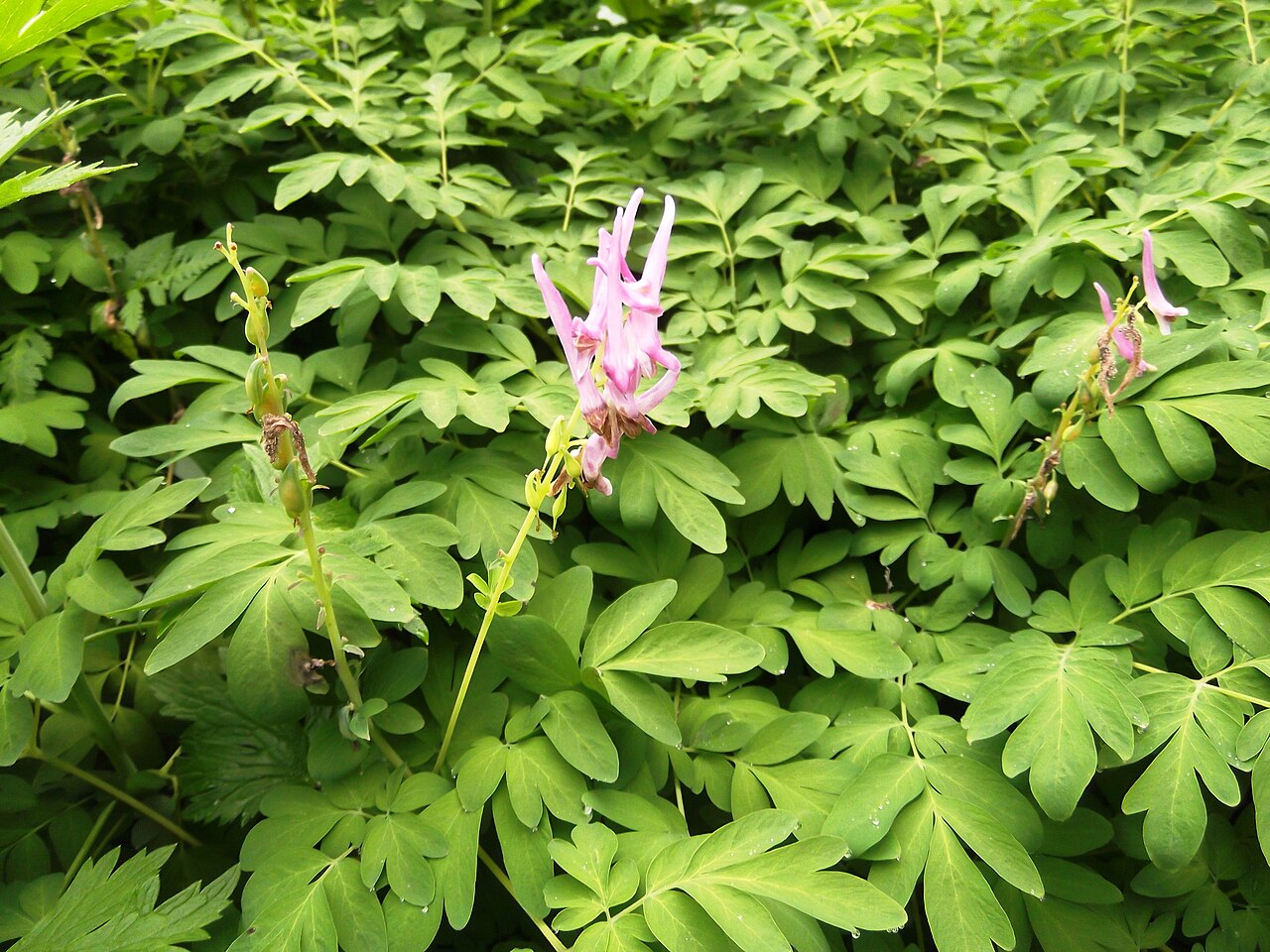
A herbaceous perennial that grows from thick, fleshy rhizomes and forms colonies. The smooth, hollow, somewhat succulent stems grow 2 to 4 feet tall and die back after the growing season.
Leaves
Usually two or three large leaves grow on each stem. They are bluish-green, smooth and divided two or three times into many oval to oblong leaflets, giving a lacy, fern-like look. A single leaf can be a foot or more across. Western bleeding heart (Dicentra formosa) has similar leaves, but they all grow from the base, and its flowers are heart-shaped and drooping.
Flowers
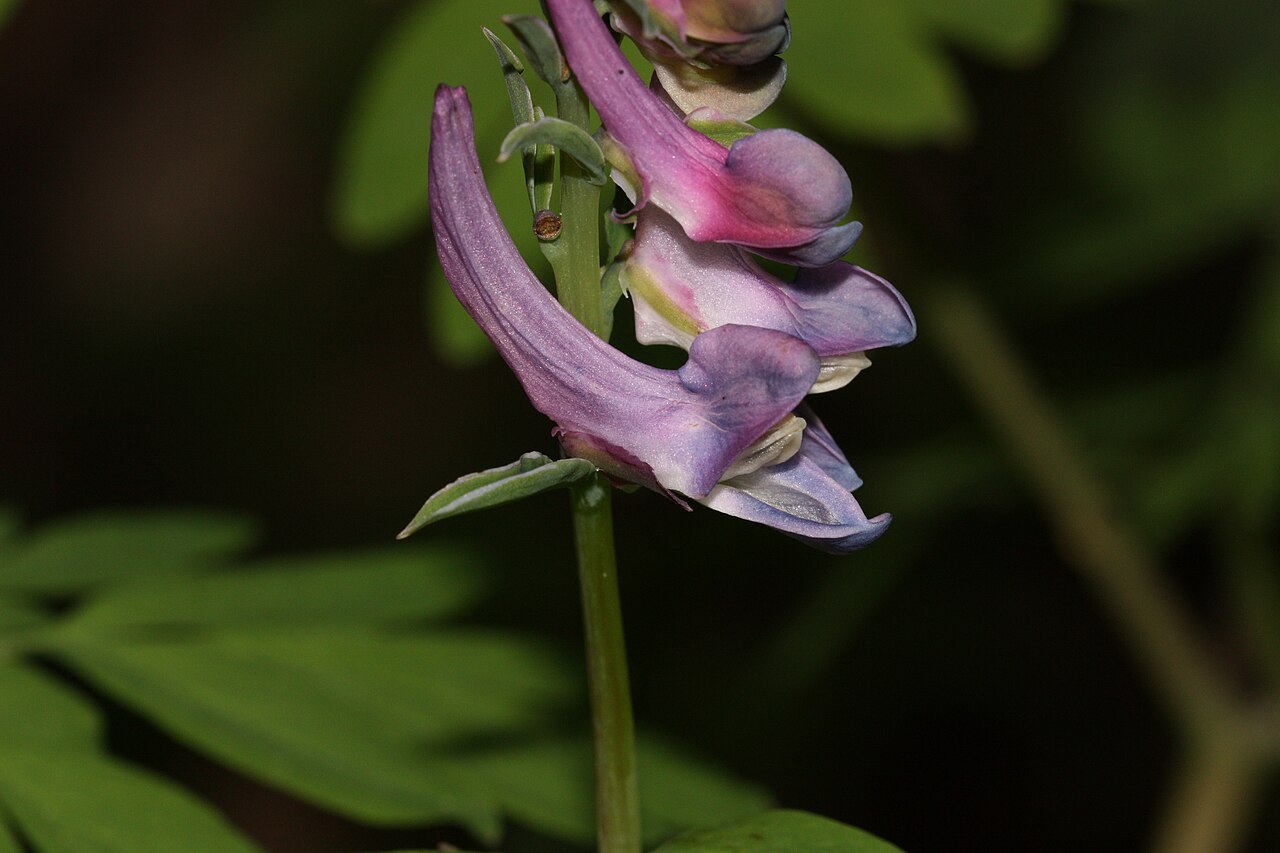
Fifteen to more than thirty flowers grow in a dense, upright spike (raceme) at the top of the stem, often with a few smaller side spikes. Each flower is about 1 inch long, pink to rose-purple and paler toward the tip, made of four petals joined into a narrow tube with a flared upper lip. The upper petal extends backward into a long, straight or slightly curved spur that is about as long as the rest of the flower. Bloom time is April to July, depending on elevation.
Fruit & Seeds
The fruit is an oval, drooping capsule about ½ inch long. When ripe it springs open, sometimes explosively, scattering shiny black seeds. Each seed carries a small, oily appendage (an elaiosome) that attracts ants, which carry seeds away to their nests.
Quick Facts
| Scientific Name | Corydalis scouleri Hook. |
| Family | Papaveraceae (poppy family; formerly Fumariaceae) |
| Plant Type | Herbaceous perennial from rhizomes |
| Mature Height | 2–4 ft |
| Mature Spread | 2–3 ft; spreads to form colonies |
| Growth Rate | Moderate to fast in moist shade |
| Sun Exposure | Partial to full shade |
| Water Needs | Moist to wet; consistent moisture |
| Soil Type | Rich, humusy, moist forest soil; streambanks |
| Soil pH | Slightly acidic to neutral (about 5.5–7.0) |
| Bloom Time | April–July |
| Flower Color | Pink to rose-purple |
| Fall Color | Foliage yellows and dies back by late summer or fall |
| Fruit | Drooping capsule; seeds with ant-attracting appendages |
| Deer Resistant | Generally yes; foliage contains bitter alkaloids |
| USDA Hardiness Zones | 6–9 |
Native Range
Scouler’s corydalis is a Pacific Northwest endemic. USDA PLANTS lists it as native in Oregon and Washington, and it also grows in southwestern British Columbia, including Vancouver Island. Its range is small: it extends from southern British Columbia south through western Washington into western Oregon.
It grows almost entirely west of the Cascade crest, from the Olympic Peninsula and Puget Sound lowlands into the western slopes of the Cascades and the Coast Ranges. It reaches into the lower and middle mountain forests, for example around Mount Rainier, where it can be abundant along trails and streams.
Its habitat is moist, shady forest: stream banks, wet seeps, ravines and rich, damp forest floors under western redcedar, western hemlock, Douglas-fir, red alder and bigleaf maple. It often grows with ferns, salmonberry and other moisture-loving plants of the understory.
📋 Regional plant lists featuring Scouler’s Corydalis: Western Oregon & Western Washington
Growing & Care Guide
Scouler’s corydalis is easy in the right place: moist, rich, shady soil in a mild Pacific Northwest-type climate. It is offered by some native plant nurseries in the region. Plant it where it has room to spread and where its foliage can go dormant in late summer without leaving a gap you mind.
Light
Partial to full shade. It grows well under deciduous trees or on the north side of buildings. Morning sun is fine where the soil stays moist, but hot afternoon sun scorches the leaves.
Soil & Water
Give it deep, humus-rich soil that stays moist through spring and early summer. It thrives along streams, near seeps and in low, damp spots in woodland gardens. Dry soil makes it go dormant early.
Planting Tips
Plant potted plants or divisions in fall or early spring, 2 to 3 feet apart. Mix in leaf mold or compost and mulch with leaves. Combine it with sword fern, lady fern, vanilla leaf and youth on age for a natural Northwest understory. It spreads by rhizomes, so keep it away from small, delicate plants. Never dig it from the wild; buy nursery-grown plants.
Pruning & Maintenance
Little care is needed. Cut back or leave the foliage once it yellows in summer. Keep soil mulched with fallen leaves. Slugs may chew young shoots in spring.
Propagation
Divide rhizomes in fall or early spring. Seed can be sown fresh in fall outdoors; it needs a cold, moist period and germinates the following spring. Seedlings take a couple of years to flower.
Landscape Uses
- Woodland gardens: bold, lacy foliage and spring flowers in moist shade
- Streambanks and rain garden edges: tolerates wet soil and helps cover banks
- Shade groundcover: spreads into colonies under trees and shrubs
- Pollinator gardens: early-season nectar for bumble bees
- Restoration of riparian forests: west of the Cascades in Washington and Oregon
Wildlife & Ecological Value
Scouler’s corydalis is a valuable spring nectar plant in Northwest forests and an interesting example of seed dispersal by ants.
For Pollinators
The long-spurred flowers hold nectar deep inside, where long-tongued bumble bees can reach it, and bumble bees are the main pollinators. Short-tongued bees sometimes chew holes in the spur to steal nectar. Hummingbirds may also visit.
For Birds
The seeds are small and mostly taken by ants. Dense colonies offer cover for ground-foraging birds such as Pacific wrens and towhees.
For Mammals
Like other members of the poppy family, the foliage contains alkaloids that make it unpalatable, and deer and elk seldom browse it.
Ecosystem Role
Its seeds carry oily elaiosomes that ants collect, carrying seeds to their nests and planting them in rich soil. Its colonies also help hold soil along shady stream banks and cover the forest floor in spring and early summer.
Cultural & Historical Uses
The species was named in honor of John Scouler (1804–1871), a Scottish physician and naturalist who visited the Pacific Northwest in 1825 aboard a Hudson’s Bay Company ship, alongside the plant explorer David Douglas. William Jackson Hooker described it in his Flora Boreali-Americana.
The genus name Corydalis comes from the Greek word for the crested lark, because the spur of the flower was thought to resemble a lark’s crest.
In its home forests, Scouler’s corydalis is one of the showier spring wildflowers along popular trails at Mount Rainier, in the Olympics and in the Oregon Coast Range, and it is a favorite of native-plant gardeners in Portland, Seattle and Vancouver who want something bold and graceful for moist shade.
Frequently Asked Questions
Is Scouler’s corydalis the same as bleeding heart?
No, but they are close relatives in the poppy family and have similar lacy foliage. Western bleeding heart has nodding, heart-shaped flowers on leafless stalks, while Scouler’s corydalis carries upright spikes of narrow, long-spurred flowers on leafy stems.
Can I grow Scouler’s corydalis in my garden?
Yes, if you can give it moist, rich soil and shade, especially in the Pacific Northwest. It spreads by rhizomes and goes dormant in late summer. Buy nursery-propagated plants; never dig wild ones.
Is Scouler’s corydalis poisonous?
Like other corydalis, it contains alkaloids and should not be eaten by people or pets. Deer and other animals generally avoid it.
Where does Scouler’s corydalis grow?
Only in southwestern British Columbia, western Washington and western Oregon, mainly west of the Cascades, in moist forests, ravines and along streams.
When does it bloom?
From April to July, earlier in the lowlands and later in the mountains.

Looking for a nursery that carries Scouler’s Corydalis?
Browse our native plant nursery directory: Oregon · Washington

