
Heartleaf Twayblade (Listera cordata)
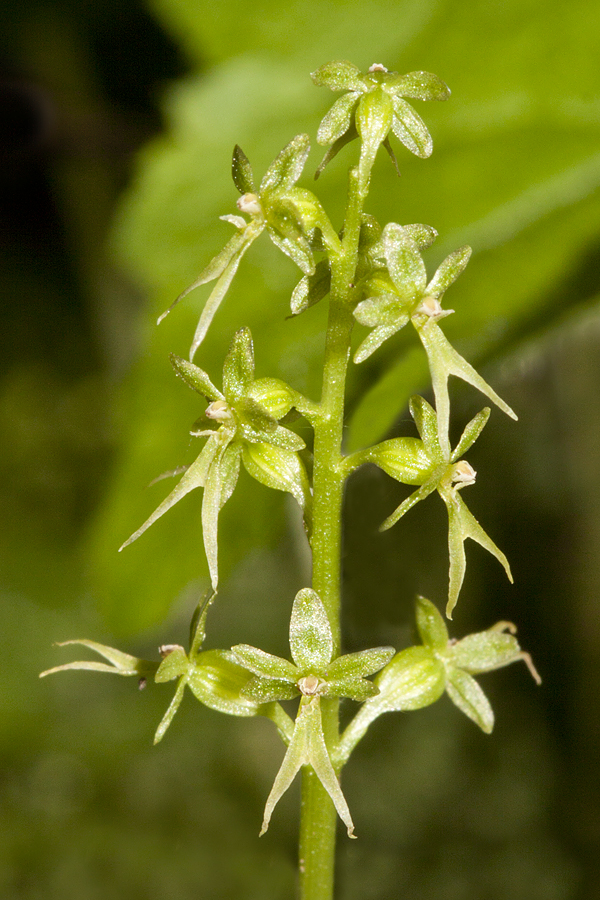
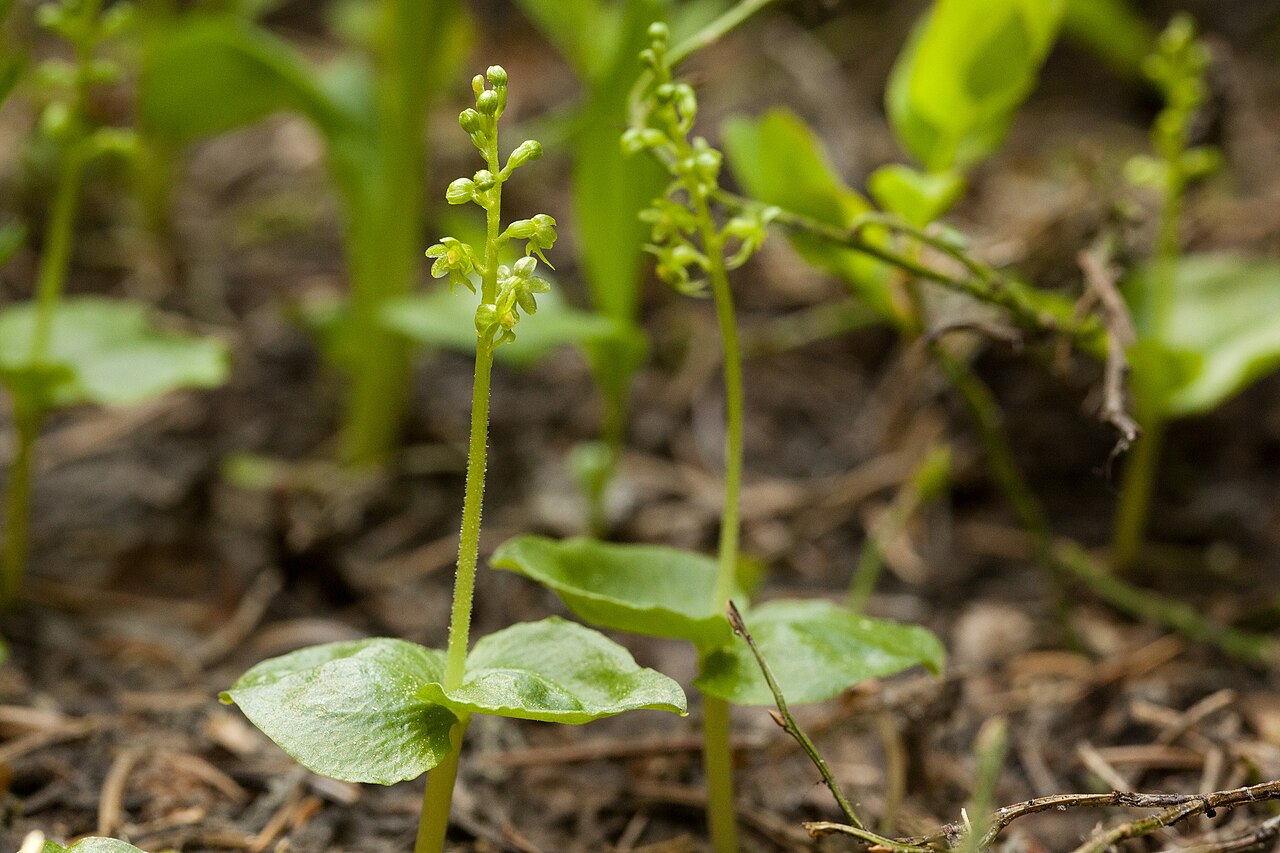
Listera cordata, known as Heartleaf Twayblade or heart-leaved twayblade, is one of North America’s smallest and most easily overlooked native orchids. A flowering plant is usually only 3 to 10 inches tall: a thread-thin stem with a single pair of heart-shaped leaves halfway up and a loose spike of tiny green or reddish-purple flowers above. Many botanists now place it in the genus Neottia, as Neottia cordata; USDA PLANTS still uses Listera cordata.
It grows across the cool northern forests of the world, from Alaska and Canada to Europe and Asia, where it is called lesser twayblade. In the United States it is found in Alaska, the Pacific Northwest and the western mountains, the upper Great Lakes, New England and, more rarely, south along the Appalachians. Its home is deep moss under conifers, in damp spruce, fir and hemlock forests and in sphagnum bogs.
This is a plant for finding, not planting. Like other orchids, it depends on soil fungi throughout its life, it is not available from nurseries, and dug plants die. This guide covers how to identify it, where and when to look for it, why it can’t be grown in gardens, and its unusual “glue-gun” pollination.
Identification
Heartleaf twayblade is tiny and green, so it is easy to walk past. Once you know the pair of leaves and the forked lip, it is unmistakable.
Growth Habit
Each plant is a single, slender, unbranched stem 3 to 10 inches tall rising from a short rhizome with thin roots in the moss or humus. Plants often grow in small, scattered groups. Non-flowering plants may show only the pair of leaves.
Leaves
The name “twayblade” means “two leaves”. Midway up the stem there is a single pair of opposite, stalkless leaves, broadly heart-shaped to nearly round, about ½ to 1½ inches long, smooth and somewhat shiny. There are no other true leaves.
Flowers
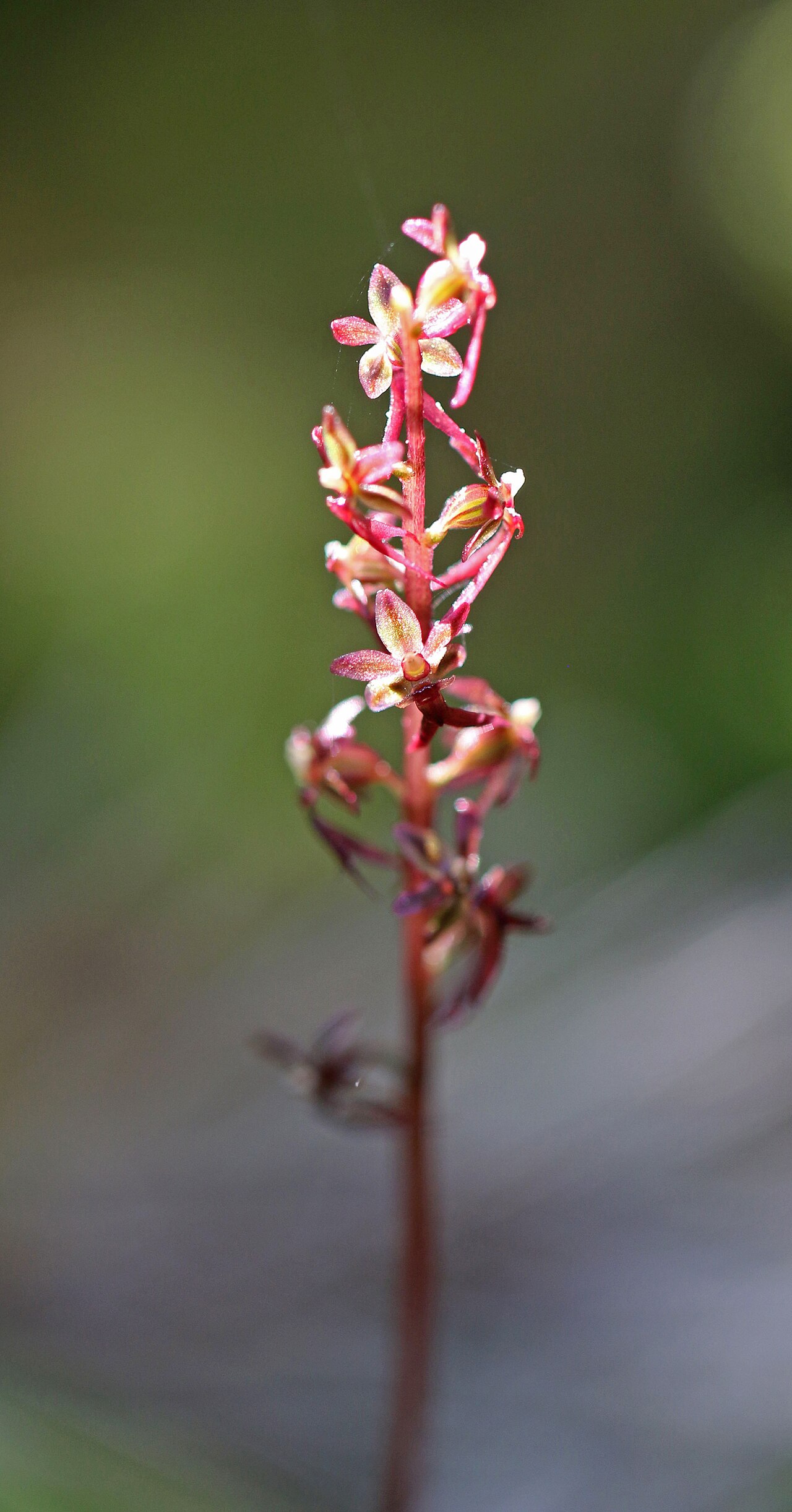
A loose spike of about 5 to 25 tiny flowers, each only about ¼ inch long, tops the stem. Flower color ranges from pale green to reddish-purple or brownish, sometimes on plants growing side by side. The sepals and side petals are small and spreading, and the lip hangs down and is split for about half its length into two narrow, pointed prongs, like a snake’s tongue, with a pair of tiny horns at its base. Bloom runs from late spring to midsummer, from May at lower elevations and in the south to August in the far north and high mountains.
Fruit & Seeds
Each pollinated flower forms a small, round capsule that releases thousands of dust-like seeds. Like all orchid seeds, they have almost no stored food and can germinate only with the help of a compatible soil fungus.
Look-alikes
Other twayblades are larger. Broadleaf twayblade (L. convallarioides) has a wedge-shaped lip that is only notched at the tip, and northwestern twayblade (L. caurina) has a rounded lip without a deep fork. Auricled twayblade (L. auriculata) is rare and has earlike lobes at the lip base. Small Canada mayflower plants also have heart-shaped leaves, but their leaves are alternate and the flowers are white and star-shaped.
Quick Facts
| Scientific Name | Listera cordata (L.) R. Br. (syn. Neottia cordata) |
| Family | Orchidaceae (orchid family) |
| Plant Type | Small terrestrial orchid; herbaceous perennial |
| Mature Height | 3–10 in |
| Mature Spread | 1–2 in per stem; forms small scattered groups |
| Growth Rate | Slow |
| Sun Exposure | Part shade to full shade |
| Water Needs | Medium to high (constantly moist moss and humus) |
| Soil Type | Moss, sphagnum and acidic conifer humus |
| Soil pH | Acidic (about 4.0–6.0) |
| Bloom Time | May–August, depending on latitude and elevation |
| Flower Color | Pale green to reddish-purple |
| Fall Color | None of note; leaves wither by late summer |
| Fruit | Small capsule with dust-like seeds |
| Deer Resistant | Not applicable; rarely noticed by browsers |
| USDA Hardiness Zones | 2–6 (wild plant; not grown in gardens) |
Native Range
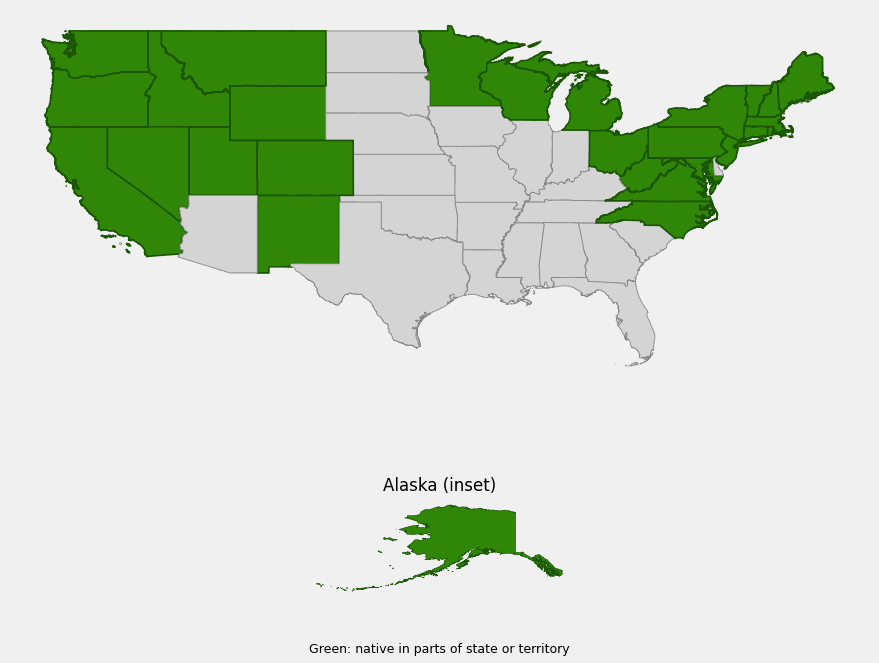
Heartleaf twayblade is circumboreal, growing in cool forests across northern North America, Europe and Asia. In North America it ranges from Alaska and the Aleutians across every Canadian province and territory to Newfoundland and Greenland. USDA PLANTS lists it as native in 28 U.S. states. It is common along the Pacific coast from Alaska to northern California, in the mountains of Washington, Oregon, Idaho and Montana, around the upper Great Lakes, and in northern New England and the Adirondacks.
South of these core areas it becomes rare and patchy. In the Rockies it reaches Colorado, Utah and northern New Mexico in high-elevation spruce-fir forest, with scattered records in the mountains of Nevada. In the East it reaches south along the Appalachians to Pennsylvania, Maryland, West Virginia, Virginia and North Carolina, and there are outlying records in New Jersey, Ohio and southern New England. These southern and lowland populations are mostly relicts in cold bogs and high-elevation forests, and several of these states list it as rare.
Throughout its range it favors constantly damp, shaded ground with a thick carpet of moss: old-growth spruce, fir, hemlock and cedar forests, sphagnum bogs and swamps, and mossy streamsides. It is often found in the same places as other small woodland orchids and wintergreens.
📋 Regional plant lists featuring Heartleaf Twayblade: Alaska · Western Oregon & Western Washington · California & Nevada · Montana & Wyoming · Utah & Western Colorado · Michigan, Wisconsin & Eastern Minnesota · Ohio & Indiana · New York, Pennsylvania & Northern New Jersey · Delaware, Southern New Jersey & Long Island · Connecticut, Massachusetts & Rhode Island · New Hampshire, Maine & Vermont · Maryland, Virginia & West Virginia · North & South Carolina
Can You Grow It?
Honestly, no. Heartleaf twayblade is a wild orchid that cannot be grown from nursery stock and does not survive transplanting. Like all orchids, it relies on specific soil fungi that supply it with nutrients, especially while it is young, and those fungi live in the undisturbed moss and conifer humus of its native forests. It is not sold by nurseries, and plants dug from the wild die. Never dig it up; in several states it is also a protected rare plant.
Light
In the wild it grows in shade or dappled light under conifers, and in the more open light of bogs where the moss stays wet.
Soil & Water
It needs a deep, constantly moist layer of living moss or acidic conifer humus, with cool soil all summer. It does not tolerate drying out, summer heat or disturbed garden soil.
Planting Tips
There is no realistic way to plant it. If you own land where it grows, the best thing you can do is keep that habitat intact: leave the forest canopy, moss and fallen logs in place and keep the site cool and moist.
Pruning & Maintenance
None. Keep foot traffic, trail building and logging equipment away from known colonies, and avoid draining wet ground. Removing the canopy dries and warms the moss and usually eliminates it.
Propagation
It spreads slowly by short rhizomes and by its dust-like seed, which can germinate only with the right fungus. Orchid labs can sometimes germinate small terrestrial orchids, but heartleaf twayblade is not produced commercially. Enjoy and photograph it where it grows.
Where to See It
- Pacific Northwest rainforests: mossy forests of the Olympic Peninsula, the Cascades and coastal Alaska in early summer
- Northern Rockies: damp spruce-fir and cedar forests in places such as Glacier National Park and northern Idaho
- Great Lakes and Northeast: cedar swamps, spruce bogs and mossy northern hardwood-conifer forests from Minnesota to Maine
- High Appalachians and southern Rockies: rare, high-elevation relict populations; look but never pick
- Orchid and macro photography: its tiny forked-lip flowers reward a close look with a hand lens or macro lens
Wildlife & Ecological Value
Heartleaf twayblade is a small but telling part of old, moist conifer forests and bogs, where it depends on a hidden web of fungi.
For Pollinators
The flowers are pollinated mainly by fungus gnats and other tiny flies attracted to nectar on the lip. When an insect touches a sensitive point at the center of the flower, a drop of quick-setting glue is released and the pollen masses (pollinia) are cemented to the insect in a fraction of a second. The insect carries them to the next flower, so the plant gets pollinated by some of the smallest insects in the forest.
For Birds
It has little direct value to birds, but it is a sign of the cool, mossy forest habitat used by birds such as varied thrushes, kinglets and winter wrens.
For Mammals
Plants are small and seldom eaten, though deer, elk and slugs may occasionally browse them.
Ecosystem Role
Heartleaf twayblade is tied to soil fungi for its whole life and is sensitive to changes in the forest floor. Its presence often indicates an undisturbed, constantly moist moss layer, and it disappears quickly when forests are logged, burned hot or drained.
Cultural & Historical Uses
Linnaeus described the species in 1753 as Ophrys cordata. The species name cordata means “heart-shaped”, after the leaves. Robert Brown moved it to Listera in 1813, a genus named for the English naturalist Martin Lister. DNA studies later showed that Listera belongs within Neottia, the genus of the bird’s-nest orchid, so many floras now call it Neottia cordata.
The flower’s “explosive” pollination has been studied since Charles Darwin, who described the instant glue of twayblades in his 1862 book on orchid pollination. A touch at the right spot fires a drop of glue that sets almost at once, sticking the pollen to the visiting insect.
Because it is so small, heartleaf twayblade is a favorite find for orchid enthusiasts and botanists on forest walks. It is often discovered by kneeling to look at moss and noticing the pair of shiny, heart-shaped leaves.
Frequently Asked Questions
Can I buy heartleaf twayblade for my garden?
No. It is not sold by nurseries and does not survive transplanting, because it depends on soil fungi in its native moss and humus. Never dig it from the wild.
Where can I find heartleaf twayblade?
Look in damp, mossy conifer forests and sphagnum bogs in Alaska, the Pacific Northwest, the northern Rockies, the upper Great Lakes and northern New England, from late spring to midsummer.
Why are there two scientific names?
USDA PLANTS uses Listera cordata, but many botanists now include Listera in the genus Neottia, so you will also see Neottia cordata. They are the same plant.
What pollinates such a tiny orchid?
Mainly fungus gnats and other tiny flies. The flower glues its pollen to them in an instant when they touch the center of the flower.
Why are some plants green and others purple?
Flower color varies naturally, from pale green to reddish-purple, even within one colony. Both color forms are the same species.

Looking for a nursery that carries Heartleaf Twayblade?
Browse our native plant nursery directory: Alaska · California · Colorado & Connecticut · Idaho · Maine, Maryland, Massachusetts, Michigan, Minnesota & Montana · Nevada, New Hampshire, New Jersey, New Mexico, New York, North Carolina & Ohio · Oregon · Pennsylvania, Rhode Island, Utah, Vermont & Virginia · Washington · West Virginia, Wisconsin & Wyoming

