
One-Flowered Wintergreen (Moneses uniflora)
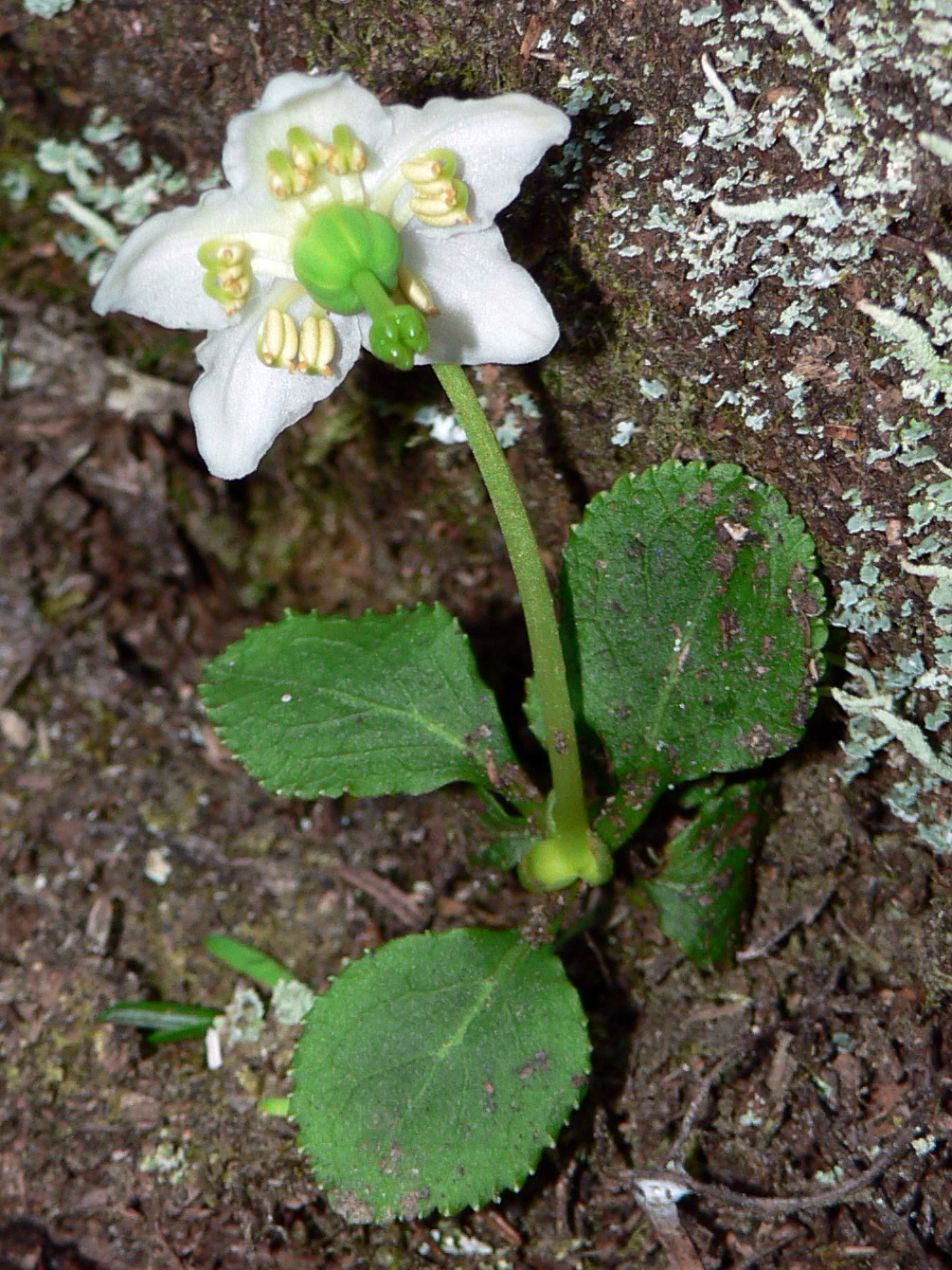
Moneses uniflora, known as One-Flowered Wintergreen, single delight, wood nymph or waxflower, is a tiny evergreen wildflower of cool, mossy conifer forests in the heath family (Ericaceae). From a small rosette of round, toothed leaves it raises a single stalk, 1 1/2 to 6 inches tall, topped by one nodding, waxy white flower about 3/4 inch across. The flower is fragrant and faces downward, so you often have to kneel and look up into it to see its star-like center.
It is the only species in the genus Moneses, a close relative of the pyrolas and pipsissewas. It is found all around the Northern Hemisphere. In the United States it grows in Alaska, through the Pacific Northwest and the Rocky Mountains south to Arizona and New Mexico, in the Sierra Nevada, around the Great Lakes and in the Northeast.
Like its relatives, it lives in close partnership with soil fungi. Its dust-like seeds cannot sprout without them, and even mature plants draw part of their food from fungi connected to the surrounding trees. This makes it an indicator of healthy, undisturbed forest, but also means it cannot be grown in gardens or moved. This page is meant to help you find, identify and appreciate it in the wild.
Identification
Look in shady, mossy conifer woods for a plant only a few inches tall with a single nodding, five-petaled white flower that has a prominent green style and a five-lobed, star-shaped stigma.
Growth Habit
A small evergreen perennial, 1 1/2 to 6 inches tall. Plants grow from slender roots that spread through moss and litter and produce new shoots, so several rosettes often appear close together in a small colony.
Leaves
The leaves are in a low rosette or in opposite pairs or whorls near the base of the stem. They are round to oval, about 1/2 to 1 inch long, light to dark green, thin to slightly leathery and finely toothed along the edges, with short stalks. They stay green through the winter.
Flowers
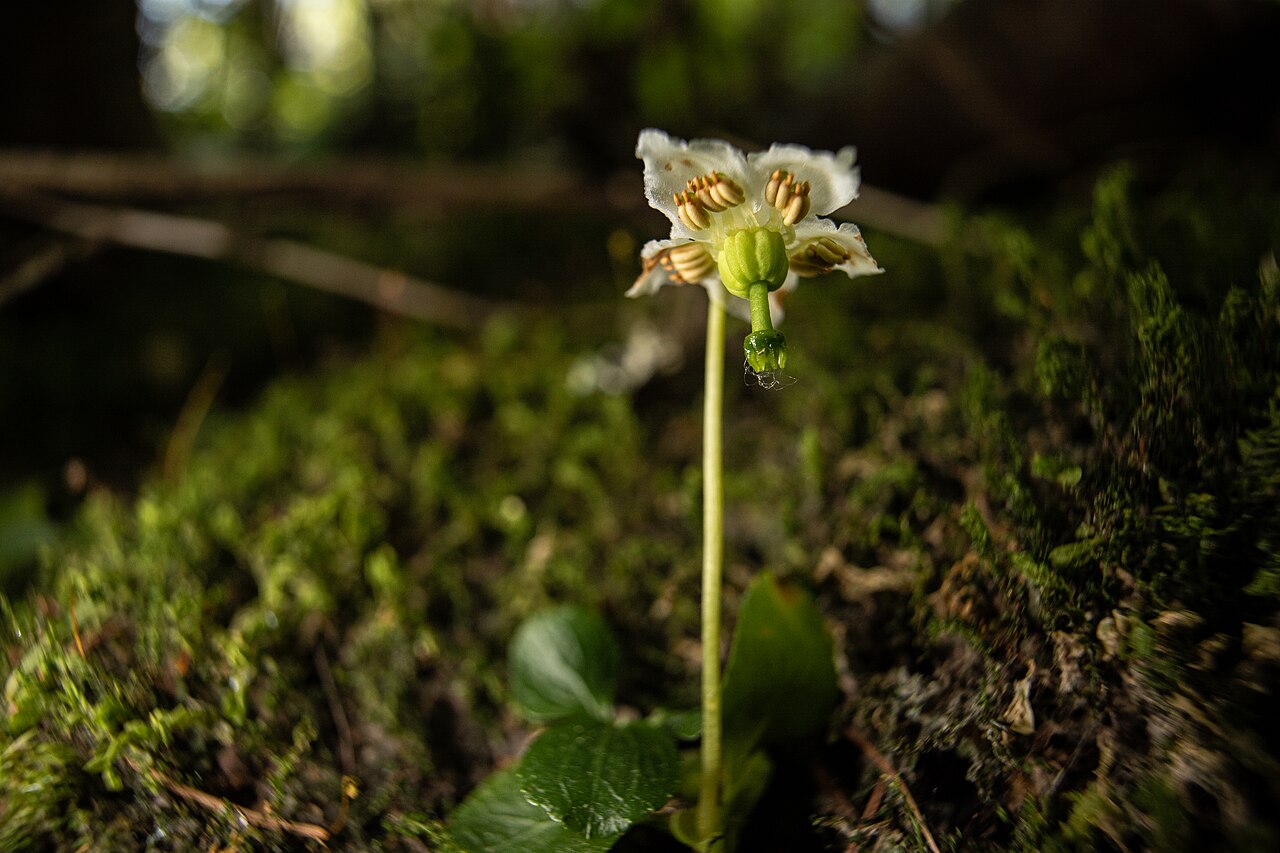
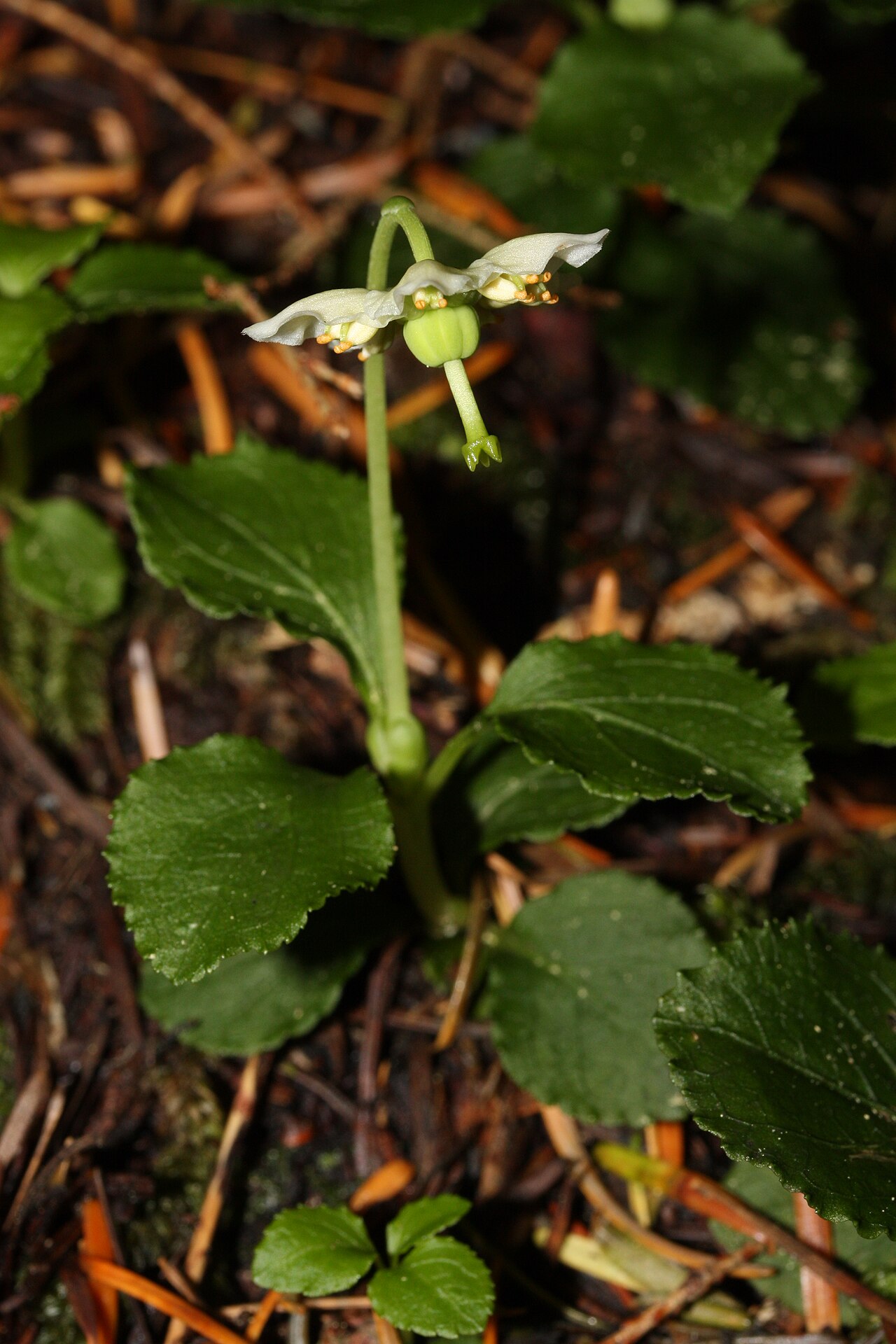
Each plant has one flower at the top of a leafless stalk. The flower is about 1/2 to 1 inch across, nodding, white or faintly pink and waxy, with five spreading, finely toothed petals. Ten stamens with paired, tube-tipped anthers surround a thick green ovary with a straight, prominent style ending in a large, five-lobed, star-shaped stigma. The flowers are sweetly fragrant and appear from June to August, depending on elevation and latitude.
Fruit
After flowering, the stalk straightens so the round capsule points upward. The capsule is about 1/4 inch across and splits from the top to release thousands of tiny, dust-like seeds that are carried by the wind.
Look-alikes
Other wintergreens have several flowers on each stalk. One-sided wintergreen (Orthilia secunda) has a row of small greenish-white bells along one side of the stem, and bog wintergreen (Pyrola asarifolia) has pink flowers in a spike. Pipsissewa has glossy, narrow leaves and a small cluster of pink-tinged flowers.
Quick Facts
| Scientific Name | Moneses uniflora |
| Family | Ericaceae (heath family) |
| Plant Type | Small evergreen woodland perennial (partly fungus-dependent) |
| Mature Height | 1 1/2–6 in |
| Mature Spread | 2–4 in per rosette; small colonies |
| Growth Rate | Slow |
| Sun Exposure | Part shade to full shade |
| Water Needs | Moist; cool forest soil that does not dry out |
| Soil Type | Mossy, humus-rich forest floor and rotting wood |
| Soil pH | Acidic to neutral (about 4.5–7.0) |
| Bloom Time | June–August |
| Flower Color | White, sometimes faintly pink |
| Fall Color | None (evergreen) |
| Fruit | Upright round capsule with dust-like seeds |
| Deer Resistant | Not applicable; not a garden plant |
| USDA Hardiness Zones | 2–7 (in the wild) |
Native Range
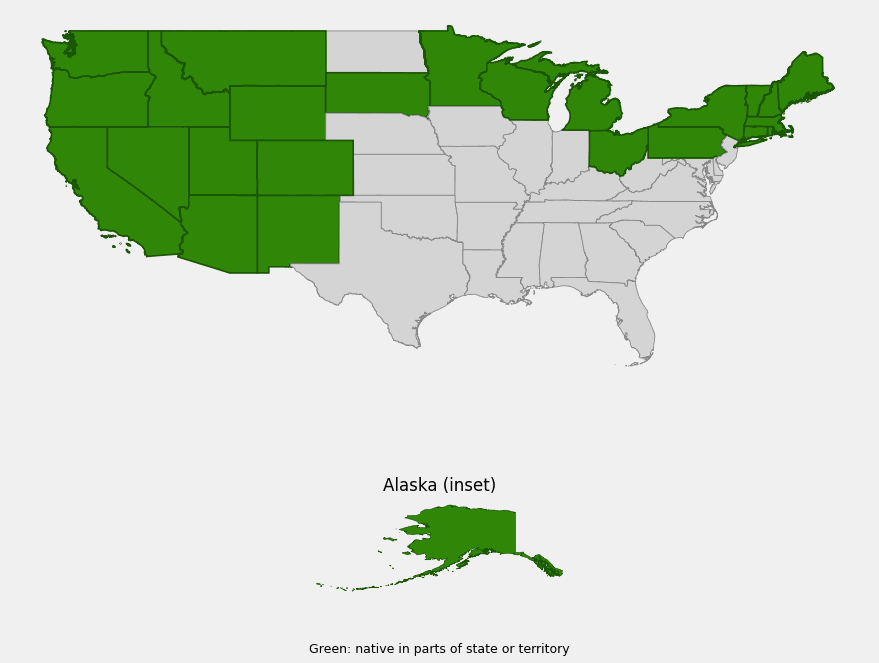
USDA PLANTS lists one-flowered wintergreen as native in Alaska and 24 states of the lower 48: Arizona, California, Colorado, Connecticut, Idaho, Maine, Massachusetts, Michigan, Minnesota, Montana, Nevada, New Hampshire, New Mexico, New York, Ohio, Oregon, Pennsylvania, Rhode Island, South Dakota, Utah, Vermont, Washington, Wisconsin and Wyoming. It also grows in every Canadian province and territory and across northern Europe and Asia.
In the West it is found in Alaska, through the Cascades, Olympics and coastal forests of Washington and Oregon, in the Sierra Nevada and northern mountains of California, and through the Rocky Mountains from Montana and Idaho south to Arizona and New Mexico, as well as in the Black Hills of South Dakota. In the East it grows around the upper Great Lakes and in northern New England and New York. Records from Ohio, Pennsylvania and southern New England are outlying populations at the southern edge of its range, where it is rare.
It grows in moist, shady coniferous and mixed forests, especially under spruce, fir, hemlock and cedar, often in deep moss, on rotting logs and stumps, and at the edges of bogs and cedar swamps. In the West it ranges from near sea level in Alaska and the Pacific Northwest to about 11,000 feet in the southern Rockies.
📋 Regional plant lists featuring One-Flowered Wintergreen: New York, Pennsylvania & Northern New Jersey · Idaho, Eastern Oregon & Eastern Washington · Ohio & Indiana · Montana & Wyoming · Michigan, Wisconsin & Eastern Minnesota · Utah & Western Colorado · Connecticut, Massachusetts & Rhode Island · New Hampshire, Maine & Vermont · Delaware, Southern New Jersey & Long Island · Arizona & New Mexico · Alaska · North Dakota, South Dakota & Western Minnesota · Western Oregon & Western Washington · California & Nevada
Can You Grow It?
Realistically, no. One-flowered wintergreen is not a garden plant. It depends on soil fungi that are also connected to forest trees, and that partnership cannot be recreated in a pot or a garden bed. It is not available as nursery stock, almost never survives transplanting, and should never be dug up from the wild. The best way to enjoy it is to protect the forests where it grows and to visit it there.
Light
In the wild it grows in part to full shade under conifers. Colonies decline when the canopy is removed and the forest floor dries out.
Soil & Water
It needs cool, constantly moist, mossy forest soil rich in decaying wood and needles, with the right fungal partners present. These conditions cannot be reproduced in ordinary gardens.
Planting Tips
Do not try to plant or transplant it. If it already grows on your land, keep the forest canopy, moss layer and fallen logs intact, and avoid trampling, raking or fertilizing the area.
Pruning & Maintenance
None. Undisturbed forest floor is all it needs. Keep foot traffic, vehicles and soil disturbance away from known colonies.
Propagation
Not practical. The dust-like seeds need specific fungi to germinate, and plants or root pieces taken from the wild do not establish elsewhere. Conserving intact, mature forest is the only way to keep it.
Where to See It
- Northern and mountain conifer forests: look in mossy shade along trails in June and July
- National parks: such as Glacier, Olympic, Mount Rainier and Rocky Mountain
- Boreal Alaska: common in spruce and birch forests
- Upper Great Lakes: cedar swamps and spruce-fir woods of Michigan, Wisconsin and Minnesota
- Northern New England: spruce-fir and hemlock forests of Maine, New Hampshire and Vermont
Wildlife & Ecological Value
One-flowered wintergreen is a small but telling part of the forest floor, linked underground to the trees around it.
For Pollinators
The nodding flowers are pollinated mainly by bumble bees, which hang beneath them and vibrate their flight muscles to shake pollen out of the tube-tipped anthers (buzz pollination). The flowers produce little or no nectar but are fragrant.
For Birds
It is too small to be an important food for birds, but it is part of the mossy ground layer where thrushes, juncos and grouse forage.
For Mammals
Small mammals live in the same moss and litter. The plant is seldom browsed.
Ecosystem Role
It is partly mycoheterotrophic: besides making its own food by photosynthesis, it obtains carbon from mycorrhizal fungi that are also connected to the roots of nearby trees. Its seedlings depend entirely on these fungi. Because of this, healthy colonies usually indicate old, undisturbed forest soil with an intact fungal network.
Cultural & Historical Uses
The genus name Moneses comes from the Greek monos, “single,” and hesis, “delight,” a reference to the one beautiful flower; uniflora also means “one-flowered.” Its many folk names include single delight, wood nymph, shy maiden and, in Norway, St. Olaf's candlestick.
Several Indigenous peoples of Alaska, British Columbia and the Pacific Northwest used the plant in traditional medicine. Such uses relied on small amounts gathered with care, and the plant is too slow-growing and fungus-dependent to be collected today.
Botanists once placed it in the wintergreen family, Pyrolaceae, along with Pyrola, Orthilia and Chimaphila. DNA studies showed that this group belongs within the heath family, Ericaceae, alongside blueberries and rhododendrons.
Frequently Asked Questions
Can I grow one-flowered wintergreen in my garden?
No. It depends on soil fungi connected to forest trees, is not sold as nursery stock and does not survive transplanting. Never dig it from the wild; enjoy it in its forest habitat.
Where can I see one-flowered wintergreen?
In cool, mossy conifer forests across Alaska, the Pacific Northwest, the Rocky Mountains, the Sierra Nevada, the upper Great Lakes and northern New England, usually blooming in June and July.
Why does the flower face downward?
The nodding flower protects its pollen from rain. Bumble bees hang beneath it and vibrate to shake the pollen loose.
Is one-flowered wintergreen rare?
It is widespread in northern and mountain forests but easy to overlook. Near the southern edge of its range, in places such as Ohio, Pennsylvania and southern New England, it is rare.
How is it different from other wintergreens?
It has a single, large, nodding white flower on each stalk. Other wintergreens such as Pyrola and Orthilia carry several smaller flowers on each stem.

Looking for a nursery that carries One-Flowered Wintergreen?
Browse our native plant nursery directory: Alaska & Arizona · California · Colorado & Connecticut · Idaho · Maine, Massachusetts, Michigan, Minnesota & Montana · Nevada, New Hampshire, New Mexico, New York & Ohio · Oregon · Pennsylvania, Rhode Island, South Dakota, Utah & Vermont · Washington · Wisconsin & Wyoming