
One-Sided Wintergreen (Orthilia secunda)
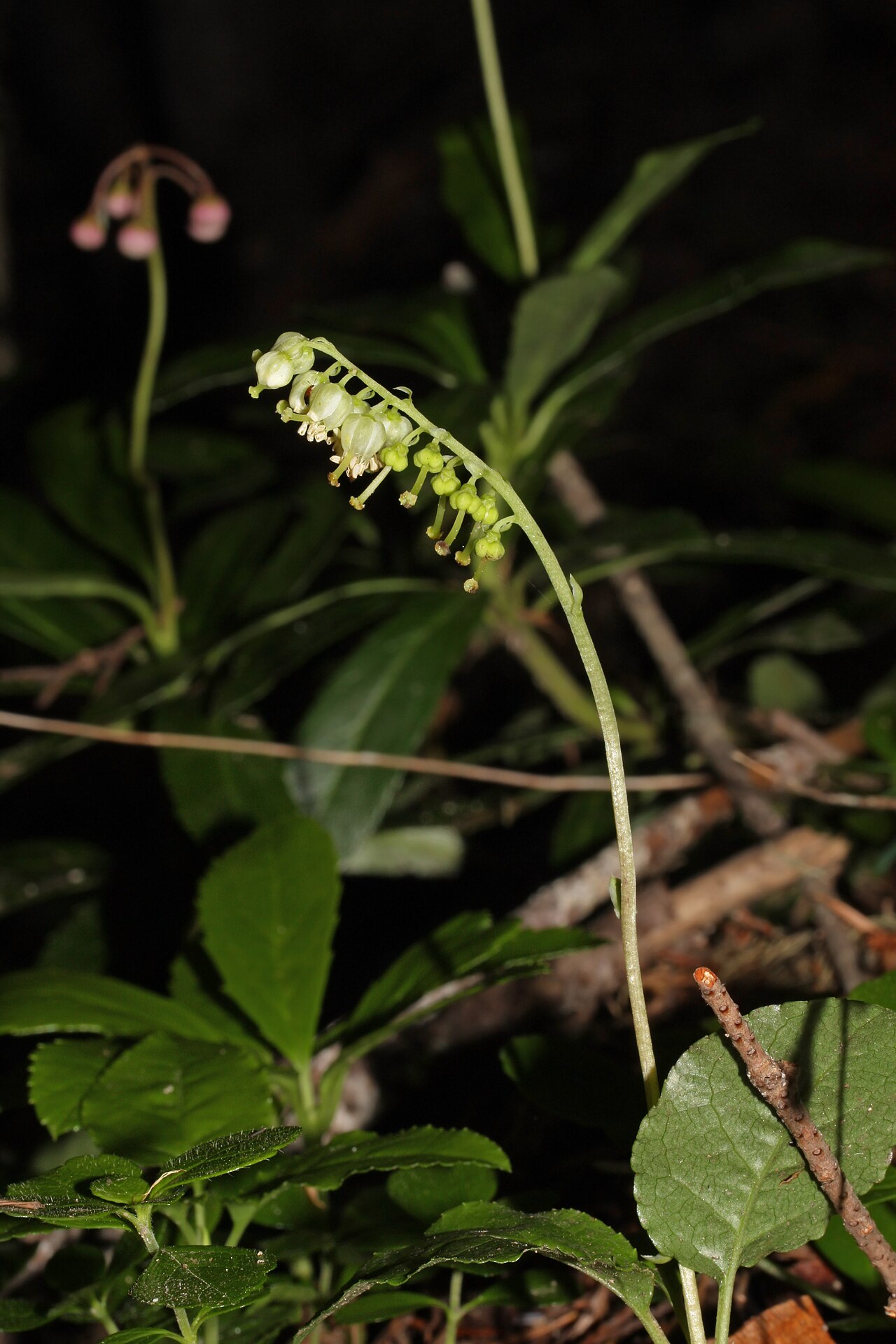
Orthilia secunda, known as One-Sided Wintergreen, sidebells wintergreen or one-sided pyrola, is a small evergreen plant of cool coniferous and mixed forests. Short stems carry glossy, oval, finely toothed leaves that stay green all winter. In summer a slender, arching stalk rises a few inches above them, lined on one side with a neat row of small, greenish-white, bell-shaped flowers. That one-sided arrangement, captured in the Latin name secunda, makes it one of the easiest wintergreens to recognize.
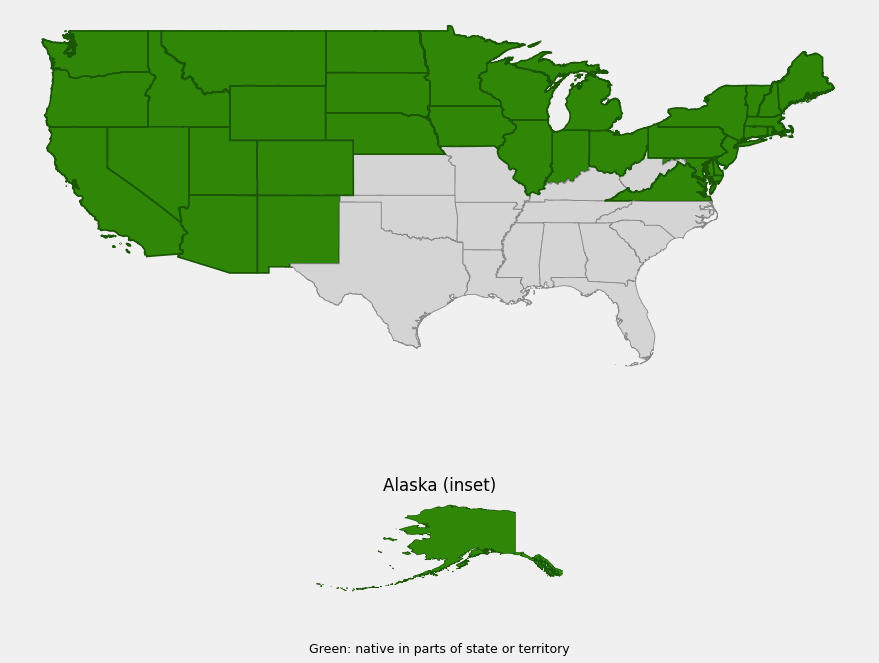
It is one of the most widespread wildflowers of the Northern Hemisphere, found across the boreal forests of North America, Europe and Asia. In the United States it ranges from Alaska and the Pacific Northwest through the Rocky Mountains to Arizona and New Mexico, and across the northern states to New England. For many years it was placed in the genus Pyrola as Pyrola secunda, and older field guides still use that name. Botanists now treat it as the only species in its own genus, Orthilia, within the heath family (Ericaceae).
One-sided wintergreen is a plant to look for and enjoy in the woods rather than to grow. Like its Pyrola relatives, it depends on soil fungi and gets part of its food from fungi linked to the roots of nearby trees. It rarely establishes from nursery stock and should never be dug up. This page is mainly an identification and appreciation guide.
Identification
Several small evergreen relatives of the heath family share the forest floor with one-sided wintergreen, and many look alike out of flower. In bloom, the one-sided flower spike settles the question almost immediately.
Stems & Leaves
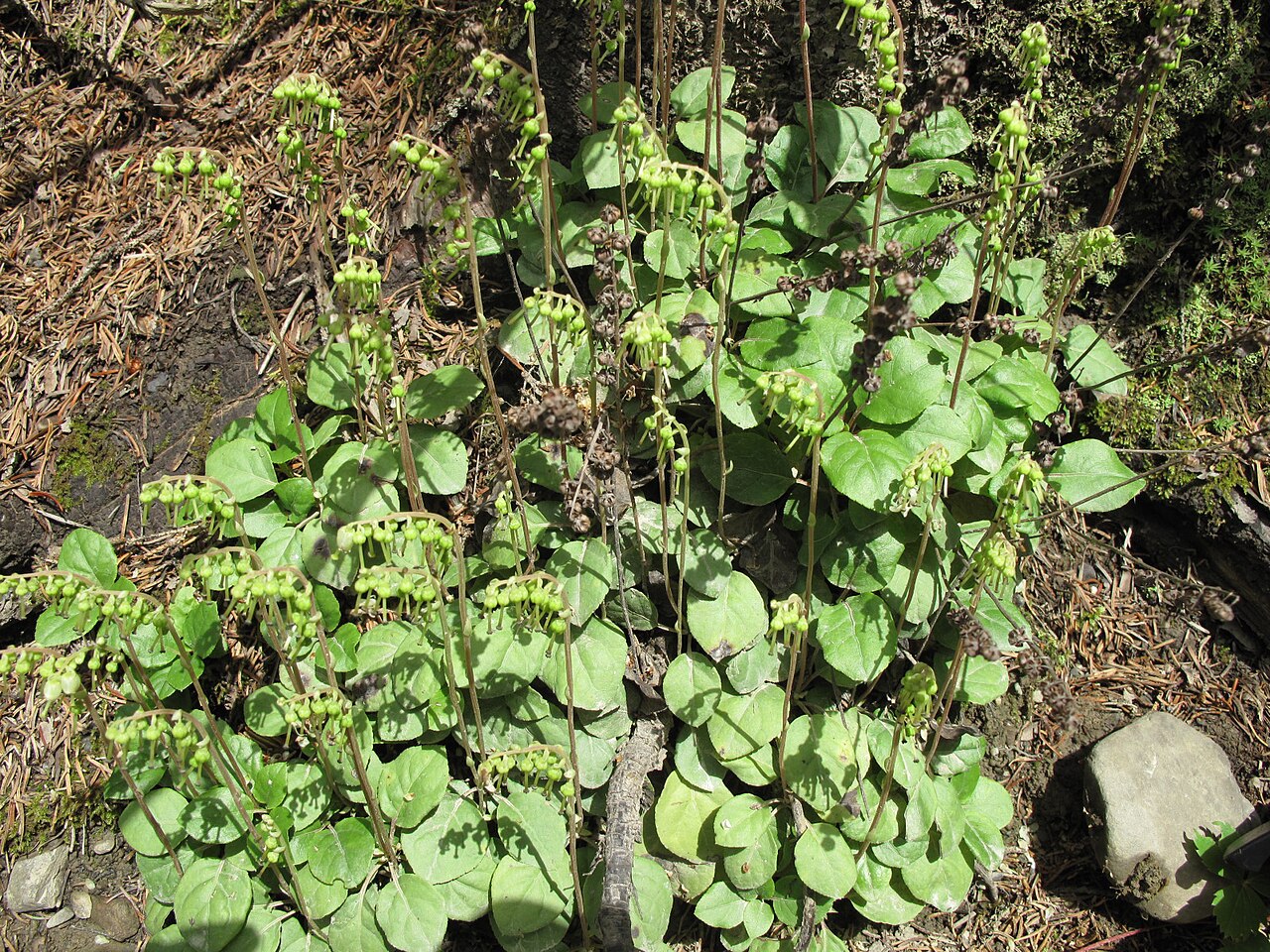
One-sided wintergreen spreads by slender, branching rhizomes and often forms loose patches. Unlike Pyrola species, which usually have a basal rosette, its leaves are scattered along the lower part of short, somewhat woody stems a few inches long. The leaves are ovate to elliptical or nearly round, about ¾ to 2½ inches long, thin to slightly leathery, shiny light to dark green, and finely toothed or scalloped along the edges. They stay green through the winter.
Plants of the far north and high mountains are often smaller, with rounded, nearly untoothed leaves. These have been named var. or subsp. obtusata, and USDA PLANTS lists them as synonyms of the species.
Flowers
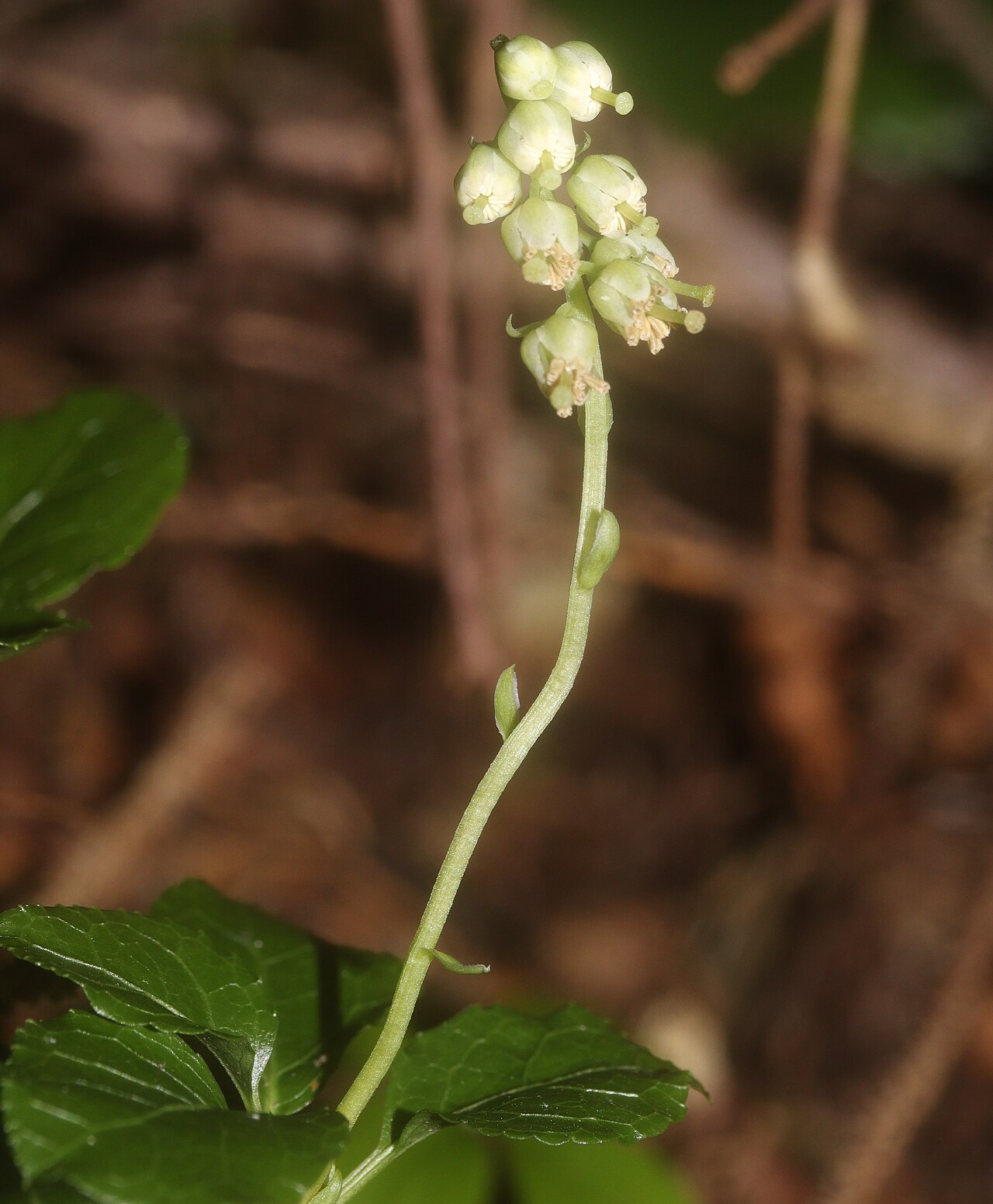
From June to August, a flowering stalk 2 to 8 inches tall rises from the leafy stem. Its upper part bends to one side, and 6 to 20 or more flowers hang in a row on that side. Each flower is a small nodding bell about ¼ inch long, with five greenish-white to creamy petals that stay partly closed. A straight style sticks out well beyond the petals and ends in a broad, disk-shaped stigma. The flowers are not showy, but a patch in bloom is charming up close.
How to Tell It Apart
Pyrola species, such as American wintergreen and shinleaf, have flowers spaced all around the stalk and a style that curves down and out. Single delight (Moneses uniflora) has one large, white, upward-facing flower per stalk. Pipsissewa (Chimaphila umbellata) has narrow, toothed, leathery leaves in whorls and pink flowers in a small cluster at the top of the stem. Out of flower, look for leaves spaced along a short stem rather than all in a rosette, and the old, one-sided fruiting stalk that often persists.
Fruit & Seeds
The flowers become small, rounded capsules about 3/16 inch across that stay in a one-sided row, often turning to face upward as they dry. In late summer and fall they split open to release enormous numbers of dust-fine seeds. These seeds have almost no stored food and need a suitable fungal partner in the soil to germinate.
Quick Facts
| Scientific Name | Orthilia secunda (L.) House (syn. Pyrola secunda) |
| Family | Ericaceae (heath family) |
| Plant Type | Evergreen perennial subshrub; partly dependent on mycorrhizal fungi |
| Mature Height | 2–8 in in flower |
| Mature Spread | Spreads slowly by rhizomes into loose patches |
| Growth Rate | Very slow |
| Sun Exposure | Partial to full shade |
| Water Needs | Moderate; dry to moist forest soils |
| Soil Type | Acidic, humus-rich forest soil and duff over sand, gravel or rock |
| Soil pH | Acidic to near neutral (about 4.5–7.0) |
| Bloom Time | June–August |
| Flower Color | Greenish-white to cream |
| Fall Color | Evergreen; leaves remain green through winter |
| Fruit | Small rounded capsules in a one-sided row; dust-like seeds |
| Deer Resistant | Usually; seldom browsed |
| USDA Hardiness Zones | 2–7 |
Native Range
One-sided wintergreen is circumboreal, growing across northern North America, Europe and Asia. USDA PLANTS lists it as native in Alaska and 33 of the lower 48 states. In Canada it is found in every province and territory from Yukon and British Columbia to Newfoundland and Labrador, and it also grows in Greenland and Saint Pierre and Miquelon.
In the West it is common in the mountains, from Alaska through Washington, Oregon, Idaho, Montana and Wyoming to California, Nevada, Utah, Colorado, Arizona and New Mexico, as well as the Black Hills of South Dakota. In the Northeast and Great Lakes it is frequent in northern Minnesota, Wisconsin, Michigan, New York and New England. Farther south, records from Iowa, Illinois, Indiana, Ohio, Nebraska, New Jersey, Delaware, Maryland and Virginia are outlying and rare, often historical, and these states track it as a rare plant or have few recent reports.
It grows in coniferous and mixed forests, from spruce, fir, pine and Douglas-fir woods to aspen groves, cedar swamps and the edges of bogs. In the Rockies it reaches high subalpine forests. It is most often found in the shade under trees, in mossy duff or deep needle litter, on soils that range from dry and sandy to moist and peaty.
📋 Regional plant lists featuring One-Sided Wintergreen: New York, Pennsylvania & Northern New Jersey · Idaho, Eastern Oregon & Eastern Washington · Ohio & Indiana · Montana & Wyoming · Michigan, Wisconsin & Eastern Minnesota · Nebraska, Kansas & Eastern Colorado · Utah & Western Colorado · Connecticut, Massachusetts & Rhode Island · New Hampshire, Maine & Vermont · Maryland, Virginia & West Virginia · Delaware, Southern New Jersey & Long Island · Arizona & New Mexico · Illinois, Iowa & Missouri · Alaska · North Dakota, South Dakota & Western Minnesota · Western Oregon & Western Washington · California & Nevada
Can You Grow It?
Realistically, no. One-sided wintergreen is not a garden plant. It lives in partnership with soil fungi that are also connected to forest trees, and that relationship cannot be packed into a pot. It rarely establishes from nursery stock, almost never survives transplanting, and should never be dug from the wild. The best way to keep it is to protect the forests where it grows.
Light
In the wild it grows in partial to full shade under conifers or mixed forest. Patches thin out or vanish when the canopy is removed and the forest floor dries out in full sun.
Soil & Water
It needs undisturbed forest soil with a layer of moss, needles or leaf litter and the fungal network that runs through it. It tolerates dry, sandy pine woods as well as moist, mossy spruce and cedar forests, but not compacted, fertilized or heavily amended garden soil.
Planting Tips
Do not plant or transplant it. Dug plants lose their fine roots and fungal connections and slowly starve. Collecting also harms populations that are rare in several eastern and midwestern states. If one-sided wintergreen already grows on wooded land you own, protect the area from trampling, raking, soil disturbance and invasive plants.
Pruning & Maintenance
None. Leave needles, leaves and fallen wood in place; they are part of its habitat. Avoid fertilizers, lime and herbicides nearby, which can disrupt the soil fungi.
Propagation
Not practical for home gardeners. The dust-like seeds need specific fungi to germinate, and rhizome pieces taken from the wild rarely establish elsewhere. Conserving intact forest is the only reliable way to keep this plant.
Where to See It
- Northern and mountain forests: look on shaded, mossy forest floors under spruce, fir, pine and aspen
- National forests and parks: common along trails in the Rockies, Cascades and Sierra Nevada
- Boreal and Great Lakes woods: frequent in northern Minnesota, Wisconsin, Michigan, New York and New England
- Summer wildflower walks: in bloom from June to August, depending on elevation
- Citizen science: report sightings on iNaturalist, especially in eastern states where it is rare
Wildlife & Ecological Value
One-sided wintergreen is a small but telling member of the forest-floor community, and a good example of the hidden partnerships between plants, fungi and trees.
For Pollinators
The small nodding flowers are visited by bumble bees and other bees, small flies and beetles. Studies in Europe suggest it can also pollinate itself when insects are scarce, which helps in short northern summers.
For Birds
It offers little direct food for birds, though grouse may pick at the evergreen leaves. The coniferous forests where it lives support spruce grouse, thrushes, kinglets, crossbills and many other forest birds.
For Mammals
Deer, elk and other browsers occasionally nibble the leaves, but it is not an important food plant. Its evergreen leaves are among the few green plants on the winter forest floor.
Ecosystem Role
Studies of carbon and nitrogen isotopes have shown that Orthilia secunda is partially mycoheterotrophic: besides making its own sugars through photosynthesis, it takes carbon from ectomycorrhizal fungi that also connect to the roots of conifers and other trees. This dependence makes it sensitive to clear-cutting, soil compaction and fire that burns deep into the duff. It is often more abundant in older, undisturbed forests.
Cultural & Historical Uses
The species was first described by Linnaeus in 1753 as Pyrola secunda. The genus Orthilia, from the Greek orthos (straight), refers to the straight style, which separates it from most Pyrola species. Although it was named in the 1840s, the genus was not widely used in North America until the 20th century, and many older field guides still list the plant as Pyrola secunda or Ramischia secunda.
Wintergreen relatives in Pyrola and Orthilia were used in traditional medicine in Europe, Asia and North America, mostly as poultices and teas. In Eastern European folk medicine, Orthilia secunda has been sold as an herbal remedy for women’s health. These uses are of historical and cultural interest only. Wild plants grow slowly and should not be harvested.
The name “sidebells wintergreen” used by USDA describes the flowers well. For hikers, finding a patch of these tiny, tidy bells under conifers on a summer day is one of the quiet pleasures of northern and mountain forests.
Frequently Asked Questions
Can I grow one-sided wintergreen in my garden?
Not realistically. It depends on soil fungi connected to forest trees, rarely establishes from nursery stock, and should never be dug from the wild. If it grows on your property, protect the surrounding forest floor.
Is it the same as Pyrola secunda?
Yes. Pyrola secunda is an older name for the same plant. Most botanists now place it in its own genus, Orthilia, because of its one-sided flower spike, straight style and leaves spread along the stem.
How do I tell it from other wintergreens?
Look at the flowers. In one-sided wintergreen they all hang from one side of an arching stalk and have a straight style. Pyrola species have flowers all around the stalk and a curved style.
Where can I see it?
In shady coniferous and mixed forests across Alaska, the western mountains, the northern Great Lakes and New England, especially in mossy spruce, fir and pine woods. It blooms from June to August.
Is it rare?
It is common across much of its range, but it is rare or known only from old records in several eastern and midwestern states near the southern edge of its range, such as Iowa, Illinois, Indiana, Ohio, New Jersey, Delaware, Maryland and Virginia.

Looking for a nursery that carries One-Sided Wintergreen?
Browse our native plant nursery directory: Alaska & Arizona · California · Colorado, Connecticut & Delaware · Idaho, Illinois, Indiana & Iowa · Maine, Maryland, Massachusetts, Michigan, Minnesota & Montana · Nebraska, Nevada, New Hampshire, New Jersey, New Mexico, New York, North Dakota & Ohio · Oregon · Pennsylvania, Rhode Island, South Dakota, Utah, Vermont & Virginia · Washington · Wisconsin & Wyoming