
Johnson’s Beehive Cactus (Echinomastus johnsonii)
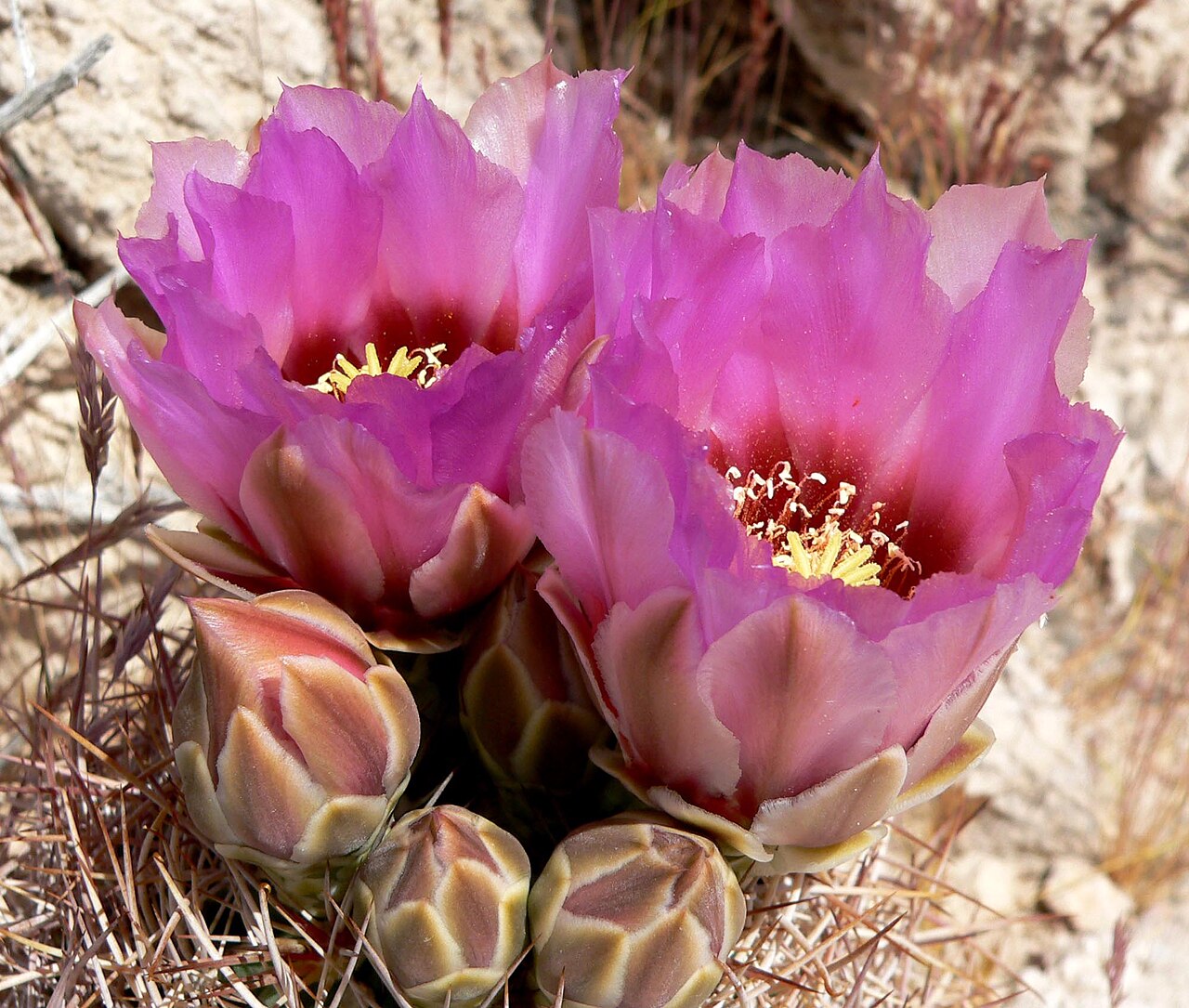
Echinomastus johnsonii, known as Johnson’s Beehive Cactus, Johnson’s fishhook cactus (the USDA name) or Johnson’s pineapple cactus, is a small, single-stemmed cactus of the Mojave Desert. Its egg-shaped to short-cylindrical stem, usually 4 to 10 inches tall, is so densely covered in reddish, pink, gray or yellowish spines that the green body is hidden. In early spring it bears large, satiny flowers, usually bright magenta-pink with a dark red center, that seem far too big for such a small plant.
It belongs to the cactus family (Cactaceae). USDA PLANTS places it in the genus Echinomastus, but many botanists now include it in Sclerocactus as Sclerocactus johnsonii, and older books call it Echinocactus johnsonii. Despite the name fishhook cactus, its spines are curved but not hooked, unlike those of true fishhook cacti such as the Mojave fishhook cactus.
Johnson’s beehive cactus grows on rocky desert slopes in southeastern California, southern Nevada, southwestern Utah and northwestern Arizona. It is uncommon to locally frequent and is slow-growing and hard to cultivate. This guide covers how to identify it, where to see it, and why wild plants should always be left in place.
Identification
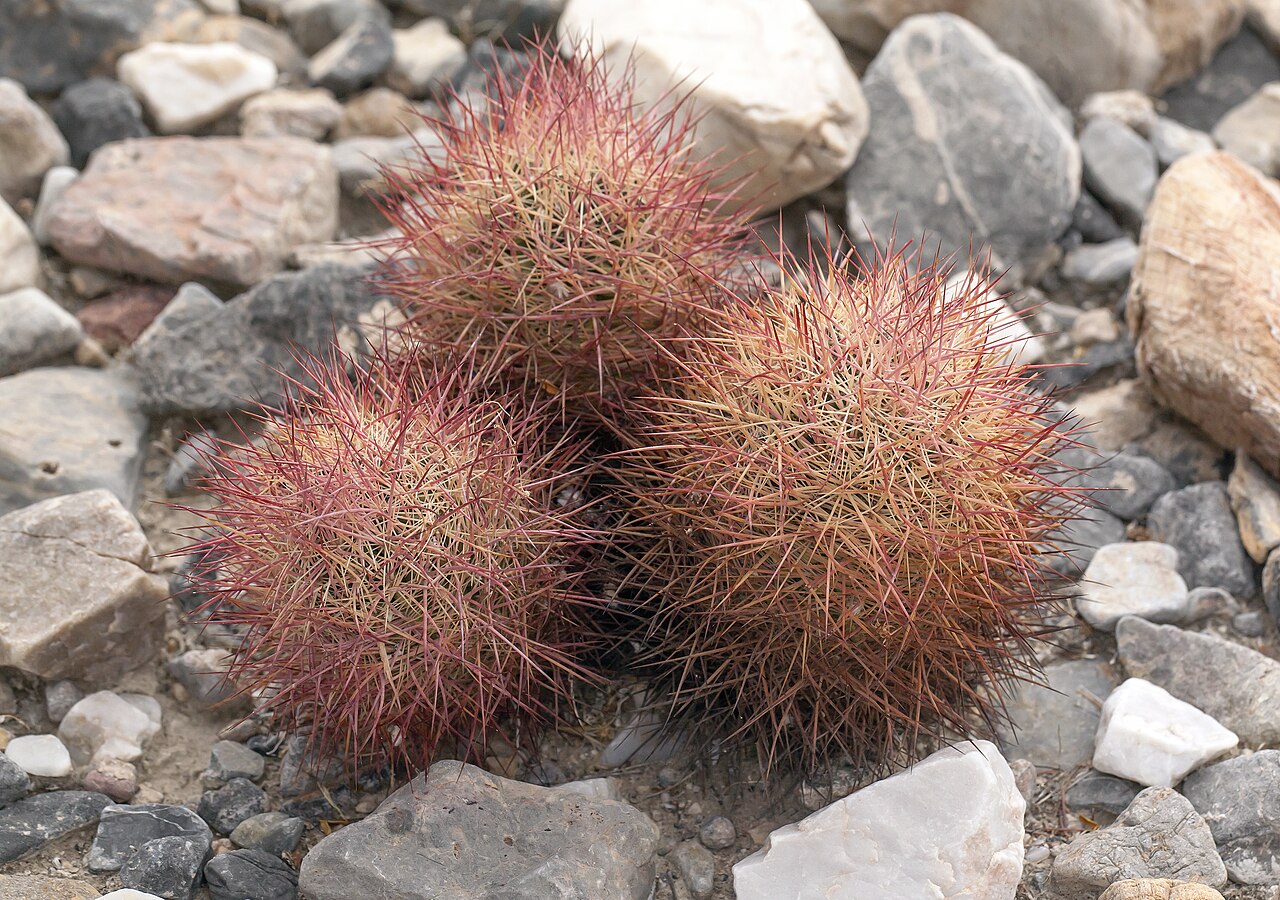
Johnson’s beehive cactus is easiest to find in spring, when its bright flowers stand out on bare, rocky slopes. At other times, look for a small, solitary, egg-shaped cactus that glows reddish or pinkish in low sun because of its dense spines.
Growth Habit
It is a small, usually single-stemmed cactus, egg-shaped when young and becoming short-cylindrical with age, typically 4 to 10 inches tall and about 2 1/2 to 4 inches wide. The stem has about 13 to 21 spiraling ribs made up of low tubercles. Plants grow very slowly and may live for decades.
Spines
Each areole carries numerous straight to curving spines, up to about 1 1/2 inches long, in shades of red, pink, lavender, gray or yellowish. The central spines are stout and curve upward, and the radial spines spread around them, together hiding the green stem. The spines are curved but not hooked at the tip. Older spines fade to gray, so the base of the plant is paler than the top.
Flowers
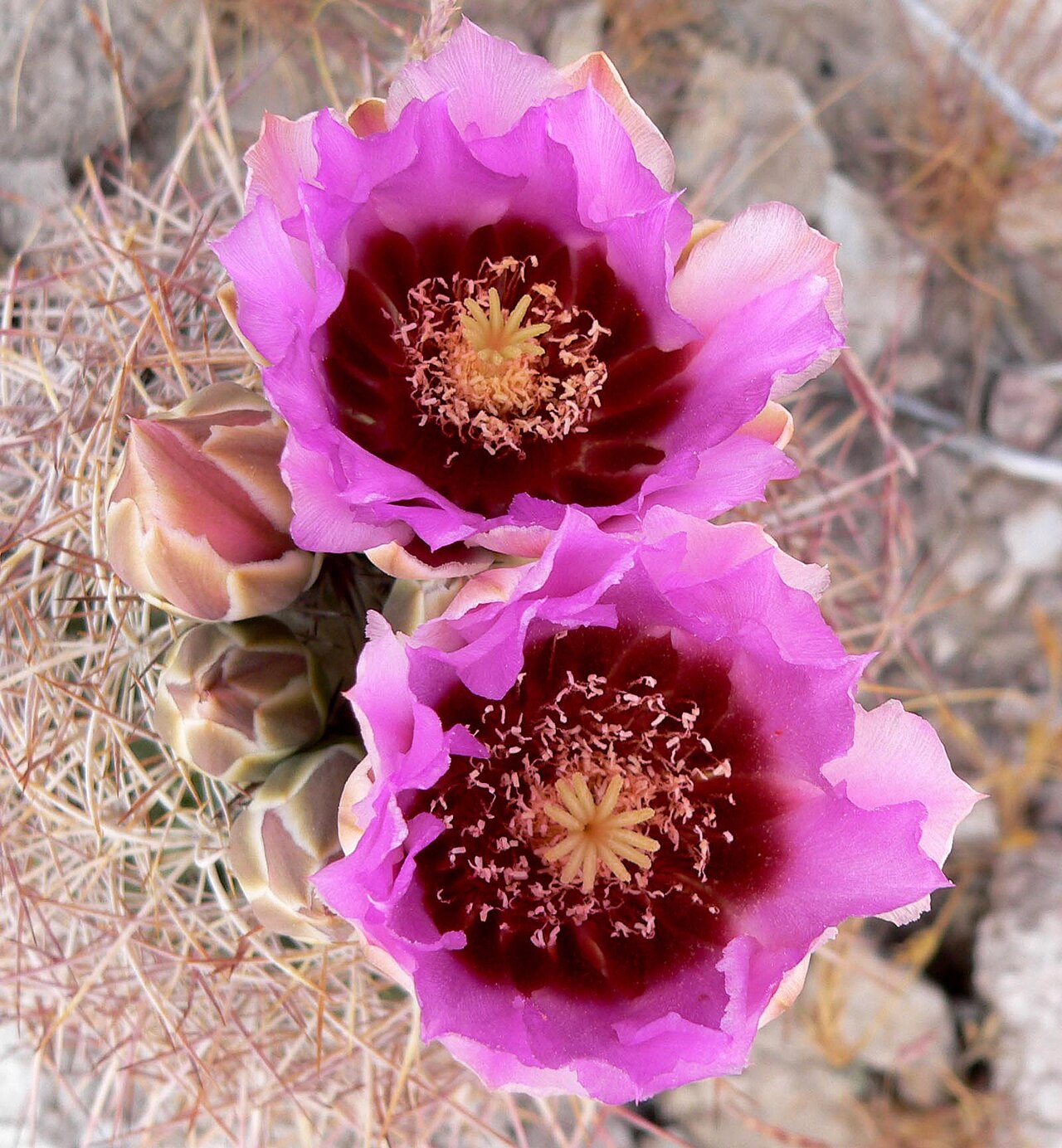
The flowers open from the top of the stem in early spring, mainly March and April. They are about 2 to 3 inches across, with glossy petals that are most often magenta to rose-pink with a dark red or maroon throat and yellow stamens. In parts of western Arizona plants with yellowish to greenish flowers occur and are sometimes treated as a separate variety, lutescens. Several flowers may open at once in a crown around the top of the stem.
Fruit & Seeds
The fruit is small, about 3/4 inch long, green to reddish, with a few scales. It dries and splits open to release small, black seeds.
Look-alikes
Mojave fishhook cactus has long, hooked central spines and magenta flowers. Engelmann’s hedgehog cactus usually grows in clumps of several stems and has green stigma lobes. Young California barrel cactus plants have yellow flowers and flattened, hooked or twisted central spines.
Quick Facts
| Scientific Name | Echinomastus johnsonii (Parry ex Engelm.) E.M. Baxter |
| Family | Cactaceae (cactus family) |
| Plant Type | Small, single-stemmed cactus |
| Mature Height | 4–10 in |
| Mature Spread | 2.5–4 in |
| Growth Rate | Very slow |
| Sun Exposure | Full sun |
| Water Needs | Very low; desert rainfall only |
| Soil Type | Rocky, gravelly, very well-drained soils; often limestone or volcanic |
| Soil pH | About 7.0–8.5 (neutral to alkaline) |
| Bloom Time | March–April (into May) |
| Flower Color | Magenta to rose-pink with a dark red throat; rarely yellowish |
| Fall Color | Evergreen succulent; reddish spines all year |
| Fruit | Small, scaly fruit that dries and splits |
| Deer Resistant | Yes; protected by dense spines |
| USDA Hardiness Zones | 7–10 |
Native Range
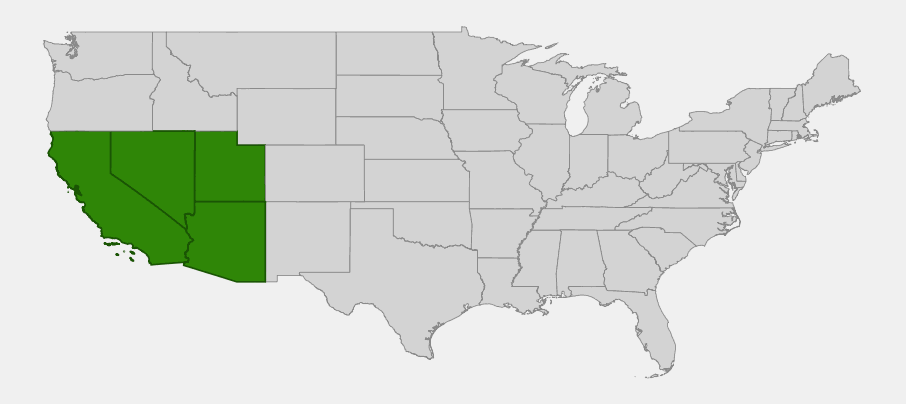
Johnson’s beehive cactus is native to the Mojave Desert and its margins. USDA PLANTS lists it in California, Nevada, Utah and Arizona. In California it grows in eastern Inyo and San Bernardino Counties, including the Death Valley region; in Nevada it occurs in the southern part of the state, especially Clark, Lincoln and Nye Counties; in Utah it is limited to the southwestern corner near St. George; and in Arizona it is found in the northwest, in Mohave County and nearby areas.
It grows on rocky and gravelly desert slopes, ridges and alluvial fans, often on limestone or volcanic soils, in creosote bush and blackbrush scrub. It is mostly found between roughly 1,500 and 4,000 feet. Plants are scattered and easily overlooked when not in flower.
Its classification has changed over time. Plants of the World Online treats it as Sclerocactus johnsonii and includes the rare Acuña cactus and needle-spined pineapple cactus of southern Arizona as subspecies of it. USDA PLANTS keeps those as separate species, and this page follows the USDA treatment, describing the Mojave Desert plant.
📋 Regional plant lists featuring Johnson’s Beehive Cactus: Utah & Western Colorado · Arizona & New Mexico · California & Nevada
Growing & Care Guide
Johnson’s beehive cactus is a plant for experienced cactus growers, not for general gardens. It is slow, sensitive to excess water and rarely sold. Never dig plants from the wild: wild cacti are protected by state native plant laws in Arizona and Nevada and by public land rules throughout the range, all cacti are listed under CITES for international trade, and wild-collected plants seldom survive. Seek seed-grown plants from specialist nurseries.
Light
It needs full sun and high heat. In cultivation, give it the brightest, hottest spot available, with protection from prolonged winter rain.
Soil & Water
Grow it in a very gritty, fast-draining mix, such as mostly pumice, crushed rock or decomposed granite with little organic matter. Water sparingly in spring and fall and keep it almost completely dry in winter and the hottest part of summer. Overwatering quickly leads to rot, the most common cause of loss.
Planting Tips
Outdoors it can be tried only in hot, dry climates similar to the Mojave Desert, on a raised mound or in a rock garden with excellent drainage. Elsewhere, grow it in a clay pot or trough that can be moved under cover during wet weather. Specialists sometimes graft it onto a more vigorous cactus rootstock to keep it alive.
Pruning & Maintenance
No pruning is needed. Keep competing weeds away, handle the plant with folded newspaper or tongs because of its spines, and watch for mealybugs and rot at the base.
Propagation
It is grown from seed, which germinates in warmth on a gritty, sterile mix kept lightly moist, after which the seedlings grow very slowly. It does not produce offsets for division. Buy only nursery-propagated plants or seed, never wild-collected plants.
Landscape Uses
- Where to see it: rocky slopes in the eastern Mojave Desert, such as around Las Vegas and Death Valley, in March and April
- Specialist cactus collections: a slow, challenging plant for experienced growers
- Desert photography: its large magenta flowers and red spines are striking in spring
- Habitat conservation: a characteristic cactus of intact Mojave Desert scrub
- Education: an example of how cacti are classified and of the need to protect wild plants
Wildlife & Ecological Value
Like other small desert cacti, Johnson’s beehive cactus is part of the diverse plant community of rocky Mojave Desert slopes.
For Pollinators
The large, bowl-shaped flowers are visited by native bees, including cactus bees and other solitary bees, which climb among the stamens to collect pollen. They open in early spring, when relatively few desert plants are in bloom.
For Birds
Birds may take some of the small fruits and seeds. The plants are too small to provide nesting sites.
For Mammals
Dense spines protect the stem from most animals, but rodents and rabbits may gnaw on plants during drought, and rodents eat fallen seeds.
Ecosystem Role
Johnson’s beehive cactus is a slow-growing, long-lived member of Mojave Desert scrub. Like many small cacti, it is vulnerable to illegal collection, off-road vehicle damage, development and the spread of invasive grasses, which carry fire into desert scrub where cacti are not adapted to burn. Protecting intact desert habitat is the best way to conserve it.
Cultural & Historical Uses
The species was first described in the nineteenth century as Echinocactus johnsonii, a name proposed by Charles C. Parry and published by George Engelmann. Its name honors J. E. Johnson, an early settler and plant collector in southwestern Utah.
The common name beehive cactus refers to the plant’s rounded, dome-like shape, which resembles an old-fashioned straw beehive. The names pineapple cactus and fishhook cactus come from related species and are used loosely for this group, though this cactus lacks the hooked spines of true fishhook cacti.
Small cacti like this one have long been targeted by collectors, and many states and public land agencies restrict or prohibit removal of wild cacti. Visitors who find Johnson’s beehive cactus in bloom are best rewarded by photographs, leaving the plants to flower for years to come.
Frequently Asked Questions
Is Johnson’s beehive cactus the same as Johnson’s fishhook cactus?
Yes. USDA PLANTS calls Echinomastus johnsonii Johnson’s fishhook cactus, although its spines are curved rather than hooked. It is also called Johnson’s pineapple cactus.
Is it Echinomastus or Sclerocactus johnsonii?
Both names are used. USDA PLANTS uses Echinomastus johnsonii, while many recent references place it in Sclerocactus as Sclerocactus johnsonii.
When does Johnson’s beehive cactus bloom?
Mainly in March and April, sometimes into May, with large magenta-pink flowers with dark red centers.
Where can I see Johnson’s beehive cactus?
On rocky desert slopes in the eastern Mojave Desert of California, southern Nevada, southwestern Utah and northwestern Arizona, for example in the hills around Las Vegas.
Can I dig up a Johnson’s beehive cactus for my garden?
No. Wild cacti are protected by state laws and public land rules, and dug plants rarely survive. Grow only seed-grown plants from reputable specialist nurseries.

Looking for a nursery that carries Johnson’s Beehive Cactus?
Browse our native plant nursery directory: Arizona · California · Nevada · Utah

