
White-flower Beardtongue (Penstemon albidus)
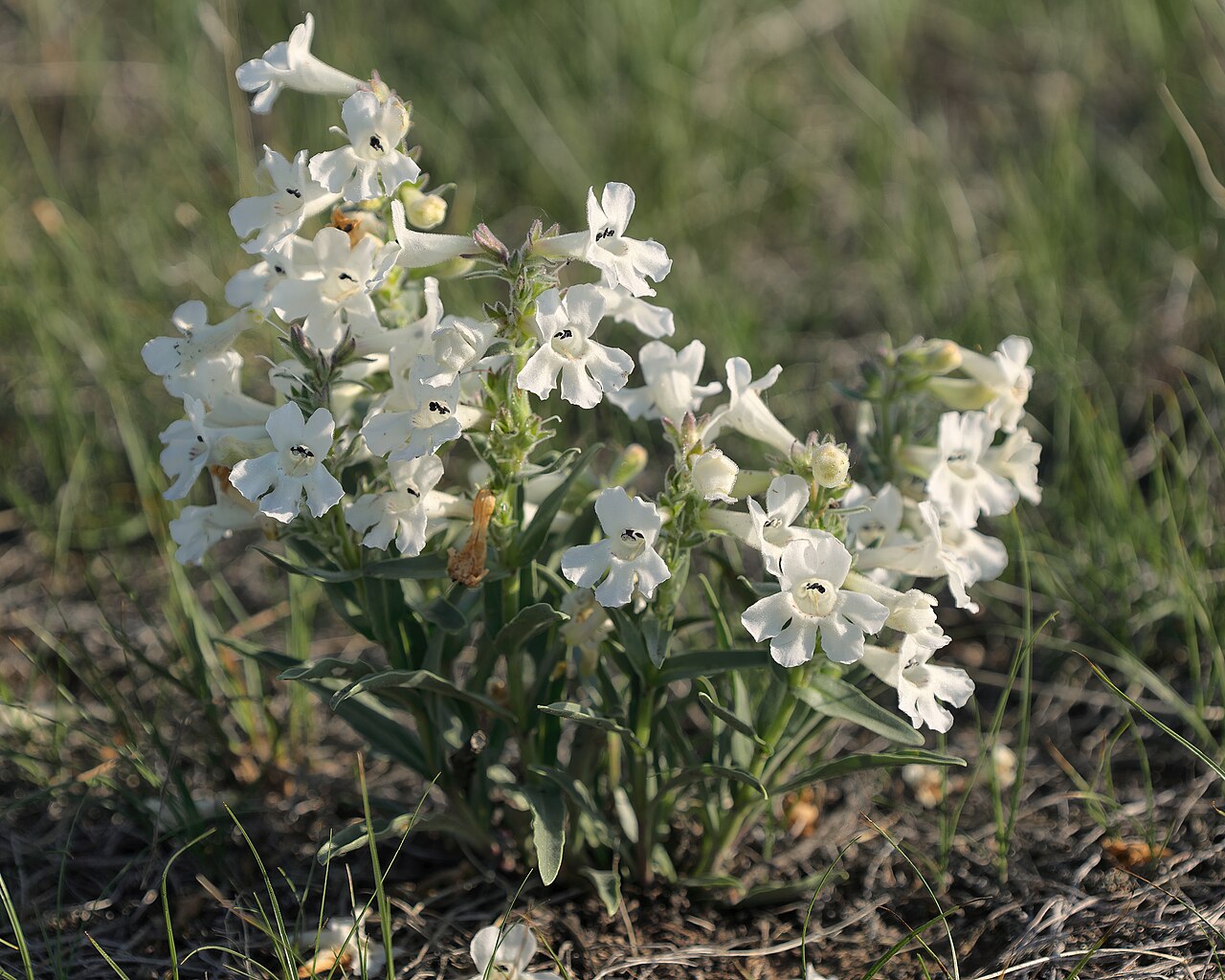
Penstemon albidus, called White-flower Beardtongue or white penstemon, is a sturdy, long-lived perennial of the mixed-grass and shortgrass prairies of the Great Plains. In late spring it sends up stout, upright stems 6 to 20 inches tall that are crowded with white, funnel-shaped flowers, each often marked inside with fine reddish-purple lines. It belongs to the plantain family (Plantaginaceae), which now includes the penstemons.
It is one of the few truly white-flowered penstemons of the plains, and the only common one whose flowers, stems and flower stalks are sticky with short glandular hairs. In bloom it stands out against the gray-green of spring grasses and sagebrush, and it is a reliable early-season nectar plant for native bees.
White-flower beardtongue grows from the Canadian prairies of Alberta, Saskatchewan and Manitoba south through Montana and the Dakotas to Colorado, Kansas, Oklahoma, northern Texas and northeastern New Mexico. This guide covers identification, native range, how to grow it in a dry, sunny garden, and its value to wildlife.
Identification
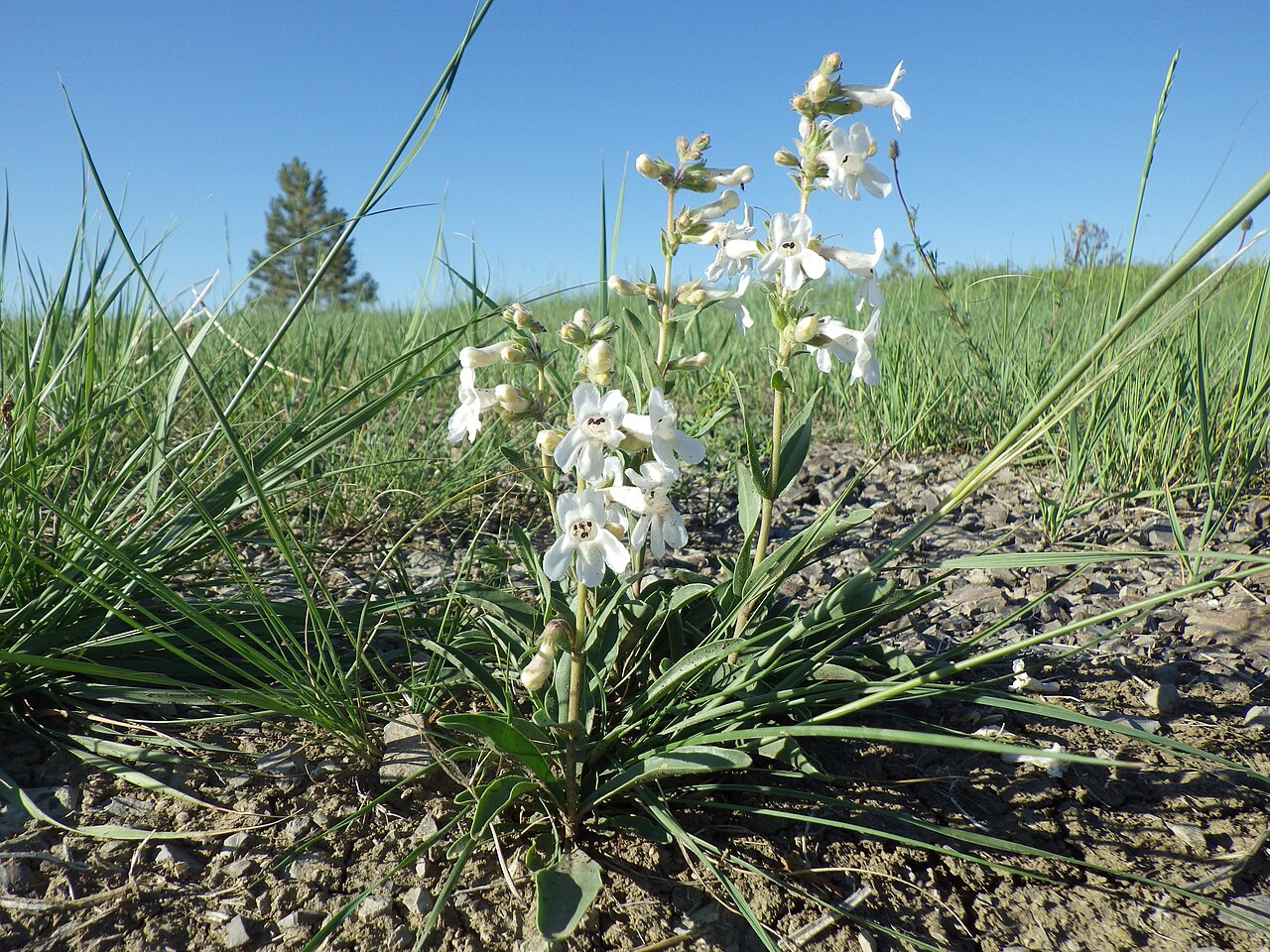
Look for a short, stiffly upright penstemon with a dense, leafy spike of white flowers in May or June, on dry, sandy or gravelly prairie. The sticky glandular hairs on the flowers and upper stem are the best field mark.
Stems & Roots
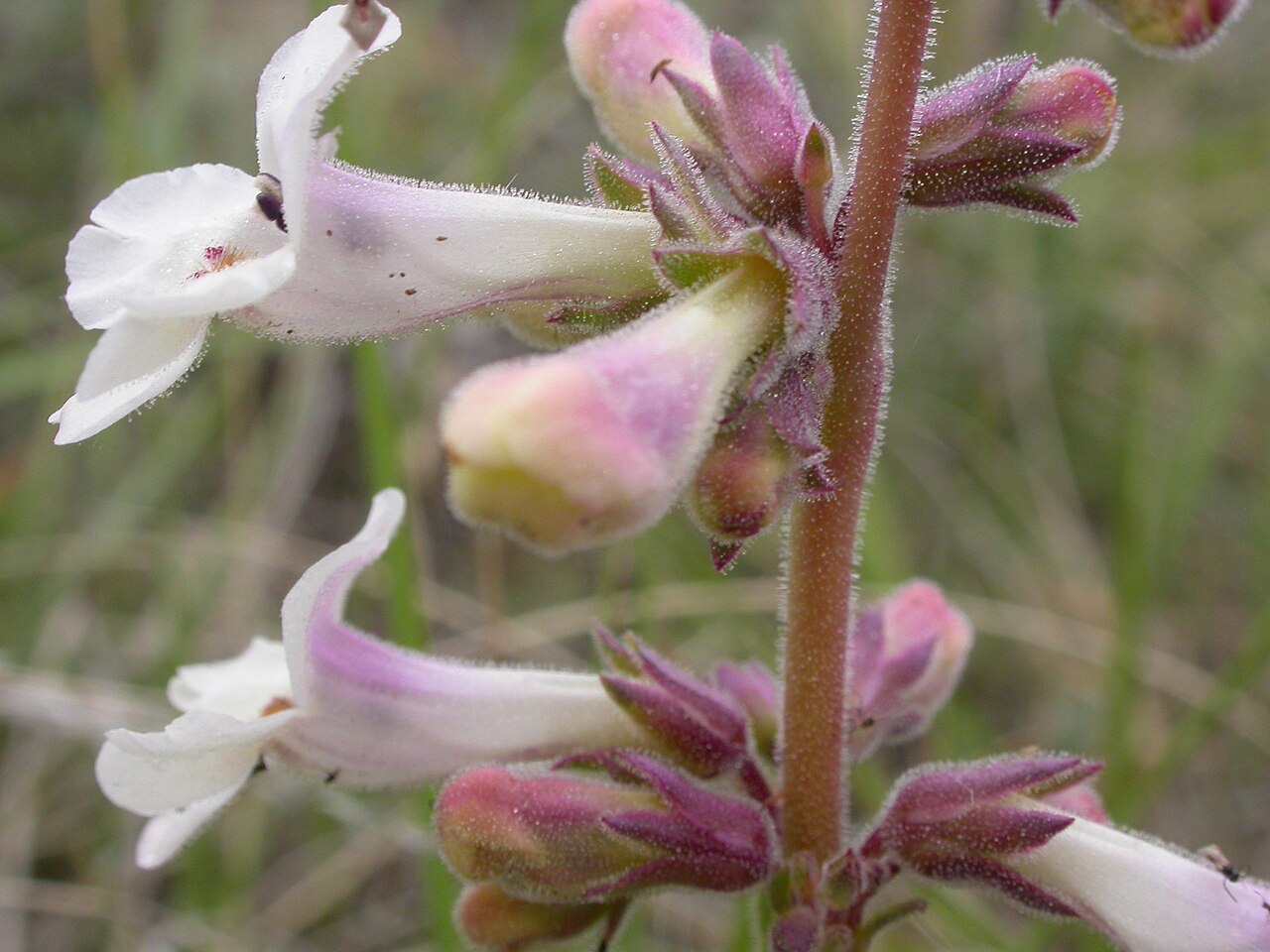
Plants grow from a short, branched woody base (caudex) on a taproot with fibrous side roots. Each plant has one to several flowering stems, usually 6 to 20 inches (15 to 50 cm) tall, upright with only a slight curve at the base. The stems are finely hairy, and the hairs become glandular and sticky toward the top. If the top is grazed or broken, the crown sends up new shoots.
Leaves
The basal leaves are lance-shaped to oblong or slightly wider toward the tip, about 1 to 3½ inches long, on short stalks. Their surfaces range from smooth to rough with short stiff hairs, and the edges vary from smooth to toothed. On the flowering stem there are a few pairs of opposite, stalkless leaves that clasp the stem, getting smaller toward the top.
Flowers
The flowers are arranged in 2 to 10 clusters along the upper stem, forming a crowded spike 2 to 10 inches long. Each flower is a funnel-shaped tube about ½ to ¾ inch long, open at the mouth, with two upper and three lower lobes. They are white, sometimes faintly tinged with lavender or pink, and usually have dark reddish-purple guide lines running into the throat. The outside and inside of the flower are glandular-hairy, and the flowers glisten in sunlight. As in all penstemons, a sterile fifth stamen (the staminode) lies along the floor of the tube; here it is lightly bearded with yellow hairs.
Bloom time is mainly May and June, starting as early as April in the southern part of the range.
Fruit & Seeds
Each flower produces an oval, pointed capsule about ⅓ to ½ inch long that turns brown and splits open in summer, releasing many small, angular, dark seeds. The dry stalks with their open capsules often remain standing into fall.
Quick Facts
| Scientific Name | Penstemon albidus Nutt. |
| Family | Plantaginaceae (plantain family); formerly placed in Scrophulariaceae |
| Plant Type | Herbaceous perennial |
| Mature Height | 6–20 in |
| Mature Spread | 6–12 in |
| Growth Rate | Moderate |
| Sun Exposure | Full sun |
| Water Needs | Low; drought tolerant |
| Soil Type | Sandy, gravelly or rocky, well-drained soil |
| Soil pH | Neutral to alkaline (about 6.5–8.0) |
| Bloom Time | April–June, mostly May–June |
| Flower Color | White, sometimes tinged lavender or pink, with reddish-purple guide lines |
| Fall Color | None notable |
| Fruit | Oval capsule with many small seeds |
| Deer Resistant | Moderately; foliage is occasionally browsed |
| USDA Hardiness Zones | 3–8 |
Native Range
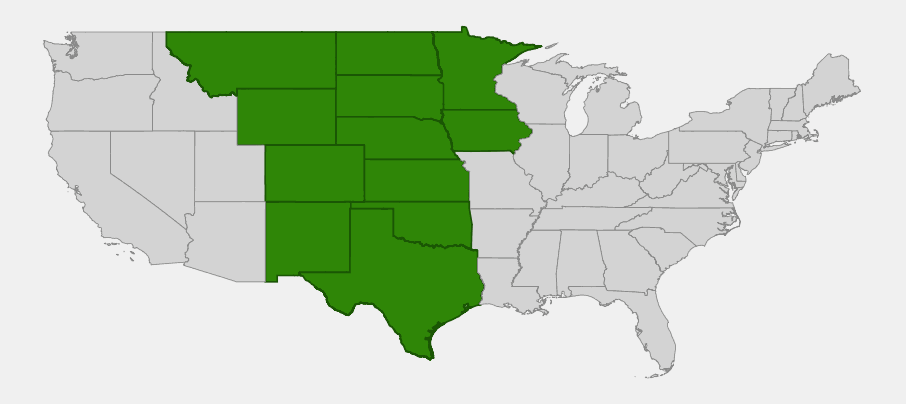
White-flower beardtongue is a characteristic plant of the northern and central Great Plains. USDA PLANTS lists it as native in Montana, Wyoming, North Dakota, South Dakota, Nebraska, Kansas, Colorado, Oklahoma, Texas, New Mexico, Minnesota and Iowa. In Canada it grows on the prairies of southern Alberta, Saskatchewan and Manitoba.
Its center of abundance is the mixed-grass prairie and sagebrush grassland of eastern Montana, the western Dakotas, Wyoming and Nebraska. Toward the edges of its range it becomes local: in Minnesota and Iowa it is limited to dry prairies in the western part of each state, and in the south it reaches western Oklahoma, the Texas Panhandle and northeastern New Mexico. It grows on the eastern plains of Colorado rather than in the mountains.
Typical sites are dry, open upland prairie, sandhills, gravelly hilltops and ridges, badland edges and sagebrush steppe. It is most common on undisturbed native grassland and tends to disappear from land that has been plowed or heavily disturbed.
📋 Regional plant lists featuring White-flower Beardtongue: North Dakota, South Dakota & Western Minnesota · Nebraska, Kansas & Eastern Colorado · Montana & Wyoming · Illinois, Iowa & Missouri · Michigan, Wisconsin & Eastern Minnesota
Growing & Care Guide
White-flower beardtongue is an easy, tough plant for dry, sunny gardens in the northern and central plains. Like most western penstemons, it fails far more often from too much water and rich soil than from drought or cold. Seed and plants are offered by some native seed companies and nurseries in the Great Plains.
Light
Plant it in full sun. In shade it becomes leggy, flowers poorly and is more prone to rot.
Soil & Water
Choose lean, sandy, gravelly or rocky soil that drains quickly. Avoid heavy clay and spots where water stands, and do not add compost or fertilizer. Water newly set plants during their first season; after that, natural rainfall in the plains is usually enough. In wetter climates, a raised bed or gravel mulch helps keep the crown dry.
Planting Tips
Set plants out in spring or early fall, keeping the crown level with the soil surface. Space them about a foot apart, and group several together for a better show. Gravel mulch suits it better than wood mulch, which holds moisture around the crown.
Pruning & Maintenance
Cut the flower stalks after seed has ripened, or leave some for wildlife and self-sowing. Individual plants may live only a few years in gardens, but they usually reseed lightly where soil is open. Keep vigorous grasses from crowding young plants.
Propagation
Grow it from seed. Seed germinates best after a cold, moist stratification of about 8 to 12 weeks, or sow it outdoors in fall. Cover seed only lightly. Stem cuttings can also root, and established crowns can sometimes be divided in early spring.
Landscape Uses
- Prairie and meadow plantings: an early-blooming white accent among short grasses and other dry-prairie wildflowers
- Rock and gravel gardens: a compact, drought-tolerant perennial for lean, fast-draining soil
- Xeriscapes: needs no irrigation once established in the plains
- Pollinator gardens: provides nectar and pollen for native bees in late spring
- Restoration: used in seed mixes for dry upland prairie and rangeland within its range
Wildlife & Ecological Value
White-flower beardtongue blooms early in the prairie season, when fewer flowers are open, so it is a useful nectar source in native grassland.
For Pollinators
The open-throated white flowers are visited mostly by bees, including bumble bees and smaller solitary bees, and the Xerces Society rates it as having special value for native bees and bumble bees. Day-flying hummingbird moths (clearwing sphinx moths) also visit the flowers.
For Birds
Seed-eating grassland birds may take seeds from the open capsules, and the insects that visit the flowers feed insectivorous birds of the prairie such as meadowlarks and sparrows.
For Mammals
Deer, pronghorn and livestock occasionally browse the plant, but it is not a major forage species. Small rodents may eat the seeds.
Ecosystem Role
Because it disappears from plowed or badly overgrazed land and persists in undisturbed grassland, white-flower beardtongue is a good indicator of healthy native prairie. Its deep taproot helps it survive drought and recover after grazing or fire.
Cultural & Historical Uses
Thomas Nuttall described Penstemon albidus in 1818 from plants collected along the upper Missouri River. The species name means “whitish,” for its flower color. The genus name Penstemon refers to the fifth stamen, and the common name beardtongue comes from the hairy staminode that sticks out like a small tongue.
Plains penstemons were used by some Indigenous peoples of the region as medicine, for example for toothache or as a wash, but specific uses of white-flower beardtongue are not well documented, and it should not be used without expert guidance.
Today it is valued by prairie restorationists and by gardeners in the northern plains who want tough, low-water wildflowers. Where it grows alongside other plains penstemons it occasionally hybridizes with them, which may explain the plants with lavender- or pink-tinged flowers.
Frequently Asked Questions
How can I tell white-flower beardtongue from other white penstemons?
On the Great Plains it is the common white-flowered penstemon with sticky, glandular-hairy flowers and upper stems. Slender beardtongue (Penstemon gracilis) is taller and more slender with pale lavender flowers, and foxglove beardtongue (Penstemon digitalis), an eastern species, is much taller with smooth flower stalks and grows in moister soil.
Is it drought tolerant?
Yes. It is adapted to dry prairie and sagebrush grassland, and once established it needs no watering in most of the plains. Overwatering and heavy soil are the main reasons it fails in gardens.
Will it grow in clay soil?
It struggles in heavy clay, especially where water stands in winter. If your soil is heavy, plant it in a raised bed, on a slope or in a gravel garden.
Does it attract hummingbirds?
Hummingbirds may visit it occasionally, but its white, open-throated flowers are adapted mainly to bees. Red-flowered penstemons such as firecracker penstemon are better choices for hummingbirds.
Is it long-lived?
In the wild it is a long-lived perennial. In gardens, especially in rich or moist soil, individual plants may last only a few years, but they often reseed if some seed is allowed to ripen.

Looking for a nursery that carries White-flower Beardtongue?
Browse our native plant nursery directory: Colorado · Iowa & Kansas · Minnesota & Montana · Nebraska, New Mexico, North Dakota & Oklahoma · South Dakota & Texas · Wyoming

