
Shinyleaf Meadowsweet (Spiraea lucida)
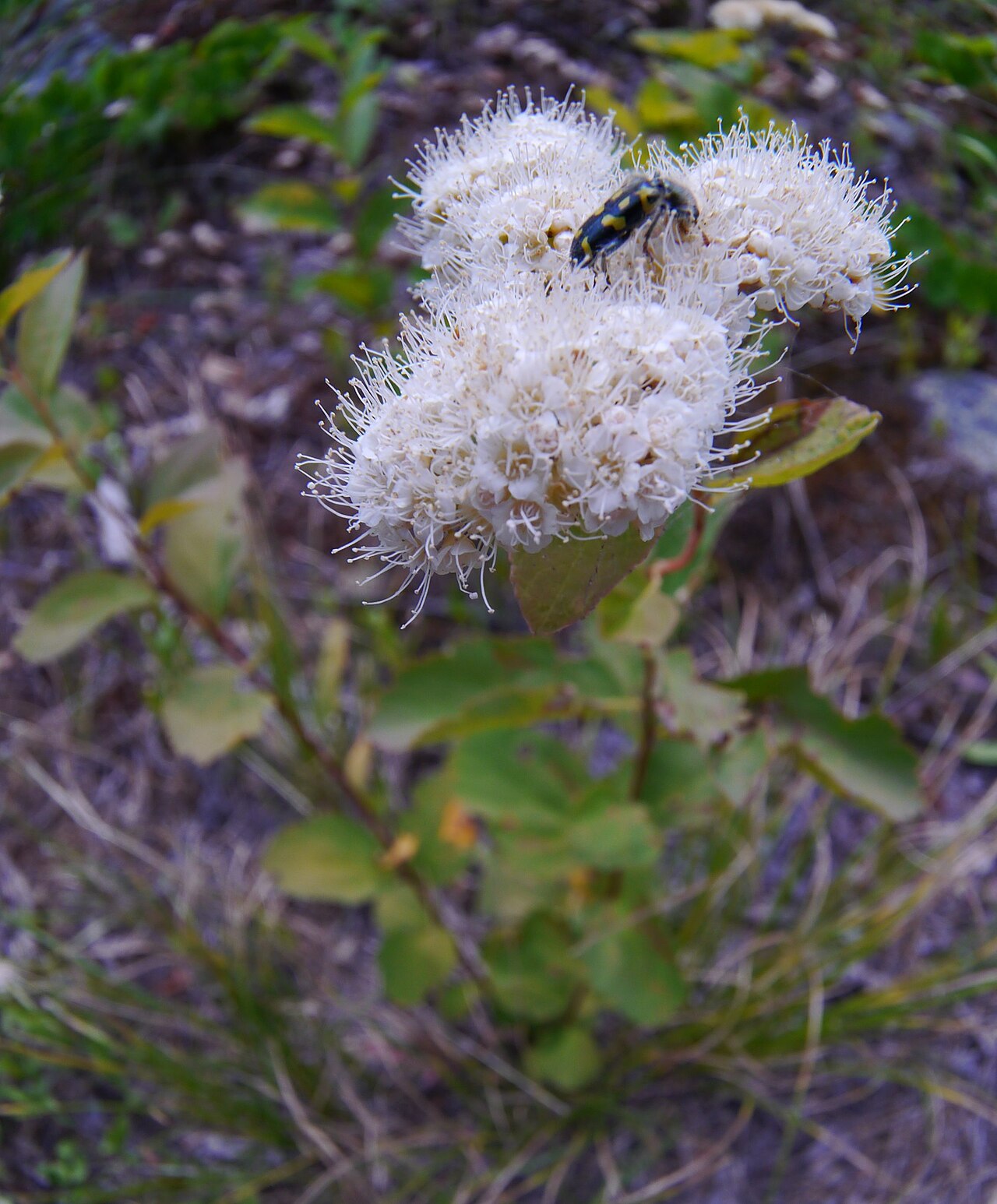
Spiraea lucida, known as Shinyleaf Meadowsweet or shinyleaf spirea, is a low, deciduous shrub of open forests in the interior Northwest, the northern Rockies and the northern Great Plains. It usually stands 1 to 2½ feet tall, spreads by underground stems into loose colonies, and in early to midsummer bears flat-topped clusters of tiny white flowers above glossy, oval leaves. It is a member of the rose family (Rosaceae).
This is one of the most common understory shrubs in the ponderosa pine and Douglas-fir forests east of the Cascades and in the Rockies. It was long treated as a variety of the birchleaf or white spirea (Spiraea betulifolia), and many references still list it as S. betulifolia var. lucida. Today most botanists recognize it as a separate species.
Shinyleaf meadowsweet is tough, adaptable and fire-tolerant. It resprouts quickly from its roots after fire or browsing, holds soil on slopes, and its flowers feed a wide variety of insects. In gardens it makes a neat, small native shrub or groundcover for dry shade and sunny slopes, with attractive yellow to reddish fall color.
Identification
Look for a low, colony-forming shrub with glossy, oval, coarsely toothed leaves and flat-topped clusters of fuzzy white flowers in summer, growing under open pines and firs in the interior West.
Leaves
The leaves are alternate, oval to broadly elliptic, about 1 to 3 inches long, dark green and shiny above and paler beneath. They are smooth on the lower half and coarsely toothed toward the tip. Leaf shape varies a good deal from plant to plant. In fall they turn yellow, orange or reddish.
Stems & Bark
Several slender, upright, sparsely branched stems rise from spreading rhizomes. Young stems are reddish-brown and smooth, and older stems are gray-brown. Stems often die back partway in winter and are replaced by new shoots.
Flowers
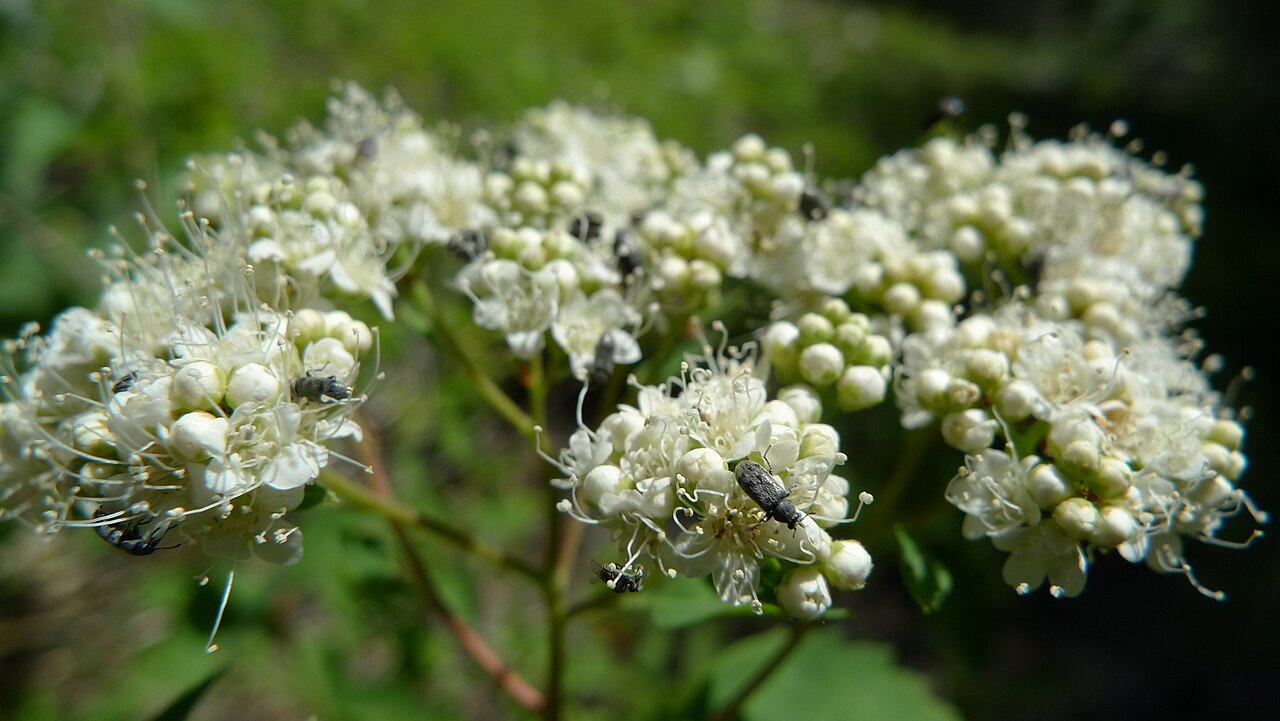
The flowers grow in dense, flat-topped or slightly rounded clusters about 1 to 4 inches across at the tips of the stems. Each flower is tiny, about 1/4 inch across, with five white petals and many long stamens that give the cluster a fuzzy appearance. Buds are round and white, sometimes tinged pink. Bloom is from about June to August, depending on elevation.
Fruit & Seeds
Each flower forms a cluster of five small, shiny, dry pods (follicles) that ripen in late summer and split along one side to release tiny seeds. The dry, brown seed heads often stay on the plant into winter.
Look-alikes
Western Spirea (S. douglasii) is taller, grows in wet places and has elongated, pink to rose flower clusters. Mountain Spirea (S. splendens) has rose-pink, rounded flower clusters. Birchleaf spirea (S. betulifolia in the strict sense) is very similar but is native to northeastern Asia; the North American plants formerly called by that name are now separated as S. lucida. Meadowsweet (S. alba) of the East has narrow leaves and cone-shaped flower clusters.
Quick Facts
| Scientific Name | Spiraea lucida |
| Family | Rosaceae (rose family) |
| Plant Type | Deciduous shrub; rhizomatous |
| Mature Height | 1–2½ ft |
| Mature Spread | 2–4 ft; spreads into colonies |
| Growth Rate | Moderate |
| Sun Exposure | Full sun to part shade |
| Water Needs | Low to medium |
| Soil Type | Well-drained loam, sandy or rocky soil |
| Soil pH | About 5.5–7.5 |
| Bloom Time | June–August |
| Flower Color | White |
| Fall Color | Yellow, orange or reddish |
| Fruit | Small clusters of dry follicles |
| Deer Resistant | No; browsed by deer and elk |
| USDA Hardiness Zones | 3–7 |
Native Range
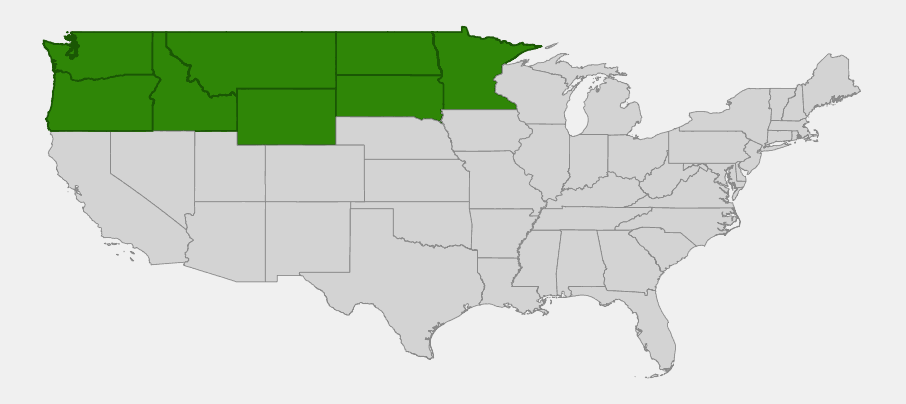
Shinyleaf meadowsweet is native to western Canada and the northwestern and north-central United States. USDA PLANTS lists it as native in Idaho, Montana, Oregon, Washington, Wyoming, North Dakota, South Dakota and Minnesota. In Canada it grows in British Columbia, Alberta and Saskatchewan.
It is most abundant in the interior: east of the Cascades in Washington and Oregon, across northern Idaho and western Montana and south into the mountains of Wyoming. It reaches the northern plains in the Black Hills and other wooded uplands of the Dakotas. The Minnesota record is at the far eastern edge of its range.
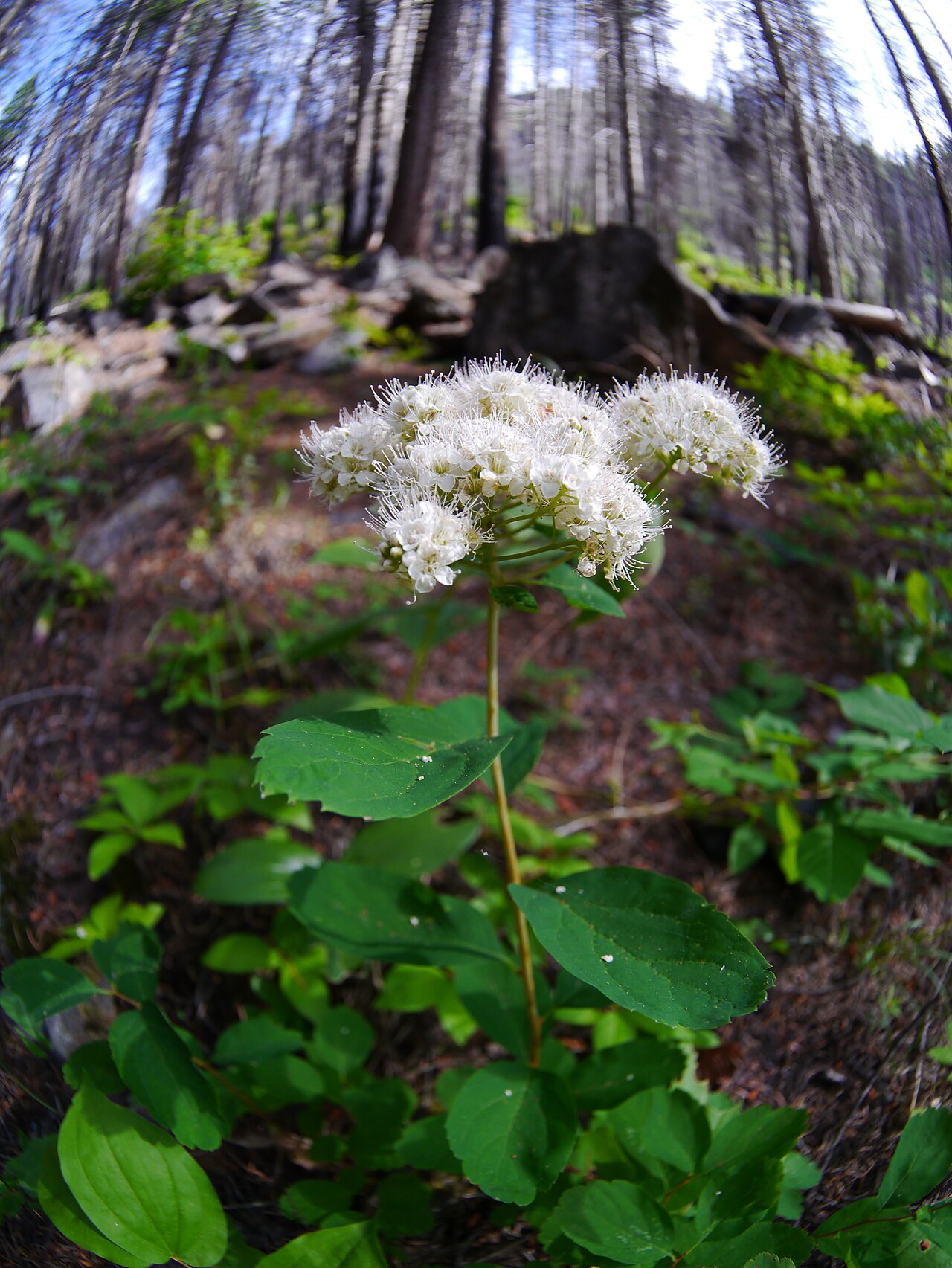
It grows in open ponderosa pine, Douglas-fir, lodgepole pine and mixed conifer forests, aspen groves, shrubby slopes, forest edges and openings, from valley foothills to subalpine elevations. It is especially common in forests with a history of frequent fire, where it resprouts after burns.
📋 Regional plant lists featuring Shinyleaf Meadowsweet: Idaho, Eastern Oregon & Eastern Washington · Montana & Wyoming · North Dakota, South Dakota & Western Minnesota · Michigan, Wisconsin & Eastern Minnesota · Western Oregon & Western Washington
Growing & Care Guide
Shinyleaf meadowsweet is an easy, cold-hardy native shrub for gardens in the interior Northwest and northern Rockies. It suits informal plantings, slopes and woodland edges, where it can spread into a low thicket.
Light
Full sun to part shade. It flowers best with at least a half day of sun, but it also grows well in the filtered light under open pines.
Soil & Water
It prefers well-drained loam but tolerates sandy, rocky and fairly poor soils. Water regularly the first summer; once established it needs only occasional deep watering in dry summers. It does not tolerate constantly wet, poorly drained soil.
Planting Tips
Plant container shrubs in spring or fall about 2 to 3 feet apart for a groundcover, or singly among larger shrubs. It is useful for stabilizing slopes and banks. Group it with snowberry, serviceberry and native bunchgrasses for a natural look.
Pruning & Maintenance
Cut back dead stem tips in early spring. Every few years you can cut the whole plant close to the ground in late winter to renew it; it resprouts vigorously. Remove spent flower heads if you prefer a tidier look, though they provide some winter interest.
Propagation
Divide rooted suckers from the edge of a colony in early spring. Softwood cuttings taken in early summer root readily. Seed can be sown outdoors in fall, but seedlings grow slowly compared with divisions.
Landscape Uses
- Native shrub borders: low, neat shrub with summer flowers and fall color
- Slope stabilization: spreads by rhizomes and resprouts after damage
- Pollinator gardens: flat flower clusters feed beetles, bees, flies and butterflies
- Fire-adapted landscapes: resprouts quickly after fire
- Woodland edges: tolerates the partial shade of open pine stands
Wildlife & Ecological Value
Shinyleaf meadowsweet is a common and valuable understory shrub in western forests.
For Pollinators
Its flat, open flower clusters are easy for many insects to use. Beetles, including flower longhorn beetles, small bees, syrphid flies and butterflies visit for pollen and nectar. The Xerces Society notes its special value to native bees.
For Birds
Ground-feeding birds and grouse use the low thickets for cover, and some birds eat the tiny seeds. Insects on the flowers provide food for songbirds raising young in summer.
For Mammals
Deer and elk browse the stems and leaves, especially in the year after a fire when new shoots are tender. Small mammals shelter in its colonies.
Ecosystem Role
Because it resprouts from rhizomes after fire, it is one of the first shrubs to return in burned forests, helping to hold soil and restore cover. Its colonies form part of the shrub layer that supports wildlife in dry conifer forests.
Cultural & Historical Uses
The genus name Spiraea comes from the Greek speira, a wreath or coil, because some spireas were used in garlands. The species name lucida means “shining,” for the glossy leaves. David Douglas, the Scottish plant collector who explored the Pacific Northwest in the 1820s, first noted the plant, and Edward Lee Greene published the name.
For much of the 20th century, botanists lumped this plant with the birchleaf spirea of eastern Asia as Spiraea betulifolia var. lucida. Its leaf shape varies widely, partly because stems often die back in winter and regrow. Later studies supported treating the North American plants as their own species.
On this site, related plants include Western Spirea, Mountain Spirea, Meadowsweet and Steeplebush.
Frequently Asked Questions
How tall does shinyleaf meadowsweet get?
Usually 1 to 2½ feet tall, spreading slowly by underground stems into colonies several feet wide.
Is shinyleaf meadowsweet the same as birchleaf spirea?
It was long treated as a variety of birchleaf spirea (Spiraea betulifolia), but most botanists now recognize the North American plants as a separate species, Spiraea lucida.
Where does shinyleaf meadowsweet grow?
In open conifer forests and forest edges from British Columbia and Saskatchewan south through eastern Washington and Oregon, Idaho, Montana and Wyoming, and east to the Black Hills and the Dakotas.
Does shinyleaf meadowsweet survive wildfire?
Yes. Its rhizomes survive fire, and it resprouts quickly, often blooming in the first or second summer after a burn.
Is shinyleaf meadowsweet good for pollinators?
Yes. Its flat, fuzzy white flower clusters attract beetles, native bees, flies and butterflies in summer.

Looking for a nursery that carries Shinyleaf Meadowsweet?
Browse our native plant nursery directory: Idaho · Minnesota & Montana · North Dakota · Oregon · South Dakota · Washington · Wyoming

