
Oregon Boxwood (Paxistima myrsinites)
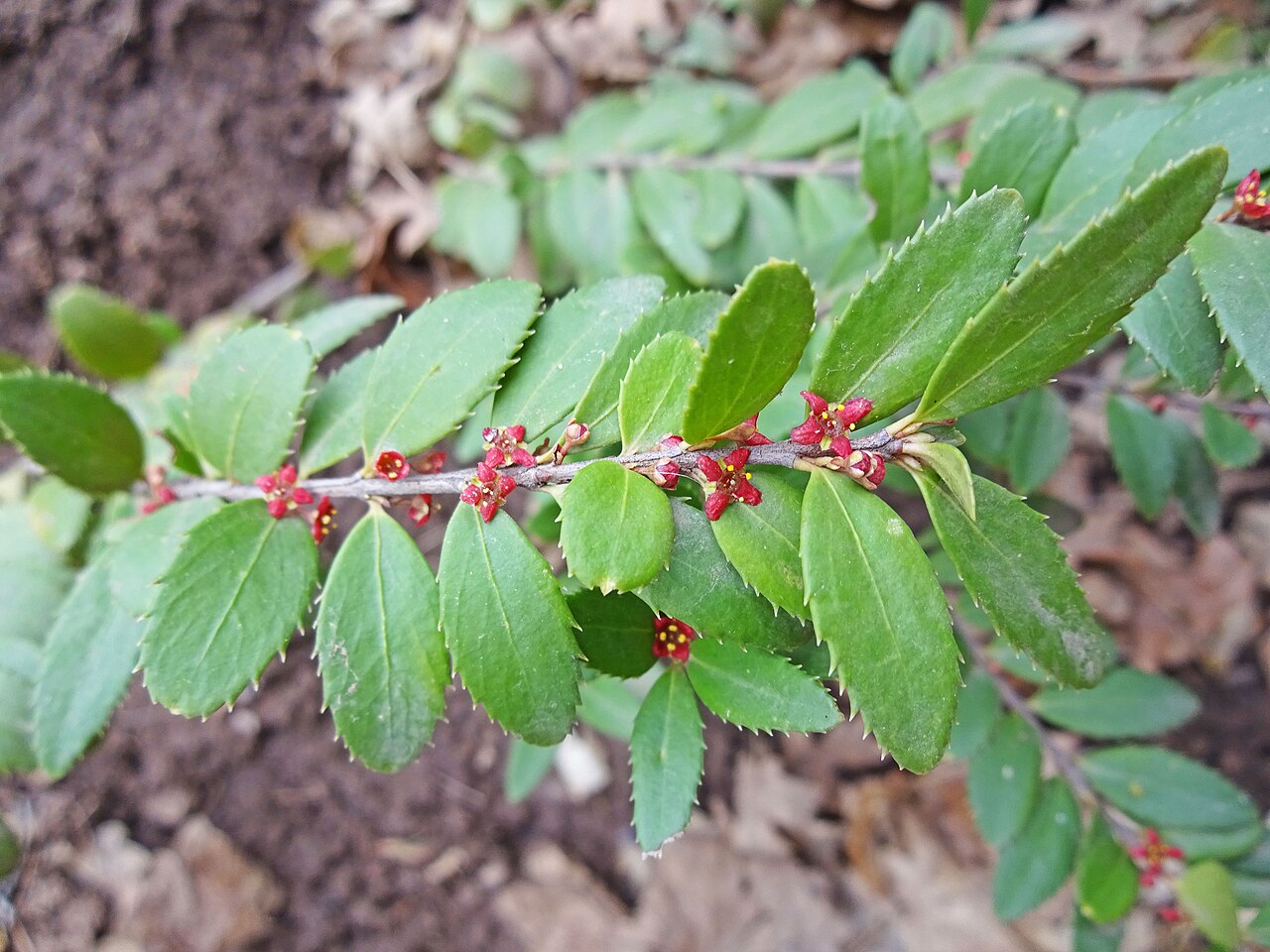
Paxistima myrsinites, known as Oregon Boxwood (USDA: Oregon boxleaf; also mountain lover, myrtle boxleaf or falsebox), is a low, evergreen shrub of the mountain forests of western North America. It belongs to the staff-tree or bittersweet family (Celastraceae), not the true boxwood family. Its genus name was long spelled Pachistima or Pachystima, and older books and nursery catalogs still use those spellings.
It usually grows 8 inches to 2 feet tall (occasionally to about 3 feet), with small, glossy, dark green, finely toothed leaves in opposite pairs that stay green all year. In spring and early summer it bears tiny, four-petaled maroon flowers along the stems. It is common in the understory of conifer forests from British Columbia and Alberta south through the Cascades, Sierra Nevada and Rocky Mountains to Arizona and New Mexico, with an outlying population in the Guadalupe Mountains of far western Texas.
Oregon boxwood makes a fine native alternative to clipped boxwood in western gardens. It is an important winter browse plant for deer and elk, and its cut branches have long been gathered as long-lasting florists’ greens in the Pacific Northwest.
Identification
Look for a low, dense, evergreen shrub with small, glossy, finely toothed leaves in opposite pairs on four-angled young twigs, growing under conifers, with tiny maroon four-petaled flowers in the leaf axils in spring.
Stems & Habit
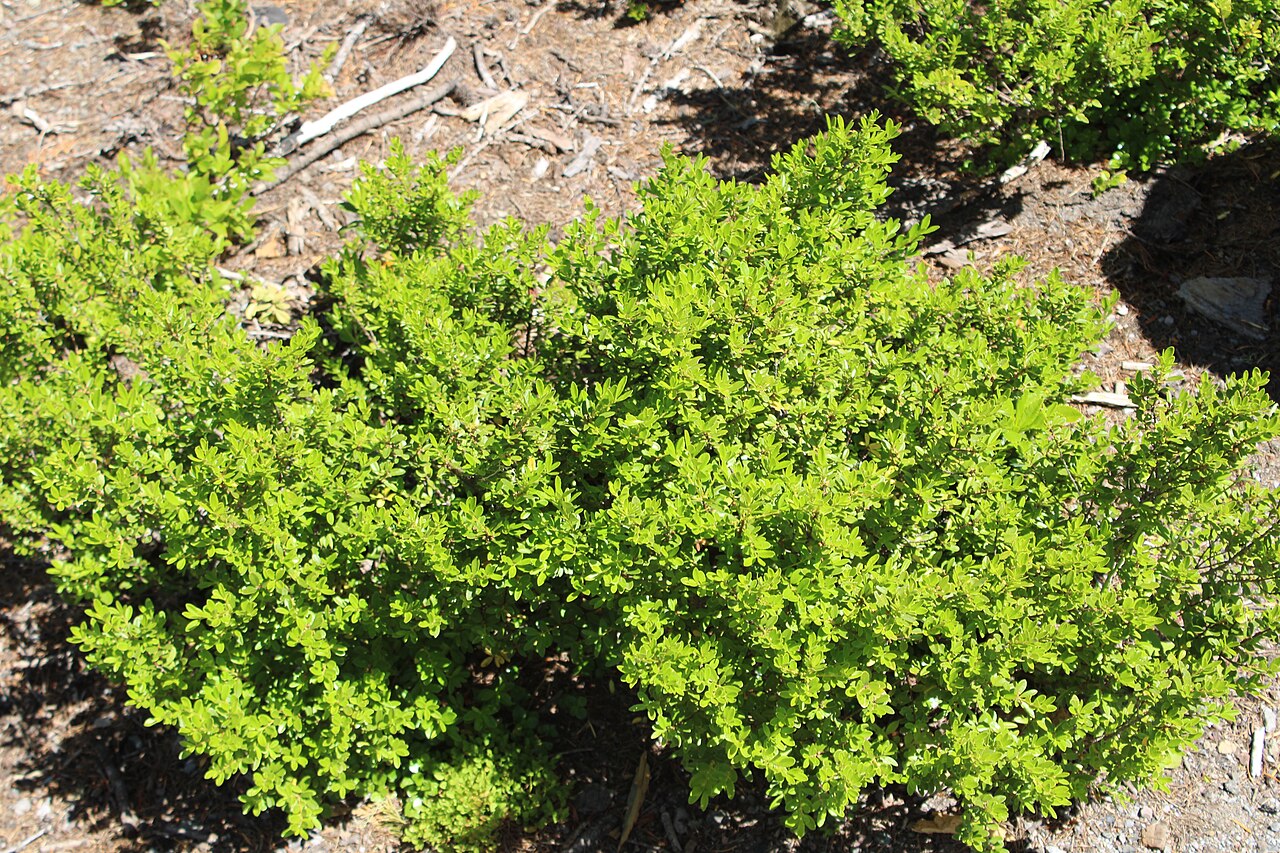
Oregon boxwood is a low, densely branched evergreen shrub, usually 8 to 24 inches (20 to 60 cm) tall, sometimes taller in shade. It spreads slowly into low mats or rounded mounds. Young twigs are reddish-brown and distinctly four-angled, becoming gray and corky with age.
Leaves
The leaves are opposite, leathery, glossy dark green above and paler below, elliptic to oblong, about 3/8 to 1 1/4 inches (1 to 3 cm) long, with finely toothed edges toward the tip and very short stalks. They remain on the plant through the winter, sometimes turning bronze or reddish in cold weather.
Flowers
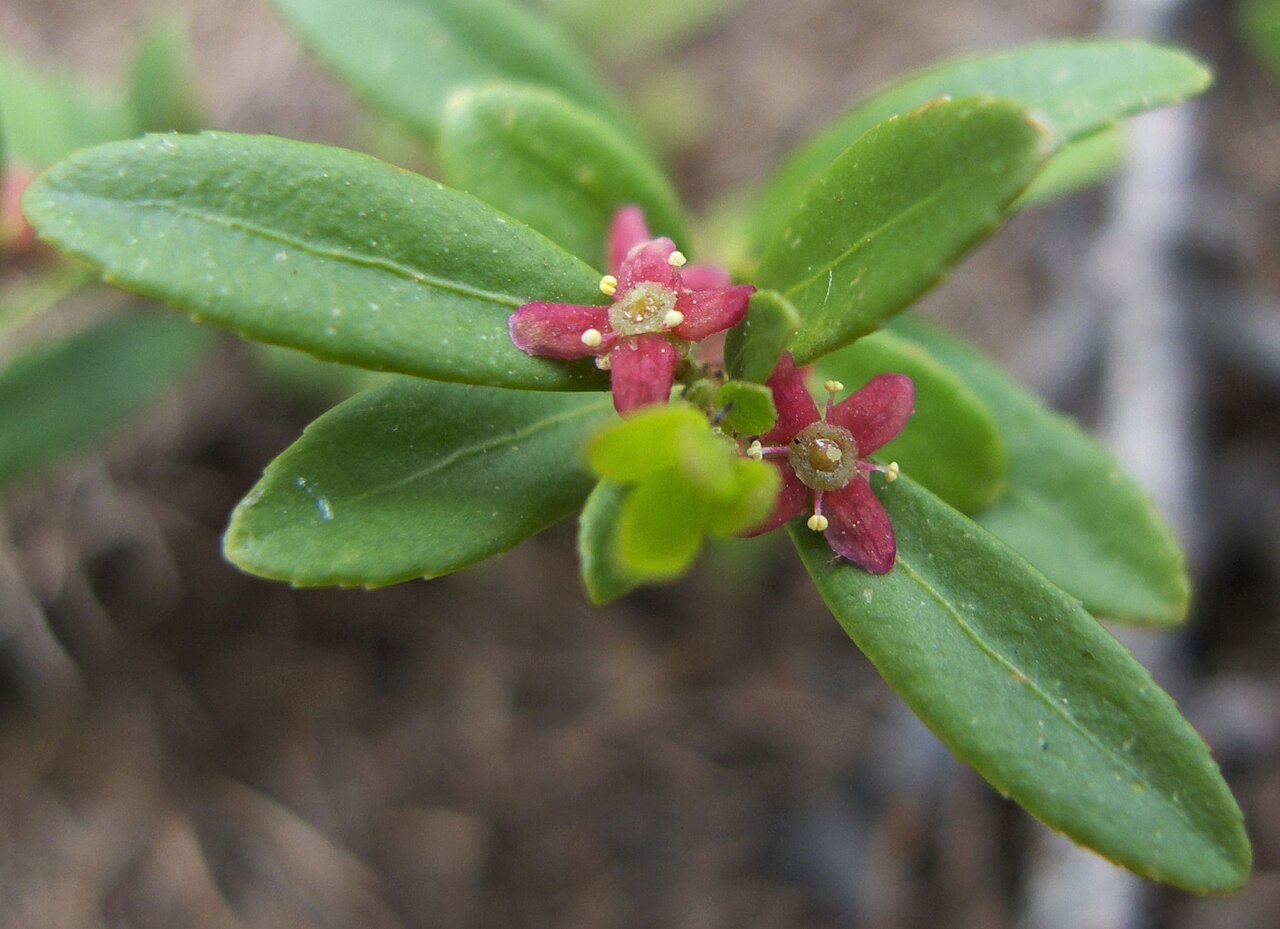
The tiny flowers are about 1/8 inch (3 to 4 mm) across, borne singly or in small clusters in the leaf axils along the stems. Each has four maroon to reddish-brown petals, four stamens and a flat nectar disk. They are inconspicuous, blooming from about April to June, earlier in the South and at low elevations and later in the North and high mountains.
Fruit & Seeds
The fruit is a small, oblong, two-chambered capsule about 1/8 to 1/4 inch long that splits open in late summer to release one or two dark seeds, each partly wrapped in a thin, whitish aril.
Look-alikes
Its glossy opposite leaves resemble those of true boxwood (Buxus), which is not native to the West and has smooth-edged leaves. Kinnikinnik has alternate, smooth-edged leaves and red berries. Pipsissewa has longer, whorled, sharply toothed leaves and pink flowers on a stalk. Creeping Oregon Grape has spiny compound leaves. Canby’s mountain lover (Paxistima canbyi), its only close relative, grows in the central Appalachians and has narrower leaves.
Safety & Conservation
No significant toxicity is reported for people or animals, and it is readily browsed by wildlife. It is common and secure across most of its range. Commercial harvest of floral greens is regulated on many public lands, so cut branches only where permitted.
Quick Facts
| Scientific Name | Paxistima myrsinites |
| Family | Celastraceae (staff-tree or bittersweet family) |
| Plant Type | Low evergreen shrub |
| Mature Height | 8–24 in (to about 3 ft) |
| Mature Spread | 2–4 ft |
| Growth Rate | Slow |
| Sun Exposure | Part shade to full sun |
| Water Needs | Low to moderate; drought tolerant once established |
| Soil Type | Well-drained loam, gravelly or rocky forest soils with organic matter |
| Soil pH | About 5.5–7.5 |
| Bloom Time | April–June (later at high elevations) |
| Flower Color | Maroon to reddish-brown |
| Fall Color | Evergreen; leaves may bronze in winter |
| Fruit | Small capsule; seeds with whitish aril |
| Deer Resistant | No; a favored browse of deer and elk |
| USDA Hardiness Zones | 4–8 |
Native Range
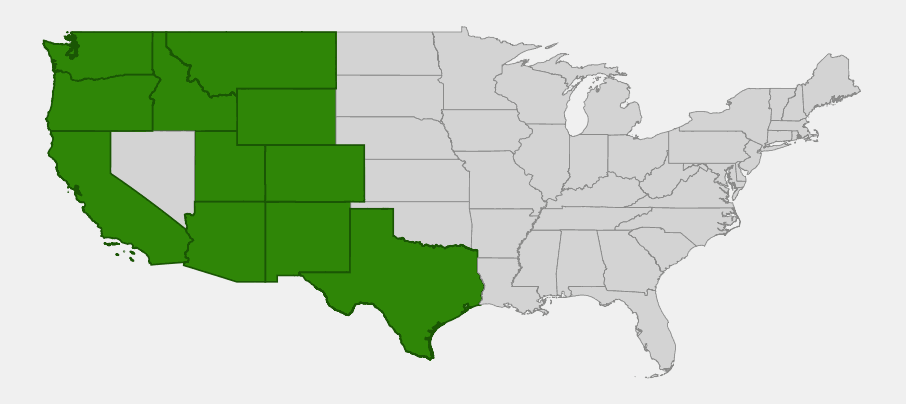
Oregon boxwood is native to the mountains of western North America. USDA PLANTS lists it as native in Arizona, California, Colorado, Idaho, Montana, New Mexico, Oregon, Texas, Utah, Washington and Wyoming, and in Canada in British Columbia and Alberta.
It is widespread in the Cascades, Olympic Mountains and Coast Ranges of Washington and Oregon, on both sides of the Cascade crest, and in the Blue Mountains, the northern Rockies of Idaho and Montana, the Sierra Nevada and Klamath Mountains of California and the mountains of Utah, Colorado, Wyoming, Arizona and New Mexico. The Texas records are outlying, from the high Guadalupe Mountains of far western Texas.
It grows in the understory of conifer and mixed forests (Douglas-fir, ponderosa pine, grand fir, subalpine fir, spruce and aspen), on open rocky slopes and in forest openings, from low elevations in the Pacific Northwest to high mountain forests in the Southwest.
📋 Regional plant lists featuring Oregon Boxwood: Idaho, Eastern Oregon & Eastern Washington · Montana & Wyoming · Utah & Western Colorado · Arizona & New Mexico · South & West Texas · Western Oregon & Western Washington · California & Nevada
Growing & Care Guide
Oregon boxwood is a tidy, low-maintenance evergreen for native gardens in the West. It is slow to establish but long-lived, and it can stand in for clipped boxwood in informal hedges and edging.
Light
Part shade to full sun. In hot, dry, low-elevation gardens it does best with afternoon shade; in cool mountain and northern gardens it tolerates full sun.
Soil & Water
Plant in well-drained soil with some organic matter; it dislikes heavy, waterlogged clay. Water regularly the first year or two, then occasionally during long dry spells. Established plants are fairly drought tolerant, especially in shade.
Planting Tips
Use it as a low hedge, edging, foundation plant or ground cover under conifers. Space plants about 2 feet apart for a continuous low border. Mulch with bark or needles to keep roots cool.
Pruning & Maintenance
Little pruning is needed. It can be lightly sheared in spring for a formal look, but it is naturally compact. Protect young plants from deer, which browse it heavily.
Propagation
Propagate from semi-hardwood cuttings in late summer or fall, which root fairly well with rooting hormone, or from seed collected when capsules open and sown outdoors in fall for natural cold stratification. Seedlings grow slowly.
Landscape Uses
- Low native hedges and edging: an evergreen alternative to boxwood
- Woodland and conifer gardens: evergreen ground cover in part shade
- Wildlife gardens: winter browse for deer and elk
- Mountain and fire-adapted landscapes: resprouts after light fires
- Florists’ greens: long-lasting glossy foliage for arrangements
Wildlife & Ecological Value
Oregon boxwood is an important evergreen food plant for wildlife in western mountain forests.
For Pollinators
The tiny flowers are visited by small bees, flies, beetles and ants that feed on the exposed nectar disk.
For Birds
Grouse eat the leaves and buds, and small birds may eat the seeds.
For Mammals
Mule deer, elk and moose browse it, especially in winter when its evergreen leaves are one of the few green foods above the snow. Small mammals also eat the foliage and seeds.
Ecosystem Role
As an evergreen understory shrub, it provides year-round cover and forage, and it resprouts from the base after low-severity fires. It is a characteristic plant of many western conifer forest communities.
Cultural & Historical Uses
The genus name has had a confusing history: it has been spelled Paxistima, Pachistima and Pachystima, and botanists now use Paxistima. The name refers to the thick stigma. The species name myrsinites means “like myrtle,” for its small, glossy leaves.
In the Pacific Northwest, Oregon boxwood has been harvested for decades as a floral green, along with salal and sword fern, because its foliage stays fresh for a long time after cutting. On national forests the harvest is managed by permit.
Its common names reflect its resemblance to boxwood and myrtle, and mountain lover reflects its habitat. On this site it can be grown with other western evergreens such as Kinnikinnik, Salal and Common Juniper.
Frequently Asked Questions
Is Oregon boxwood a real boxwood?
No. It belongs to the staff-tree or bittersweet family (Celastraceae), not the boxwood family. It just looks similar, with small, glossy, evergreen leaves.
What is the correct spelling: Paxistima, Pachistima or Pachystima?
All three spellings have been used. Botanists now accept Paxistima myrsinites, but you will still see Pachistima and Pachystima in older books and nursery catalogs.
Does Oregon boxwood grow in Texas?
Only as an outlying population in the high Guadalupe Mountains of far western Texas. Its main range is in the mountains of the western states and Canada.
Is it deer resistant?
No. Deer and elk browse it heavily, especially in winter. Protect young plants where deer are common.
Can I use it as a hedge?
Yes. It makes a low, informal native hedge or edging and can be lightly sheared, though it grows slowly.

Looking for a nursery that carries Oregon Boxwood?
Browse our native plant nursery directory: Arizona · California · Colorado · Idaho · Montana · New Mexico · Oregon · Texas & Utah · Washington · Wyoming