
Great Waterleaf (Hydrophyllum appendiculatum)
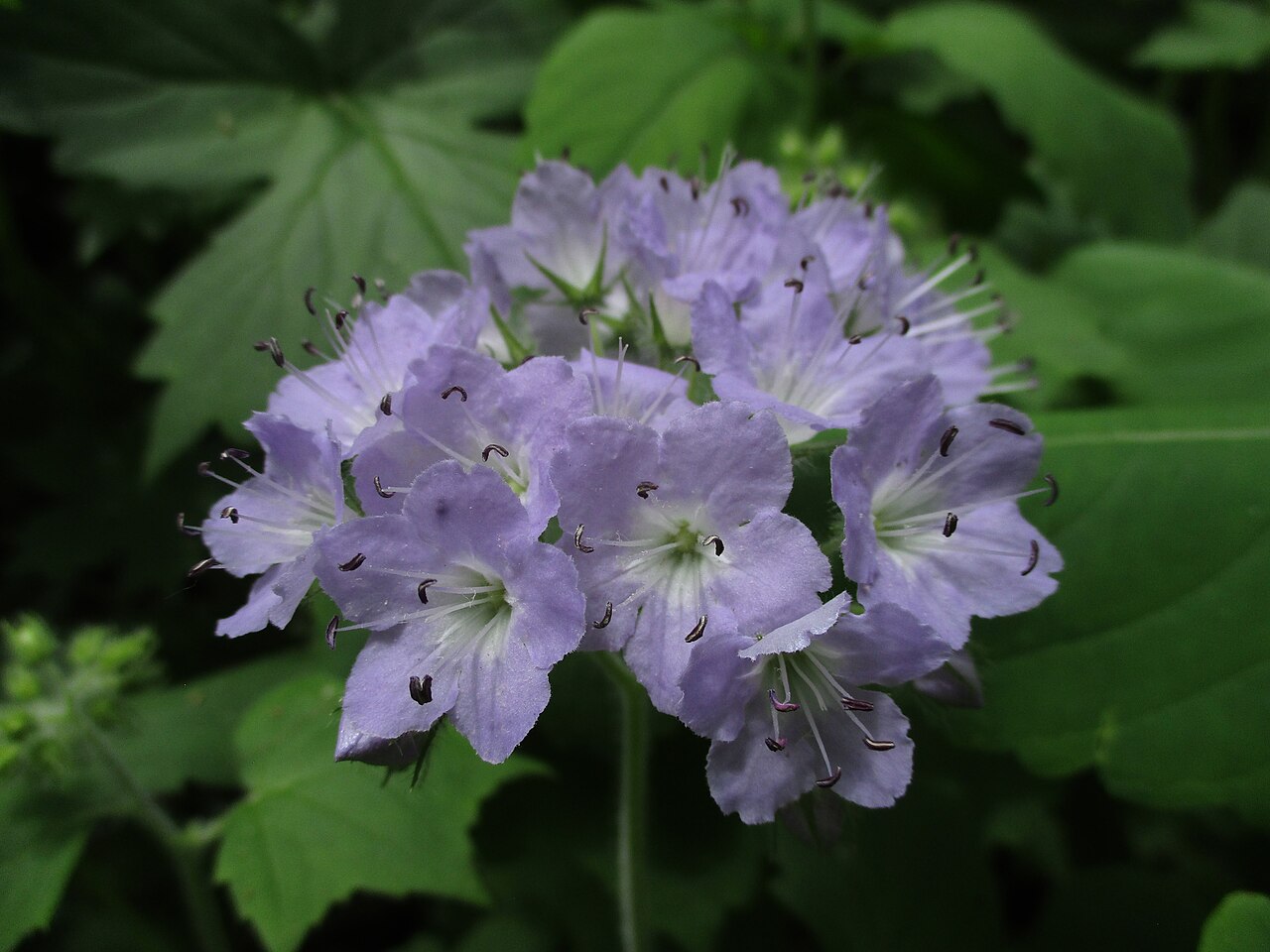
Hydrophyllum appendiculatum, known as Great Waterleaf or appendaged waterleaf, is a woodland wildflower of rich, moist forests in the Midwest, the Ohio Valley and the mid-South. It is usually a biennial: in its first year it forms a low clump of large, divided leaves, and in its second spring it sends up hairy stems 1 to 2 feet tall topped with loose clusters of lavender to pale purple, bell-shaped flowers.
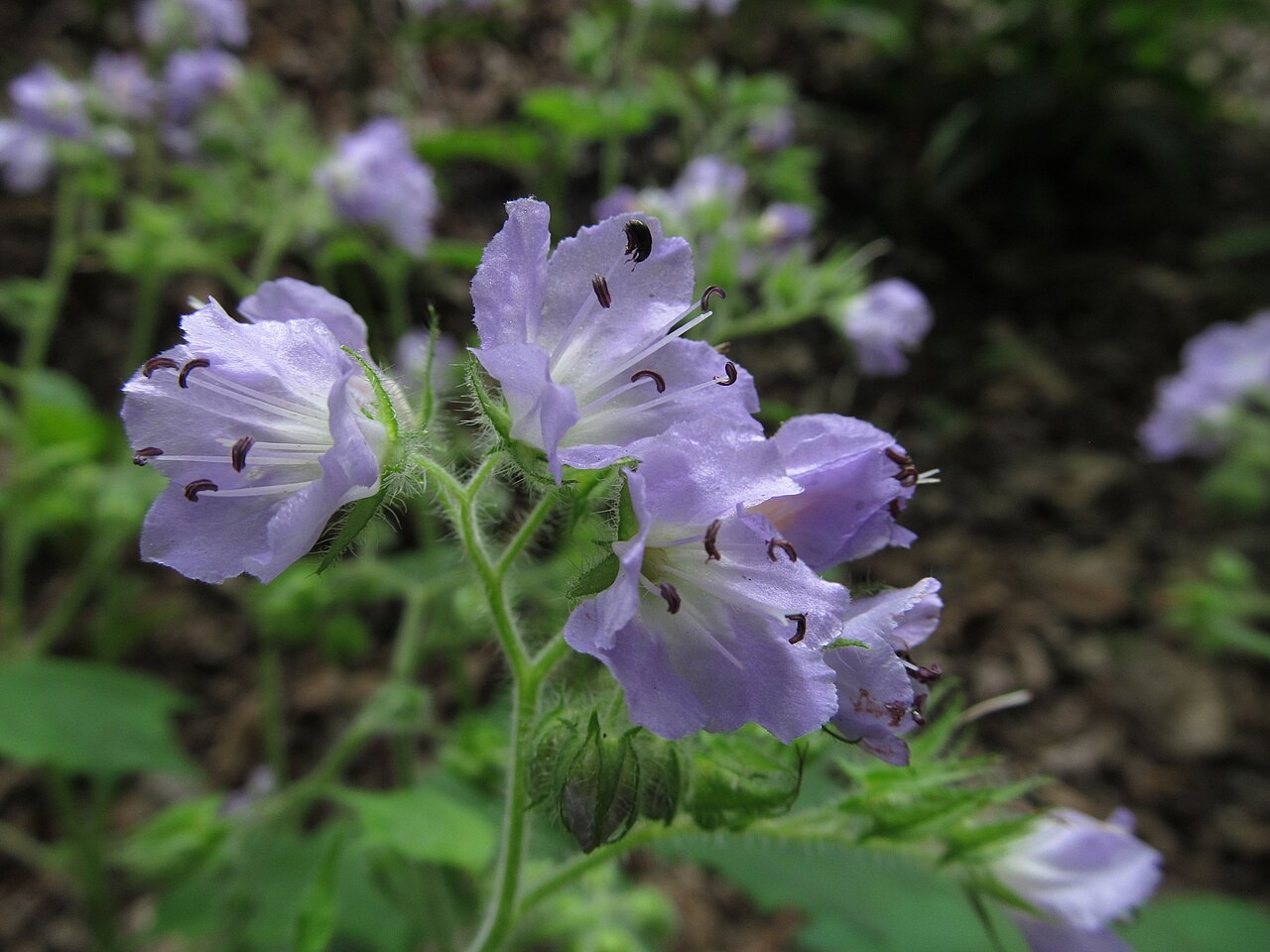
Great waterleaf has the showiest flowers of the eastern waterleafs, blooming in late spring after many spring ephemerals have finished. Its upper leaves are broad and shallowly lobed like a maple leaf, unlike the deeply divided leaves of the more familiar Virginia waterleaf. The name “appendiculatum” refers to tiny, turned-back appendages between the lobes of its calyx, a small but reliable identification clue.
This guide covers how to identify great waterleaf, where it grows, how to establish it in a shady woodland garden and its value to bumblebees and other native bees. It is easy to grow from seed in the right conditions and reseeds readily into a self-sustaining colony.
Identification
Look for a hairy woodland plant with large, maple-like upper leaves and loose clusters of lavender, bell-shaped flowers held above the foliage in late spring. Its bristly calyx with small appendages between the lobes confirms the identification.
Stems & Growth Habit
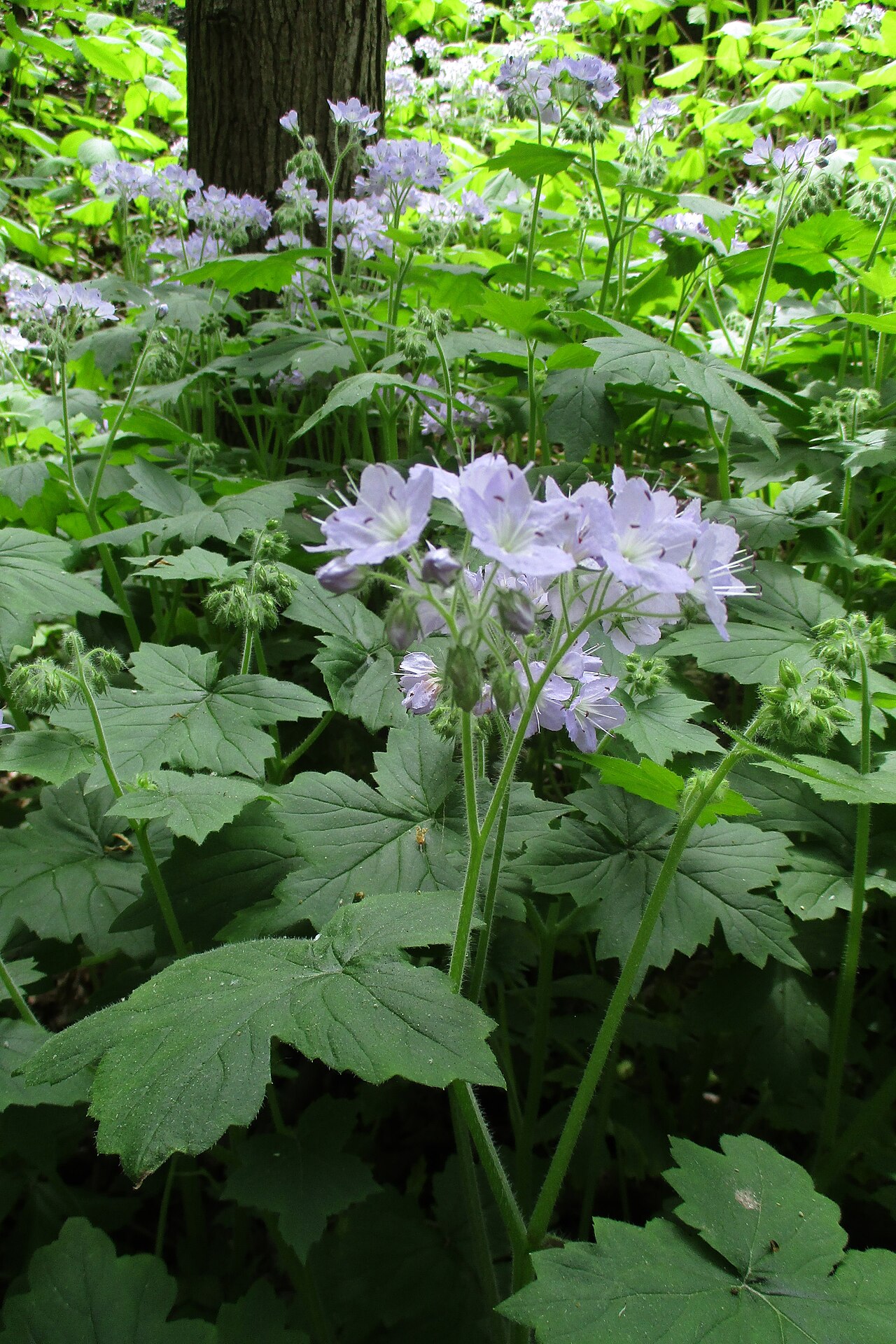
In its first year, great waterleaf forms a rosette of large basal leaves. In the second year, it produces one or a few branching flowering stems, usually 1 to 2 feet tall (occasionally to about 2 1/2 feet), covered with spreading, bristly hairs. After setting seed, the plant dies. Because first-year and second-year plants grow together, colonies flower every year.
Leaves
Basal leaves are long-stalked and pinnately divided into five to nine coarsely toothed segments. Stem leaves are alternate and quite different: broad, roughly rounded, 2 to 5 inches across, and palmately cut into five shallow, toothed lobes, much like a maple or wild geranium leaf. All leaves are hairy, and young leaves may show pale, water-stained-looking spots, the origin of the name “waterleaf.”
Flowers
The flowers grow in loose, branching clusters on long stalks from the upper leaf axils and stem tips, usually held above the leaves. Each flower is bell-shaped, about 1/2 inch long and wide, with five lavender, pale purple or occasionally whitish petal lobes. The five stamens extend only slightly beyond the petals, less than in other eastern waterleafs. The calyx is densely bristly, with a small, reflexed appendage between each of its five lobes. Bloom is mostly in May and June.
Fruit & Seeds
Each flower produces a small, round, hairy capsule containing one to three seeds. The capsules ripen in early summer and drop their seeds close to the parent plant, where they germinate the following year to form new rosettes.
Look-alikes
Virginia waterleaf (Hydrophyllum virginianum) is a perennial with deeply divided stem leaves and white to pale lavender flowers with long, protruding stamens. Broadleaf waterleaf (Hydrophyllum canadense) also has maple-like leaves, but its white to pinkish flowers are held below the leaves and it lacks calyx appendages. Wild geranium (Geranium maculatum) has similar leaves but open, saucer-shaped flowers. Phacelias have smaller flowers with fringed or narrow lobes.
Quick Facts
| Scientific Name | Hydrophyllum appendiculatum |
| Family | Boraginaceae (borage family; formerly Hydrophyllaceae) |
| Plant Type | Biennial wildflower (sometimes a short-lived perennial) |
| Mature Height | 1–2 ft |
| Mature Spread | 1–1 1/2 ft; forms colonies by seed |
| Growth Rate | Moderate |
| Sun Exposure | Part shade to full shade |
| Water Needs | Medium |
| Soil Type | Moist, rich, well-drained loam |
| Soil pH | About 6.0–7.5 |
| Bloom Time | May–June |
| Flower Color | Lavender to pale purple |
| Fall Color | None of note; flowering plants die after seed set |
| Fruit | Small round hairy capsule |
| Deer Resistant | Moderate |
| USDA Hardiness Zones | 4–8 |
Native Range
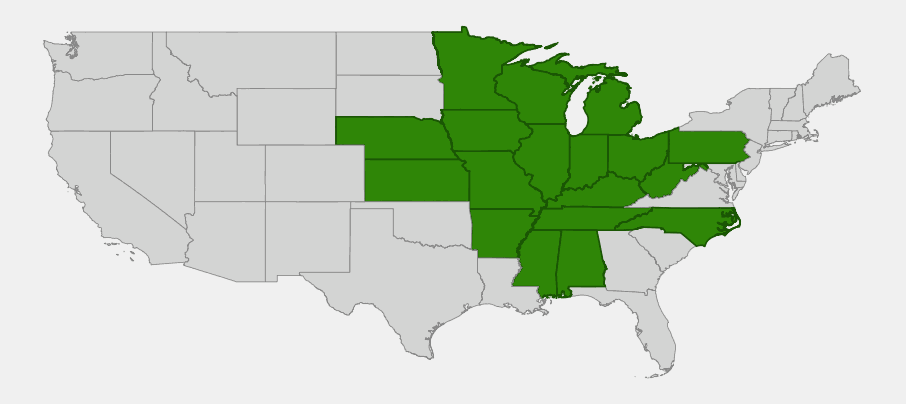
Great waterleaf is native to the eastern interior of North America. The Lady Bird Johnson Wildflower Center describes its range as Ontario and Minnesota south to Pennsylvania, Tennessee, Missouri and eastern Kansas. USDA PLANTS lists it in 18 states: Minnesota, Wisconsin, Michigan, Iowa, Illinois, Indiana, Ohio, Pennsylvania, West Virginia, Kentucky, Tennessee, Missouri, Arkansas, Kansas, Nebraska, North Carolina, Alabama and Mississippi. In Canada it occurs in southern Ontario.
It is most common in the Ohio Valley and the Midwest, especially in Kentucky, Indiana, Ohio, Illinois, Iowa and Missouri, where it can carpet floodplains and wooded slopes in late spring. Toward the edges of its range it becomes rare: NatureServe ranks it as critically imperiled in Mississippi and Nebraska, imperiled in Alabama and Ontario, and vulnerable in Kansas. Records from North Carolina, at the southeastern edge, are scattered.
It grows in rich, moist deciduous forests, especially on wooded slopes, in ravines and coves, along streams and on floodplain terraces. It favors fertile, often calcareous soils under trees such as sugar maple, basswood, buckeye, beech and oaks, and it often grows with other spring and early-summer woodland wildflowers.
📋 Regional plant lists featuring Great Waterleaf: New York, Pennsylvania & Northern New Jersey · Ohio & Indiana · Michigan, Wisconsin & Eastern Minnesota · Kentucky & Tennessee · Nebraska, Kansas & Eastern Colorado · Maryland, Virginia & West Virginia · Illinois, Iowa & Missouri · Alabama, Georgia & Mississippi · North & South Carolina · Arkansas, Louisiana, Eastern Oklahoma & Eastern Texas
Growing & Care Guide
Great waterleaf is a good choice for a naturalistic woodland garden in the Midwest and Ohio Valley, where it fills the gap between the spring ephemerals and summer bloomers. Because it is a biennial, individual plants live only two years, but it reseeds well in moist, rich soil and soon forms a lasting colony with flowering plants every year. It can spread enthusiastically in ideal conditions, so give it room in an informal planting rather than a small, formal bed.
Light
Part shade to full shade. It grows best under deciduous trees, with bright spring light before the canopy closes. It tolerates morning sun but suffers in hot, dry, sunny spots.
Soil & Water
Give it moist, fertile, well-drained loam rich in organic matter, like the soil of a mature hardwood forest or a floodplain terrace. It tolerates clay and slightly alkaline soils. Keep the soil from drying out in spring; after seeding, the flowering plants die back, and summer dryness is less of a concern.
Planting Tips
Sow seed outdoors in fall where you want the plants, or set out first-year rosettes in spring or fall about 12 inches apart. Plant both first-year and second-year plants, or sow two years in a row, so that you get flowers every year. Combine it with spring ephemerals, ferns and sedges that can hold the ground in summer.
Pruning & Maintenance
Little care is needed. Let flowering plants set and drop seed before removing the dead stems in summer. Leave fallen leaves in place as a natural mulch. If it spreads more than you want, pull extra seedlings or first-year rosettes, which come up easily.
Propagation
Grow it from seed. Collect seeds in early summer as the capsules ripen, and sow them right away or in fall, outdoors or in pots left outside over winter. The seeds need a period of cold, moist conditions over winter and usually germinate the following spring. Do not let the seeds dry out completely before sowing.
Landscape Uses
- Woodland gardens: late-spring lavender flowers under deciduous trees
- Naturalized shade plantings: self-sows into a lasting colony with ferns and sedges
- Pollinator gardens in shade: valuable for bumblebees and other native bees in late spring
- Floodplain and riparian restoration: rich, moist woodland edges and stream terraces
- Forest restoration: understory layer for Midwest and Ohio Valley hardwood forests
Wildlife & Ecological Value
Great waterleaf blooms in late spring, a time when woodland flowers are beginning to fade, so its nectar-rich bells are especially valuable to forest bees.
For Pollinators
The lavender bells are visited mainly by bumblebees and other medium to large bees, along with smaller native bees and occasionally butterflies and flies. The Xerces Society lists it as having special value to native bees.
For Birds
It has little direct value for birds, but it is part of the diverse woodland understory that supports insects eaten by warblers, thrushes and other forest birds.
For Mammals
Deer and rabbits may browse the leaves, especially young growth. The hairy foliage is less favored than that of some other woodland plants.
Ecosystem Role
Great waterleaf helps cover and protect the soil of rich forests and floodplains and adds to the diversity of flowers available to bees in late spring. Its seeds fall close to the parent plant, so it tends to form dense, slowly expanding colonies in the most favorable sites.
Cultural & Historical Uses
The genus name Hydrophyllum combines the Greek words for “water” and “leaf.” It probably refers to the pale, water-stained-looking spots on the young leaves of some species, or to the watery sap of the stems. The species name appendiculatum means “with small appendages,” referring to the tiny reflexed lobes between the calyx lobes.
Waterleafs were traditionally placed in their own family, the Hydrophyllaceae, along with phacelias and baby blue eyes. Genetic studies have shown that they belong in the borage family (Boraginaceae), with Virginia bluebells and forget-me-nots, and most modern references now place them there.
Young leaves of some waterleafs, especially Virginia waterleaf, have been eaten as cooked greens. Great waterleaf is hairier and less commonly used, and since it is a declining or rare plant at the edges of its range, it is best enjoyed in the woods and the garden.
Frequently Asked Questions
Is great waterleaf a perennial?
It is usually a biennial. It forms a leafy rosette in its first year, flowers in its second spring, and then dies after setting seed. It reseeds readily, so a colony keeps flowering year after year.
How is great waterleaf different from Virginia waterleaf?
Great waterleaf has broad, maple-like upper leaves, larger lavender flowers and stamens that barely extend beyond the petals. Virginia waterleaf is a perennial with deeply divided leaves and white to pale lavender flowers with long protruding stamens.
Where does great waterleaf grow?
It grows in rich, moist deciduous woods and on floodplains from Ontario and Minnesota south to Pennsylvania, Tennessee, Missouri and eastern Kansas, with scattered populations in Arkansas, Alabama, Mississippi and North Carolina.
Does great waterleaf attract pollinators?
Yes. Its late-spring flowers attract bumblebees and many other native bees, and the Xerces Society lists it as having special value to native bees.
Will great waterleaf spread in my garden?
It spreads by seed, and in moist, rich, shady soil it can form a dense colony. Extra seedlings are easy to pull if it spreads farther than you want.

Looking for a nursery that carries Great Waterleaf?
Browse our native plant nursery directory: Alabama & Arkansas · Illinois, Indiana, Iowa & Kansas · Kentucky, Michigan, Minnesota, Mississippi & Missouri · Nebraska, North Carolina & Ohio · Pennsylvania & Tennessee · West Virginia & Wisconsin