Woodland Phlox (Phlox divaricata)
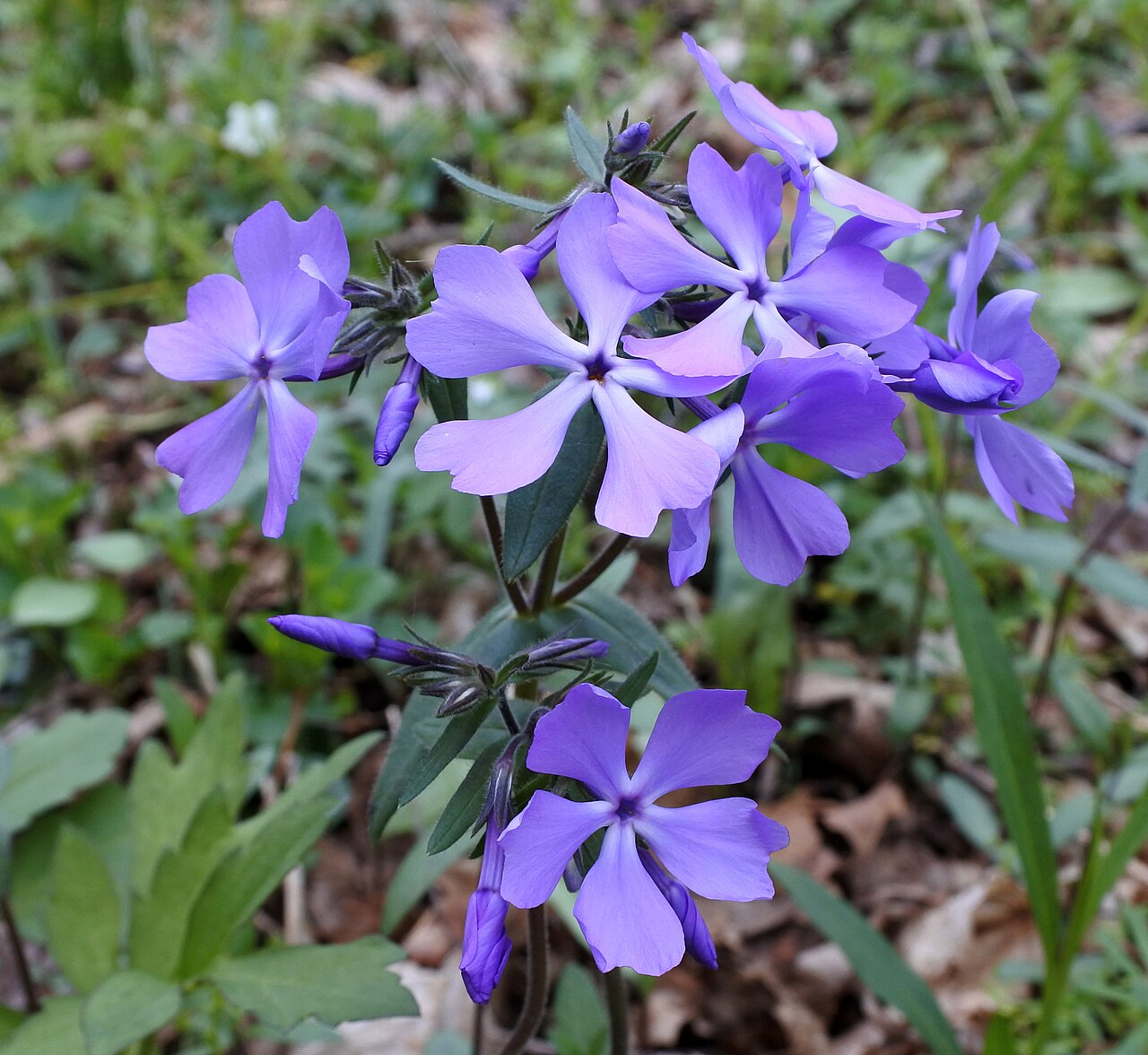
Phlox divaricata, known as Woodland Phlox, Wild Blue Phlox, Blue Woodland Phlox, and in many regions Wild Sweet William, is one of the great spring wildflowers of the eastern deciduous forest. In the weeks when the canopy is still bare and the soil is warming, it sends up loose, flat-topped clusters of fragrant, lavender-blue flowers on stems a foot or so tall, and it does so reliably, year after year, in the kind of dappled shade where lawn grass and most shrubs give up. It belongs to the Polemoniaceae, the phlox family, and is a true native across a huge swath of the eastern and central United States, including Alabama, Georgia, Mississippi, Iowa, Illinois, and Missouri, the two regional lists on which it appears here.
For a gardener, the appeal is a rare combination: a native that is genuinely beautiful, genuinely easy, and genuinely useful. The flowers are a nectar source for swallowtails, skippers, bumblebees, and hummingbird clearwing moths in the early season. The plant spreads at a civilized pace by creeping stolons that root at the nodes, weaving a semi-evergreen mat of sterile shoots beneath the flowering stems, so it doubles as a groundcover once the bloom fades. It pairs naturally with Virginia bluebells, trilliums, wild ginger, foamflower, and ferns, and it tolerates the root competition of mature hardwoods better than most spring perennials.
Woodland Phlox has a wide natural range and a wide climate tolerance, hardy from the northern Midwest down into the Gulf South. That breadth is also why the plant needs a little regional interpretation. In Iowa, Illinois, and Missouri it is a common woodland plant and does well in almost any shady garden with decent soil. In Alabama, Georgia, and Mississippi it sits near the southern edge of its core range: it still thrives in rich, moist, shaded sites, but it appreciates protection from hot afternoon sun and summer drought in a way that gardeners farther north can overlook. This page covers how to recognize it, where it grows wild, how to grow it well in either region, and what it does for wildlife.
Identification
Woodland Phlox is a herbaceous perennial that grows 8 to 20 inches tall, with 12 to 16 inches being typical of a healthy garden colony. It is semi-evergreen: the flowering shoots die back after the seed capsules mature in late spring, but the shorter sterile shoots stay green through the rest of the growing season and often through mild winters. The species name divaricata means “spreading and straggling,” a fair description of the way the runners sprawl across the forest floor and root wherever they touch down.
Stems & Growth Habit
Two kinds of shoots grow from each plant. The fertile shoots are upright, 12 to 20 inches, unbranched except near the top where the flowers occur, and light green to reddish-brown. They are finely hairy, and some of the hairs are sticky and glandular, which you can feel if you brush a stem with a fingertip. The sterile shoots are shorter and prostrate to decumbent, root at the nodes, and form the leafy carpet that persists after bloom. Over several years a single plant becomes a small clonal colony, and colonies eventually knit together into a drift. This stoloniferous habit is one of the field marks that separates Woodland Phlox from many other phlox species, and it is what makes it useful as a groundcover.
Leaves
The leaves are opposite, stalkless, and untoothed, with a softly hairy surface and fine hairs along the edges. On the flowering stems they are narrowly lanceolate to ovate, about 1 to 2½ inches long and up to ¾ inch wide, and they are spaced widely along the stem with each pair set at right angles to the pair above and below. The leaves on the sterile shoots are noticeably broader and shorter with more rounded tips, and they are less hairy overall. Learning to distinguish the two leaf types is helpful because it explains why the plant looks different before and after bloom: in April it is a leafy stem topped with flowers, and by July it is a low mat of broader green leaves.
Flowers
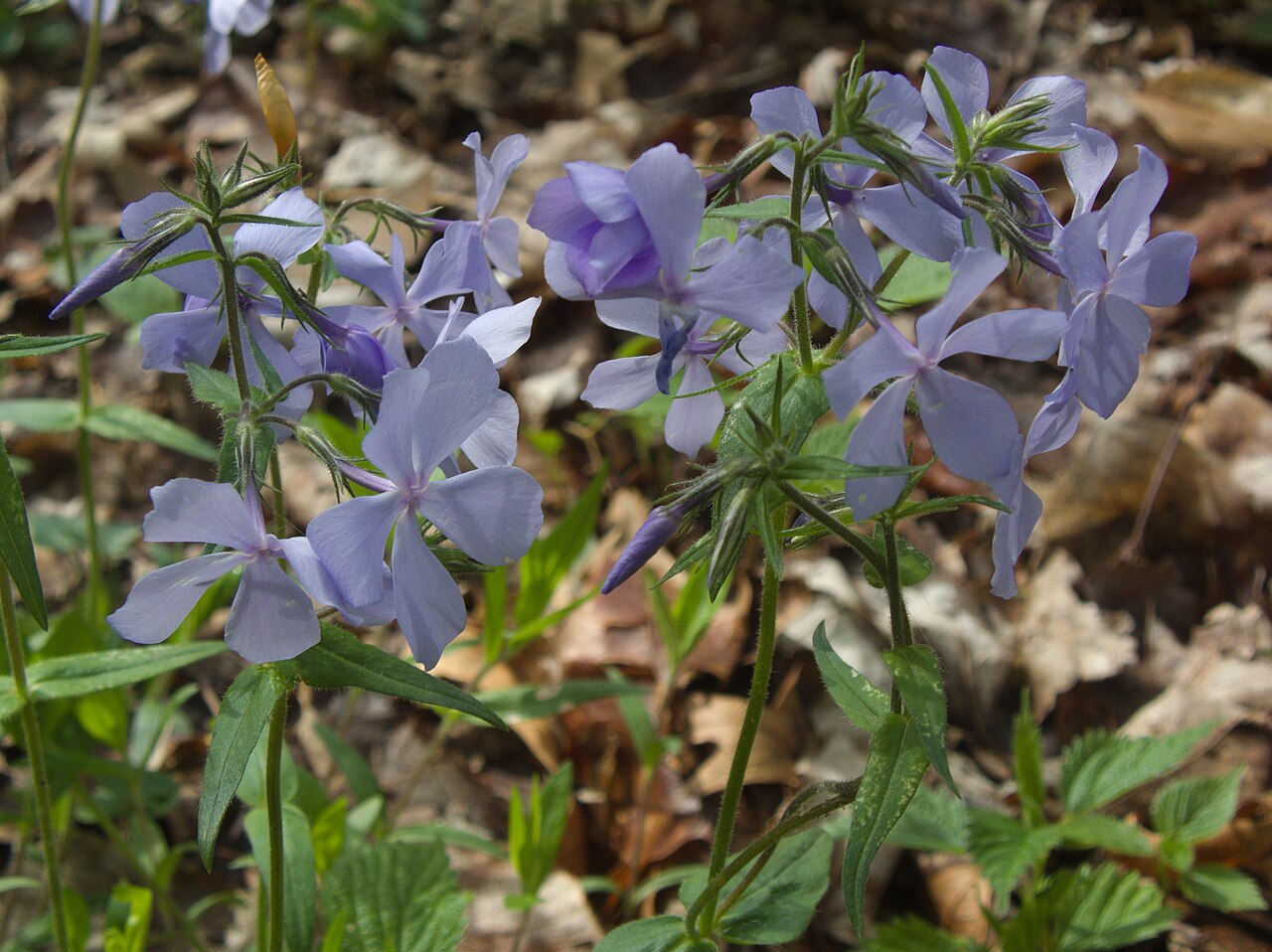
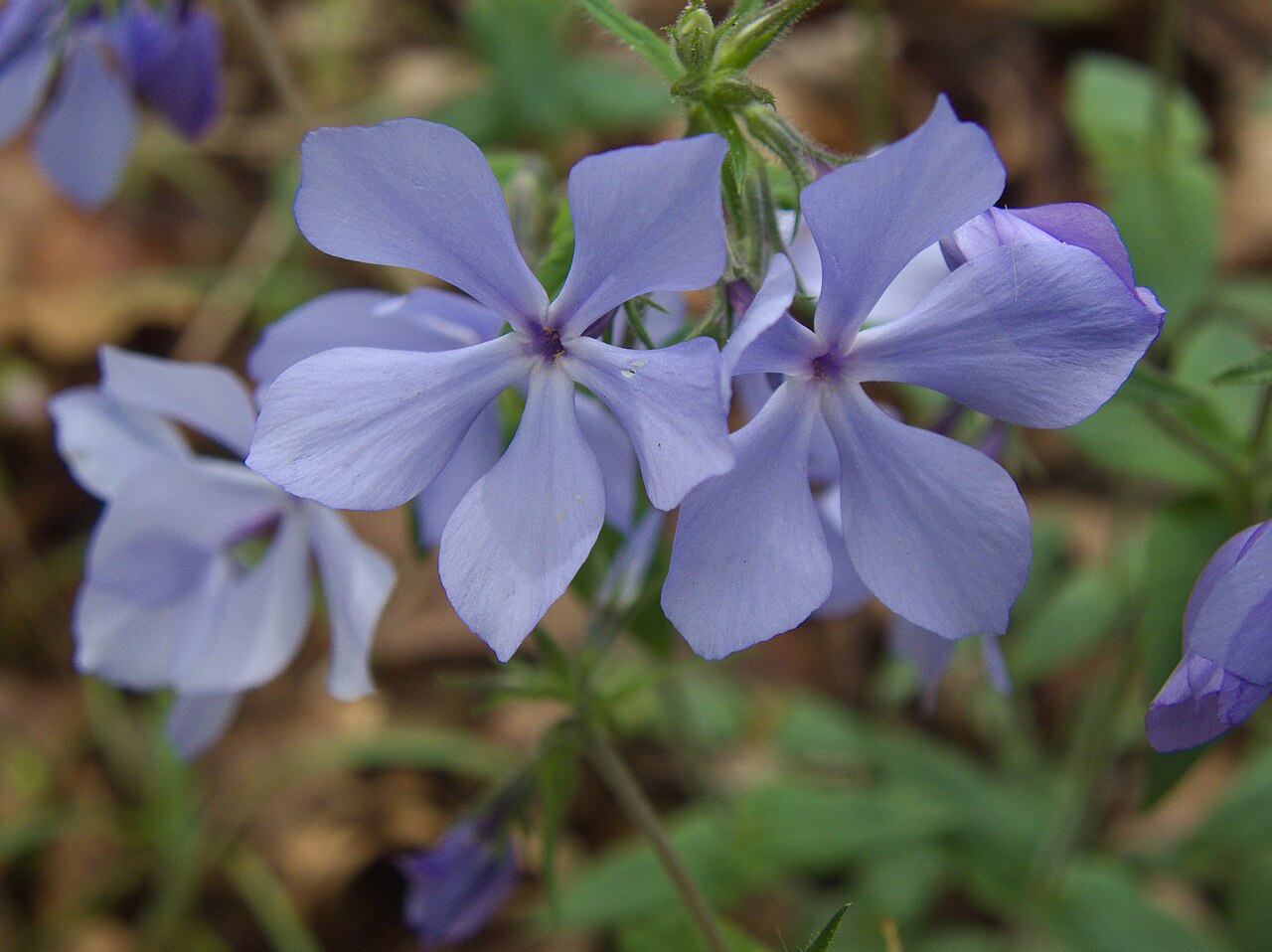
The flowers are what everyone remembers. Each is about ¾ to 1 inch across (up to 1½ inches in larger forms), with five spreading lobes fused into a long, slender tube. The lobes are narrow toward the throat and widen toward the tip, and the color runs from pale blue-lavender through blue-violet to reddish-purple and pink, with occasional pure-white forms. The flowers are borne in a loose, flat-topped cluster 2 to 3½ inches across at the top of each fertile stem, and they are pleasantly, sweetly fragrant, especially on warm still evenings. Beneath each flower is a slender, purplish, glandular-hairy calyx with five long narrow teeth. Inside the corolla tube, hidden from view, are five stamens and a short style.
The species has two recognized subspecies, and the difference is visible in the petal tips. Subspecies divaricata has petal lobes with a shallow notch at the tip, and it is the form of the eastern part of the range, from the Appalachians west to about Illinois. Subspecies laphamii has petal lobes that are rounded or bluntly angular and never notched; it is widespread across much of the eastern half of North America and is the form found in the western part of the range, including Illinois and Minnesota, so the two overlap and intergrade in places. Gardeners seldom need to care which one they have, but if you are collecting seed or purchasing plants for a restoration project, matching the subspecies to your region is a nice bit of local fidelity. Neither is ever deeply cleft like Sand Phlox (Phlox bifida), which is a plant of dry, sunny sands.
Fruit & Seeds
Pollinated flowers are replaced by small, oval capsules about 1/6 inch (4 mm) long, shorter than the persistent calyx, containing a few small seeds. The seeds mature in late spring, around the time the flowering shoots begin to yellow and collapse. Woodland Phlox is self-incompatible, meaning a single plant cannot fertilize itself, so good seed set depends on cross-pollination between genetically distinct clumps, which is one more reason to plant several rather than a single specimen.
Once you know the details, Woodland Phlox is easy to confirm. Look for opposite, stalkless, hairy leaves; sticky glandular stems; a long slender corolla tube opening to five lobes; and a mat of broader, shorter, non-flowering shoots at the base. The look-alike most gardeners meet is Creeping Phlox (Phlox stolonifera), which has fewer, smaller leaves on the flowering stems and fewer flowers per cluster, and forms much denser, wider mats. Both are woodland natives, but Woodland Phlox is taller, more upright when in flower, and more common in Midwestern woods.
Quick Facts
| Scientific Name | Phlox divaricata L. (subspecies divaricata and laphamii) |
| Family | Polemoniaceae (Phlox) |
| Plant Type | Semi-evergreen perennial wildflower / groundcover |
| Mature Height | 12–16 in typical; flowering stems to 20 in (30–50 cm) |
| Mature Spread | 12–24 in, slowly colonizing by stolons |
| Growth Rate | Moderate |
| Sun Exposure | Full Sun to Shade (best in part shade to shade in the South) |
| Water Needs | Medium; average, evenly moist soil |
| Soil Type | Rich, humusy loam; also sandy loam, clay loam, and calcareous soils |
| Soil pH | Tolerates acidic to alkaline (about 5.5–7.5) |
| Bloom Time | March – May in the Deep South; April – June northward |
| Flower Color | Lavender-blue to violet, pink, or white; fragrant |
| Fall Color | None; sterile shoots stay green through winter |
| Fruit | Small oval capsule with a few seeds |
| Deer Resistant | No (deer and rabbits browse it, especially new growth) |
| USDA Hardiness Zones | 3–8 |
Native Range
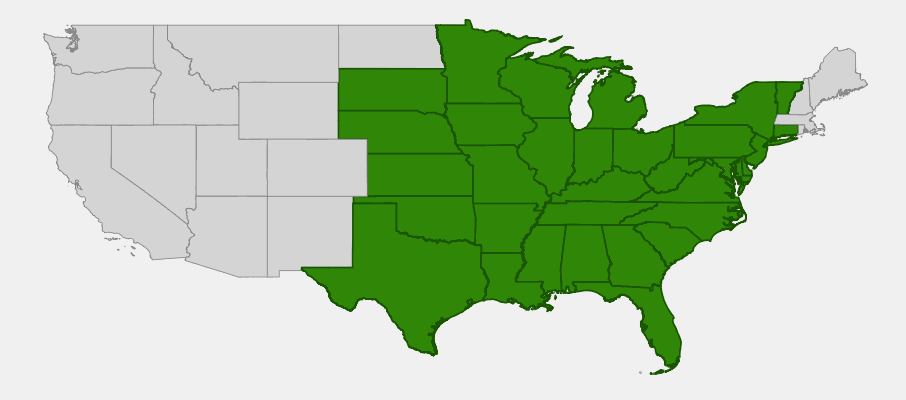
Woodland Phlox is native across eastern and central North America. The Lady Bird Johnson Wildflower Center summarizes its native distribution as southwestern Quebec to Michigan, south to North Carolina and Alabama. Within the United States it is documented as native in Alabama, Arkansas, Connecticut, Delaware, Florida, Georgia, Illinois, Indiana, Iowa, Kansas, Kentucky, Louisiana, Maryland, Michigan, Minnesota, Mississippi, Missouri, Nebraska, New Jersey, New York, North Carolina, Ohio, Oklahoma, Pennsylvania, South Carolina, South Dakota, Tennessee, Texas, Vermont, Virginia, West Virginia, and Wisconsin, and in the Canadian provinces of Ontario and Quebec.
The plant is most common in the Midwest, where the LBJ Wildflower Center notes it is abundant in woods and fields; in Illinois, for example, it occurs in nearly every county, though it is somewhat less common in the northwest. Its native habitat is moist, rich deciduous woods and bluffs, on both acidic and calcareous soils. It is not a plant of dry pine flatwoods or open sun-baked sites, and it is absent or scarce from the youngest woodlands that have sprung up on formerly plowed or heavily disturbed ground, since it is slow to recolonize once the woodland understory has been lost. Ecologists describe it as most common in the climax stage of woodland succession.
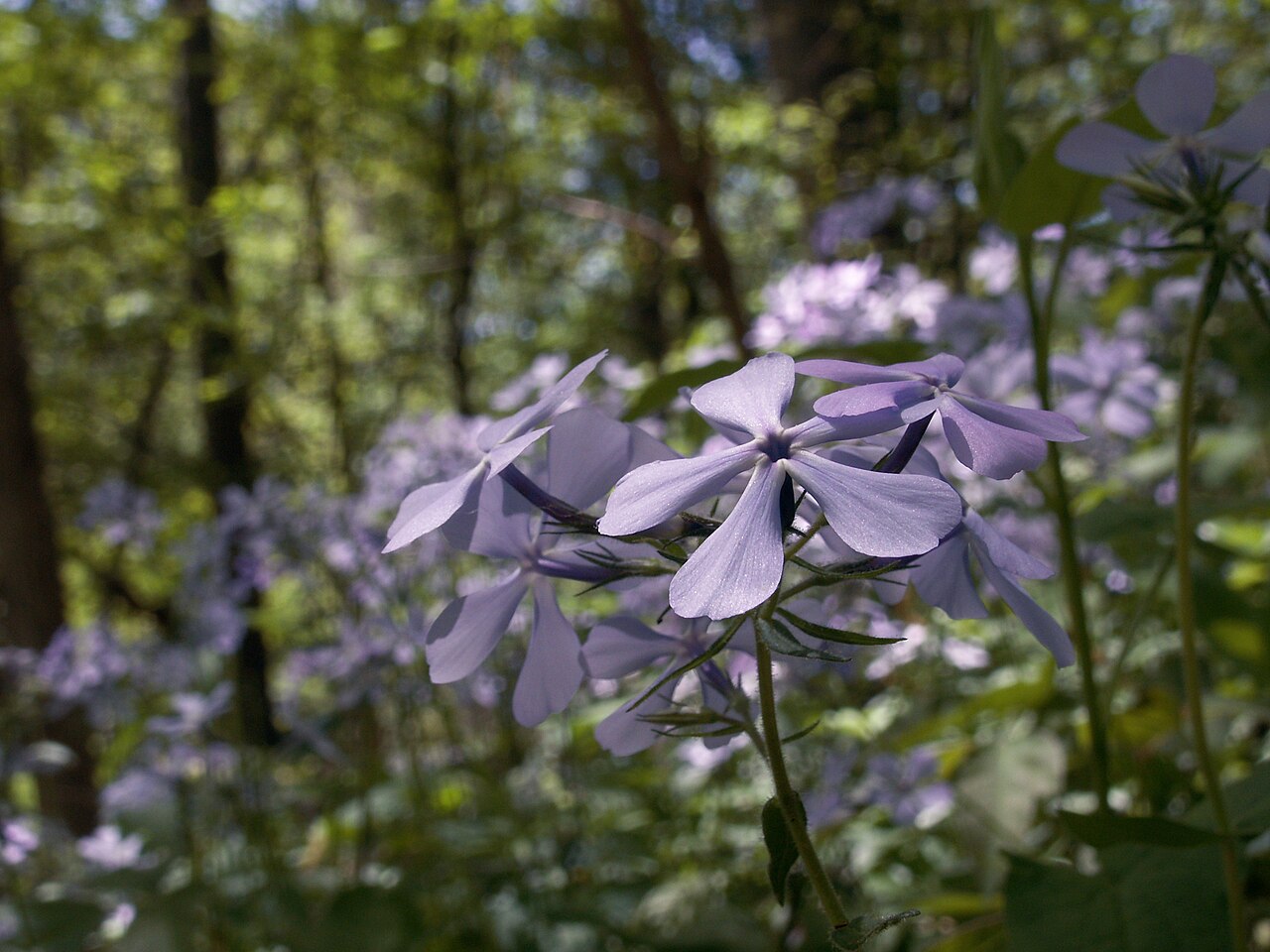
For gardeners in Alabama, Georgia, and Mississippi, the practical takeaway is that Woodland Phlox belongs to the mesic, deciduous forest community: sites with rich humusy soil, leaf litter, and spring sun followed by summer shade. Gardeners in Iowa, Illinois, and Missouri can place it in almost any hardwood woodland understory, oak-hickory or maple-basswood, and it is among the best spring bloomers for the loamy soils of the Midwest. In both regions, buy nursery-propagated plants rather than digging from the wild; the plant is sold widely and easily divided, so there is no reason to disturb natural populations.
📋 Regional plant lists featuring Woodland Phlox: Alabama, Georgia & Mississippi · Iowa, Illinois & Missouri
Growing & Care Guide
Woodland Phlox is easy to grow if you mimic what it gets in the wild: rich soil, steady moisture in spring, and shade from summer heat. Give it those three things and it will settle in within a season and slowly expand for decades. Ignore them and it will survive but look tired, particularly in the hot, humid summers of the Gulf South.
Light
The Lady Bird Johnson Wildflower Center lists Woodland Phlox for part shade to shade, and that is the best guide for Alabama, Georgia, and Mississippi. Morning sun with afternoon shade, or the high open shade under deciduous hardwoods, gives the best flowering and keeps the foliage clean through summer. In the cooler, more northern parts of its range, and in Iowa, Illinois, and Missouri gardens with consistently moist soil, it will tolerate more sun, but the flowers fade faster and the leaves scorch when the soil dries out. The regional plant list rates it as Full Sun to Shade, which reflects that flexibility, but treat full sun as a northern option rather than a Southern one.
Soil & Water
Choose a rich, moist, humusy loam with plenty of organic matter, the sort of soil that forms under a hardwood canopy from years of leaf fall. Woodland Phlox is unusually forgiving about pH for a woodland species. It grows in acidic soils and also in calcareous sites, and the LBJ Wildflower Center lists a high tolerance for calcium carbonate along with sandy, sandy loam, medium loam, clay loam, and clay textures. What it does not tolerate is a soil that bakes solid in summer or stays waterlogged in winter. Good drainage matters, but so does moisture retention. In Southern gardens, a 2 to 3 inch mulch of shredded leaves or pine straw does more for this plant than fertilizer will, and adding compost at planting time is usually all the feeding it needs.
Planting Tips
Plant nursery-grown divisions or container plants in fall or in very early spring. In the Deep South, fall planting is generally preferred because it gives the roots time to establish in cool, moist conditions before the first summer. Space plants 12 to 18 inches apart for a drift that will knit together in two or three seasons, or 24 inches for a slower, more open effect. Set the crown at the soil surface, water thoroughly, and keep the bed evenly moist for the first growing season. Plant in groups of at least three to five, because the species is self-incompatible and drifts of several clones set more seed and look better than single specimens.
Pruning & Maintenance
Woodland Phlox needs very little care. After the flowers fade, you can shear the spent flowering stems back by about half. That tidies the planting and prevents the shoots from collapsing untidily; the Lady Bird Johnson Wildflower Center also advises removing spent inflorescences to encourage more flowering. If you want the plant to self-sow, leave a few stems standing until the capsules mature in late spring. Keep the soil from drying completely during summer dry spells; regular deep watering is worth the effort in July and August in the South. In hot, dry weather, phlox foliage can develop powdery mildew or look ragged, especially where air circulation is poor. Give plants room, avoid overhead watering in the evening, and cut back damaged foliage; the sterile shoots will regrow. Leave the fallen leaves in place around the plants; the leaf litter is the mulch this species evolved with.
Propagation
The easiest method is root division: dig a clump in early spring or fall, separate rooted sections of the stolons, and replant them at the same depth. The plant can also be propagated by layering (simply pin a sterile shoot to the soil and let it root), by softwood stem cuttings taken in late spring, or by seed. Seed matures in late spring and needs cold, moist stratification before it will germinate, so sow it outdoors in fall or stratify it in the refrigerator for several weeks before sowing in late winter. Seedlings may need a couple of seasons to flower. Named cultivars, including the lavender-blue ‘Blue Moon’, ‘Clouds of Perfume’, the white ‘Fuller’s White’ and ‘White Perfume’, and ‘Chattahoochee’ (a selection of subspecies laphamii), must be propagated vegetatively to come true.
Landscape Uses
Woodland Phlox is a versatile plant for shade and part shade:
- Woodland gardens under oaks, hickories, tulip poplars, and maples, where it can naturalize slowly
- Spring ephemeral drifts combined with Virginia Bluebells, trilliums, Bloodroot, and Mayapple
- Groundcover for shady beds where the sterile shoots give year-round green
- Pollinator gardens for early butterflies, bumblebees, and hummingbird clearwing moths
- Stream and pond edges in moist, part-shaded sites above the flood line
- Shady rain garden margins where soil stays moist but not waterlogged
- Cottage and fragrance gardens as a native alternative to non-native spring perennials
Good companions include Wild Geranium, Golden Ragwort, Foamflower, Wild Ginger, Jack-in-the-pulpit, Solomon’s Seal, and native ferns such as Christmas Fern. Because the flowering stems die back in early summer, planting it with ferns or later-emerging perennials lets their foliage fill the gap. For related phlox species suited to other conditions, see our pages on Carolina Phlox for sunnier, drier spots and Prairie Phlox for open, well-drained sites.
Wildlife & Ecological Value
Woodland Phlox is a modest plant with a real ecological role, providing nectar during the weeks when few other flowers are open in the forest understory.
For Pollinators
The long, narrow corolla tube limits who can reach the nectar, and that shapes the pollinator community. Only long-tongued insects, including butterflies, moths, skippers, and long-tongued bees, can reach the nectar at the base of the tube. Swallowtails, gray hairstreaks, and skippers are regular visitors, and the Lady Bird Johnson Wildflower Center reports that the flowers attract butterflies including swallowtails and hairstreaks. Bumblebees and other long-tongued bees, bee flies, and moths such as Hummingbird Clearwing and sphinx moths feed on the nectar. Because the anthers sit in the tube while the stigma is at its mouth, butterflies are the most effective pollinators: as they probe for nectar they touch the anthers, and as they curl their proboscis before flying to the next flower some pollen is deposited on the stigma. Short-tongued bees and flower flies cannot reach the nectar but may collect pollen.
For Birds
Woodland Phlox is not a significant bird food plant, since it produces only tiny seed capsules. Its value to birds is indirect: by hosting a few phlox-feeding insects and drawing pollinators to its flowers, it adds to the insect supply that migrating and nesting songbirds lean on during the spring woodland season. Leaving the leaf litter and the surrounding wildflower community intact adds much more.
For Mammals
The foliage of Woodland Phlox is browsed by white-tailed deer, rabbits, and livestock, and the LBJ Wildflower Center notes that rabbits and voles consume the roots. This is worth knowing if you garden in an area with heavy deer or rabbit pressure: young plants may need protection, and mature colonies usually recover from occasional browsing because the stolons spread new growth. Do not count on this species as deer-resistant.
Ecosystem Role
Several specialist insects feed on Phlox species, including the Phlox Plant Bug (Lopidea davisi), which damages buds and flowers, and the caterpillars of the Spotted Straw moth (Heliothis phloxiphagus), which feed on the flowers, and Olive Arches (Lacinipolia olivacea), which feed on the foliage. A few chewed leaves are a sign that the plant is functioning as part of a food web rather than as a purely decorative one. The sterile shoots that stay green after the flowering stems die back store energy in the roots for the early production of next year’s fertile shoots and flowers, which lets the plant bloom early enough to catch the first flush of pollinators. Finally, as a mid-successional to climax woodland species, its presence is a good indicator of a healthy, relatively undisturbed woodland understory.
Cultural & Historical Uses
The genus name Phlox is the Greek word for “flame,” originally applied to brightly colored, fiery flowers and later attached to the entire genus. The species epithet divaricata means “spreading and straggling.” The common name “Wild Sweet William” is an example of folk borrowing: Sweet William is properly the garden pink Dianthus barbatus of Old World cottage gardens, and the name was borrowed for native wildflowers with similar clustered, fragrant flowers. The name is shared with another native phlox, Spotted Phlox (Phlox maculata), so it is worth using the scientific name when ordering plants or seed.
The species is also a staple of gardens outside North America. The Royal Horticultural Society has given both the species itself and the lavender-blue ‘Chattahoochee’ cultivar, a selection of subspecies laphamii, its Award of Garden Merit. Cultivated selections include the blue ‘Blue Moon’, the lavender ‘Clouds of Perfume’, and the whites ‘Fuller’s White’ and ‘White Perfume’. Native plant nurseries in the Southeast and Midwest typically sell the straight species, which is the better choice for wildlife value and regional character.
Today Woodland Phlox is valued mainly as a garden and restoration plant. It is a reliable component of spring wildflower displays in woodland gardens and nature preserves across the Midwest and Southeast, and native plant nurseries offer it for woodland restoration plantings. Like many spring ephemerals, it is slow to return once mature woodland understory has been destroyed, which makes protecting existing colonies more effective than replacing them. If you are lucky enough to have it growing naturally on your property, the best stewardship is to remove invasive shrubs such as bush honeysuckle and privet, thin dense maple saplings that overshade it, and leave the leaf litter in place.
Frequently Asked Questions
Is Woodland Phlox the same as Wild Sweet William?
Usually, yes, but the name is ambiguous. Wild Sweet William is a widely used common name for Phlox divaricata, and it is how this plant appears on our Iowa, Illinois & Missouri list. The same name is also given to Spotted Phlox (Phlox maculata), a taller plant with pointed, pyramidal flower clusters that blooms in early summer. If you want Woodland Phlox, ask for Phlox divaricata by its scientific name.
How is Woodland Phlox different from Creeping Phlox?
Creeping Phlox (Phlox stolonifera) forms broad, dense mats from basal runners and has fewer leaves on the flowering stems and fewer flowers per cluster. Woodland Phlox has more upright flowering stems, more flowers per cluster, and hairy, sticky stems, and it forms looser colonies. Both are native woodland plants, and both are good in shady gardens. Do not confuse either with Moss Phlox (Phlox subulata), a sun-loving plant with needle-like evergreen leaves.
Will Woodland Phlox take over my garden?
No. It spreads steadily but politely by stolons and occasional seedlings, and it is easy to thin by digging a few divisions in spring or fall. It is not aggressive, and a colony that has outgrown its space makes an excellent source of free plants for friends and neighbors.
Can Woodland Phlox grow in the heat of Alabama, Georgia, and Mississippi?
Yes, it is native to all three states, but give it the conditions of its natural habitat: rich soil, mulch, and shade from afternoon sun. Plants in full sun with dry soil decline in summer, while plants under deciduous trees in moist, humusy soil often persist for decades. Fall planting and deep watering during the first summer make a large difference.
Do deer and rabbits eat Woodland Phlox?
They can. Deer, rabbits, and livestock browse the foliage, and voles and rabbits will eat the roots. It is not a deer-proof plant. In areas with heavy pressure, protect new plantings with fencing or a repellent until they establish, and plant it in drifts so occasional browsing does not spoil the display.