
Virginia Pennywort (Obolaria virginica)
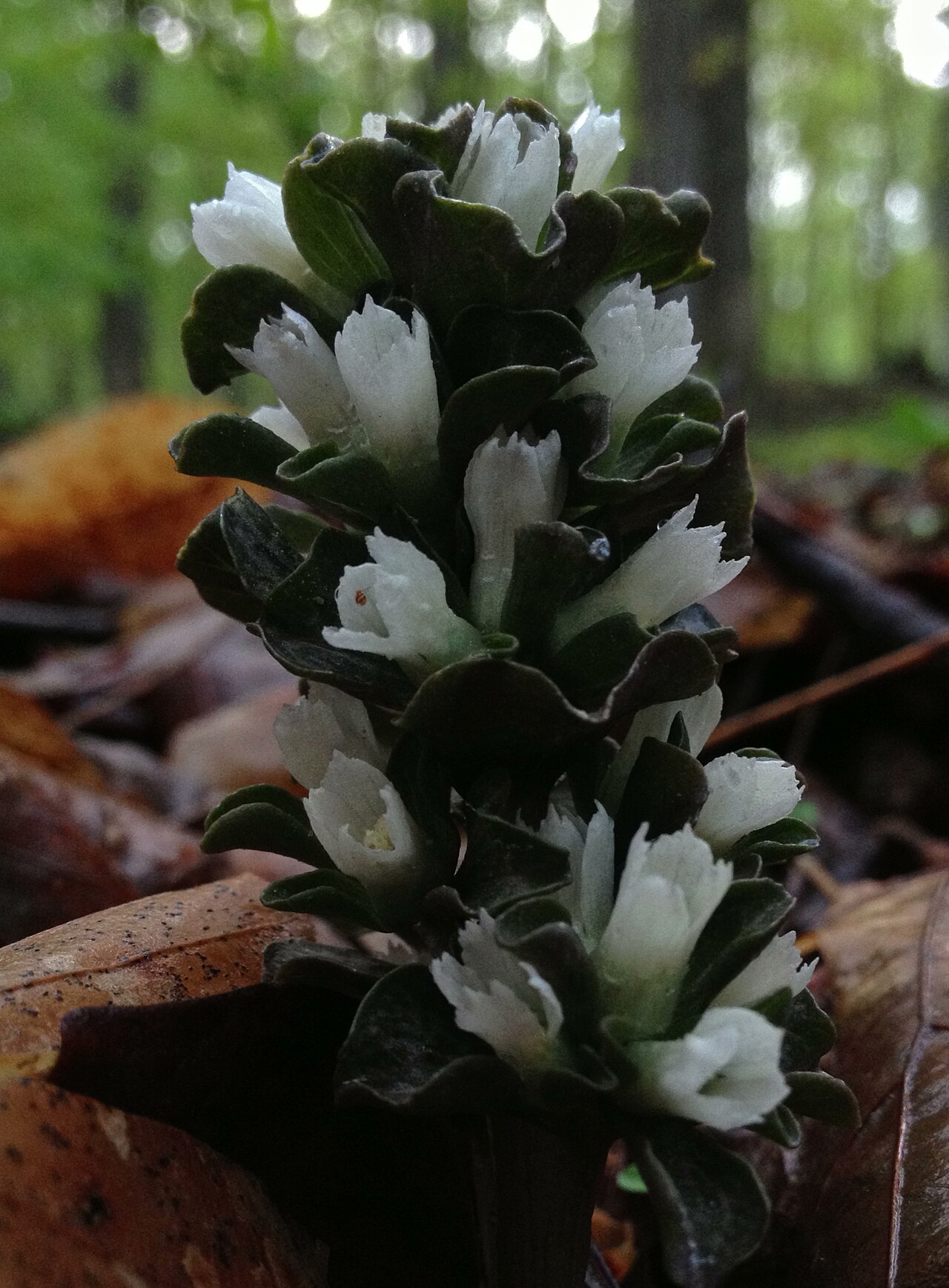
Obolaria virginica, known as Virginia Pennywort, is a tiny, curious spring wildflower of rich hardwood forests in the eastern United States. It stands only 2 to 6 inches tall, with a short, fleshy stem, small rounded purplish-green leaves arranged in pairs like coins (hence “pennywort”), and pale white to lavender flowers tucked among the upper leaves in early spring.
It is the only species in its genus and belongs to the gentian family (Gentianaceae). It is not related to the pennyworts of the genus Hydrocotyle, which share the common name because of their round leaves. What makes Virginia pennywort remarkable is how it lives: it has little chlorophyll and is believed to be partly mycoheterotrophic, drawing much of its carbon and nutrients from soil fungi rather than from photosynthesis.
Because of that dependence on fungi, Virginia pennywort cannot be grown from nursery stock or transplanted, and it should never be dug up. This page is an identification and appreciation guide: how to recognize it, where and when to look for it, and how it fits into the forest ecosystem.
Identification
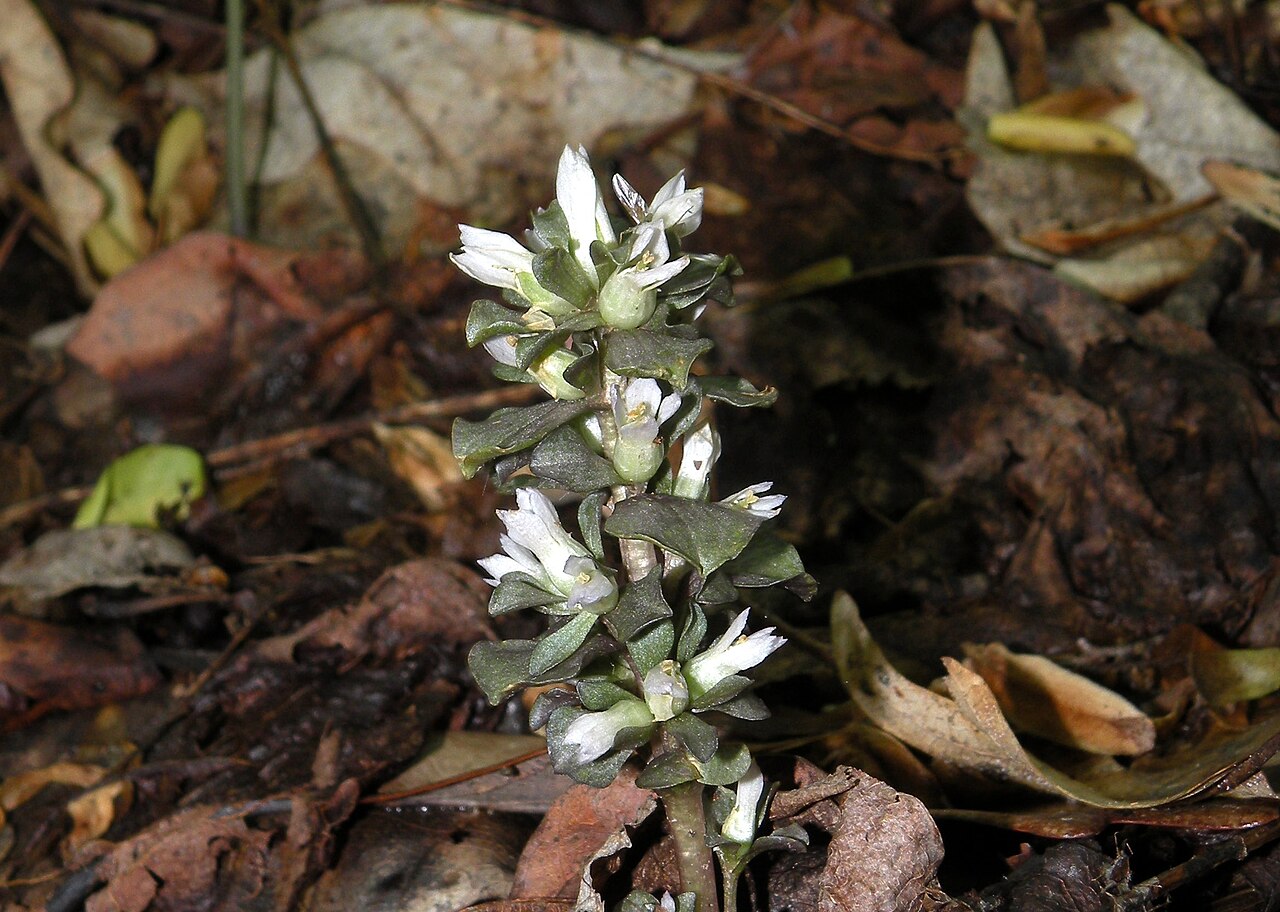
Virginia pennywort is small, dusky and easy to overlook among dead leaves. Look in early spring for a short, fleshy, purplish plant with opposite, rounded leaves and white to pale lavender flowers in small groups.
Growth Form
A small perennial with a fleshy, often clustered stem 2 to 6 inches tall, rising from a short base with a dense mass of brittle, fungus-associated roots. The whole plant is smooth and has a dull purplish, greenish or bronze tint that blends into the leaf litter.
Leaves
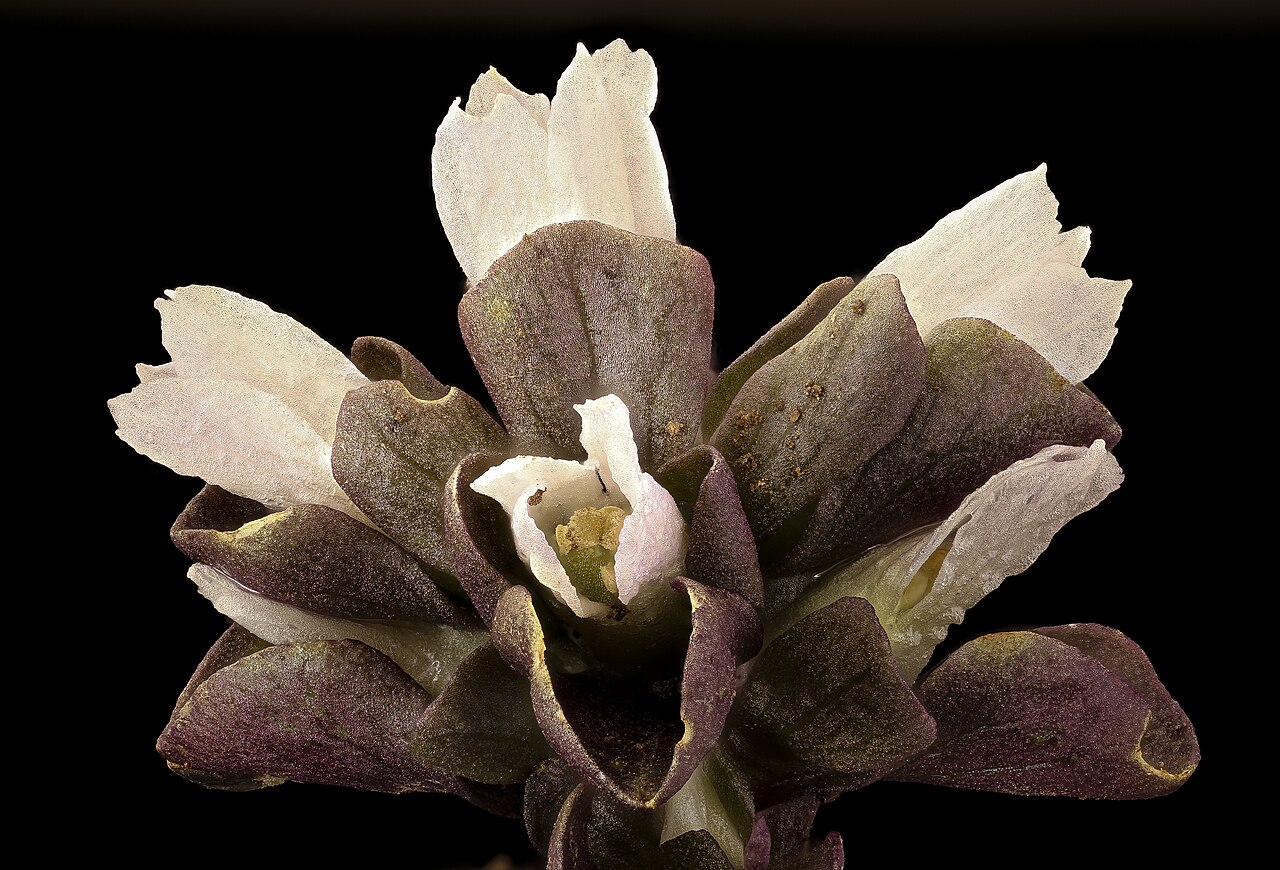
The leaves are opposite, thick and fleshy, rounded to wedge-shaped, about ½ inch long, and purplish-green. The lower leaves are reduced to small scales; the upper leaves are larger and act as bracts around the flowers.
Flowers
From about March to May, the flowers appear in small clusters, usually in threes, in the axils of the upper leaves and at the top of the stem. Each flower is about ½ inch long, tubular to bell-shaped, white to pale lavender, with four spreading lobes.
Fruit & Seeds
The fruit is a small capsule that holds many tiny, dust-like seeds. Like the seeds of other mycoheterotrophic plants, they have almost no stored food and depend on the right fungi to germinate and grow.
Similar Species
Few plants look much like it. Beechdrops (Epifagus virginiana) and pinesap (Monotropa hypopitys) also lack green leaves, but beechdrops are branched, brownish and bloom in late summer and fall under beech trees, and pinesap is yellow to reddish with nodding flowers in summer and fall. Pennyworts of the genus Hydrocotyle are green, round-leaved plants of wet places and are unrelated.
Quick Facts
| Scientific Name | Obolaria virginica |
| Family | Gentianaceae (gentian family) |
| Plant Type | Small herbaceous perennial; partly mycoheterotrophic |
| Mature Height | 2–6 in |
| Mature Spread | 1–3 in |
| Growth Rate | Slow |
| Sun Exposure | Shade (deciduous forest floor) |
| Water Needs | Moderate; moist forest soil |
| Soil Type | Rich, humus-rich forest soil with abundant leaf litter |
| Soil pH | About 5.5–7.5 |
| Bloom Time | March–May |
| Flower Color | White to pale lavender |
| Fall Color | None; not visible outside spring |
| Fruit | Small capsule with dust-like seeds |
| Deer Resistant | Not applicable; not a garden plant |
| USDA Hardiness Zones | Not cultivated; native roughly to zones 5–9 |
Native Range
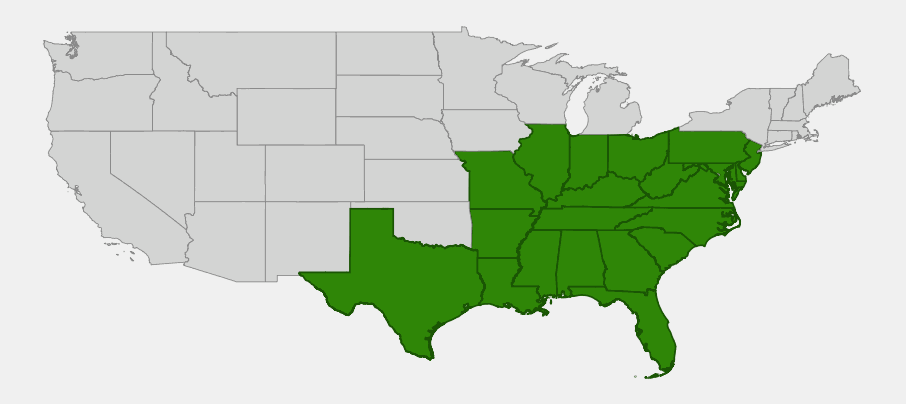
Virginia pennywort is native to the eastern United States. USDA PLANTS records it from New Jersey, Pennsylvania and Delaware south to northern Florida, and west through the Ohio Valley and the Gulf states to Illinois, Missouri, Arkansas, Louisiana and eastern Texas.
It is most often found in the Piedmont and mountains of Virginia and the Carolinas, in the Ohio and Tennessee valleys and in the Interior Low Plateaus of Kentucky and Tennessee. It is scarce toward the edges of its range: in Florida it is limited to the Panhandle, in Texas to the eastern part of the state, and in several northern and western states it is uncommon to rare.
It grows in rich, moist deciduous forests, wooded slopes and ravines, floodplain and bottomland woods, and on rocky limestone wooded slopes, almost always among deep leaf litter in the shade of hardwoods such as beech, oaks and tulip tree.
📋 Regional plant lists featuring Virginia Pennywort: New York, Pennsylvania & Northern New Jersey · Ohio & Indiana · Kentucky & Tennessee · Maryland, Virginia & West Virginia · Delaware, Southern New Jersey & Long Island · Illinois, Iowa & Missouri · Alabama, Georgia & Mississippi · North & South Florida · North & South Carolina · Arkansas, Louisiana, Eastern Oklahoma & Eastern Texas
Can You Grow It?
No. Virginia pennywort cannot be grown in a garden. It is not sold as nursery stock, it cannot be transplanted, and it should never be dug up from the wild. The best way to “grow” it is to protect the forests where it already lives.
Why It Cannot Be Cultivated
Virginia pennywort depends on a partnership with specific soil fungi, which in turn are linked to the roots of forest trees. The plant draws much of its carbon from this fungal network. Without the right fungi and trees, it cannot survive, and no one has a reliable method for raising it from seed or keeping it alive in cultivation.
Never Dig It Up
Digging up a plant destroys its connection to the fungal network, and it will die. Collecting also harms small, slow-growing populations. Enjoy it where it grows and leave it undisturbed.
How to Help It
Protect mature hardwood forests and their leaf litter. Avoid raking, compacting or clearing the forest floor in woods where it grows, and control invasive ground covers such as English ivy, Japanese stiltgrass and garlic mustard, which can smother native spring wildflowers.
Garden Alternatives
If you want small spring wildflowers for a woodland garden, choose species that can be propagated, such as spring beauty, round-lobed hepatica and mayapple, bought from nurseries that propagate their own plants.
Photographing It
Get low and look closely in early spring. Shoot from ground level, avoid trampling the area around the plant, and do not clear away leaf litter to get a better view.
Where to See It
- Rich hardwood forests of the Piedmont and Blue Ridge: in Virginia, North Carolina and Maryland, often alongside spring ephemerals
- Ohio and Tennessee valley woodlands: on moist slopes and ravines with beech, oaks and tulip tree
- Limestone woods of Kentucky and Tennessee: on rocky wooded slopes in the Interior Low Plateaus
- Bottomland and floodplain woods: in moist forests of the Southeast and lower Mississippi Valley
- Parks and preserves: for example Great Falls Park and Rock Creek Park near Washington, D.C.; look from March to May along trails, without leaving the path
Wildlife & Ecological Value
Virginia pennywort is a small but telling part of the forest floor, linking plants, fungi and trees in the soil beneath the leaf litter.
For Pollinators
Its small spring flowers are visited by small bees and flies, which are among the few pollinators active on the forest floor at that time of year.
For Birds
It is too small and scarce to be a significant food plant for birds.
For Mammals
It is not a known food plant for mammals. Its presence depends on undisturbed forest floor, which also benefits many small woodland animals.
Ecosystem Role
Virginia pennywort is believed to obtain much of its carbon from mycorrhizal fungi that also connect to the roots of nearby trees, effectively taking a share of the sugars those trees make. It still has some green tissue and may photosynthesize a little, which is why it is described as partly mycoheterotrophic. Plants like it are indicators of healthy, long-undisturbed forest soils.
Cultural & Historical Uses
The genus name Obolaria comes from the Greek obolos, a small ancient coin, referring to its small, rounded leaves. The common name “pennywort” carries the same idea. Linnaeus named the species in 1753, and it has remained the only member of its genus.
Its closest relatives are the gentians and other members of the gentian family, a group known for its mostly green, colorful-flowered species. Virginia pennywort is one of very few North American gentian relatives that rely heavily on fungi for food, along with the screwstems (Bartonia).
Because it is small, dull-colored and blooms early, many hikers walk past it without noticing. For botanists and wildflower enthusiasts, finding Virginia pennywort is one of the small rewards of a careful early-spring walk in rich woods.
Frequently Asked Questions
Can I grow Virginia pennywort in my garden?
No. It depends on a partnership with soil fungi and forest trees and cannot be grown from nursery stock or transplanted. Never dig it up; enjoy it in the wild.
Is Virginia pennywort related to other pennyworts?
No. Pennyworts in the genus Hydrocotyle are in a different family. Virginia pennywort is in the gentian family and is the only species in its genus.
What does mycoheterotrophic mean?
A mycoheterotrophic plant gets its carbon and nutrients from fungi in the soil instead of making all its own food through photosynthesis. Virginia pennywort is partly mycoheterotrophic, with some green tissue but heavy reliance on fungi.
When is the best time to see Virginia pennywort?
In early spring, roughly March to May depending on latitude, in rich, moist hardwood forests. Look carefully among leaf litter.
Why is it so hard to find?
It is only a few inches tall, colored like the leaf litter, and appears for a short time in spring. Many people walk past it without noticing.

Looking for a nursery that carries Virginia Pennywort?
Browse our native plant nursery directory: Alabama & Arkansas · Delaware, Florida & Georgia · Illinois & Indiana · Kentucky, Louisiana, Maryland, Mississippi & Missouri · New Jersey, North Carolina & Ohio · Pennsylvania, South Carolina, Tennessee, Texas & Virginia · West Virginia