
Beechdrops (Epifagus virginiana)
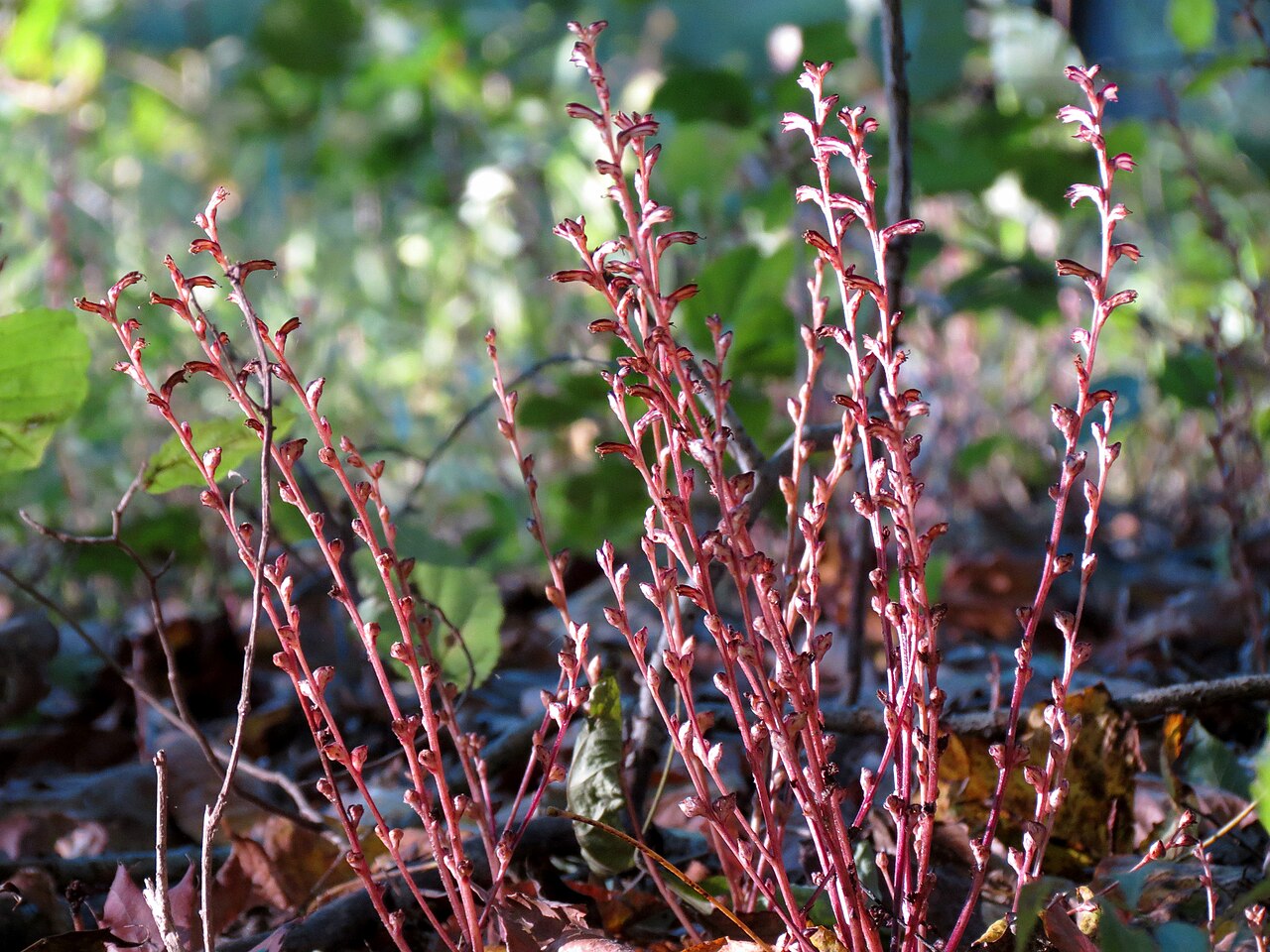
Epifagus virginiana, known as Beechdrops, is a small, leafless plant that grows only under American beech trees. It has no green leaves and no chlorophyll, and it cannot make its own food. Instead it attaches to the roots of beech trees and takes water and nutrients directly from them. In late summer and fall, clusters of slender, branched, tan to reddish-brown stems rise from the leaf litter beneath beeches, dotted with small white and maroon-striped flowers.
Beechdrops belongs to the broomrape family (Orobanchaceae), which includes many parasitic plants, such as cancer-root. It is the only species in its genus, and its name says exactly where to find it: Epifagus means “upon beech”, after Fagus, the beech genus. Wherever American beech grows in eastern North America, from Nova Scotia and Ontario to Florida and eastern Texas, beechdrops can usually be found nearby.
Because it is a true parasite that depends entirely on living beech roots, beechdrops cannot be grown from nursery stock or transplanted. A dug plant has been cut off from its host and will die. This page is an identification and appreciation guide: how to recognize beechdrops, where and when to look for it, and how protecting beech trees protects this unusual native plant.
Identification
Beechdrops is easy to identify once you know to look under beech trees. No other plant in eastern forests combines branched, leafless brown stems with small, striped, tubular flowers in late summer and fall.
Stems & Scales
Plants rise from a swollen, knobby base attached to a beech root just below the surface. The stems are usually 4 to 18 inches tall and branch freely into a bushy, broom-like cluster. They are tan, yellowish, pinkish or reddish-brown, often with fine darker purple-brown streaks. There are no true leaves, only a few tiny, brown, triangular scales scattered along the stems.
Flowers
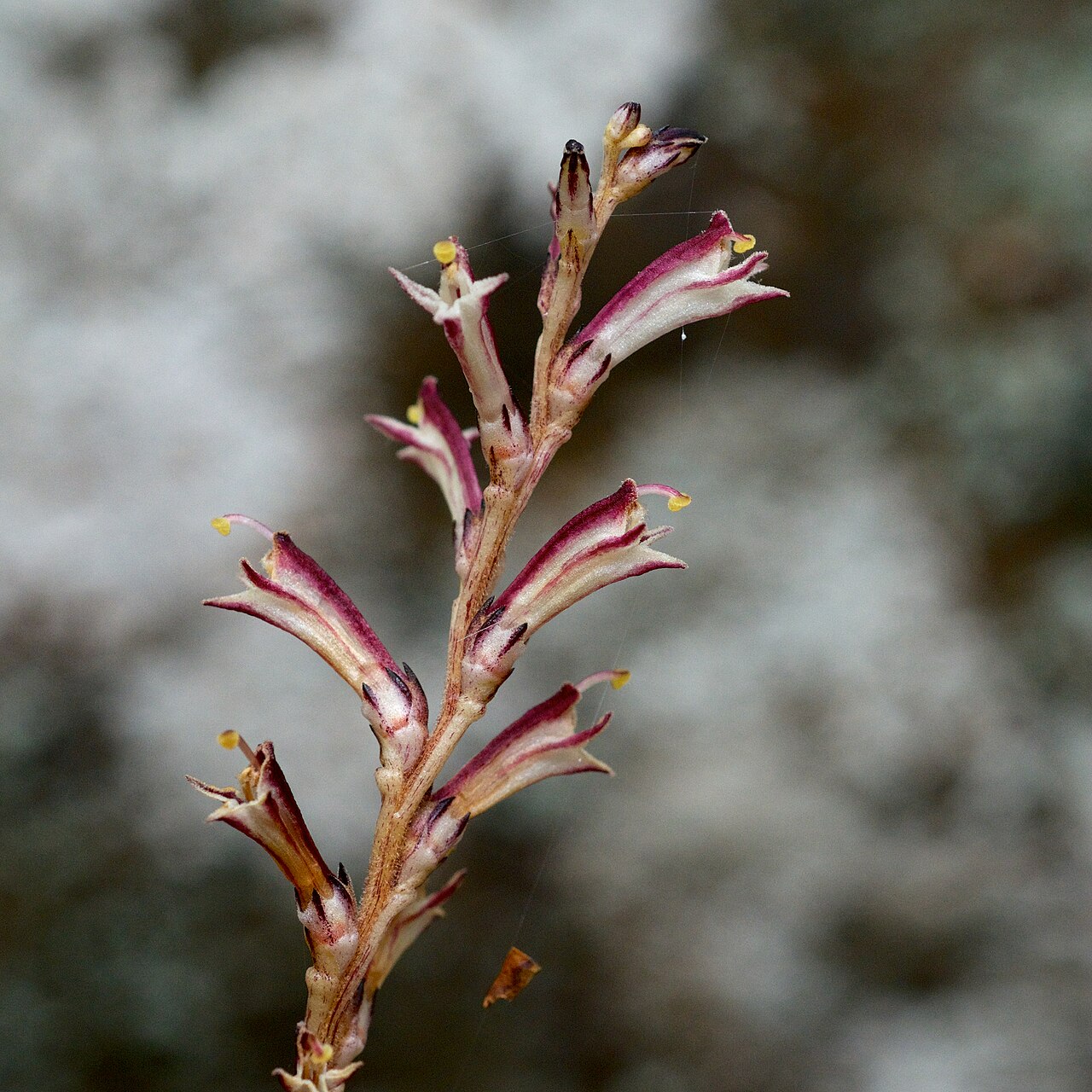
Beechdrops has two kinds of flowers on the same plant. The upper flowers along the branches are open, slender tubes about 1/2 inch long, white or cream with two maroon to brownish-purple stripes and four short lobes at the mouth. These can be cross-pollinated by insects. The lower flowers are smaller and remain closed, pollinating themselves inside the bud (cleistogamy). These closed flowers produce most of the plant’s seed. Beechdrops blooms from August to October, and sometimes into November in the South.
Fruit & Seeds
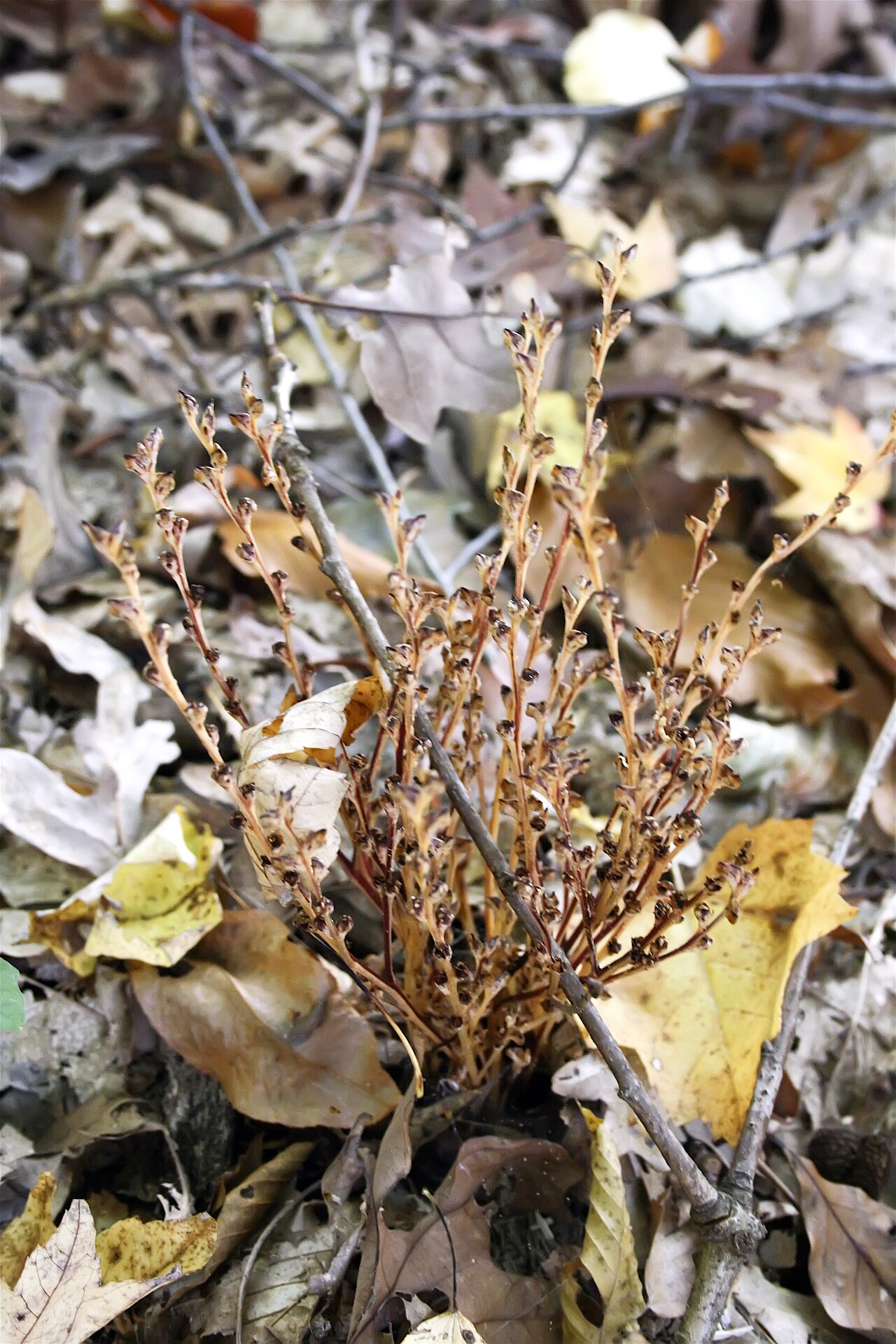
The closed lower flowers develop into small, cup-shaped capsules that split open at the top. They contain many tiny, dust-like seeds, which are thought to be splashed out by raindrops and washed into the soil. A seed germinates only when it comes into contact with chemical signals from a beech root, then attaches to the root and develops into a new plant.
Year-round Signs
After flowering, the stems dry to a dull brown and often stand through the winter and into the next spring. These dead stems, clustered in beech leaf litter, are a good way to find beechdrops in any season. Confusing it with other plants is unlikely. American cancer-root (Conopholis americana), another parasitic relative, grows under oaks and has thick, unbranched, cone-like stems covered in scales, and it blooms in spring.
Quick Facts
| Scientific Name | Epifagus virginiana (syn. Leptamnium virginianum) |
| Common Names | Beechdrops (USDA), beech-drops |
| Family | Orobanchaceae (broomrape family) |
| Plant Type | Parasitic herb without chlorophyll; attaches only to American beech roots |
| Mature Height | 4–18 in |
| Mature Spread | 4–12 in per clump |
| Growth Rate | Appears in late summer and fall; size depends on the host tree |
| Sun Exposure | Shade under American beech |
| Water Needs | Not applicable; draws water from its host |
| Soil Type | Forest soil within the root zone of American beech |
| Soil pH | Not applicable; follows its host (beech favors acid to near-neutral soils) |
| Bloom Time | August–October (to November in the South) |
| Flower Color | White to cream with maroon stripes |
| Fall Color | Stems turn dull brown and persist through winter |
| Fruit | Small capsule with many dust-like seeds |
| Deer Resistant | Generally not browsed |
| USDA Hardiness Zones | 3–9 (wherever American beech grows) |
Native Range
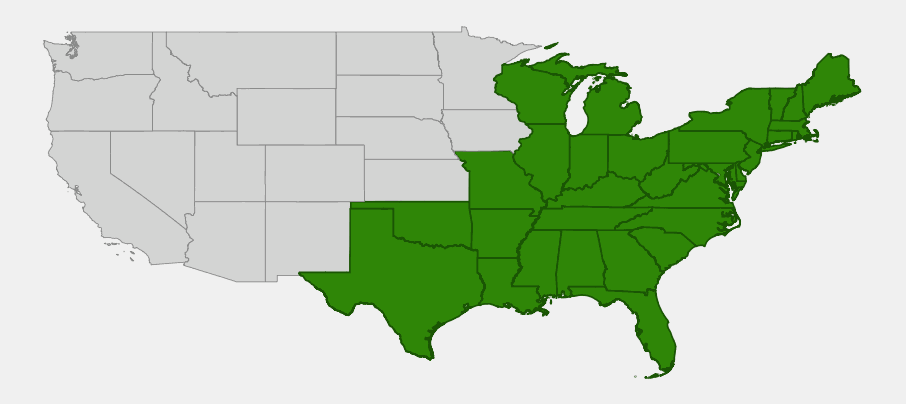
The range of beechdrops closely follows that of its only host, American beech (Fagus grandifolia). USDA PLANTS records it from 31 states, from Maine, Vermont and New Hampshire west through the Great Lakes states to Wisconsin and Illinois, and south through the Appalachians and the Ohio and Mississippi valleys to northern Florida, Louisiana and eastern Texas, with outlying sites in Missouri, Arkansas and Oklahoma. In Canada it grows in Ontario, Quebec, New Brunswick, Nova Scotia and Prince Edward Island.
Beechdrops is common wherever beech is common, especially in the beech-maple forests of the Great Lakes region and the Northeast, the mixed mesophytic forests of the Appalachians, and the beech-magnolia forests of the southern Coastal Plain. At the edges of the beech range, for example in Wisconsin, Oklahoma and Texas, both the tree and its parasite are scattered and local.
Look for it within the root zone of mature beech trees in moist, shaded woods: ravines, north-facing slopes, stream terraces and rich upland forests. It often appears in large numbers under a single big beech, scattered across the ground as far as the roots reach.
📋 Regional plant lists featuring Beechdrops: New York, Pennsylvania & Northern New Jersey · Ohio & Indiana · Michigan, Wisconsin & Eastern Minnesota · Kentucky & Tennessee · Connecticut, Massachusetts & Rhode Island · New Hampshire, Maine & Vermont · Maryland, Virginia & West Virginia · Delaware, Southern New Jersey & Long Island · Illinois, Iowa & Missouri · Alabama, Georgia & Mississippi · North & South Florida
Growing & Care Guide
Beechdrops is a plant to look for and enjoy in the woods, not one to grow. It is a parasite that depends completely on living American beech roots, so it cannot be grown from nursery stock, and it cannot be transplanted: a dug plant is separated from its host and dies. The sections below describe the conditions where it grows naturally and how you can help it, mainly by protecting beech trees.
Light
Beechdrops grows in the shade of beech trees. Since it has no chlorophyll, light does not matter to the plant itself. It occurs wherever the roots of a healthy beech tree run, usually in moist, shady forest.
Soil & Water
It grows in the soil around beech roots, typically moist, well-drained, humus-rich loams and sandy loams. Its water and nutrients come from the host tree, so it needs no watering or feeding of any kind.
Planting Tips
Beechdrops cannot be planted. The best way to have it on your property is to protect existing American beech trees and to plant young beech trees in suitable sites; beechdrops may appear on its own over time if seed reaches the roots. Protect the root zone of beech trees from soil compaction, trenching, grading and heavy equipment. Watch for beech leaf disease, which causes dark bands between leaf veins and is spreading through the Northeast and Great Lakes region, and for beech bark disease, which causes cankers and dieback. Contact your state forestry agency or extension service if you see signs of either.
Pruning & Maintenance
No maintenance is needed. Leave the dry stems standing over winter, since they help mark where plants grow, and leave the leaf litter under beech trees undisturbed. Do not pick the stems for dried arrangements; they will not regrow if the base is damaged.
Propagation
Beechdrops reproduces only by seed, mostly from its self-pollinating closed flowers. The seeds germinate only in contact with beech roots. It cannot be propagated by gardeners, and neither seeds nor plants should be collected.
Landscape Uses
- Nature study: an easy-to-find parasitic plant that shows how some plants live without photosynthesis
- Forest education: an indicator of American beech, useful for teaching tree-parasite relationships
- Woodland stewardship: a reason to protect mature beech trees and their root zones
- Fall wildflower walks: one of the few native plants in bloom on the shady forest floor in autumn
Wildlife & Ecological Value
Beechdrops is a small part of the beech forest ecosystem, but it shows how plants have evolved to live in close association with a single host.
For Pollinators
The open upper flowers have a small amount of nectar and are visited by small bees and other insects, especially ants. Most seed comes from the closed lower flowers, which pollinate themselves without insects. This makes beechdrops less dependent on pollinators than most wildflowers.
For Birds
Beechdrops has little direct value for birds. The beech trees it depends on are very important, though: beechnuts are eaten by blue jays, wild turkeys, woodpeckers and many other birds.
For Mammals
Deer and other mammals rarely eat beechdrops. American beech, its host, produces nuts eaten by black bears, deer, squirrels, chipmunks and mice.
Ecosystem Role
Beechdrops takes only a small share of water and nutrients from its host, and it is not considered harmful to healthy beech trees. Its life cycle depends on finding beech roots, so it is a living indicator of beech in a forest. Because it has no need for photosynthesis, it has lost most of the genes plants normally use for this process. Its chloroplast genome was one of the first of any parasitic plant to be fully sequenced, in the early 1990s, and it became a classic example of how parasitic plants evolve.
Cultural & Historical Uses
Linnaeus described beechdrops in 1753 as Orobanche virginiana, placing it with the broomrapes. The American botanist William P. C. Barton later gave it its own genus, Epifagus, a name that records its strict association with beech. It has also been called Leptamnium virginianum.
Some early American herbalists used beechdrops in remedies, and it was sometimes known as cancer-root, a name shared with several other parasitic plants and used for their supposed medicinal value. There is no reliable evidence that it has medicinal properties, and wild plants should not be collected.
Many people walk past beechdrops for years without noticing them. Once they know to look under beech trees in fall, they often find them in great numbers, sometimes hundreds of stems around a single large tree. Teaching people to recognize it is a simple way to show that not all plants are green.
Frequently Asked Questions
Can I grow beechdrops in my garden?
No. Beechdrops is a parasite that lives only on the roots of American beech trees. It cannot be grown from nursery stock or transplanted, because a dug plant is cut off from its host and dies. The best way to encourage it is to protect and plant American beech.
Does beechdrops harm beech trees?
Not noticeably. It takes a small amount of water and nutrients from the roots, but healthy beech trees show no obvious harm, even with many beechdrops around them.
Why is beechdrops not green?
It has no chlorophyll, so it cannot photosynthesize. All its food comes from the beech tree it is attached to. Its stems are tan, pink or reddish-brown instead.
When can I find beechdrops?
It flowers from late summer through fall, usually August to October. The dry, brown stems stand through the winter, so you can find plants under beech trees almost any time of year.
Is beechdrops the same as cancer-root?
No, although it has sometimes been called cancer-root. American cancer-root (Conopholis americana) is a related parasite of oak roots with thick, cone-like stems and spring flowers. Beechdrops has slender, branched stems, grows under beech trees, and flowers in fall.

Looking for a nursery that carries Beechdrops?
Browse our native plant nursery directory: Alabama & Arkansas · Connecticut, Delaware, Florida & Georgia · Illinois & Indiana · Kentucky, Louisiana, Maine, Maryland, Massachusetts, Michigan, Mississippi & Missouri · New Hampshire, New Jersey, New York, North Carolina, Ohio & Oklahoma · Pennsylvania, Rhode Island, South Carolina, Tennessee, Texas, Vermont & Virginia · West Virginia & Wisconsin