
Pinesap (Monotropa hypopitys)
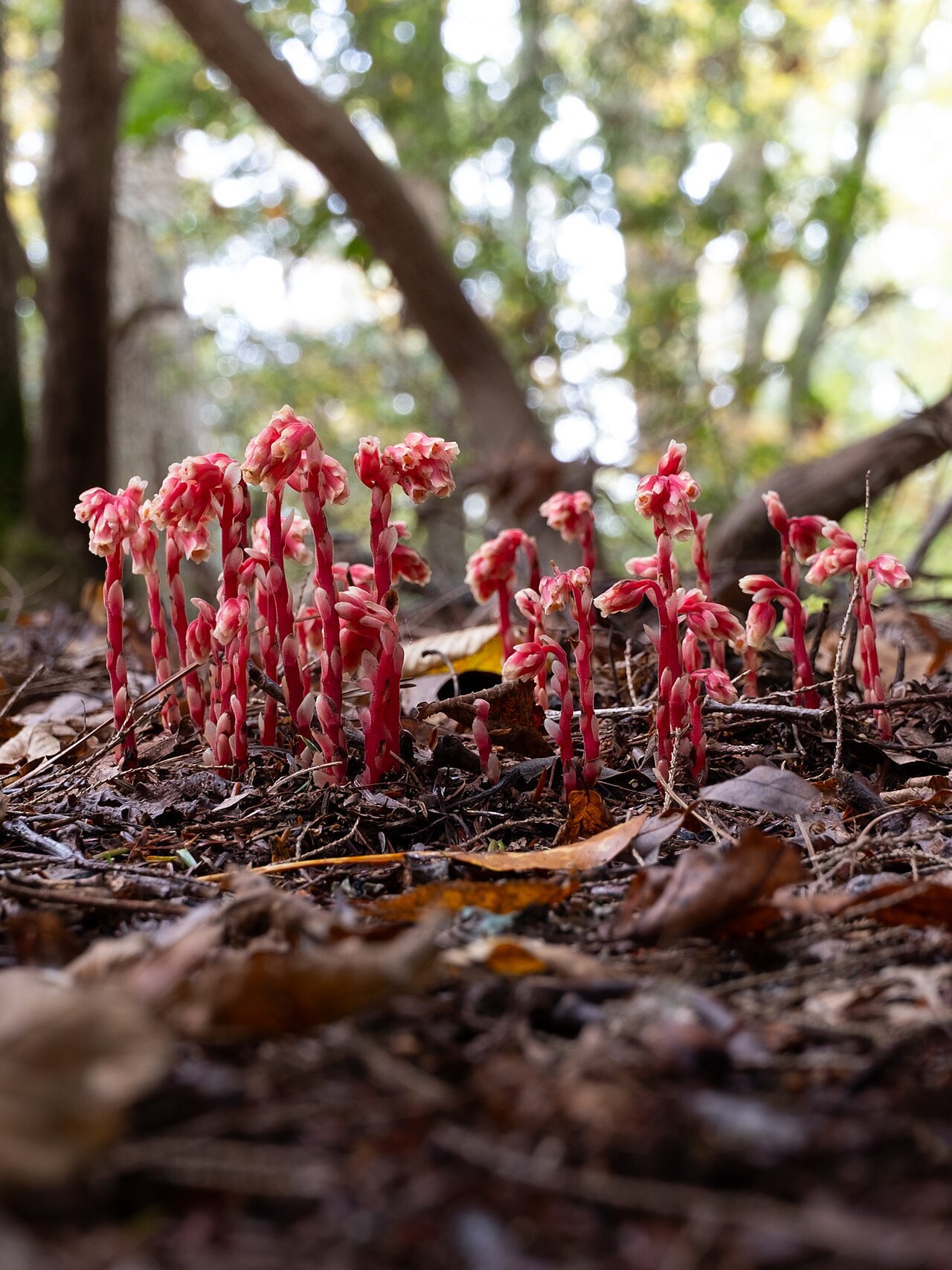
Monotropa hypopitys, known as Pinesap, false beechdrops or (in Europe) yellow bird’s-nest, is a small, leafless wildflower that appears as if from nowhere on shady forest floors. Its fleshy stems, 4 to 12 inches tall, are entirely yellow, tan, pink or deep red, and each one carries a nodding cluster of several bell-shaped flowers. It belongs to the heath family (Ericaceae) and is a close relative of the better-known ghostly white Indian Pipe. USDA PLANTS places both in the Indian pipe family, Monotropaceae, and some botanists put pinesap in its own genus as Hypopitys monotropa.
Pinesap has no chlorophyll and makes none of its own food. It is a mycoheterotroph: its roots are joined to soil fungi, chiefly species of Tricholoma, that also form mycorrhizae with the roots of trees such as oaks, beech and pines. The trees feed the fungi, and pinesap takes a share of that sugar from the fungi. The name hypopitys means “under the pines”, although in eastern North America it is at least as common under oaks and beech.
Pinesap cannot be grown from nursery stock or transplanted, and it should never be dug up. Removed from its fungal partners, it dies. This page explains how to identify pinesap, where to look for it, and how to protect the forests that support it. It is one of the most widespread native plants in North America, found in 45 states including Alaska, but it is uncommon to rare in many areas and easy to miss.
Identification
Pinesap is most often confused with Indian pipe. Both are leafless, fleshy and nodding when in flower, but Indian pipe is waxy white (rarely pink) with a single flower on each stem, while pinesap is yellow to red, usually slightly hairy, and has several flowers on each stem. Pinedrops, another relative in the West, is far taller and has a sticky stem with dozens of small bells.
Stems & Color
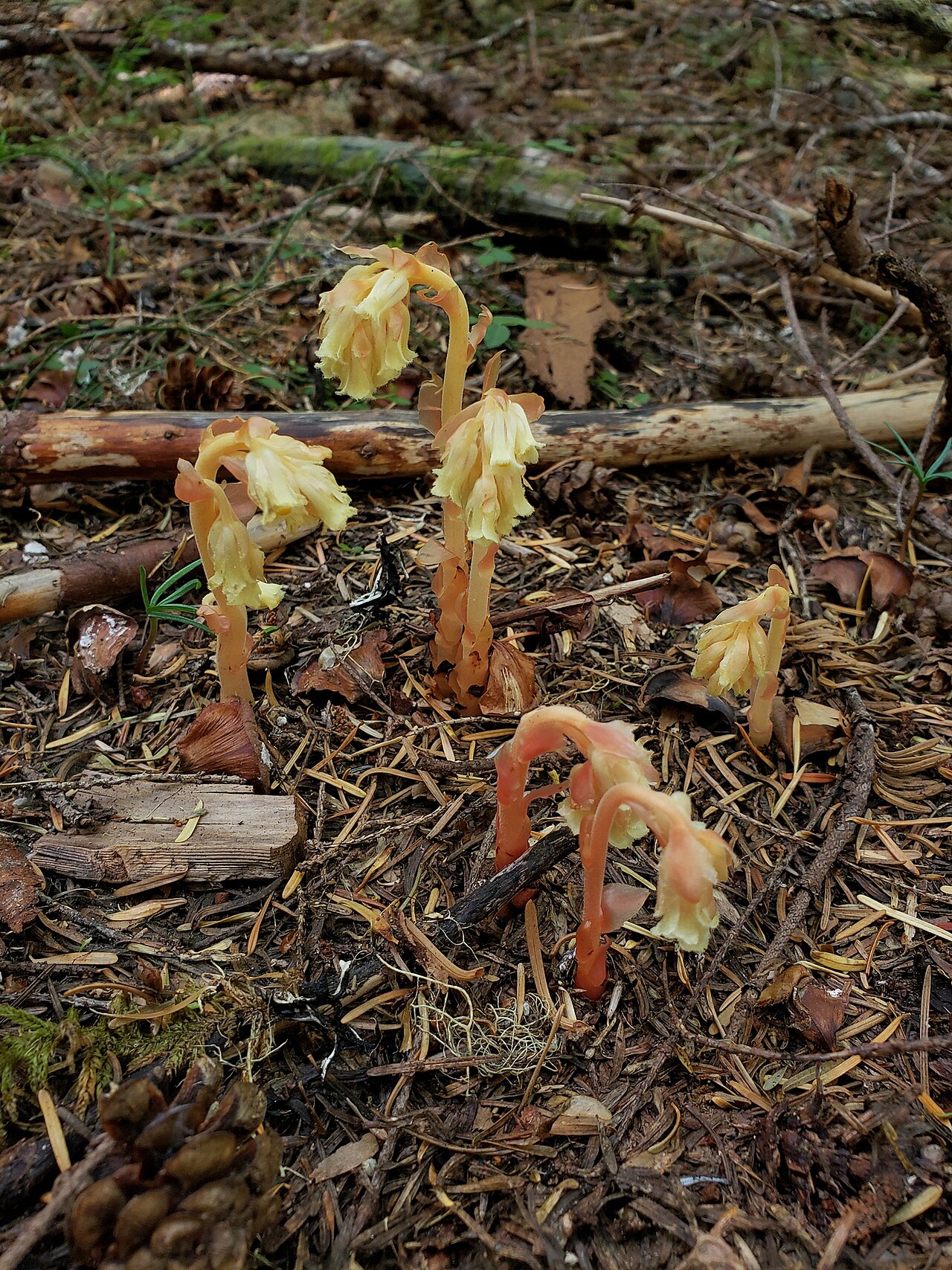
Stems grow in small clumps from a mass of brittle roots in the leaf litter. They are thick, fleshy and covered with small scale leaves, usually 4 to 12 inches tall. Color varies a great deal. Plants that emerge in early and midsummer are often pale yellow to tan, while those that come up in late summer and fall are frequently pink to deep crimson. Some botanists have suggested the color forms are distinct varieties or even species, but this is not settled, and USDA treats them all as one species.
Leaves
There are no green leaves. Overlapping, translucent scale leaves of the same color as the stem clasp the stem along its length. They are the remnants of ordinary leaves in the plant’s green ancestors.
Flowers
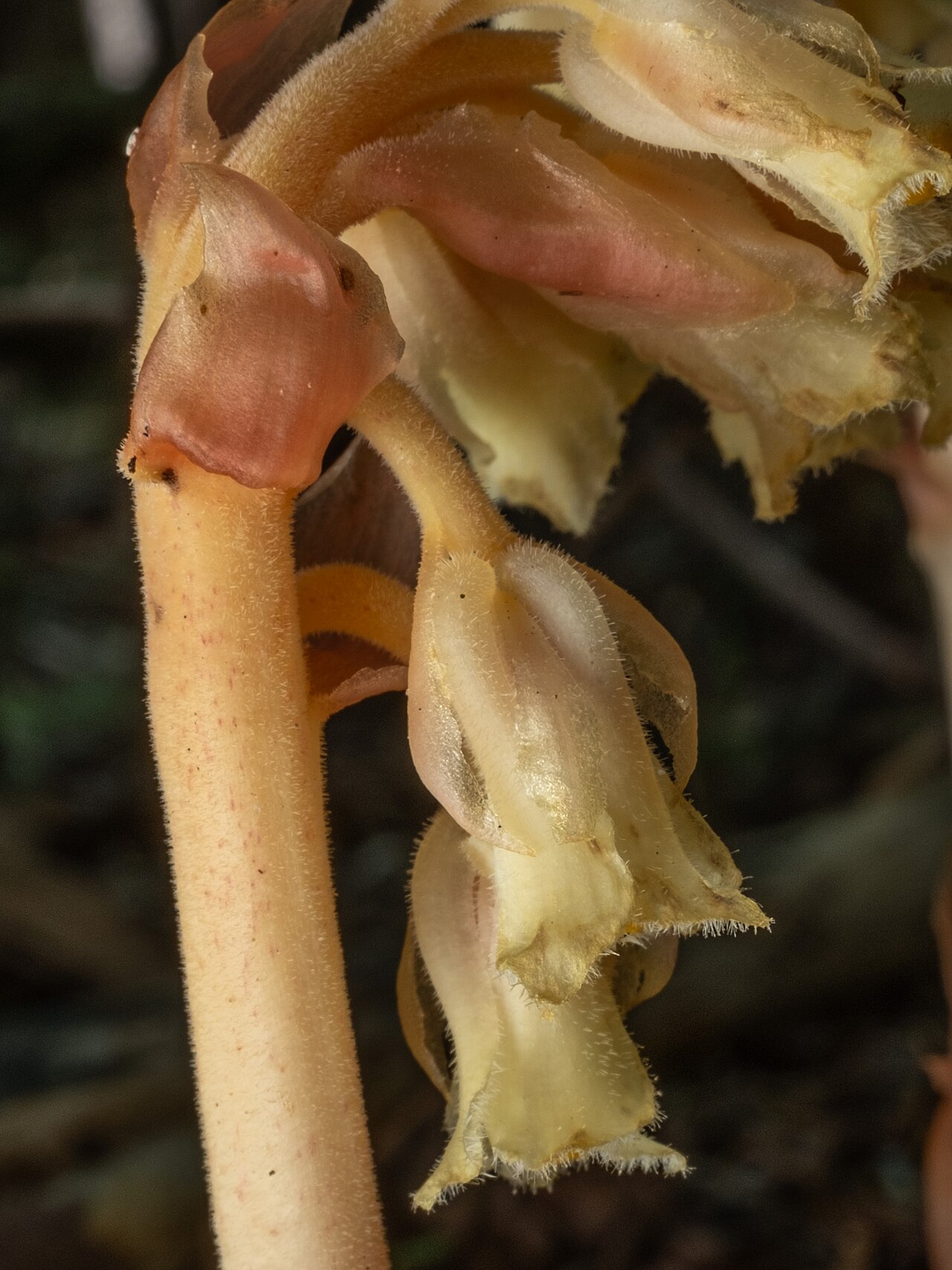
The top of the stem bends over like a shepherd’s crook and carries a one-sided cluster of usually 3 to 10 flowers. Each flower is a narrow bell about half an inch long, with 4 or 5 petals that are often finely fringed or hairy on the inside and along the edges. A useful detail: the uppermost (terminal) flower usually has five petals, while the side flowers usually have four. The flowers may have a faint scent.
Fruit & Seeds
After pollination the stem straightens, and the flower cluster turns upright. Each flower forms an oval capsule that dries and splits to release thousands of dust-like seeds. Dried stalks turn dark brown to black and can persist through winter. As with all its relatives, the seeds can only develop if they meet the right fungus in the soil.
Quick Facts
| Scientific Name | Monotropa hypopitys L. (syn. Hypopitys monotropa, H. lanuginosa) |
| Family | Ericaceae (heath family), subfamily Monotropoideae; Monotropaceae in USDA PLANTS |
| Plant Type | Mycoheterotrophic perennial herb without chlorophyll |
| Mature Height | 4–12 in |
| Mature Spread | Small clumps a few inches across |
| Growth Rate | Stems emerge and flower within a few weeks |
| Sun Exposure | Shade of deciduous and conifer forest; not cultivated |
| Water Needs | Not applicable (wild plant); grows in moist to fairly dry forest soils |
| Soil Type | Deep leaf litter and humus; sandy to loamy forest soils |
| Soil pH | Acidic to near-neutral forest soils |
| Bloom Time | June–October; yellow plants mostly earlier, red plants later |
| Flower Color | Yellow, tan, pink or red (same color as the stem) |
| Fall Color | None; stems blacken after fruiting |
| Fruit | Upright oval capsule with dust-like seeds |
| Deer Resistant | Rarely browsed; not a garden plant |
| USDA Hardiness Zones | Not cultivated; wild populations in roughly zones 2–9 |
Native Range
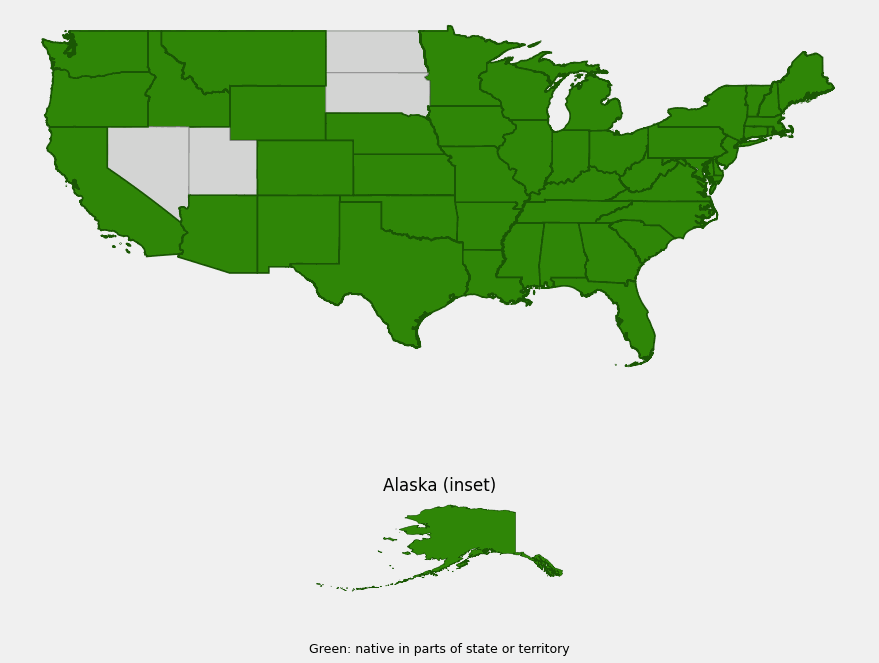
Pinesap has one of the widest ranges of any North American wildflower. USDA PLANTS lists it as native in 45 states, from Alaska, Washington and California east to Maine and south to Florida and Texas, and in every Canadian province from British Columbia to Newfoundland, plus Saint Pierre and Miquelon. It is also native across the temperate forests of Europe and Asia, and it extends south into the mountains of Mexico.
Despite this huge range, pinesap is seldom abundant anywhere. In the East it is scattered in oak, beech, oak-hickory and pine forests, from the Appalachians and the Northeast through the Midwest to the upland woods of the Deep South, where it becomes rare toward the Gulf Coast and Florida. In the West it grows mainly in conifer forests of the Pacific Coast, the Rockies and the Southwest mountains. It is missing from treeless country, which explains its absence from much of the northern Great Plains and the Great Basin.
Pinesap appears irregularly. Like other mycoheterotrophs, it can stay hidden underground for years and then flower in numbers after a wet season. Many people find it only once or twice in a lifetime of walks, even in woods where it is established.
📋 Regional plant lists featuring Pinesap: New York, Pennsylvania & Northern New Jersey · Idaho, Eastern Oregon & Eastern Washington · Ohio & Indiana · Montana & Wyoming · Michigan, Wisconsin & Eastern Minnesota · Kentucky & Tennessee · Nebraska, Kansas & Eastern Colorado · Connecticut, Massachusetts & Rhode Island · New Hampshire, Maine & Vermont · Maryland, Virginia & West Virginia · Delaware, Southern New Jersey & Long Island · Arizona & New Mexico · Illinois, Iowa & Missouri · Alabama, Georgia & Mississippi · Alaska · North & South Florida
Growing & Care Guide
Pinesap is not a garden plant. It cannot be bought, propagated or moved, because it lives entirely on sugars passed to it by soil fungi connected to living trees. Plants that are dug up die. Instead of care instructions, the sections below explain how to find and appreciate pinesap and how to protect the woods where it grows.
Light
Search shady, mature woods. Pinesap needs no light to grow, but its host trees must be healthy, so it is found under a full forest canopy rather than in clearings. The flowers are low and often dark against the leaf litter. A flashlight or a reflector helps when photographing them.
Soil & Water
Pinesap grows in deep, undisturbed leaf litter and humus. It is sensitive to soil compaction, raking, heavy trampling, and the removal of the litter layer. Emergence depends on rainfall: dry summers may produce no stems at all. On your own land, leave leaf litter in place under trees, and avoid running equipment or heavy foot traffic through woods where it grows.
Planting Tips
Do not try to plant, sow or transplant pinesap. If you have it in your woods, the best “planting” you can do is keep the trees: oaks, beech, pines and other ectomycorrhizal trees support its fungal partners. Avoid fungicides and heavy fertilizer in woodland areas.
Pruning & Maintenance
There is nothing to prune. Leave flowering and fruiting stems standing so they can release their seed, and mark the spot in your notes rather than with stakes that draw attention. Do not pick the stems, which blacken quickly once cut and have no use as cut flowers.
Propagation
Pinesap spreads only by its dust-like seeds, which must land near the right Tricholoma fungus already connected to tree roots. There is no practical way to grow it, and no legitimate nursery source. Protecting mature forest and its undisturbed soil is the only way to help it.
Landscape Uses
- Woodland walks: a rewarding find for wildflower enthusiasts in late summer and fall
- Photography: striking red and gold colors against brown leaf litter
- Nature education: a clear example of a plant that feeds through fungi rather than sunlight
- Woodland stewardship: a sign of healthy, undisturbed forest soil worth protecting
- Citizen science: photo records on iNaturalist and with state heritage programs help map an uncommon plant
Wildlife & Ecological Value
Pinesap is a quiet part of the forest community, but it reveals the underground partnerships between trees and fungi that hold the forest together.
For Pollinators
Bumblebees are the main pollinators recorded for pinesap. They work the nodding flowers from below for nectar and pollen. Its late flowering in many areas makes it one of the few woodland flowers available to bees in early fall.
For Birds
Pinesap has no direct food value for birds. It grows in mature woods that support many forest birds, from ovenbirds and wood thrushes in the East to nuthatches and woodpeckers in western conifer forests.
For Mammals
Pinesap is rarely eaten by mammals. Its fungal partners, however, are part of the forest food web: many mushroom-forming mycorrhizal fungi are eaten by squirrels, chipmunks, deer and other animals.
Ecosystem Role
Pinesap is a “cheater” in the mycorrhizal network. Its Tricholoma partners normally trade soil nutrients to trees for sugar, but pinesap takes sugar from the fungus without returning any. Studies of pinesap and its relatives have shown that each tends to rely on a narrow group of fungi. Because of this, a pinesap colony is a sign of an intact, mature forest soil with healthy trees and diverse fungi.
Cultural & Historical Uses
Linnaeus described Monotropa hypopitys in 1753 from European plants. The genus name means “one turn”, referring to the bent stem tip, and the species name means “under the pines”. The European names yellow bird’s-nest and Dutchman’s pipe refer to its tangled root mass and its pipe-like shape.
In North America pinesap has long been confused with Indian pipe, and many older names lump the two together. The name “false beechdrops” reflects its habit of growing under beech trees, like true beechdrops (Epifagus virginiana), which is a root parasite of beech and an unrelated plant.
Pinesap has no known significant food use, and there are few reliable records of medicinal use. Its main value today is as a symbol of the hidden life of the forest floor. In some states it is rare enough to be tracked by natural heritage programs. If you find it, photograph it and report it rather than picking it.
Frequently Asked Questions
Is pinesap a mushroom?
No. Pinesap is a flowering plant in the heath family, related to blueberries and rhododendrons. It has flowers and seeds, but no chlorophyll, and it gets its food from fungi in the soil.
Can I grow pinesap or move it into my garden?
No. Pinesap cannot be grown from nursery stock or transplanted, and it should never be dug up. It depends on specific soil fungi connected to living trees. Plants that are moved die, and digging damages the fungal network.
What is the difference between pinesap and Indian pipe?
Indian pipe is waxy white and has one flower per stem. Pinesap is yellow, tan, pink or red, often slightly hairy, and has several flowers clustered at the top of each stem.
Why are some pinesap plants red and others yellow?
Color varies with season and possibly genetics. In many eastern forests, yellow plants appear in early to midsummer and red plants in late summer and fall. Whether these forms are separate varieties is still debated.
When can I see pinesap in flower?
Look from June through October, depending on region and color form. It emerges after rain in shady woods with deep leaf or needle litter, often under oaks, beech and pines. The dried black stalks may remain into winter.

Looking for a nursery that carries Pinesap?
Browse our native plant nursery directory: Alabama, Alaska, Arizona & Arkansas · California · Colorado, Connecticut, Delaware, Florida & Georgia · Idaho, Illinois, Indiana, Iowa & Kansas · Kentucky, Louisiana, Maine, Maryland, Massachusetts, Michigan, Minnesota, Mississippi, Missouri & Montana · Nebraska, New Hampshire, New Jersey, New Mexico, New York, North Carolina, Ohio & Oklahoma · Oregon · Pennsylvania, Rhode Island, South Carolina, Tennessee, Texas, Vermont & Virginia · Washington · West Virginia, Wisconsin & Wyoming