
Yellow Fritillary (Fritillaria pudica)
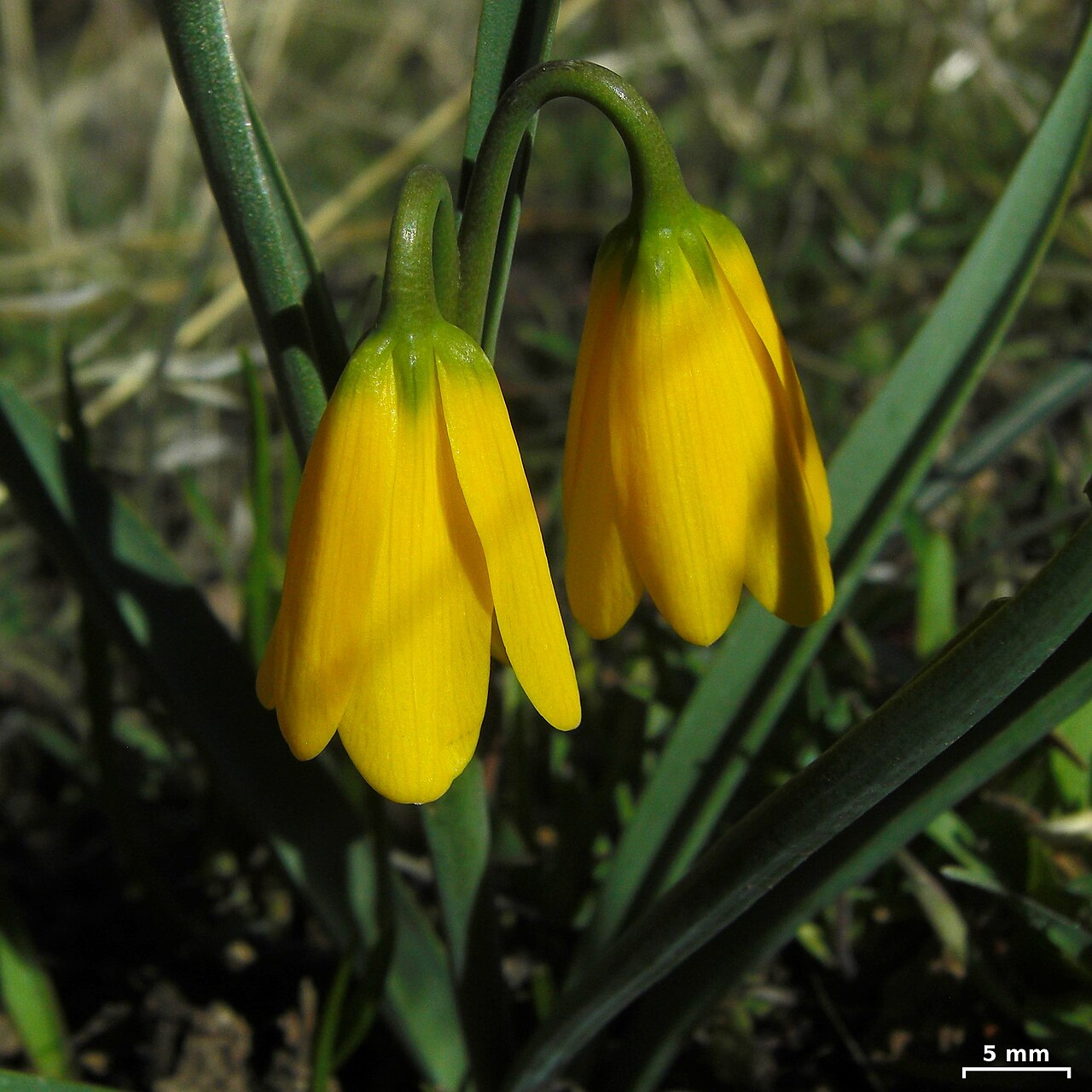
Fritillaria pudica, known as Yellow Fritillary (also yellow bells or yellow missionbells), is a small spring bulb of the dry interior West. It belongs to the lily family (Liliaceae). It is one of the very first wildflowers to bloom in sagebrush country, often appearing within days of the snow melting, from late February at low elevations to June in the mountains.
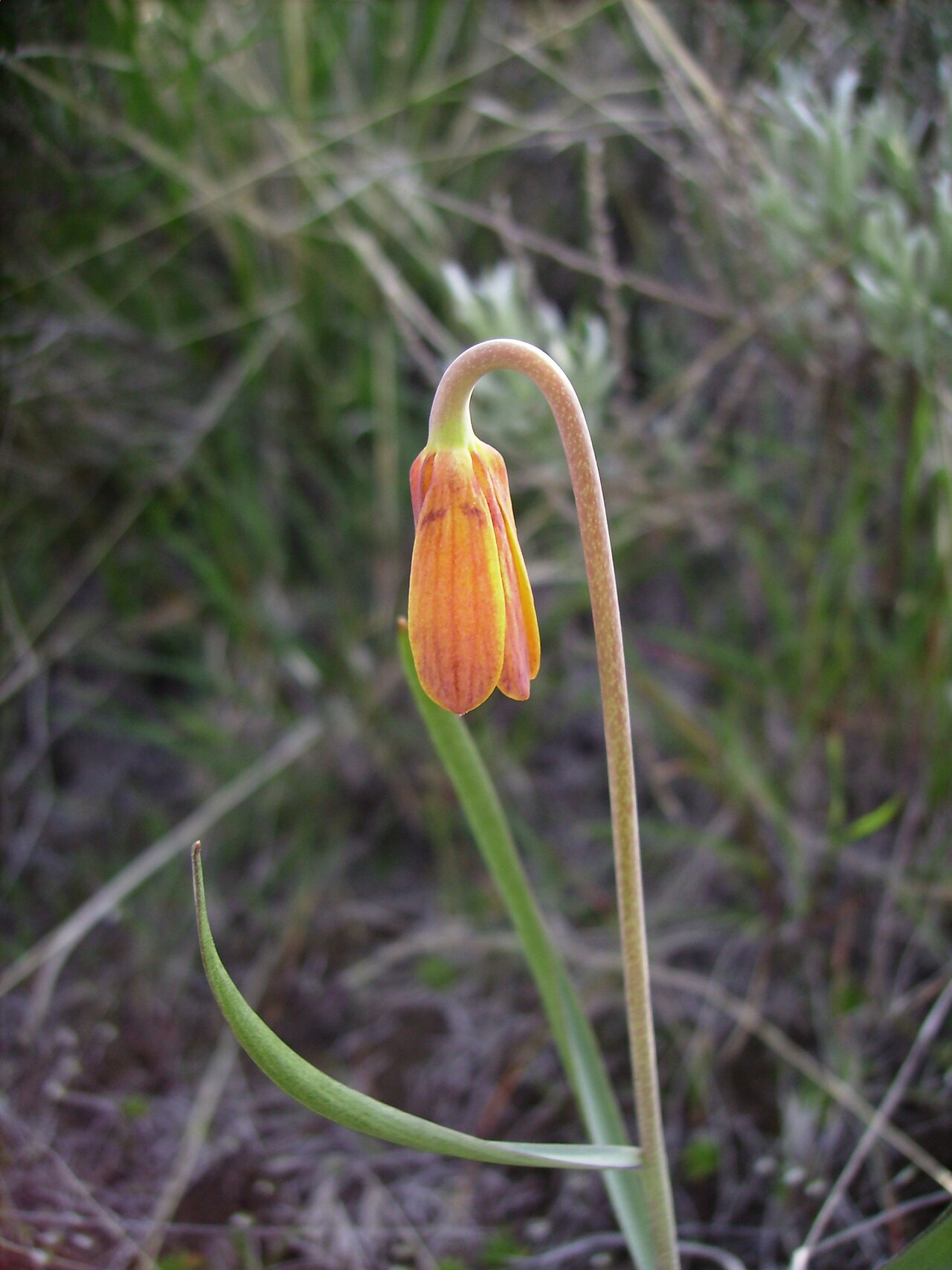
Each plant is only 4 to 12 inches tall, with a few narrow, grass-like leaves and usually a single nodding, bell-shaped flower of clear golden yellow. As the flower ages it turns orange and then brick red or purplish, so a patch may show several colors at once. The species name pudica means “bashful” or “modest,” for the downward-facing blossom.
Yellow fritillary grows in sagebrush steppe, grasslands and open pine forest from southern British Columbia and Alberta south to northern California, Nevada, Utah and Colorado. Its starchy bulbs were a traditional food of Native peoples of the Plateau. It is difficult to grow outside its native region; buy only nursery-propagated bulbs and never dig wild ones.
Identification
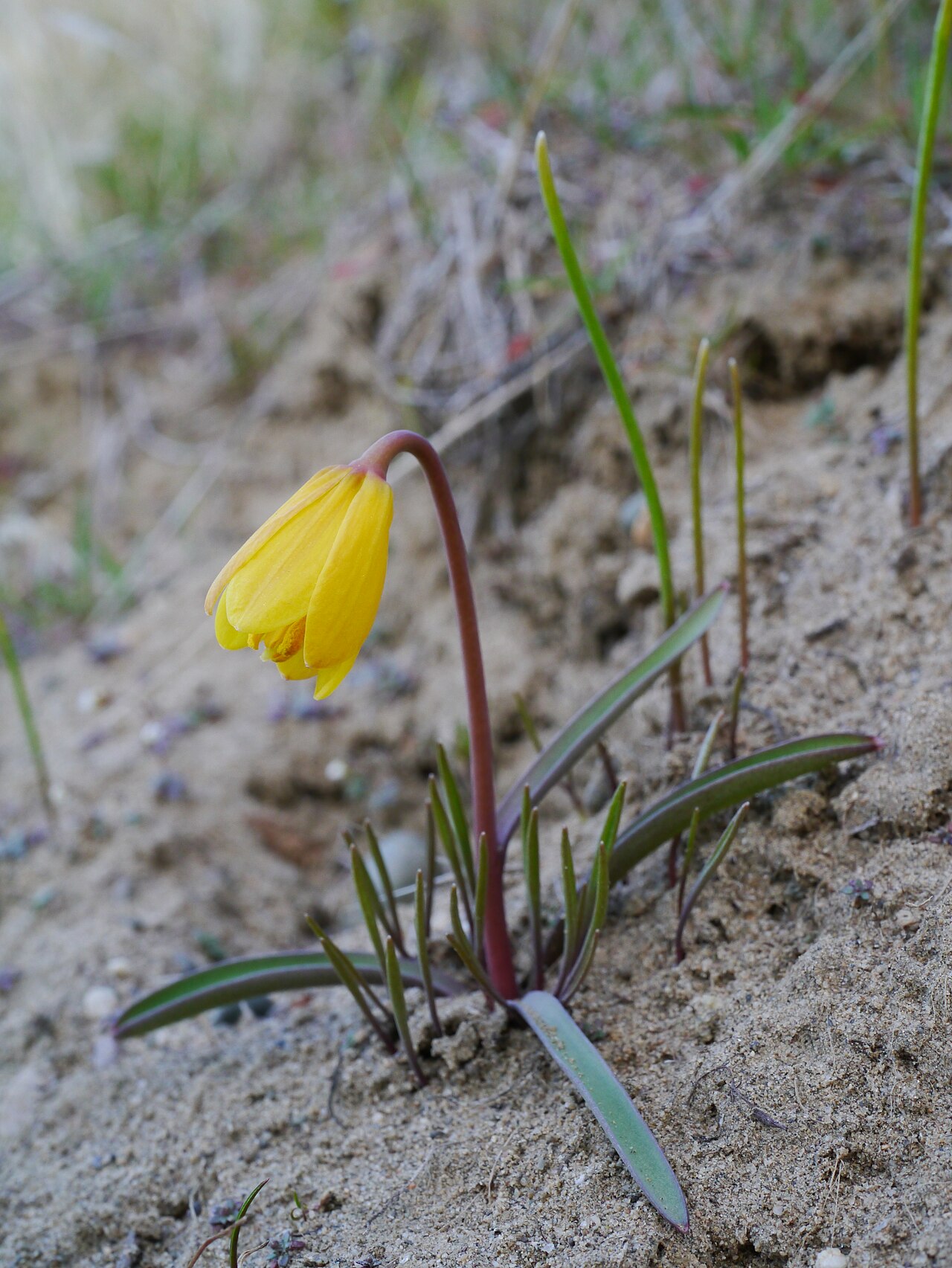
Look for a very early spring plant a few inches tall with a few narrow leaves and one or two nodding, yellow, bell-shaped flowers that fade to orange or red, in sagebrush, grassland and open pine woods.
Stems & Habit
Yellow fritillary grows from a small, scaly bulb surrounded by many tiny, rice-like bulblets. Each bulb produces a single unbranched stem 4 to 12 inches (10 to 30 cm) tall. The plant appears early in spring and dies back completely by early summer.
Leaves
There are usually two to eight narrow, linear to lance-shaped leaves, 2 to 6 inches long, alternate or nearly opposite or whorled near the middle of the stem. They are smooth, slightly fleshy and blue-green.
Flowers
The flower is usually single, though vigorous plants may have two or three. It hangs from the curved stem tip and is narrowly bell-shaped, about 1/2 to 1 inch long, with six tepals of bright yellow, sometimes faintly lined with purple near the base. Older flowers turn orange, then brick red or purple. Bloom time is March to June, depending on elevation and snowmelt.
Fruit & Seeds
After flowering, the stem straightens and the fruit, a six-angled, upright capsule about 1/2 to 1 inch long, ripens by early summer. It holds many flat, papery seeds. Seedlings take several years to reach flowering size.
Look-alikes
Other western fritillaries, such as checker lily (Checker Lily, F. affinis) and chocolate lily (Chocolate Lily), have larger, mottled brown, purple or greenish flowers. Glacier lily (Glacier Lily, Erythronium grandiflorum) is also yellow and blooms at snowmelt, but its tepals curve sharply backward and it has two broad basal leaves. Yellow fritillary is recognized by its small size and plain yellow, nodding bells.
Quick Facts
| Scientific Name | Fritillaria pudica |
| Family | Liliaceae (lily family) |
| Plant Type | Perennial spring bulb (geophyte) |
| Mature Height | 4–12 in |
| Mature Spread | 2–4 in |
| Growth Rate | Slow |
| Sun Exposure | Full sun to light shade |
| Water Needs | Low; moist in spring, dry in summer |
| Soil Type | Well-drained sandy, gravelly or rocky loam |
| Soil pH | About 6.0–8.0 |
| Bloom Time | March–June (soon after snowmelt) |
| Flower Color | Golden yellow, aging orange to red |
| Fall Color | None; summer dormant |
| Fruit | Upright six-angled capsule with flat seeds |
| Deer Resistant | No; flowers and bulbs are eaten by wildlife |
| USDA Hardiness Zones | 3–8 |
Native Range
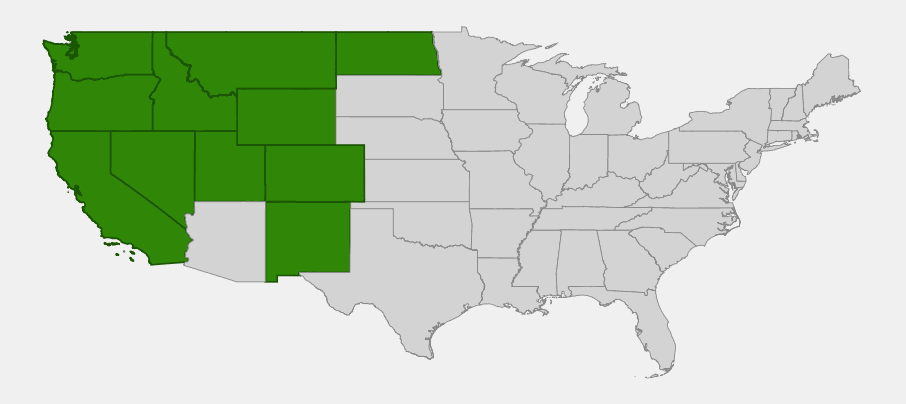
Yellow fritillary is native to western North America. USDA PLANTS lists it as native in California, Colorado, Idaho, Montana, Nevada, New Mexico, North Dakota, Oregon, Utah, Washington and Wyoming, and in British Columbia and Alberta.
Its center of abundance is the Columbia Plateau and the dry interior of Washington, Oregon and Idaho, east of the Cascades, and the valleys and foothills of western Montana. It extends south through the Great Basin to northeastern California and Nevada, east to Wyoming and northern Utah, and into northwestern Colorado, where it is rare. Records from North Dakota (along the Missouri River near Mandan) and New Mexico are outlying, and a few populations reach the Siskiyou region near the Oregon-California border.
It grows in open, sunny places that are moist in early spring and dry in summer: sagebrush steppe, bunchgrass prairies, rocky slopes and open ponderosa pine and Douglas-fir forests, from low valleys to the lower subalpine zone.
📋 Regional plant lists featuring Yellow Fritillary: Idaho, Eastern Oregon & Eastern Washington · Montana & Wyoming · Utah & Western Colorado · North Dakota, South Dakota & Western Minnesota · California & Nevada
Growing & Care Guide
Yellow fritillary is a charming but challenging bulb. It does best in dry-summer gardens of the interior West or in a bulb frame or rock garden where it can be kept dry while dormant. Buy bulbs only from growers who propagate them; never dig wild bulbs.
Light
Full sun to light shade, as under open pines.
Soil & Water
It needs sharp drainage: sandy, gravelly or rocky loam. Moisture from winter snow and spring rain is enough. Keep the bulbs dry from early summer through fall; summer irrigation causes rot. In wet-summer climates, grow it in a raised scree bed, trough or bulb frame.
Planting Tips
Plant bulbs in early fall about 2 to 3 inches deep, handling them gently because the tiny bulblets break off easily. Plant in small groups among low bunchgrasses or other dry-garden plants, and mark the spot since the plant disappears by summer. Protect from rodents with wire mesh if needed.
Pruning & Maintenance
None needed. Let the leaves yellow and die back naturally so the bulb can store energy for next year, and leave the seed capsules to ripen if you want seedlings.
Propagation
Grow from fresh seed sown in fall in pots left outdoors over winter; seedlings take three to five years to bloom. The rice-grain bulblets around the main bulb can also be separated and grown on when the plant is dormant.
Landscape Uses
- Rock and scree gardens: a tiny early bulb for dry, gravelly beds
- Dry-summer native gardens: early color in sagebrush and bunchgrass plantings
- Early pollinator food: one of the first nectar sources in spring
- Wildflower viewing: a classic first sign of spring in sagebrush country
- Habitat restoration: part of native shrub-steppe and prairie flora
Wildlife & Ecological Value
Yellow fritillary blooms when little else is in flower, making it an important early food for insects and animals in sagebrush country.
For Pollinators
Early-flying native bees, including bumblebee queens, mining bees and mason bees, visit the nodding flowers for nectar and pollen, along with flies.
For Birds
Sage-grouse and other grouse eat early spring forbs, and the tender flowers and buds of plants like yellow fritillary are part of that early spring diet.
For Mammals
Deer, elk, pronghorn and livestock eat the flowers and leaves. Ground squirrels, pocket gophers and bears dig the bulbs.
Ecosystem Role
As a geophyte, it survives the long dry summer, fire and grazing as a bulb underground, and its early bloom helps start the season for pollinators in shrub-steppe and grassland communities.
Cultural & Historical Uses
The genus name Fritillaria comes from the Latin fritillus, a dice box or cup, referring to the shape or checkered pattern of the flowers of some species. Pudica means “bashful,” for the nodding flower.
The starchy bulbs, with their clusters of rice-like bulblets, were gathered in spring and eaten fresh or cooked by Native peoples of the Columbia Plateau and northern Great Basin. Today the plant is widely loved as one of the first signs of spring in the interior Northwest.
The first scientific specimens were collected by the Lewis and Clark Expedition in 1806, and the species was described by Frederick Pursh. Related lilies on this site include Checker Lily and Chocolate Lily.
Frequently Asked Questions
When does yellow fritillary bloom?
From about March to June, often within days of snowmelt. It is one of the first wildflowers of spring in sagebrush country.
Why do some flowers look orange or red?
The flowers change color as they age, from bright yellow to orange and then brick red or purplish.
Can I grow yellow fritillary?
Yes, in dry-summer climates or a rock garden or bulb frame. Plant nursery-propagated bulbs in fall in very well-drained soil and keep them dry in summer.
Is it edible?
Its bulbs were a traditional Native food, but wild plants should not be dug. Many populations are small, and digging destroys the plant.
Where does yellow fritillary grow?
In sagebrush steppe, grasslands and open pine forests from British Columbia and Alberta south to northern California, Nevada, Utah, Wyoming and Colorado.

Looking for a nursery that carries Yellow Fritillary?
Browse our native plant nursery directory: California · Colorado · Idaho · Montana · Nevada, New Mexico & North Dakota · Oregon · Utah · Washington · Wyoming