
Tall Boneset (Eupatorium altissimum)
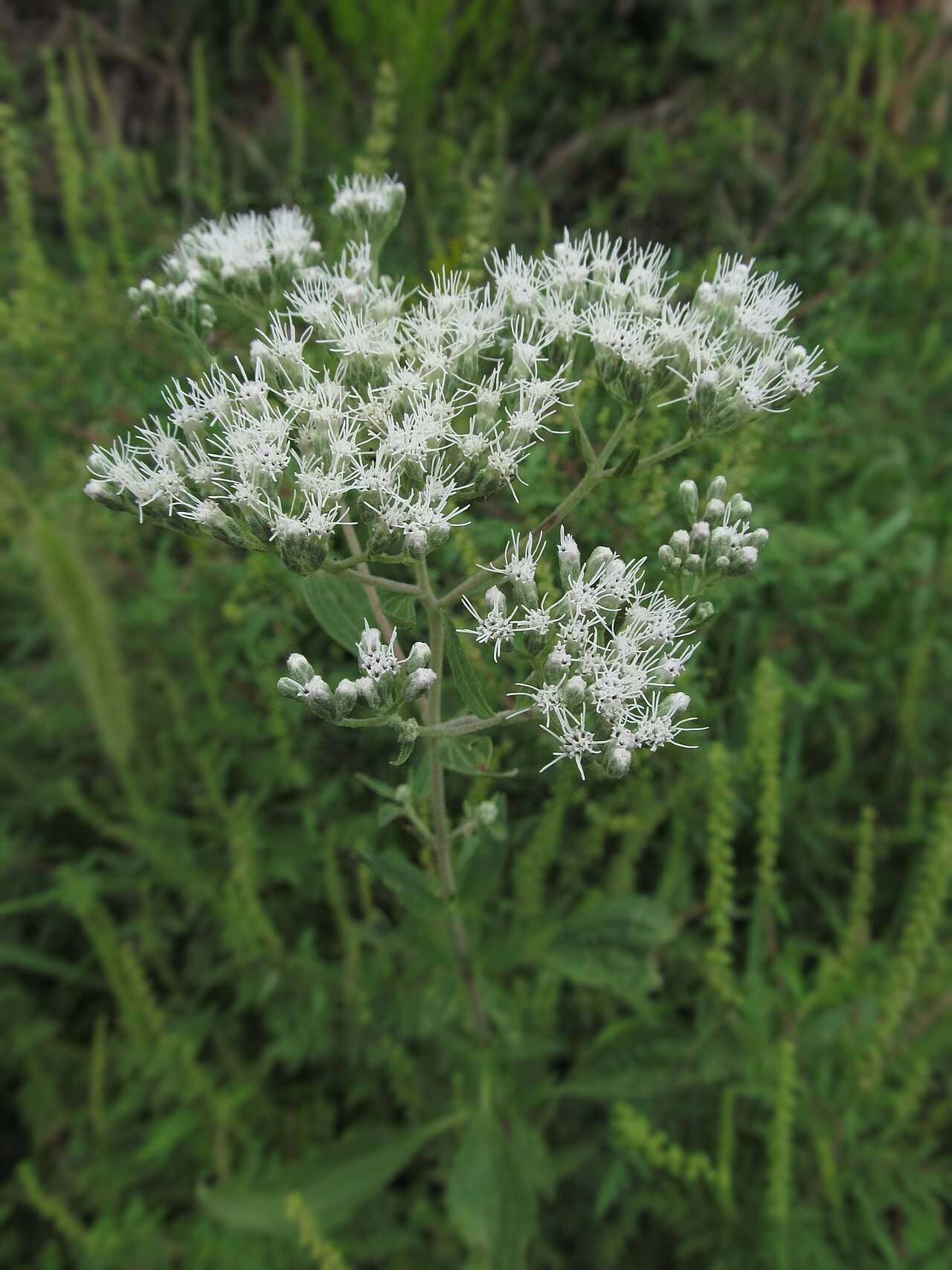
Eupatorium altissimum, known as Tall Boneset (USDA: tall thoroughwort), is a native late-summer wildflower of dry prairies, old fields, roadsides and open woods across the eastern and central United States. A member of the aster family (Asteraceae), it grows 3 to 6 feet tall, with stiff, downy stems, narrow leaves with three prominent veins, and broad, flat-topped clusters of small white flower heads from August into October.
Tall boneset is one of the best plants for late-season pollinators. Its flowers attract an extraordinary variety of insects: bees, wasps, flies, beetles, butterflies and moths. On a warm September afternoon a single patch can be busy with dozens of species, including spectacular solitary wasps such as the great black wasp and the great golden digger wasp.
Unlike its relative common boneset, which grows in wet ground, tall boneset prefers dry to medium soils and tolerates drought, clay and lime-rich soils. It is an easy, long-lived plant for a sunny meadow, prairie planting or pollinator garden, and it spreads slowly by rhizomes to form clumps.
Identification
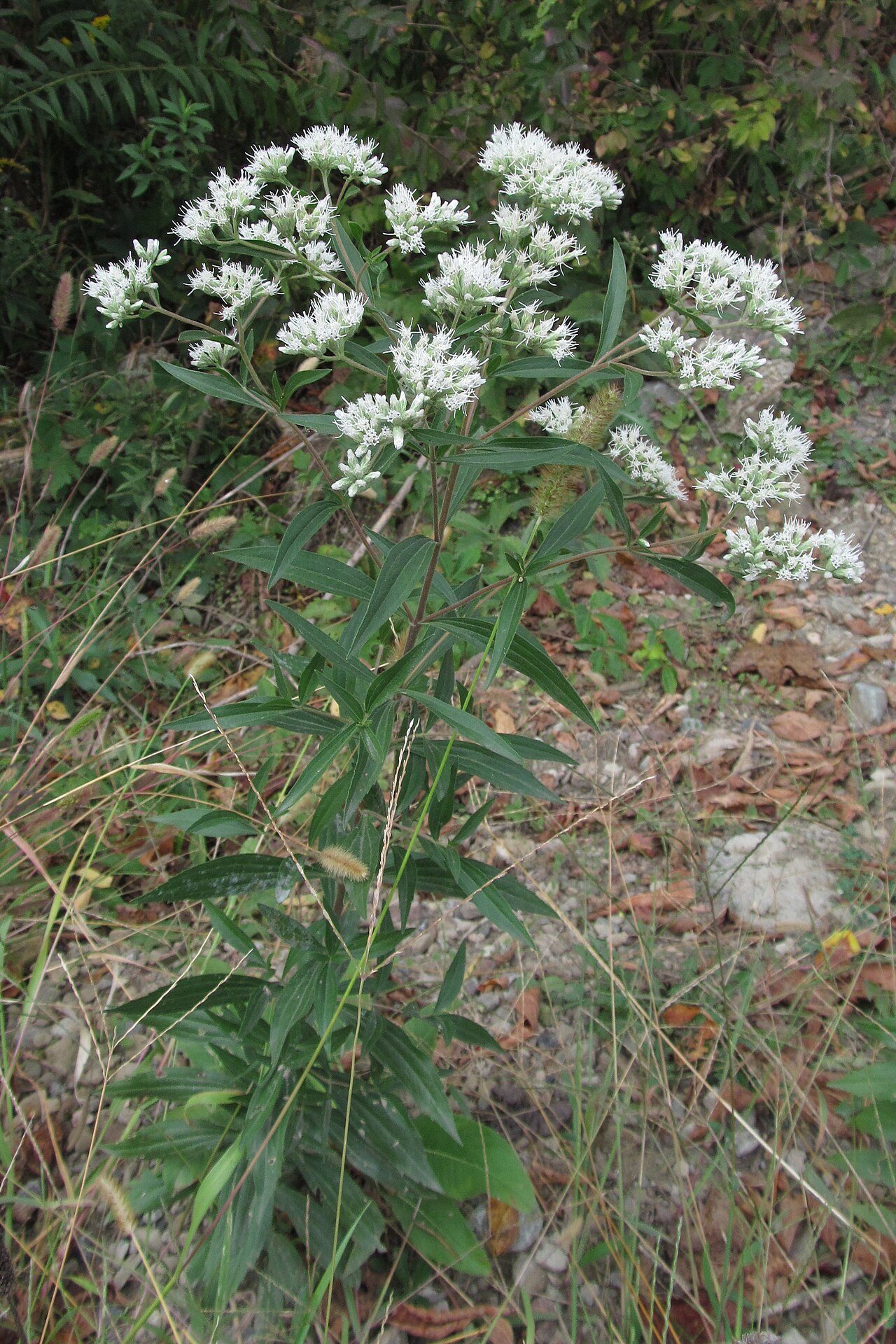
Tall boneset is a tall, white-flowered late-summer plant. Look for opposite, narrow leaves with three strong veins running lengthwise, teeth only on the outer half of the leaf, and dense, flat-topped clusters of small white heads.
Stems & Roots
Plants grow 3 to 6 feet tall (occasionally to 7 feet) from short rhizomes and form clumps or small colonies. The stems are stiff, upright, round and covered with short, fine hairs, and they branch only near the top, in the flower cluster.
Leaves
Leaves are opposite, lance-shaped, 2 to 5 inches long and about 1/2 to 1 inch wide, tapering to a narrow, stalkless base. They are finely hairy, with three prominent veins running from the base toward the tip, and have a few coarse teeth only on the outer half; the lower half is smooth-edged. Smaller leaves often grow in clusters in the leaf axils.
Flowers
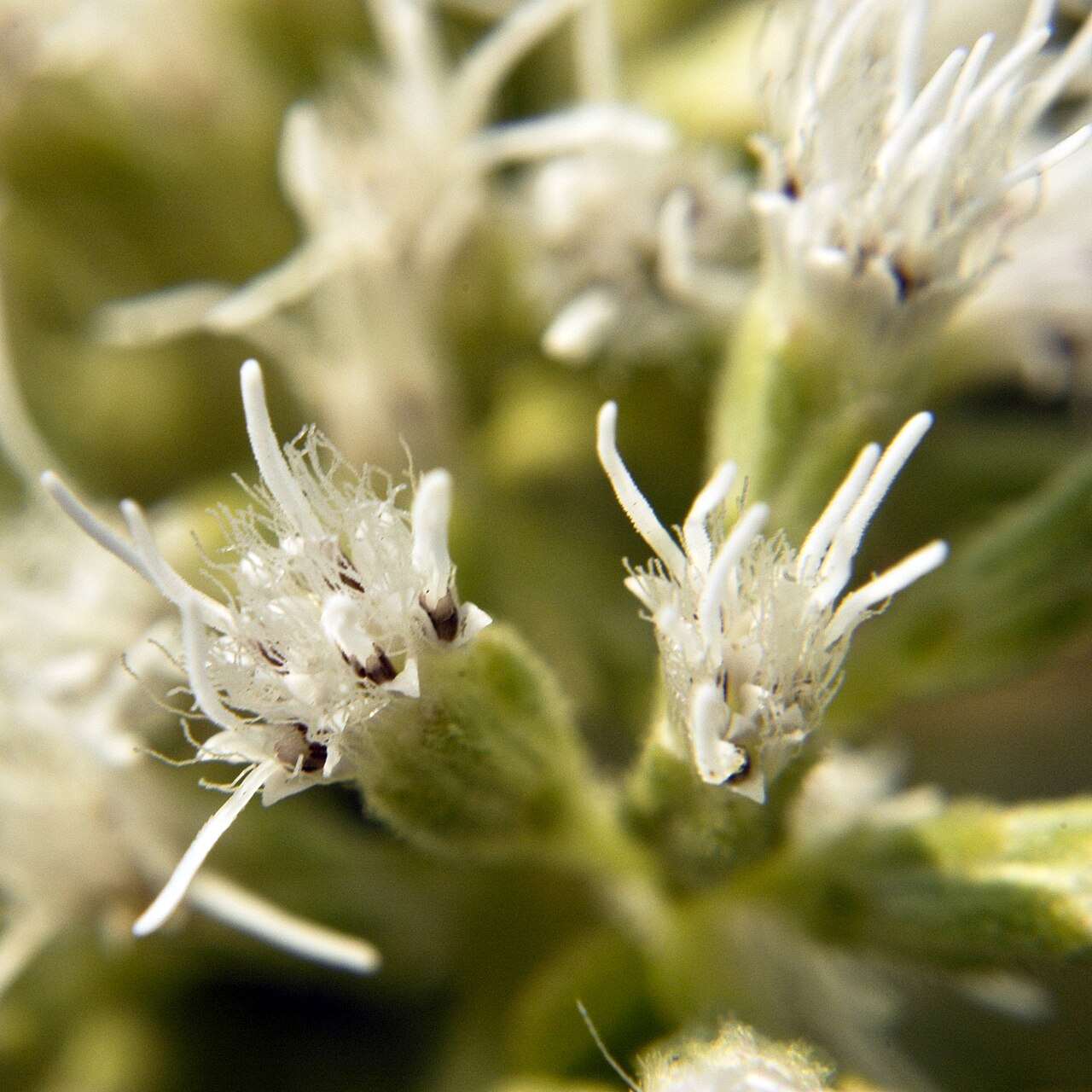
From August into October, the top of the stem branches into broad, flat to slightly rounded clusters up to about 8 inches across, made of many small flower heads. Each head is about 1/4 inch long and contains about five white, tubular florets with long, thread-like white styles that give the clusters a fuzzy look. There are no ray florets (petals).
Fruit & Seeds
After flowering, each floret produces a small, dark, ribbed seed (achene) with a tuft of fine white bristles (pappus) that carries it on the wind. The dried seed heads give the plant a soft, grayish look in late fall.
Look-alikes
Late boneset (E. serotinum) has broader leaves on distinct stalks, toothed along most of their length, and usually grows in moister soils. Common boneset (E. perfoliatum) has wrinkled leaves joined at the base so that the stem seems to pierce through them, and grows in wet places. White snakeroot (Ageratina altissima) has broad, heart-shaped, stalked leaves and grows in shade. The three-veined, narrow leaves toothed only near the tip are the best clue for tall boneset.
Safety
Like other Eupatorium species, tall boneset contains bitter compounds, including pyrrolizidine alkaloids, which can damage the liver if eaten. Do not eat it or use it as a home remedy, and keep livestock from grazing large amounts. It is not generally a problem in gardens, since animals usually avoid its bitter foliage.
Quick Facts
| Scientific Name | Eupatorium altissimum |
| Family | Asteraceae (aster family) |
| Plant Type | Herbaceous perennial; clump-forming, rhizomatous |
| Mature Height | 3–6 ft |
| Mature Spread | 2–3 ft; slowly spreads by rhizomes |
| Growth Rate | Moderate |
| Sun Exposure | Full sun to light shade |
| Water Needs | Low to medium; drought tolerant once established |
| Soil Type | Dry to medium loam, clay, rocky or sandy soils; tolerates lime |
| Soil pH | About 6.0–8.0 (slightly acidic to alkaline) |
| Bloom Time | August–October |
| Flower Color | White |
| Fall Color | Fluffy grayish seed heads in late fall |
| Fruit | Small achenes with white bristles, wind-dispersed |
| Deer Resistant | Yes; bitter foliage is rarely browsed |
| USDA Hardiness Zones | 3–9 |
Native Range
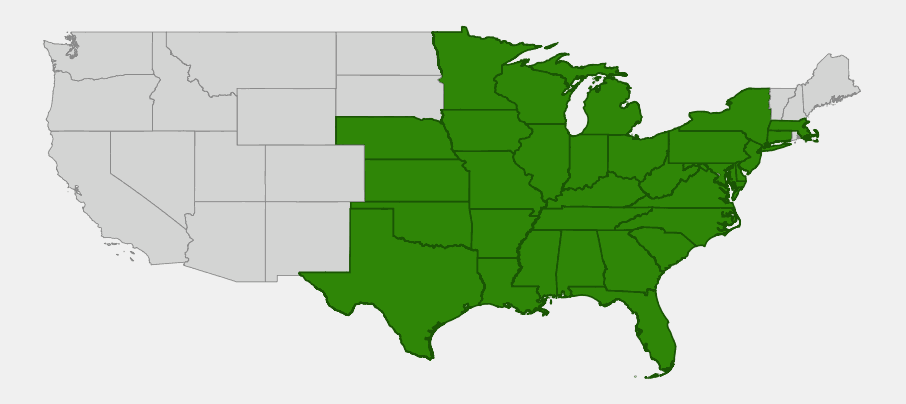
Tall boneset is native to the eastern and central United States and to southern Ontario. USDA PLANTS records it as native in 31 states and the District of Columbia, from Massachusetts, Connecticut and New York west through the Great Lakes states to Minnesota, Iowa, Nebraska and Kansas, and south to Florida, the Gulf states and Texas.
It is most common in the Midwest and the Ohio and Mississippi valleys, from Ohio, Indiana and Illinois to Missouri, Iowa and eastern Kansas, where it is a familiar plant of old fields, prairies and roadsides. Eastward it is scattered through the mid-Atlantic and Southeast, and it becomes uncommon in New England, where Massachusetts and Connecticut are at the edge of its range. In Texas it grows in the eastern and north-central parts of the state, and in Minnesota it reaches the prairie region in the west.
Habitats include dry and mesic prairies, old fields, pastures, savannas, open woods and woodland edges, glades, bluffs, roadsides and railroad embankments. It is especially common on limestone and other calcium-rich soils and on disturbed, open ground.
📋 Regional plant lists featuring Tall Boneset: New York, Pennsylvania & Northern New Jersey · Ohio & Indiana · Michigan, Wisconsin & Eastern Minnesota · Kentucky & Tennessee · Nebraska, Kansas & Eastern Colorado · Connecticut, Massachusetts & Rhode Island · New Hampshire, Maine & Vermont · Maryland, Virginia & West Virginia · Delaware, Southern New Jersey & Long Island · Illinois, Iowa & Missouri · Alabama, Georgia & Mississippi · North & South Florida · North & South Carolina · Arkansas, Louisiana, Eastern Oklahoma & Eastern Texas · North Dakota, South Dakota & Western Minnesota
Growing & Care Guide
Tall boneset is a tough, easy, long-lived perennial for sunny, dry to medium sites. It thrives in average or poor soil and needs little care once established. Buy nursery-grown plants or seed.
Light
Full sun gives the sturdiest plants and the most flowers. It tolerates light shade but may lean and flop in shadier spots.
Soil & Water
It grows in almost any well-drained soil, including clay, rocky, sandy and limy soils, and it tolerates dry conditions once established. Avoid rich, heavily fertilized soil, which makes the stems tall and floppy. Water new plantings until they root in.
Planting Tips
Plant in spring or fall, 2 to 3 feet apart, toward the back of a border or in a meadow or prairie planting. It looks good with goldenrods, asters and native grasses such as little bluestem and Indian grass, and its white flowers make a good foil for purple asters and blazing stars.
Pruning & Maintenance
For shorter, sturdier plants, cut the stems back by about a third to a half in late May or early June; they will branch and bloom a little later. Leave the seed heads standing in fall and winter for birds and structure, and cut back old stems in early spring. It can self-seed; remove unwanted seedlings while small.
Propagation
Sow seed in fall outdoors, or give it a 30- to 60-day cold, moist stratification before spring sowing; the seed needs light to germinate, so press it onto the surface. Clumps can be divided in early spring.
Landscape Uses
- Pollinator gardens: one of the best late-season plants for bees, wasps and butterflies
- Prairie and meadow plantings: with goldenrods, asters and native grasses
- Dry, sunny borders: drought-tolerant height and white flowers in late summer
- Roadside and old-field restoration: tolerates poor, disturbed and limy soils
- Fall wildlife habitat: seed heads and stems for birds and overwintering insects
Wildlife & Ecological Value
Tall boneset is a late-season powerhouse for insects, and through them for birds and other wildlife.
For Pollinators
The flowers produce abundant, easily reached nectar and attract a huge variety of insects: honey bees, bumble bees, small native bees, butterflies such as monarchs and skippers, moths, flies and beetles. They are especially attractive to wasps, including the great black wasp, great golden digger wasp, thread-waisted wasps and many smaller species, which help control garden pests. Native Eupatorium species also support a number of moth caterpillars.
For Birds
Songbirds such as goldfinches and sparrows eat the small seeds in fall and winter, and many insect-eating birds forage among the flowers and foliage for the insects they attract.
For Mammals
Deer and rabbits usually avoid tall boneset because of its bitter foliage, which makes it a dependable plant where browsing is heavy.
Ecosystem Role
Tall boneset fills an important late-summer gap in the flowering season of prairies and old fields, feeding insects as they build up reserves for fall migration or winter. Some insects, such as certain moths that store plant toxins, seek out Eupatorium plants. The hollow, dry stems left standing in winter can shelter overwintering insects.
Cultural & Historical Uses
The genus name Eupatorium is traditionally said to honor Mithridates VI Eupator, king of Pontus, who was famous for his knowledge of medicinal plants and poisons. The species name altissimum means “tallest.” The common names boneset and thoroughwort come from its relative common boneset, whose leaves appear to be pierced, or “thorough-grown,” by the stem.
Common boneset was one of the most widely used folk remedies in 19th-century America, taken as a bitter tea for fevers and colds. Tall boneset has a much smaller history of use. Modern research has shown that Eupatorium species contain pyrrolizidine alkaloids that can damage the liver, so none should be used as home remedies.
In recent years tall boneset has gained popularity among pollinator gardeners, who have noticed how many different insects visit its flowers. It is often recommended as a native alternative to non-native late-season nectar plants, and as a tough, unfussy plant for poor soils.
Frequently Asked Questions
Is tall boneset the same as tall thoroughwort?
Yes. Tall thoroughwort is the USDA PLANTS common name for Eupatorium altissimum. Tall boneset and tall eupatorium are other common names.
How is tall boneset different from common boneset?
Common boneset (E. perfoliatum) has wrinkled leaves that wrap around the stem, so the stem seems to pass through them, and it grows in wet places. Tall boneset has separate, narrow, three-veined leaves and grows in dry to medium soils.
Is tall boneset invasive?
No. It is native and spreads slowly by rhizomes and seed. It can self-seed in open, disturbed soil, but seedlings are easy to remove.
Will tall boneset grow in clay or dry soil?
Yes. It tolerates clay, rocky, sandy and limy soils and is drought tolerant once established. It does best in full sun.
Is tall boneset poisonous?
It contains bitter compounds, including pyrrolizidine alkaloids, that can harm the liver if eaten. It should not be eaten or used as a remedy, but it is safe to grow and handle.

Looking for a nursery that carries Tall Boneset?
Browse our native plant nursery directory: Alabama & Arkansas · Connecticut, Delaware, Florida & Georgia · Illinois, Indiana, Iowa & Kansas · Kentucky, Louisiana, Maryland, Massachusetts, Michigan, Minnesota, Mississippi & Missouri · Nebraska, New Jersey, New York, North Carolina, Ohio & Oklahoma · Pennsylvania, South Carolina, Tennessee, Texas & Virginia · West Virginia & Wisconsin