Tall Goldenrod (Solidago altissima)
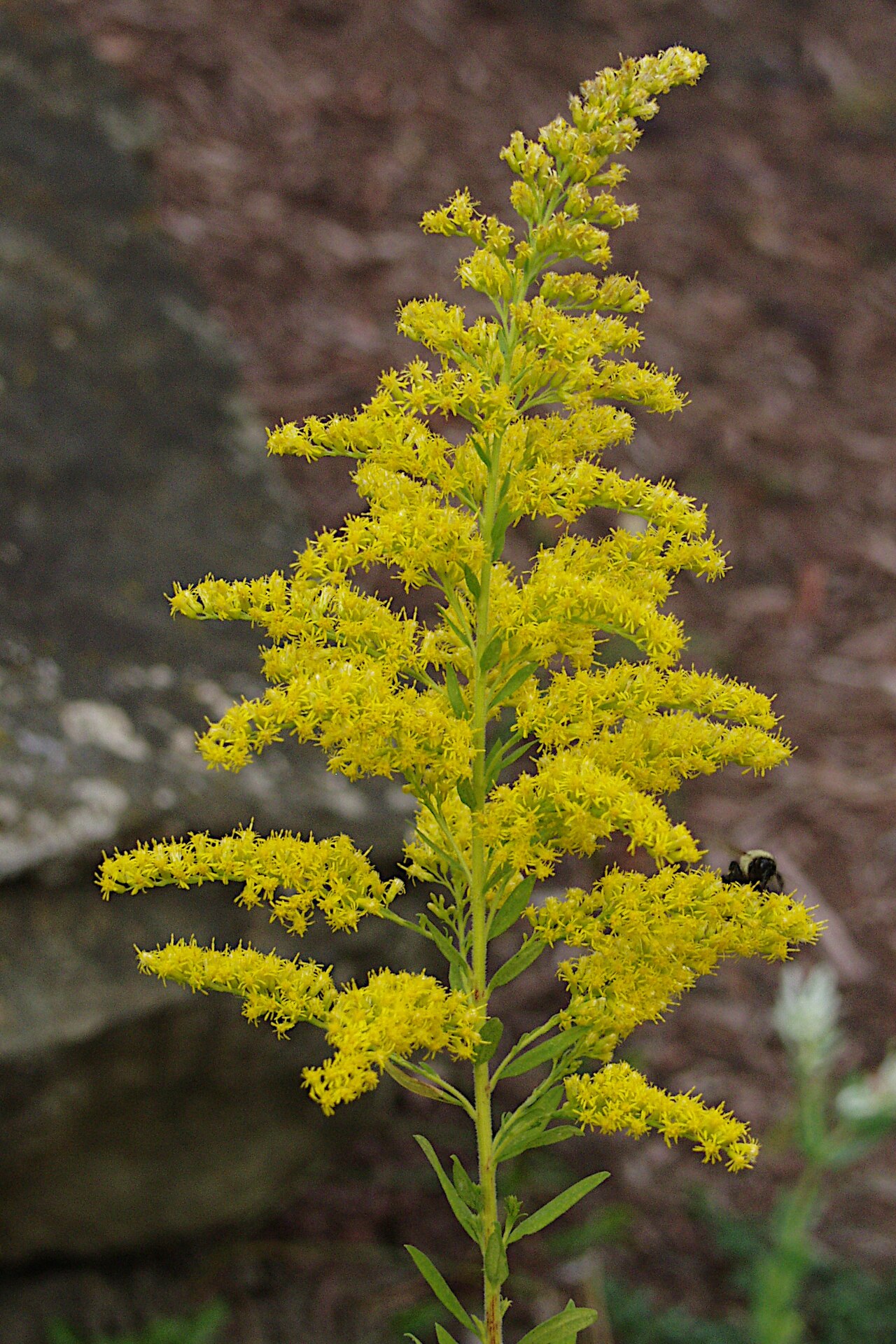
Solidago altissima, commonly known as tall goldenrod or late goldenrod, is one of the most widespread and recognizable wildflowers of late summer and fall across the United States. A tall, rhizomatous perennial in the aster family (Asteraceae), it forms dense colonies topped with plume-shaped sprays of small, bright yellow flower heads that light up meadows, roadsides, and old fields from late August into October. It is the state wildflower of South Carolina and a defining feature of the late-season landscape across most of the continent.
Tall goldenrod typically grows 3 to 7 feet tall on a single, unbranched, finely hairy stem lined with narrow, rough-textured leaves. It spreads aggressively by underground rhizomes, often forming large, dense, single-species colonies, or clones, that can persist and expand for years in disturbed or open ground. This same vigor that makes it a nuisance in a mowed lawn makes it a hugely valuable late-season nectar source where it is allowed to grow, supporting an extraordinary number of pollinators, including many species that depend on it almost entirely for fall foraging.
Tall goldenrod is often confused with the closely related Canada goldenrod (Solidago canadensis), and the two were treated as a single species for decades. They can be told apart in the field: tall goldenrod has stems that are densely short-hairy for their full length, while Canada goldenrod’s stems are smooth or only lightly hairy near the top. Tall goldenrod also tolerates drier soils and ranges farther south and west, while Canada goldenrod favors moister ground and reaches farther north into Canada. This page covers tall goldenrod specifically; see our separate profile for Canada goldenrod if that is the plant you are identifying.
Identification
Tall goldenrod is identified by its tall, unbranched, densely hairy stem, narrow rough-surfaced leaves, and a one-sided, plume-like flower cluster of small yellow heads that arches outward at the top of the plant in late summer.
Stems
The stem is single, upright, unbranched below the flower cluster, and typically 3 to 7 feet tall, occasionally taller in rich soil. It is covered in short, fine hairs along its entire length, a key feature separating it from the smoother-stemmed Canada goldenrod. Plants spread by shallow, branching rhizomes, so a single plant quickly becomes a dense colony of genetically identical stems.
Leaves
Leaves are alternate, lance-shaped to narrowly elliptic, 2 to 6 inches long, sessile or nearly so, and rough to the touch on both surfaces. They are usually toothed above the middle and smooth-edged toward the base, with three main veins running the length of the blade, a pattern typical of this goldenrod group. Lower leaves often wither and drop by flowering time.
Flowers
From August into October, the plant produces a large, pyramidal to plume-shaped inflorescence, usually 6 to 12 inches long, made up of many small flower heads arranged along one side of spreading, arching branches. Each head is only about 1/8 inch across but carries both tiny yellow ray flowers and disk flowers, and the sheer number of heads per plant makes the whole inflorescence strikingly bright and showy at a distance.
Fruit & Seeds
After flowering, each head produces small, dry, one-seeded fruits (achenes) tipped with a tuft of fine bristles (pappus) that carries them on the wind, much like a dandelion seed. A single large colony can produce an enormous number of wind-dispersed seeds, which along with its spreading rhizomes helps explain how readily it colonizes open, disturbed ground.
Quick Facts
| Scientific Name | Solidago altissima |
| Family | Asteraceae (Aster) |
| Plant Type | Herbaceous Perennial Wildflower |
| Mature Height | 3–7 ft |
| Mature Spread | Forms colonies several feet wide via rhizomes |
| Growth Rate | Fast |
| Sun Exposure | Full Sun to Part Sun |
| Water Needs | Low to Average; drought tolerant once established |
| Soil Type | Adaptable; average to poor, well-drained soils |
| Soil pH | Acidic to neutral |
| Bloom Time | Late August – October |
| Flower Color | Bright yellow |
| Fall Color | Tan/brown as stems dry after flowering |
| Fruit | Tiny wind-dispersed achenes with a bristly pappus |
| Deer Resistant | Mostly yes (occasionally browsed) |
| USDA Hardiness Zones | 3–9 |
Native Range
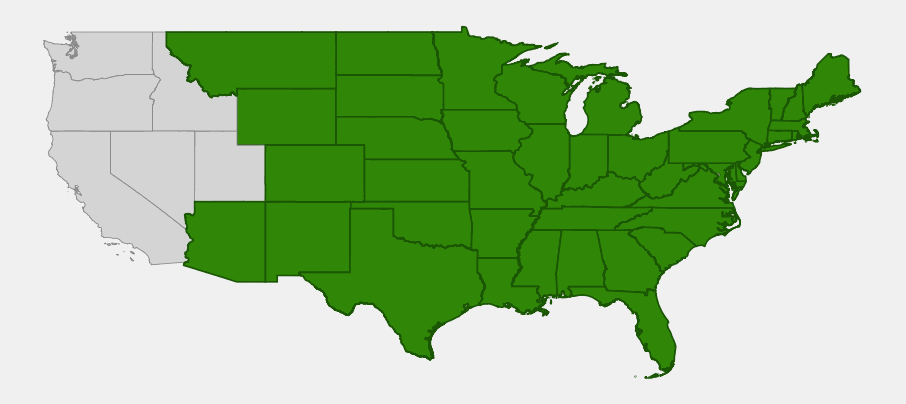
Tall goldenrod is native across nearly the entire continental United States east of the Rockies, from Texas, New Mexico and Arizona in the south, north through the Great Plains and upper Midwest into Montana, Wyoming, and the Dakotas, and east to the Atlantic coast from Florida to Maine. It is absent as a native plant from the Pacific Coast and much of the Intermountain West, including Washington, Oregon, Idaho, Nevada, Utah, and California, where it does not naturally occur.
It grows in open, sunny habitats: old fields, prairies, meadows, roadsides, pastures, woodland edges, and other disturbed or recently cleared ground. It is one of the classic early- to mid-succession species that moves into abandoned farmland and vacant lots, often forming large, pure stands before trees and shrubs reestablish.
Despite its vigor in disturbed ground, tall goldenrod is a true native across its wide range, not an introduced weed, and it has become invasive only where it has been carried outside North America — notably in parts of Europe and East Asia, where it escaped cultivation and now spreads aggressively as an introduced species. Within its home range in the U.S., it is simply an exceptionally successful native wildflower.
📋 Regional plant lists featuring Tall Goldenrod: New Hampshire, Maine & Vermont · Connecticut, Massachusetts & Rhode Island · New York, Pennsylvania & Northern New Jersey · Delaware, Southern New Jersey & Long Island · Maryland, Virginia & West Virginia · North Carolina & South Carolina · Georgia, Alabama & Mississippi · Arkansas, Louisiana, Eastern Oklahoma & Eastern Texas · Kentucky & Tennessee · Ohio & Indiana · Illinois, Iowa & Missouri · Michigan, Wisconsin & Eastern Minnesota · North Dakota, South Dakota & Western Minnesota · Nebraska, Kansas & Eastern Colorado · Utah & Western Colorado · Montana & Wyoming · Arizona & New Mexico
Growing & Care Guide
Tall goldenrod is one of the easiest native wildflowers to grow — almost too easy. Give it sun and average soil and it will reward you with a late-season flush of color and a pollinator magnet, but plan for its spreading habit from the start.
Light
Full sun produces the strongest flowering and sturdiest stems. Tall goldenrod tolerates light shade but becomes leggier and flowers less heavily as shade increases.
Soil & Water
It thrives in average to lean, well-drained soil and is notably drought tolerant once established, needing little supplemental water outside of its first season. Rich, heavily fertilized soil tends to produce floppy, overly tall growth that may need staking.
Planting Tips
Plant tall goldenrod where its spreading rhizomes have room to roam — a meadow planting, a naturalized border, or a dedicated pollinator bed, rather than a small, tightly bordered flower bed. Give plants at least 2 to 3 feet of space, since a single plant will expand into a colony within a few seasons.
Pruning & Maintenance
Little maintenance is needed. To control spread, pull or dig unwanted rhizomes in spring before they harden, or install a root barrier. Cutting spent stems back in late winter tidies the planting, though leaving some stems standing through winter provides habitat for overwintering beneficial insects.
Landscape Uses
Tall goldenrod’s vigor and late bloom time make it most useful in informal, naturalistic settings:
- Pollinator meadows — one of the single best late-season nectar sources available
- Naturalized borders and old-field restorations, where its spreading habit is an asset
- Erosion control on slopes and disturbed sites thanks to its rhizome network
- Cut flower use, where the plume-shaped sprays add bright late-season color indoors
- Wildlife gardens that prioritize fall forage for bees and migrating butterflies
Wildlife & Ecological Value
Few native wildflowers support as much late-season wildlife activity as tall goldenrod, which blooms exactly when most other nectar sources have finished for the year.
For Pollinators
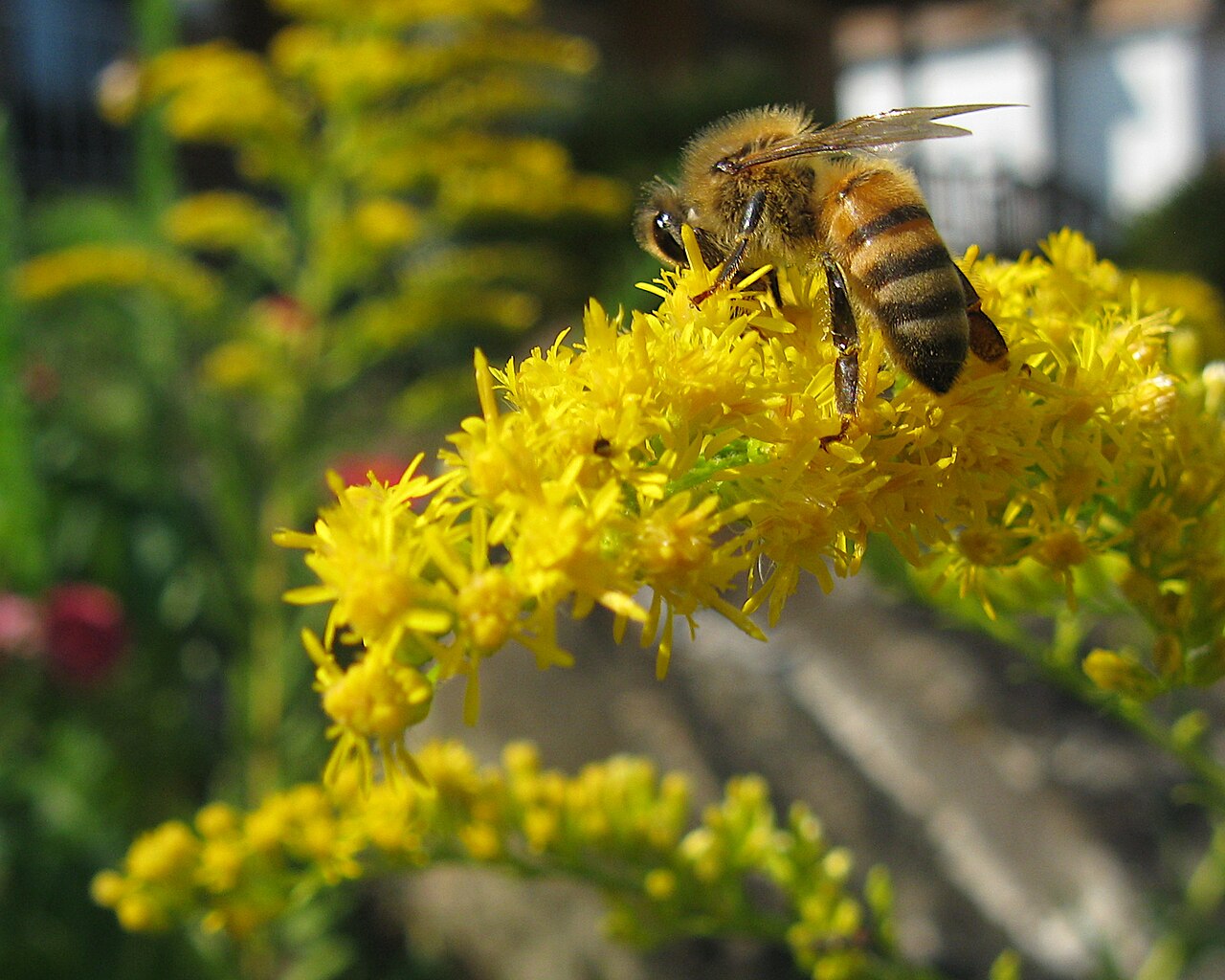
Tall goldenrod is an exceptional late-season nectar and pollen source, visited heavily by native bees, honeybees, bumblebees, wasps, beetles, and a wide range of butterflies and moths building up reserves for migration or winter dormancy. Monarch butterflies in particular rely on goldenrod nectar during their southward migration, making it one of the most important native plants for fueling that journey.
For Birds
The tiny seeds, each carried on a tuft of down, are eaten by American Goldfinches, sparrows, and other seed-eating birds through fall and winter. Dense goldenrod stands also provide cover for ground-nesting and overwintering birds.
For Mammals
White-tailed Deer and Eastern Cottontails occasionally browse young foliage, though goldenrod is generally low on the preference list for most mammalian herbivores, making it a reasonably deer-resistant choice for a native planting.
Ecosystem Role
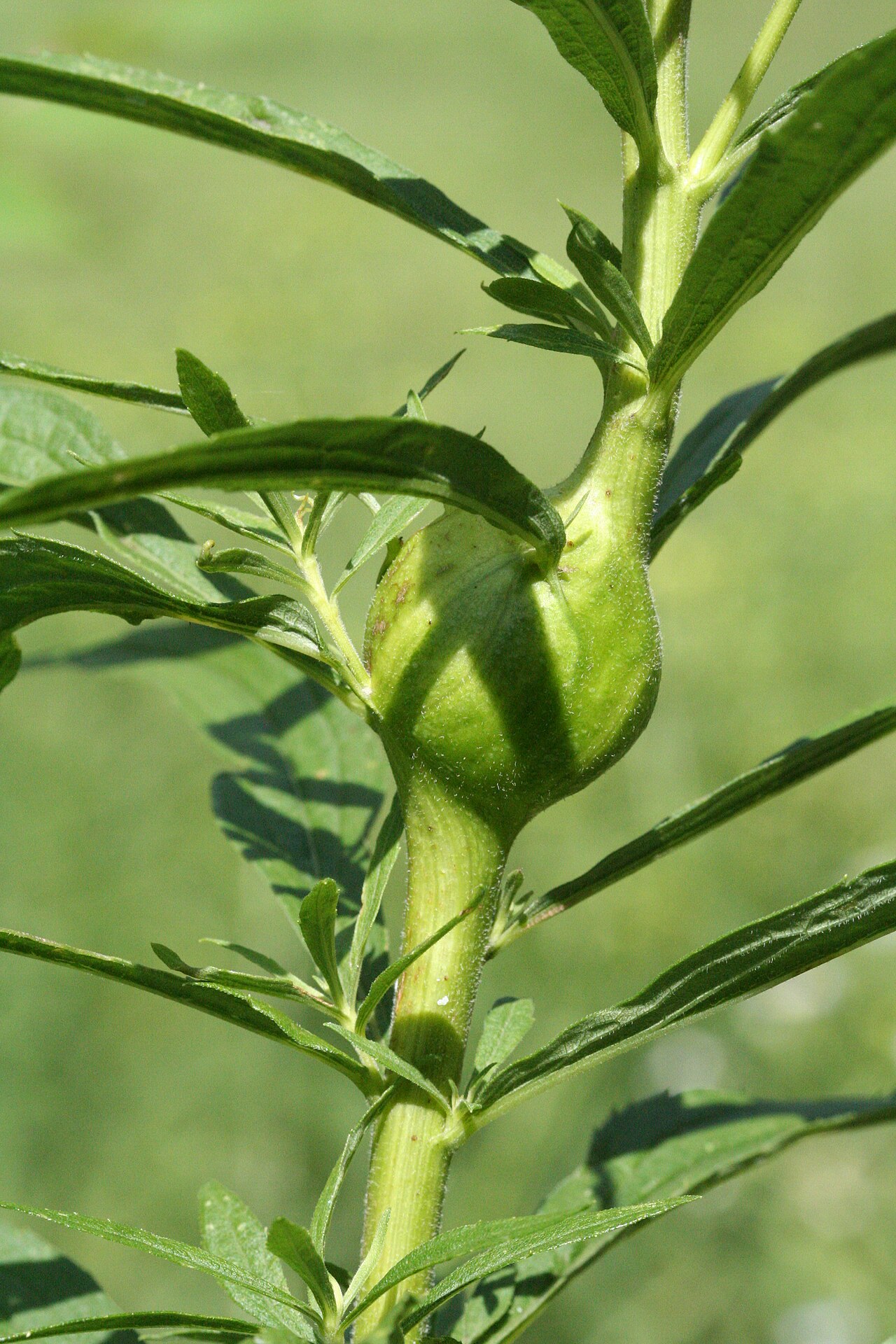
Tall goldenrod’s stems commonly host the goldenrod gall fly (Eurosta solidaginis), whose larvae induce the characteristic round swelling partway up the stem, as well as the goldenrod bunch gall midge. These galls, in turn, support an entire community of parasitoid wasps, overwintering woodpeckers that forage for the larvae, and other insects, making a single goldenrod stem a small ecosystem of its own. As an aggressive early colonizer, the species also plays an important role stabilizing soil and shading out competing weeds on disturbed ground while later-successional plants reestablish.
Cultural & Historical Uses
Indigenous peoples across tall goldenrod’s range used the plant for a variety of purposes. Leaves and flowers were brewed into teas, and the flowering tops were used historically as a source of yellow dye for fibers and textiles, a practice that continues today among some natural-dye enthusiasts.
Thomas Edison famously experimented with goldenrod, including Solidago altissima and related species, as a domestic source of natural rubber (latex) during the early 20th century, even gifting a goldenrod-rubber tire to his friend Henry Ford; the effort never became commercially practical, but it remains a well-known footnote in the plant’s history.
Goldenrod has also long been wrongly blamed for causing hay fever, largely because it blooms at the same time as ragweed (Ambrosia species), the actual culprit. Goldenrod’s pollen is heavy and sticky, carried by insects rather than wind, and is rarely airborne in quantities that trigger allergies.
Frequently Asked Questions
Does tall goldenrod cause hay fever?
No. Goldenrod pollen is heavy and insect-carried, not wind-borne, so it is not a significant allergy trigger. It is commonly confused with ragweed, which blooms at the same time and is the real source of most fall pollen allergies.
What is the difference between tall goldenrod and Canada goldenrod?
The two are closely related and were once considered the same species. Tall goldenrod has stems that are densely short-hairy along their full length and tends to grow in drier sites farther south and west; Canada goldenrod has smoother stems, prefers moister ground, and ranges farther north.
Will tall goldenrod take over my garden?
It spreads readily by rhizome and can form large colonies, so it is best suited to naturalized areas, meadows, or beds where some spread is welcome, rather than small, tightly planted borders. Unwanted rhizomes can be dug out in spring.
What are the swellings on goldenrod stems?
Round swellings partway up the stem are galls caused by the goldenrod gall fly, whose larvae live and overwinter inside. The galls do not seriously harm the plant and support a web of insects and foraging birds.
Is tall goldenrod good for pollinators?
Yes, exceptionally so. It is one of the most important native nectar sources in late summer and fall, supporting a huge range of bees, wasps, butterflies, and migrating Monarchs at a time when few other flowers are blooming.

Looking for a nursery that carries Tall Goldenrod?
Browse our native plant nursery directory: Alabama, Arizona & Arkansas · Colorado, Connecticut, Delaware, Florida & Georgia · Illinois, Indiana, Iowa & Kansas · Kentucky, Louisiana, Maine, Maryland, Massachusetts, Michigan, Minnesota, Mississippi, Missouri & Montana · Nebraska, New Hampshire, New Jersey, New Mexico, New York, North Carolina, North Dakota, Ohio & Oklahoma · Pennsylvania, Rhode Island, South Carolina, South Dakota, Tennessee, Texas, Vermont & Virginia · West Virginia, Wisconsin & Wyoming