
Wand Holdback (Hoffmannseggia microphylla)
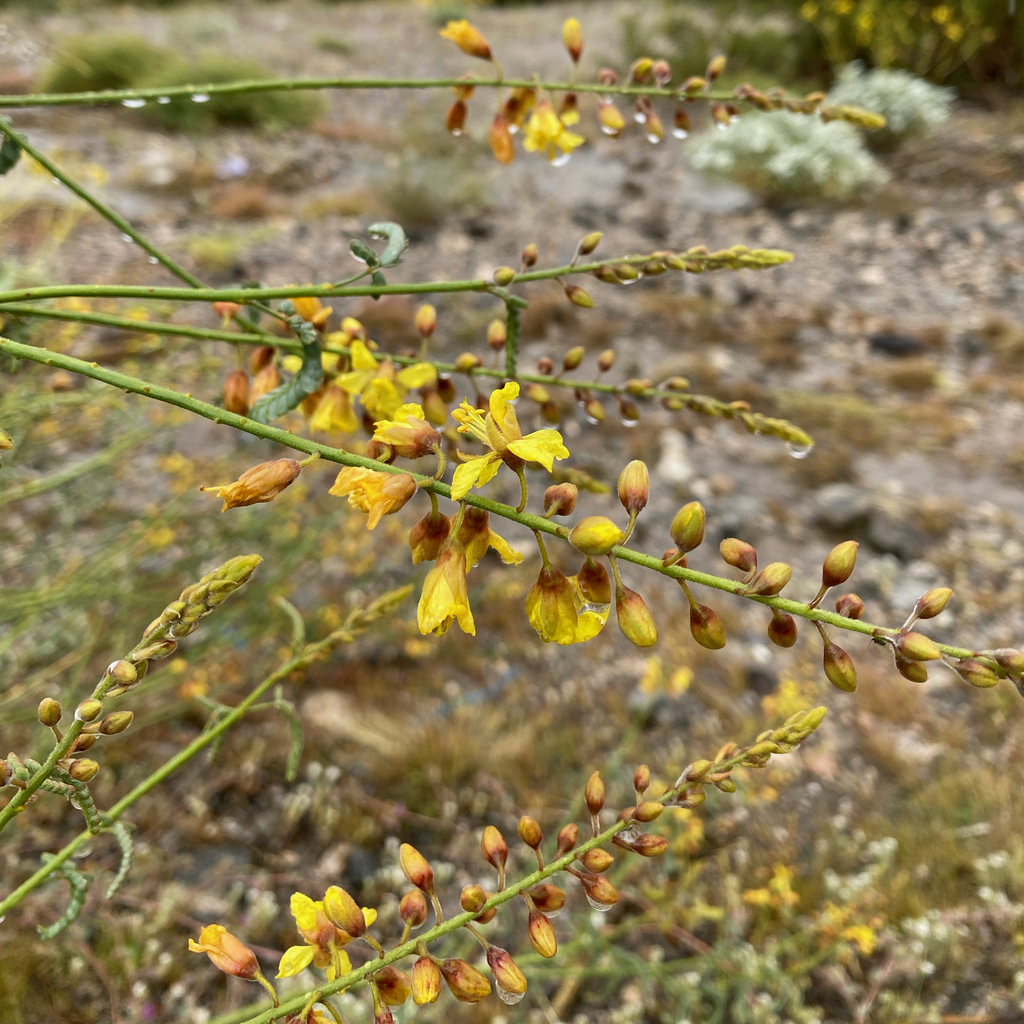
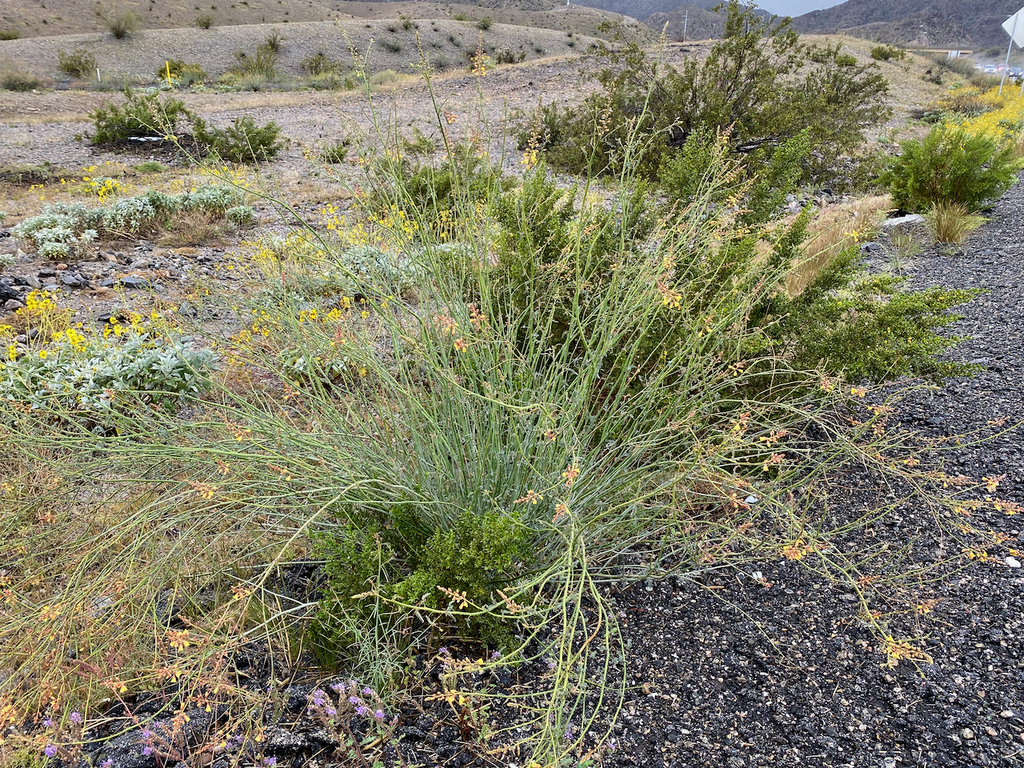
Hoffmannseggia microphylla, known as Wand Holdback, rushpea or wand rushpea, is a broom-like desert shrub in the pea family (Fabaceae). It forms a clump of slender, green, nearly leafless stems 2 to 6 feet tall that look more like a rush than a pea. In spring the stems carry long spikes of yellow flowers with orange-red markings, opening from reddish-orange buds.
Wand holdback is native to the low deserts of southeastern California and southwestern Arizona, and to Baja California and Sonora in Mexico. It grows in sandy and gravelly washes, on dunes and on desert flats in the Colorado Desert section of the Sonoran Desert, where its deep roots reach moisture far below the surface.
Its green stems carry out most of the plant’s photosynthesis, and its tiny leaves drop in drought, an adaptation to one of the hottest and driest parts of North America. In a low-desert garden it is a light, airy accent plant that needs no water once established and provides nectar for native bees in spring.
Identification
Look for a clump of slender, upright, bright green to gray-green stems in a sandy wash, with very few small leaves and long spikes of yellow, orange-marked flowers or curved, flat pods.
Growth Habit
Wand holdback is a perennial shrub or subshrub that grows from a woody base into a broom-like clump of many slender, rush-like stems, usually 2 to 4 feet tall and occasionally up to 6 feet. The stems are green and smooth or slightly glandular, and they stay green through the year, letting the plant photosynthesize even when it has no leaves.
Leaves
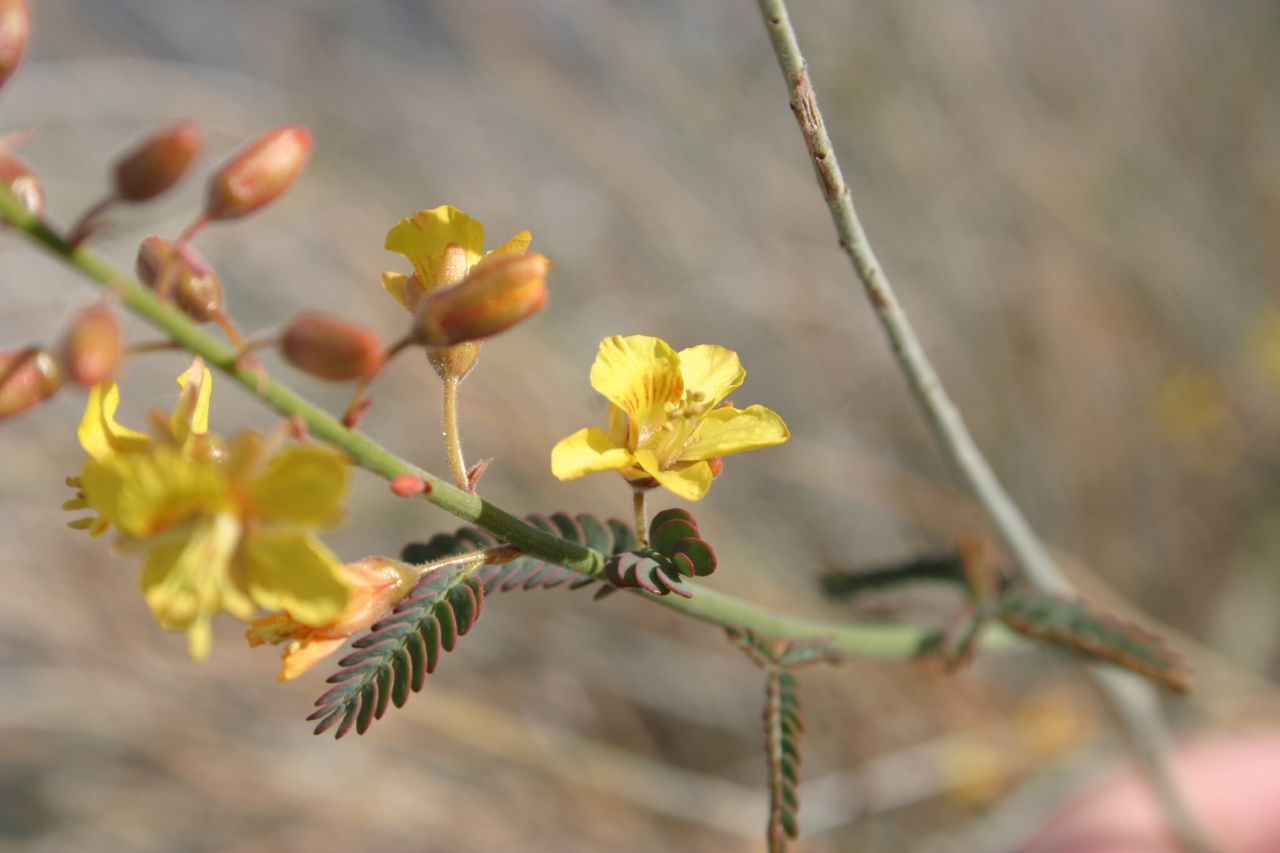
The leaves are small and widely spaced, bipinnately compound, with a few pairs of side branches and tiny oblong leaflets only about 1/16 to 1/8 inch long. This gives the species its name microphylla, “small-leaved.” The leaves appear after rain and fall off in dry, hot weather, leaving the stems almost bare.
Flowers
The flowers grow in long, open spikes (racemes) at the tips of the stems. Each flower is about 1/2 inch across, with five yellow petals; the upper petal (banner) is marked with orange-red, and the buds and sepals are reddish-orange, sometimes dotted with dark glands. Flowering is mainly from March to May, with some flowers after summer or fall rain.
Fruit & Seeds
The fruit is a flat, curved or crescent-shaped pod about 1 to 1 1/2 inches long, often dotted with glands. The pods split open when dry to release a few seeds.
Look-alikes
Smoke tree (Psorothamnus spinosus) also grows in washes with gray, nearly leafless stems, but it is a spiny tree with purple flowers. Sweetbush (Bebbia juncea) has similar rush-like stems but yellow, rayless daisy heads. Desert senna (Senna armata) has yellow flowers and spiny, nearly leafless stems, but its flowers are more cup-shaped and its stems end in spines. Hog potato (Hoffmannseggia glauca) is a low, spreading relative with leafy stems.
Quick Facts
| Scientific Name | Hoffmannseggia microphylla |
| Family | Fabaceae (pea family) |
| Plant Type | Broom-like perennial shrub or subshrub |
| Mature Height | 2–6 ft |
| Mature Spread | 2–4 ft |
| Growth Rate | Moderate |
| Sun Exposure | Full sun |
| Water Needs | Very low; drought tolerant |
| Soil Type | Sandy or gravelly, very well drained |
| Soil pH | Neutral to alkaline (about 7.0–8.5) |
| Bloom Time | March–May; sometimes after summer or fall rain |
| Flower Color | Yellow with orange-red markings |
| Fall Color | None (stems stay green) |
| Fruit | Flat, curved pod |
| Deer Resistant | Moderately |
| USDA Hardiness Zones | 9–11 |
Native Range
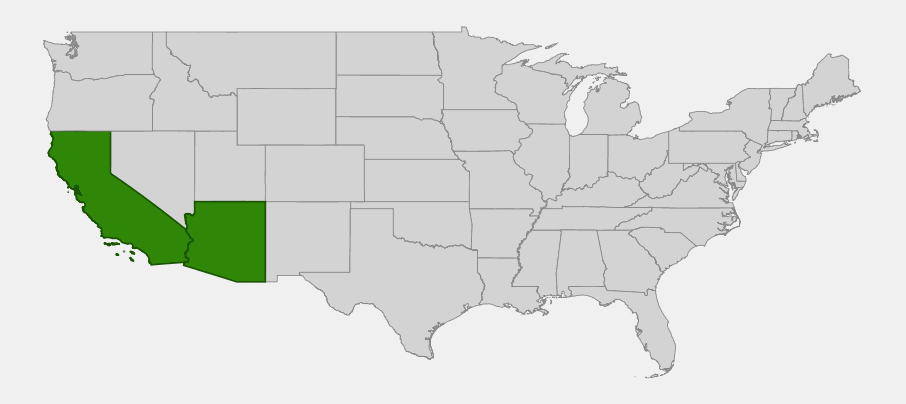
USDA PLANTS lists wand holdback as native in Arizona and California. It also grows in Baja California and northwestern Sonora in Mexico. It is not found in Canada.
In California it is found in the Colorado Desert of Imperial, eastern San Diego and Riverside counties, including the Coachella Valley and the Anza-Borrego Desert. In Arizona it grows in the southwestern low desert, mainly in Yuma County and nearby areas along the lower Gila and Colorado rivers.
It is a plant of hot, low desert, generally below about 2,000 feet. It grows in sandy and gravelly washes, on sand dunes and sandy flats, and on alluvial fans, often with other wash-loving shrubs and trees.
📋 Regional plant lists featuring Wand Holdback: Arizona & New Mexico · California & Nevada
Growing & Care Guide
Wand holdback is a specialty plant for low-desert gardens. It is seldom sold in general nurseries, but it is occasionally offered by native plant societies and desert botanical garden sales in Southern California and Arizona.
Light
Full sun and reflected heat. It does not do well in shade.
Soil & Water
Plant it in sandy or gravelly soil that drains quickly. It is extremely drought tolerant once established and does not need regular water; occasional deep watering in the first year helps it establish. Too much water, especially in heavy soil, can cause root rot.
Planting Tips
Plant small plants in fall or winter so roots can grow before the summer heat. Use it in a wash-like dry streambed, a gravel garden or a naturalistic desert planting, where its airy stems can be seen against rocks or a wall.
Pruning & Maintenance
Little care is needed. Old, dead stems can be cut out at the base in winter. It may look sparse in summer drought, and it fills out again after rain.
Propagation
Grow it from seed. Nick or soak the hard seeds before sowing in warm weather, in a deep pot of sandy mix so the taproot can develop. Plant seedlings out while young, since older plants resent root disturbance.
Landscape Uses
- Low-desert gardens: an airy, green-stemmed accent with spring color
- Dry washes and gravel gardens: suits sandy, fast-draining sites
- Pollinator plantings: spring nectar and pollen for native bees
- Habitat restoration: native to washes and dunes of the Colorado Desert
- Xeriscapes: needs no irrigation once established
Wildlife & Ecological Value
Wand holdback is part of the wash community of the low Sonoran Desert, where its flowers feed native bees and its stems provide light cover.
For Pollinators
The yellow flowers are visited by native bees, including solitary bees and carpenter bees, as well as other insects. Like many plants in this group, the flowers are adapted to bees that gather pollen.
For Birds
The light, airy clumps give some cover for small birds, lizards and insects in open washes, and birds may eat the seeds.
For Mammals
Rodents may gather the seeds. The stems are browsed lightly at most.
Ecosystem Role
As a legume, wand holdback may help add nitrogen to the poor, sandy soils of desert washes. Its deep roots and clumping stems also help hold sand in place on dunes and in washes.
Cultural & Historical Uses
The genus Hoffmannseggia honors Johann Centurius von Hoffmannsegg, a German botanist and entomologist of the late eighteenth and early nineteenth centuries. The species name microphylla means “small-leaved.”
The odd common name holdback is used for several Hoffmannseggia and related Caesalpinia-group plants in the Southwest. “Wand” refers to the long, straight, slender stems.
Its close relative hog potato (Hoffmannseggia glauca) has small edible tubers that were eaten by Native peoples, but wand holdback does not produce tubers and is not known as a food plant.
Frequently Asked Questions
Why does wand holdback have almost no leaves?
It drops its tiny leaves in drought to save water and relies on its green stems for photosynthesis. New leaves appear after rain.
Where does wand holdback grow?
In the low deserts of southeastern California and southwestern Arizona, and in Baja California and Sonora, in sandy and gravelly washes and on dunes.
When does wand holdback bloom?
Mainly from March to May, with some flowering after summer or fall rains.
Is wand holdback good for a desert garden?
Yes, in hot, low-desert gardens with sandy or gravelly soil. It needs full sun, very good drainage and little or no water once established.
Is wand holdback a shrub or a grass?
It is a shrub in the pea family. Its slender, green, rush-like stems make it look like a grass or rush from a distance.

Looking for a nursery that carries Wand Holdback?
Browse our native plant nursery directory: Arizona · California

