
Water Horsetail (Equisetum fluviatile)
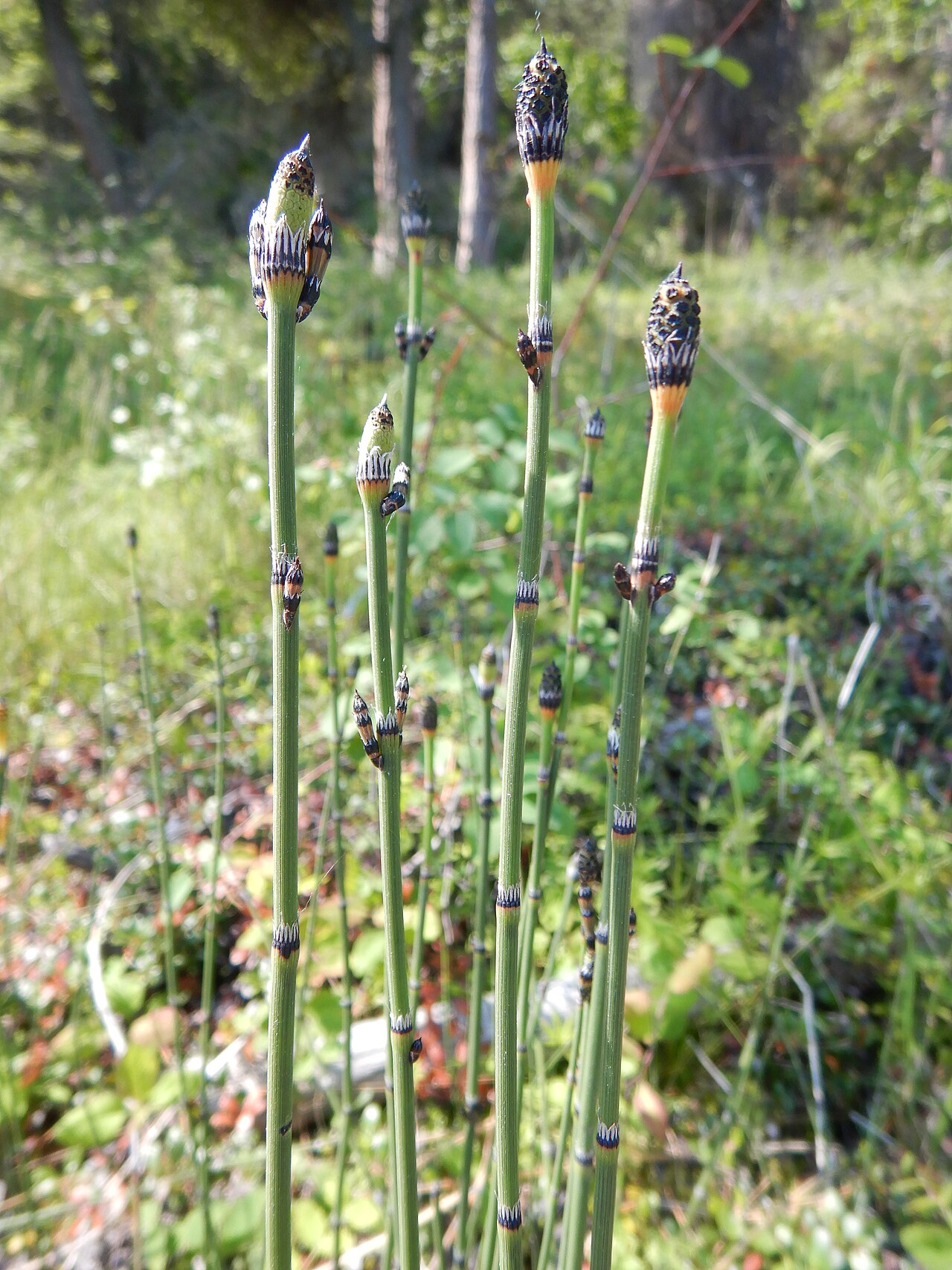
Equisetum fluviatile, known as Water Horsetail or swamp horsetail, is a tall, aquatic horsetail that grows standing in shallow water along lakeshores, in marshes and ponds, and in slow streams across the northern half of the continent. Its smooth, green, jointed stems rise 1 1/2 to 4 feet above the water in dense, reed-like stands, some plain and some with whorls of thin green branches, and in early summer many end in a blunt spore cone.
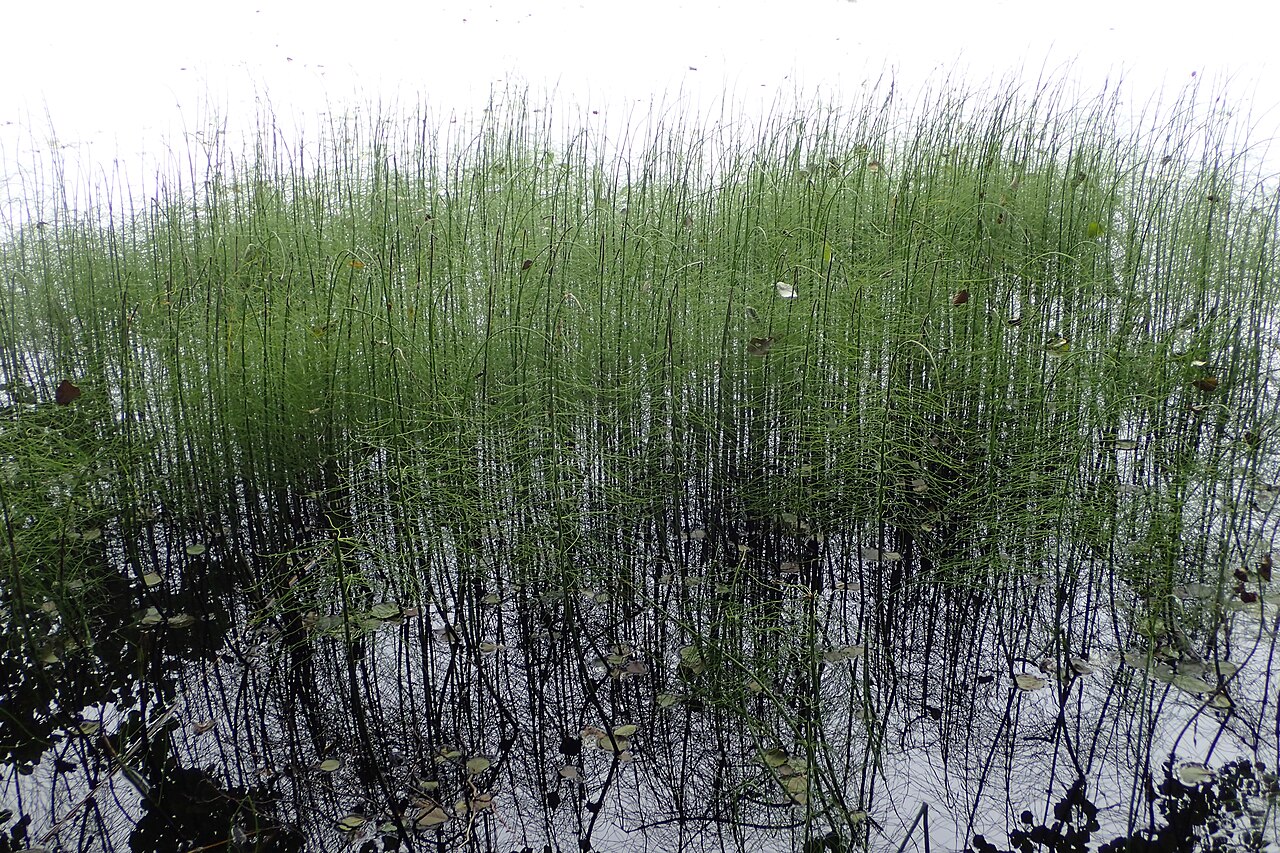
It is the most truly aquatic of North America’s horsetails. Its stems are mostly hollow, with a central air canal that takes up nearly the whole stem, which helps carry air to the roots buried in waterlogged mud. A single colony, connected by creeping rhizomes in the sediment, can cover large areas of shallow water and shoreline.
It is circumboreal, found in North America, Europe and Asia. In the United States it ranges from New England and the mid-Atlantic west through the Great Lakes states to the northern plains and Rockies, the Pacific Northwest and Alaska. This guide covers how to identify water horsetail, where it grows, how to use it in a pond or wetland garden, and its role in aquatic habitats.
Identification
Look for tall, smooth, bright green jointed stems growing up out of shallow water in dense stands, with many small dark teeth at each joint and blunt cones at the tips of some stems.
Growth Habit
Water horsetail is an emergent aquatic perennial that grows from long, creeping rhizomes in mud under shallow water. The stems are usually 1 1/2 to 4 feet tall (occasionally taller) and stand in dense, reed-like colonies.
Stems
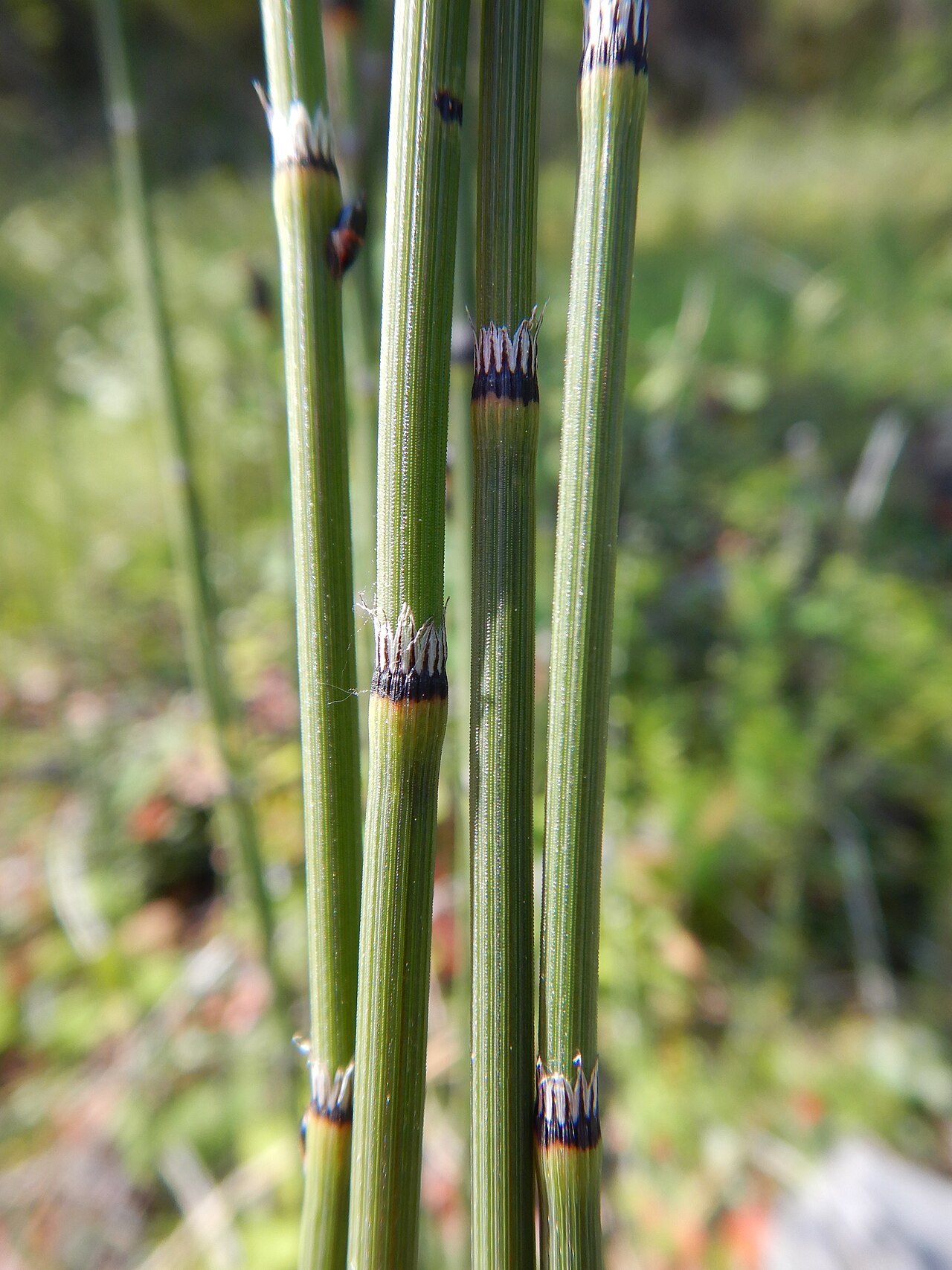
The stems are smooth, soft and easily squashed, because the central hollow takes up most of the stem. They have many fine, shallow ridges (often 10 to 30). Some stems are unbranched; others have whorls of slender green branches at the middle joints, so a colony often has a mix of plain and branched stems.
Sheaths & Teeth
At each joint, a short green sheath fits tightly around the stem and ends in a ring of many (often 15 to 20 or more) small, narrow, dark brown to black teeth.
Cones (Strobili)
Fertile stems end in a blunt, rounded spore cone about 1/2 to 1 inch long, which releases green spores in late spring and early summer. Water horsetail has no flowers or seeds.
Look-alikes
Smooth horsetail (E. laevigatum) and scouring-rush (E. hyemale) have firmer, rougher stems with a much smaller central hollow and grow on moist land rather than in water. Marsh horsetail (E. palustre) has fewer, deeper ridges, fewer and larger sheath teeth and a small central hollow. Field horsetail is shorter, densely branched and grows on land. A squeeze test helps: water horsetail stems collapse easily between your fingers.
Quick Facts
| Scientific Name | Equisetum fluviatile L. |
| Family | Equisetaceae (horsetail family) |
| Plant Type | Emergent aquatic, rhizomatous perennial horsetail (spore-bearing) |
| Mature Height | 1 1/2–4 ft (occasionally to about 5 ft) |
| Mature Spread | Spreads indefinitely by rhizomes to form colonies |
| Growth Rate | Moderate to fast |
| Sun Exposure | Full sun to part shade |
| Water Needs | Very high; shallow standing water or saturated mud |
| Soil Type | Mucky, peaty, sandy or silty sediments in shallow water |
| Soil pH | About 5.0–7.5 |
| Bloom Time | Does not flower; cones release spores in late spring to early summer |
| Flower Color | None; blunt dark spore cones |
| Fall Color | Stems turn yellow to brown and die back in fall |
| Fruit | None; spores from blunt cones |
| Deer Resistant | Mostly; browsed by moose and some waterfowl rather than deer |
| USDA Hardiness Zones | 1–7 |
Native Range
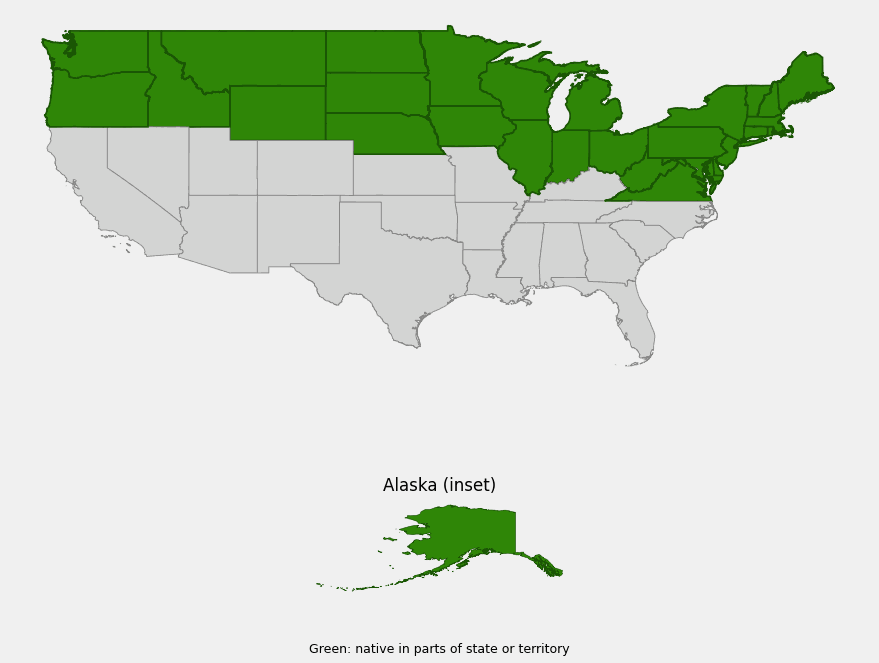
Water horsetail is circumboreal, native to northern North America, Europe and Asia. In North America it ranges across Canada from Newfoundland and Labrador to British Columbia, the Yukon, the Northwest Territories and Nunavut, and through Alaska. USDA PLANTS lists it in 29 U.S. states.
In the East it grows from Maine and the rest of New England south to New Jersey, Delaware, Maryland, Virginia and West Virginia, where it reaches the southern edge of its range in mountain bogs and wetlands. It is widespread in New York, Pennsylvania and the Great Lakes states (Ohio, Indiana, Illinois, Michigan, Wisconsin and Minnesota) and extends to Iowa, Nebraska and the Dakotas. In the West it grows in Montana, Wyoming, Idaho, Washington and Oregon.
It grows in shallow water up to about 3 feet deep along the edges of lakes and ponds, in marshes, bogs, fens, swamps, ditches and slow-moving streams, and in saturated mud along shorelines. It often forms large, pure stands at the outer edge of emergent vegetation.
📋 Regional plant lists featuring Water Horsetail: Alaska · New Hampshire, Maine & Vermont · Connecticut, Massachusetts & Rhode Island · New York, Pennsylvania & Northern New Jersey · Delaware, Southern New Jersey & Long Island · Maryland, Virginia & West Virginia · Ohio & Indiana · Michigan, Wisconsin & Eastern Minnesota · Illinois, Iowa & Missouri · Nebraska, Kansas & Eastern Colorado · North Dakota, South Dakota & Western Minnesota · Montana & Wyoming · Idaho, Eastern Oregon & Eastern Washington · Western Oregon & Western Washington
Growing & Care Guide
Water horsetail is a striking vertical accent for natural ponds, water gardens and constructed wetlands within its native range. It is sold by some aquatic and wetland plant nurseries. Because it spreads vigorously by rhizomes in mud, it is best used where it has room or confined to a submerged container.
Light
Full sun to part shade. It grows densest in open, sunny water.
Soil & Water
Plant it in shallow water, from saturated mud to about 1 foot deep (it tolerates deeper water in the wild), in mucky, peaty or sandy sediment. It must never dry out during the growing season. It tolerates fairly acidic to neutral water.
Planting Tips
Plant rhizome sections or potted plants in spring. In a small pond, set it in a wide, submerged pot or planting basket so it cannot spread through the whole pond. In a larger wetland or rain-fed pond it can be planted directly into the sediment to stabilize the shoreline.
Pruning & Maintenance
Cut back dead stems in late fall or early spring if you want a tidy look, or leave them as winter cover for wildlife. Thin or divide container plants every few years. Remove runners that escape a container before they root into the pond bottom.
Propagation
Divide rhizomes in spring, keeping several joints and a few stems with each piece, and replant immediately in wet mud. Stem pieces with a node can also root in water. Horsetail spores are short-lived and are not a practical way to propagate it.
Landscape Uses
- Natural ponds and water gardens: a bold, vertical, bamboo-like accent in shallow water
- Shoreline stabilization: dense rhizomes bind soft lake and pond margins
- Constructed wetlands: tolerates permanent shallow flooding
- Wildlife ponds: provides cover for fish, amphibians and aquatic insects
- Wetland restoration: a native emergent for northern marshes, bogs and lakeshores
Wildlife & Ecological Value
Water horsetail stands provide shelter and food in shallow-water habitats, from northern lakes to prairie potholes.
For Pollinators
As a spore plant without flowers or nectar, it offers nothing to pollinators directly, but dragonflies and damselflies use the emergent stems to climb out of the water and molt into adults.
For Birds
Waterfowl such as ducks and geese eat the stems and rhizomes, and the dense stands give cover to nesting and feeding marsh birds. Red-winged blackbirds and wrens forage among the stems.
For Mammals
Water horsetail is an important food for moose, which wade into ponds to eat it in summer, and it is also eaten by muskrats, beavers and, in the north, bears and caribou in some areas.
Ecosystem Role
Its stands slow water movement, trap sediment and protect shorelines from wave erosion. The submerged stems and rhizomes shelter small fish, tadpoles and aquatic invertebrates, and decaying stems add organic matter to the wetland.
Cultural & Historical Uses
Linnaeus named the species in 1753. Fluviatile is Latin for “growing in rivers”, and the genus name Equisetum combines the Latin words for “horse” and “bristle”, a reference to the brushy, branched stems of many horsetails.
Horsetails are among the oldest living groups of vascular plants, with relatives that grew as trees in the swamps of the Carboniferous period, more than 300 million years ago. Water horsetail, growing in dense stands in shallow water, gives a good impression of what those ancient wetlands might have looked like.
Safety note: horsetails contain an enzyme (thiaminase) and other compounds that can poison livestock, especially horses, when eaten in quantity in hay. Water horsetail should not be eaten by people or pets or used as a home remedy, although wild herbivores such as moose eat it safely in large amounts.
Frequently Asked Questions
Is water horsetail invasive?
It is native across the northern United States, Canada and Alaska, but it spreads aggressively by rhizomes in shallow water. In a small pond, grow it in a submerged container to keep it in bounds.
How deep can water horsetail grow?
It grows from saturated mud to water about 3 feet deep, and does best in a few inches to about 1 foot of water in gardens.
How do I tell water horsetail from other horsetails?
Water horsetail grows in water, and its smooth stems collapse easily when squeezed because the central hollow takes up most of the stem. Its sheaths have many small dark teeth.
Do animals eat water horsetail?
Yes. Moose eat large amounts of it in summer, and waterfowl, muskrats and beavers also feed on it. It is toxic to horses and livestock in hay, however.
Where does water horsetail grow?
In shallow water of lakes, ponds, marshes, bogs and slow streams across Canada, Alaska and the northern United States from New England to Washington, south to Virginia and West Virginia in the East.

Looking for a nursery that carries Water Horsetail?
Browse our native plant nursery directory: Alaska · Connecticut & Delaware · Idaho, Illinois, Indiana & Iowa · Maine, Maryland, Massachusetts, Michigan, Minnesota & Montana · Nebraska, New Hampshire, New Jersey, New York, North Dakota & Ohio · Oregon · Pennsylvania, Rhode Island, South Dakota, Vermont & Virginia · Washington · West Virginia, Wisconsin & Wyoming

