
Variegated Yellow Pond-Lily (Nuphar variegata)
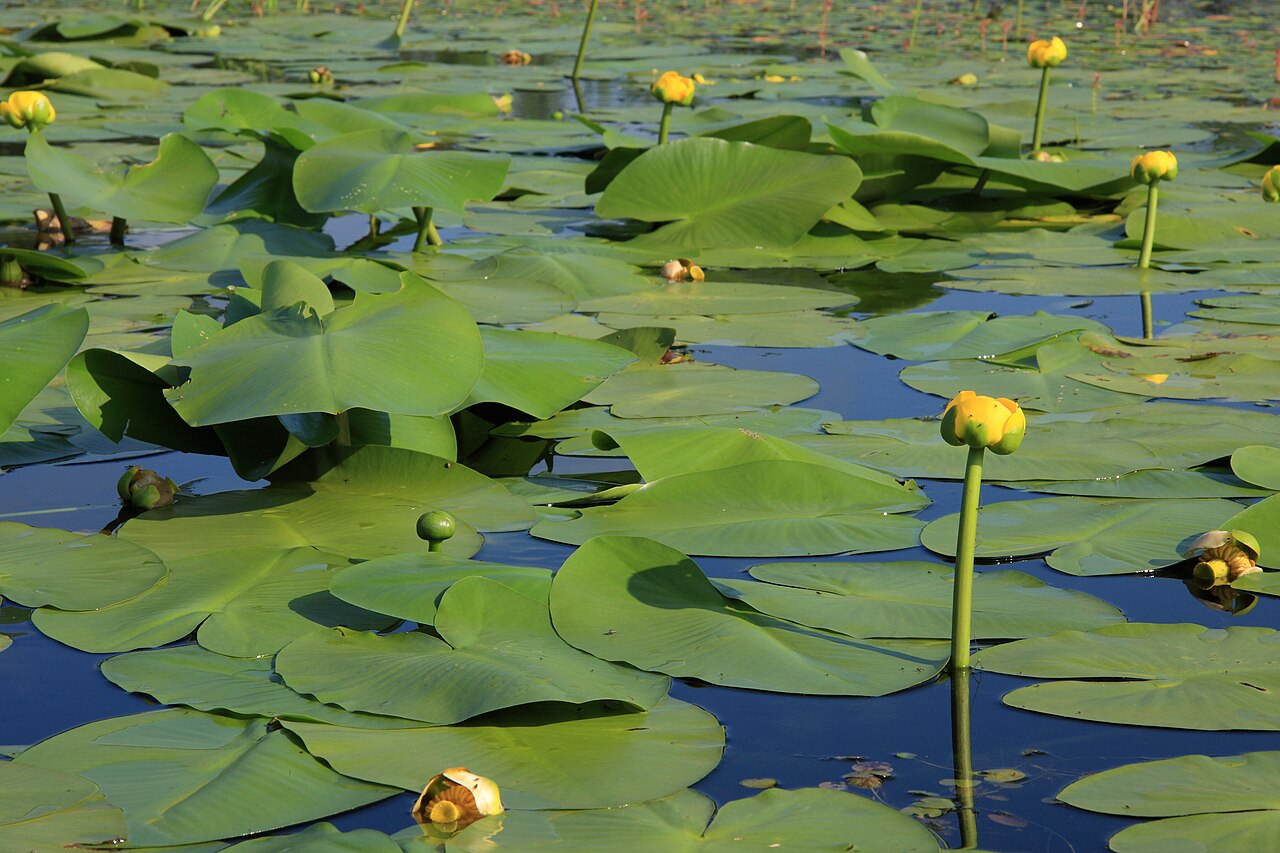
Nuphar variegata, known as Variegated Yellow Pond-Lily, bullhead lily or variegated spatterdock, is the common yellow pond-lily of northern lakes and ponds. It is a perennial aquatic plant rooted in mud by a thick rhizome, with heart-shaped leaves that float flat on the water and round, cup-shaped yellow flowers about 1 1/2 to 2 inches across held just above the surface from late spring through summer.
USDA PLANTS treats it as a subspecies of the broad Eurasian and North American species Nuphar lutea, as Nuphar lutea ssp. variegata (USDA symbol NULUV, “varigated yellow pond-lily”). Most North American botanists, including the Flora of North America, Go Botany and many state floras, recognize it as its own species, Nuphar variegata, and that is the name used on this page.
It ranges across Canada and the northern United States from the Atlantic coast to Montana and Idaho. On PlantNative it sits between two related pond-lilies: Spatterdock (Nuphar advena) of the East and South, and Western Yellow Pond-Lily (Nuphar polysepala) of the western mountains. Its flattened, winged leaf stalks and red-blotched sepals tell it apart.
Identification
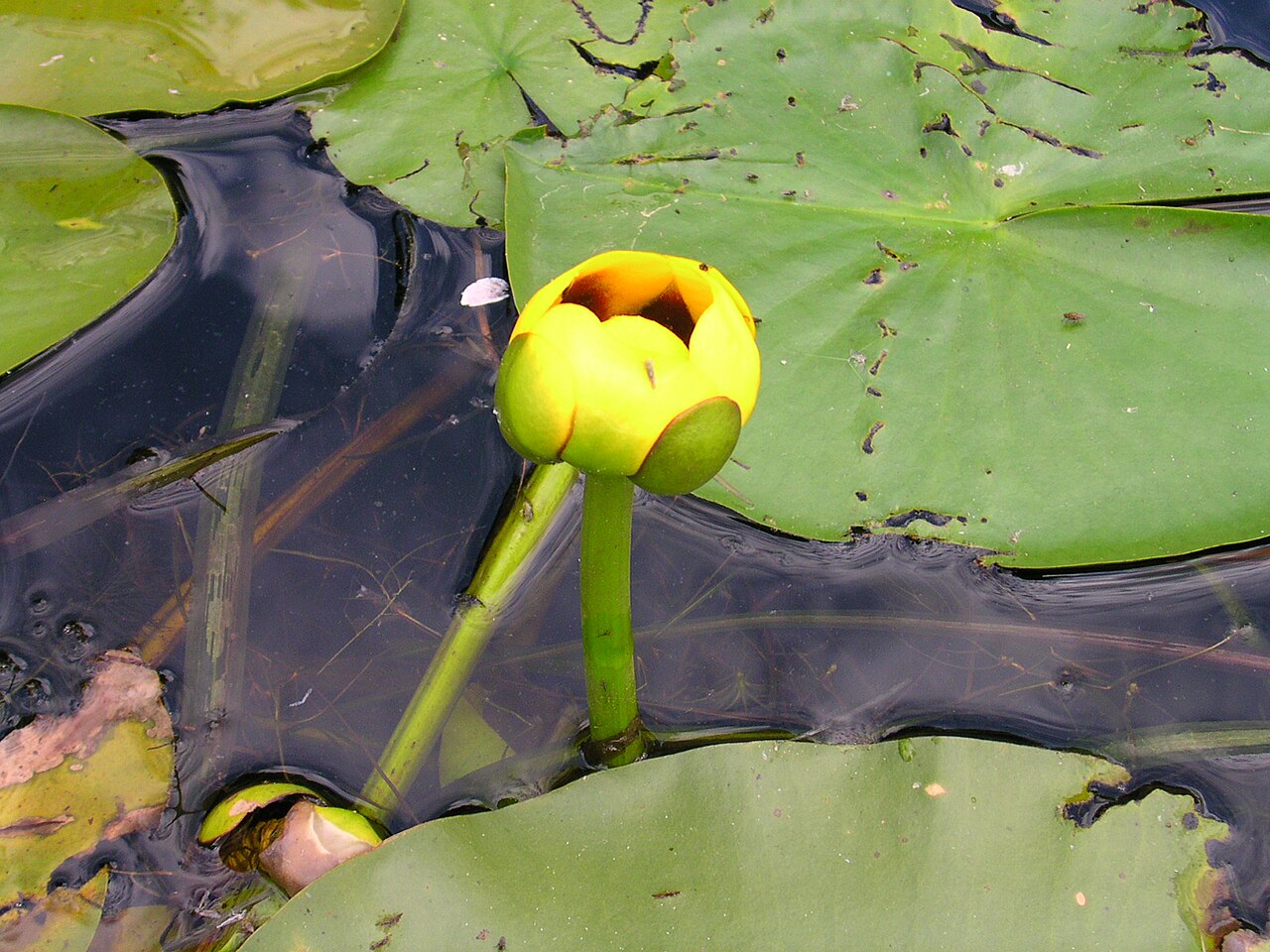
Look for floating, heart-shaped leaves on flattened, winged stalks, and globe-shaped yellow flowers whose sepals are often marked with red or maroon on the inside near the base.
Growth Habit
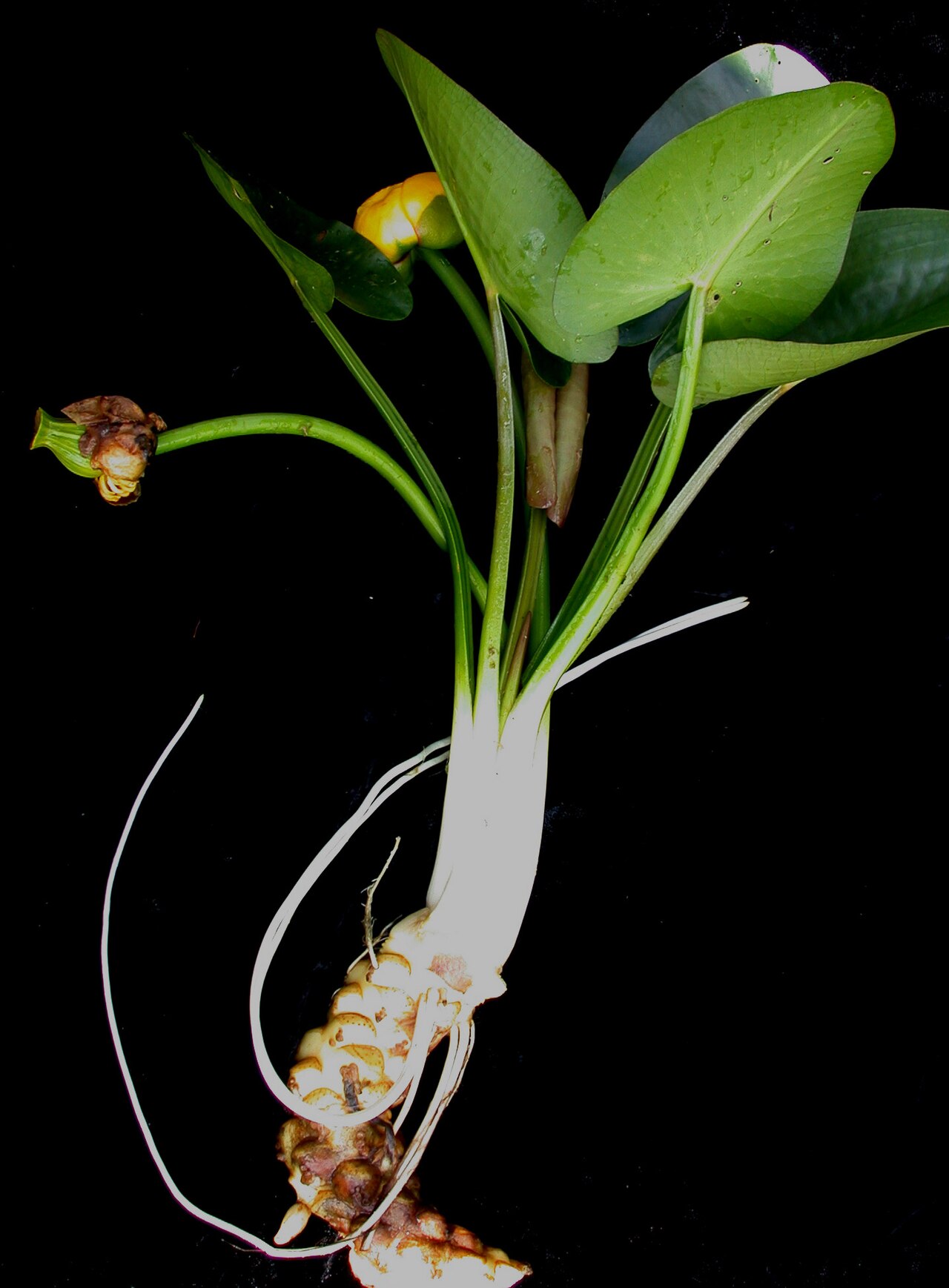
Variegated yellow pond-lily grows from a thick, creeping rhizome, often several inches across and covered with diamond-shaped leaf scars, buried in mucky lake or pond bottoms. Long, flexible stalks carry leaves and flowers to the surface. Plants usually grow in water about 1 to 6 feet deep and can form large colonies. Thin, translucent underwater leaves are sometimes present as well.
Leaves
The floating leaves are broadly oval to nearly round, about 4 to 10 inches long, with a deep notch (sinus) at the base where the stalk attaches; the two basal lobes often lie close together or overlap. The leaf stalks (petioles) are distinctly flattened on the upper side and edged with narrow wings, which you can feel by rolling a stalk between your fingers. Leaves usually lie flat on the water rather than standing above it.
Flowers
The flowers are about 1 1/2 to 2 inches across, globe- or cup-shaped, and float on or just above the surface. What look like petals are mostly five or six thick, waxy sepals, yellow outside and often greenish at the base, with a red to maroon patch on the inner side near the base. The true petals are small and stamen-like, hidden among many yellow stamens around a flat, disk-shaped stigma. It blooms from about May to September.
Fruit
The fruit is a ribbed, green to purplish, jug-shaped capsule about 1 to 1 1/2 inches long, crowned by the persistent stigma disk and narrowed just below it. It ripens underwater or at the surface and breaks apart to release many seeds.
Look-alikes
Spatterdock (Nuphar advena) usually holds its leaves erect above the water, has round, unwinged leaf stalks, and its sepals lack the red inner blotch; it is the common pond-lily from southern New England and the Great Lakes south. Western Yellow Pond-Lily (Nuphar polysepala) of the Rockies and Pacific states has larger flowers with seven to nine sepals and round leaf stalks. Small yellow pond-lily (Nuphar microphylla) has much smaller leaves and flowers under about 1 inch across. Hybrids occur where the species meet. American White Waterlily has a narrow leaf notch and showy white, many-petaled flowers.
Quick Facts
| Scientific Name | Nuphar variegata; USDA: Nuphar lutea ssp. variegata |
| Family | Nymphaeaceae (water-lily family) |
| Plant Type | Perennial aquatic plant with floating leaves |
| Mature Height | Leaves float on the surface; flowers to a few inches above |
| Mature Spread | Colonies spread several feet to many yards by rhizomes |
| Growth Rate | Moderate |
| Sun Exposure | Full sun to part shade |
| Water Needs | Aquatic; still or slow water about 1–6 ft deep |
| Soil Type | Mucky, organic or silty lake and pond bottoms |
| Soil pH | Acidic to neutral (about 5.5–7.5) |
| Bloom Time | May–September |
| Flower Color | Yellow, sepals red-blotched inside at the base |
| Fall Color | Leaves yellow and die back in fall |
| Fruit | Ribbed, jug-shaped green to purplish capsule |
| Deer Resistant | Not applicable; eaten by moose, beaver and muskrat |
| USDA Hardiness Zones | 2–7 |
Native Range
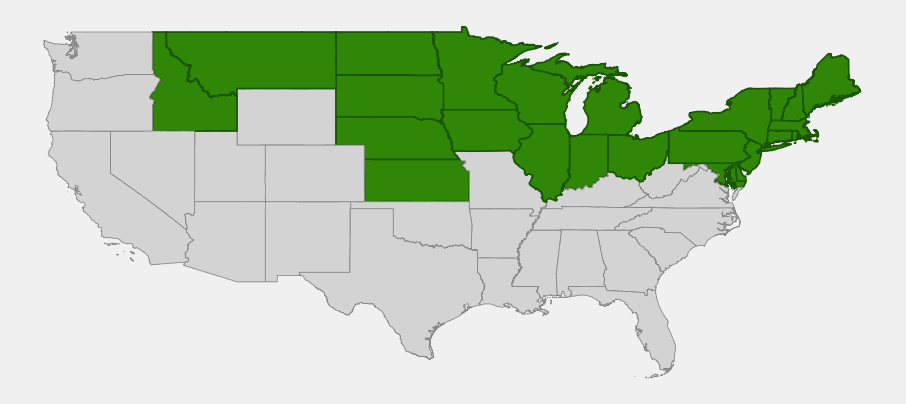
USDA PLANTS lists variegated yellow pond-lily as native in 24 states across the northern United States, from Maine to Montana and Idaho: Connecticut, Delaware, Idaho, Illinois, Indiana, Iowa, Kansas, Maine, Maryland, Massachusetts, Michigan, Minnesota, Montana, Nebraska, New Hampshire, New Jersey, New York, North Dakota, Ohio, Pennsylvania, Rhode Island, South Dakota, Vermont and Wisconsin. In Canada it grows in every province and in the Yukon, Northwest Territories and Nunavut.
It is most common in the glaciated lake country of New England, New York, the Great Lakes states and Minnesota, and across the northern Plains in prairie pothole ponds and sloughs. In the West it reaches the lakes of northern Idaho and Montana. Records in Kansas, Delaware, Maryland and southern New Jersey are at the southern edge of its range and are scattered or outlying; farther south, spatterdock replaces it.
It grows in ponds, lakes, beaver ponds, bog pools, sluggish streams, river backwaters and ditches, usually in quiet water 1 to 6 feet deep over soft, organic mud.
📋 Regional plant lists featuring Variegated Yellow Pond-Lily: New York, Pennsylvania & Northern New Jersey · Idaho, Eastern Oregon & Eastern Washington · Ohio & Indiana · Montana & Wyoming · Michigan, Wisconsin & Eastern Minnesota · Nebraska, Kansas & Eastern Colorado · Connecticut, Massachusetts & Rhode Island · New Hampshire, Maine & Vermont · Maryland, Virginia & West Virginia · Delaware, Southern New Jersey & Long Island · Illinois, Iowa & Missouri · North Dakota, South Dakota & Western Minnesota
Growing & Care Guide
Variegated yellow pond-lily is a hardy, low-care plant for natural ponds in cold climates. It is vigorous, so it suits larger ponds better than small water gardens.
Light
Full sun gives the most flowers. It tolerates part shade, such as ponds edged by trees, but blooms less.
Soil & Water
Plant it in still or slow-moving water about 1 to 6 feet deep, in mucky, organic soil or heavy loam. It needs permanent water; the rhizome should never dry out or freeze solid, so water must be deep enough to stay liquid at the bottom in winter.
Planting Tips
In late spring, plant a section of rhizome horizontally in the pond bottom or in a wide, heavy container of clay loam topped with gravel, with the growing tip just exposed. Lower containers gradually as leaves reach the surface. Use containers in small ponds to keep it from covering the whole surface.
Pruning & Maintenance
Remove yellowing leaves and spent flowers if you want a tidy look. Divide or thin rhizomes every few years if it crowds out other plants or shades too much of the water. Leave foliage over winter; it dies back naturally.
Propagation
Divide rhizomes in spring, keeping a growing tip on each piece. It can also be grown from fresh seed kept wet and sown in submerged pots of mud, though seedlings are slow. Buy from aquatic nurseries that sell nursery-propagated native stock; do not take plants from the wild or move plants between water bodies, which can spread invasive species.
Landscape Uses
- Natural and wildlife ponds: floating cover and summer flowers in larger ponds
- Shoreline restoration: stabilizes soft bottoms and shelters shallow water
- Fish habitat: shade and cover for young fish
- Cold-climate water gardens: hardy far into Canada
- Wetland education areas: an easy-to-see example of a floating-leaved native plant
Wildlife & Ecological Value
Pond-lily beds are some of the richest wildlife habitats in northern lakes and ponds.
For Pollinators
The flowers are visited mainly by flies, beetles and small bees, which crawl into the cup for pollen. Specialized beetles and flies feed and mate inside the flowers.
For Birds
Ducks eat the seeds, and wading birds, terns and kingfishers hunt the fish and frogs that shelter beneath the leaves. Birds such as rails and blackbirds walk across dense leaf beds to feed on insects.
For Mammals
Beavers, muskrats and porcupines eat the rhizomes and leaves, and moose wade into ponds in summer to feed heavily on pond-lily leaves and stems.
Ecosystem Role
Its leaves shade the water, keeping it cooler and limiting algae, while the stalks and undersides of leaves host snails, insect larvae and other invertebrates eaten by fish. Pond-lily beds provide cover for fish, frogs and turtles, and the large rhizomes help hold soft lake sediments in place.
Cultural & Historical Uses
The name Nuphar comes from an ancient Persian and Arabic name for water-lilies. The species name variegata refers to the red-blotched inner bases of the sepals.
Many Indigenous peoples of the northern forests and plains used yellow pond-lily rhizomes, which were dug in fall, cooked and eaten, or used in traditional medicine for poultices and other remedies. The seeds of the western species were also roasted and eaten. The raw rhizomes are bitter and contain alkaloids, so they should not be eaten casually.
The common name bullhead lily may refer to the bulging, jug-like fruit or to the bullhead fish that often lurk beneath the leaves. Botanists have long debated whether the North American yellow pond-lilies are one species or several; today most treat Nuphar variegata, N. advena and N. polysepala as separate species.
Frequently Asked Questions
Is Nuphar variegata the same as Nuphar lutea?
USDA PLANTS lists it as Nuphar lutea ssp. variegata, a subspecies of the Eurasian yellow water-lily. Most North American botanists treat it as a separate species, Nuphar variegata. Both names refer to the same plant.
How do I tell it from spatterdock?
Roll a leaf stalk between your fingers: variegated yellow pond-lily has a flattened, winged stalk, while spatterdock (Nuphar advena) has a round one. Variegated pond-lily leaves usually float flat, and its sepals have a red blotch inside at the base. Spatterdock often holds its leaves above the water.
Will it take over my pond?
It spreads steadily by rhizomes and can cover much of a small, shallow pond. In small ponds, grow it in containers and thin it every few years.
How deep should the water be?
About 1 to 6 feet deep is ideal. In cold regions, the rhizome should sit below the depth that freezes solid in winter.
Is it edible?
The rhizomes and seeds were traditional foods for some Indigenous peoples after careful preparation, but the raw rhizomes are bitter and contain alkaloids. It is best enjoyed as a wildlife plant rather than foraged.

Looking for a nursery that carries Variegated Yellow Pond-Lily?
Browse our native plant nursery directory: Connecticut & Delaware · Idaho, Illinois, Indiana, Iowa & Kansas · Maine, Maryland, Massachusetts, Michigan, Minnesota & Montana · Nebraska, New Hampshire, New Jersey, New York, North Dakota & Ohio · Pennsylvania, Rhode Island, South Dakota & Vermont · Wisconsin