
Big Bur-Reed (Sparganium eurycarpum)
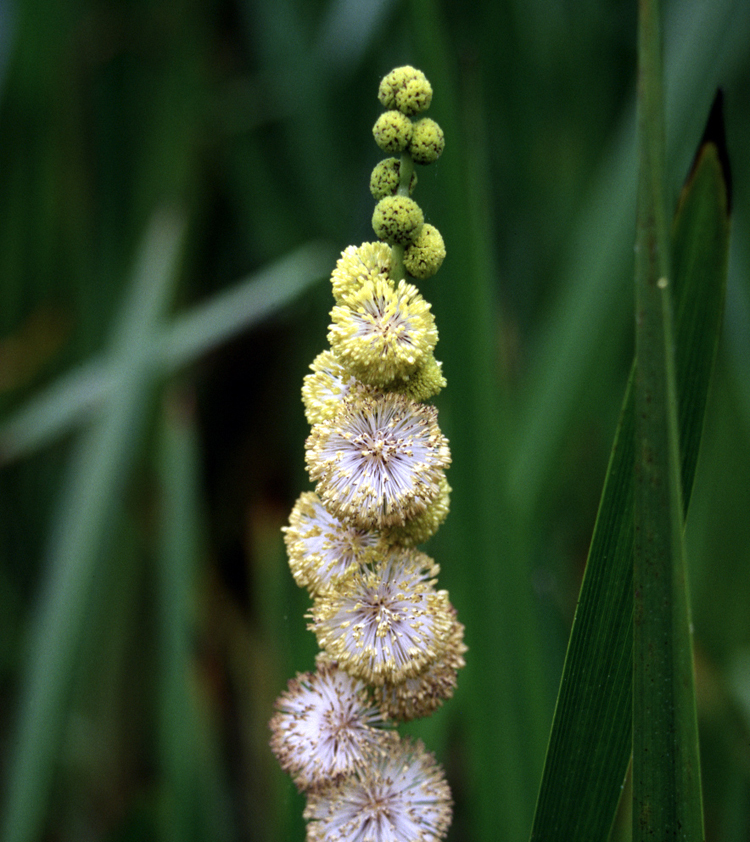
Sparganium eurycarpum, known as Big Bur-Reed, broadfruit bur-reed or giant bur-reed, is a tall, emergent wetland plant of marshes, pond edges and slow streams across most of the northern and western United States and southern Canada. It grows 2 to 5 feet tall, sometimes taller, from creeping rhizomes, with long, strap-like, keeled leaves and zigzag flowering stems lined with round, spiky flower heads.
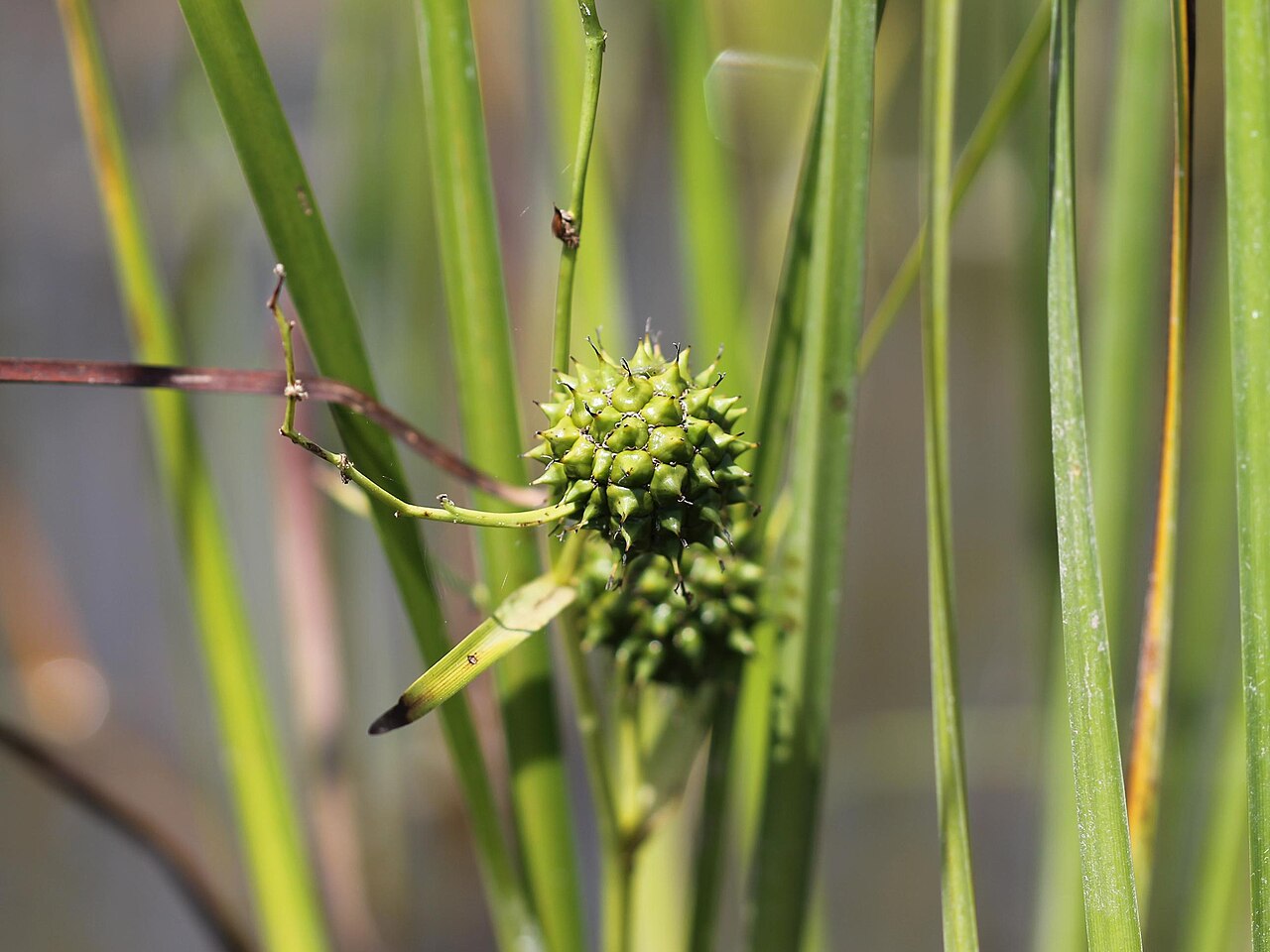
The upper heads are small and male, turning fluffy white with pollen in early summer; the larger female heads below ripen into hard, green, bur-like balls about an inch across. It is the largest North American bur-reed and the only one whose fruits typically carry two stigmas, which gives them a broad, flat-topped shape and the species its name, eurycarpum, “broad-fruited”. Bur-reeds have traditionally been placed in their own family, Sparganiaceae, now often included in the cattail family (Typhaceae).
Big bur-reed is an excellent native plant for pond margins, constructed wetlands and shoreline restoration, and its seeds and rhizomes feed waterfowl and muskrats. This guide covers how to identify it, where it grows, how to plant it, and its value to wildlife.
Identification
Big bur-reed looks a little like a cattail or iris from a distance, but its branched, zigzag flower stems with round, spiky heads make it unmistakable from early summer through fall.
Growth Habit
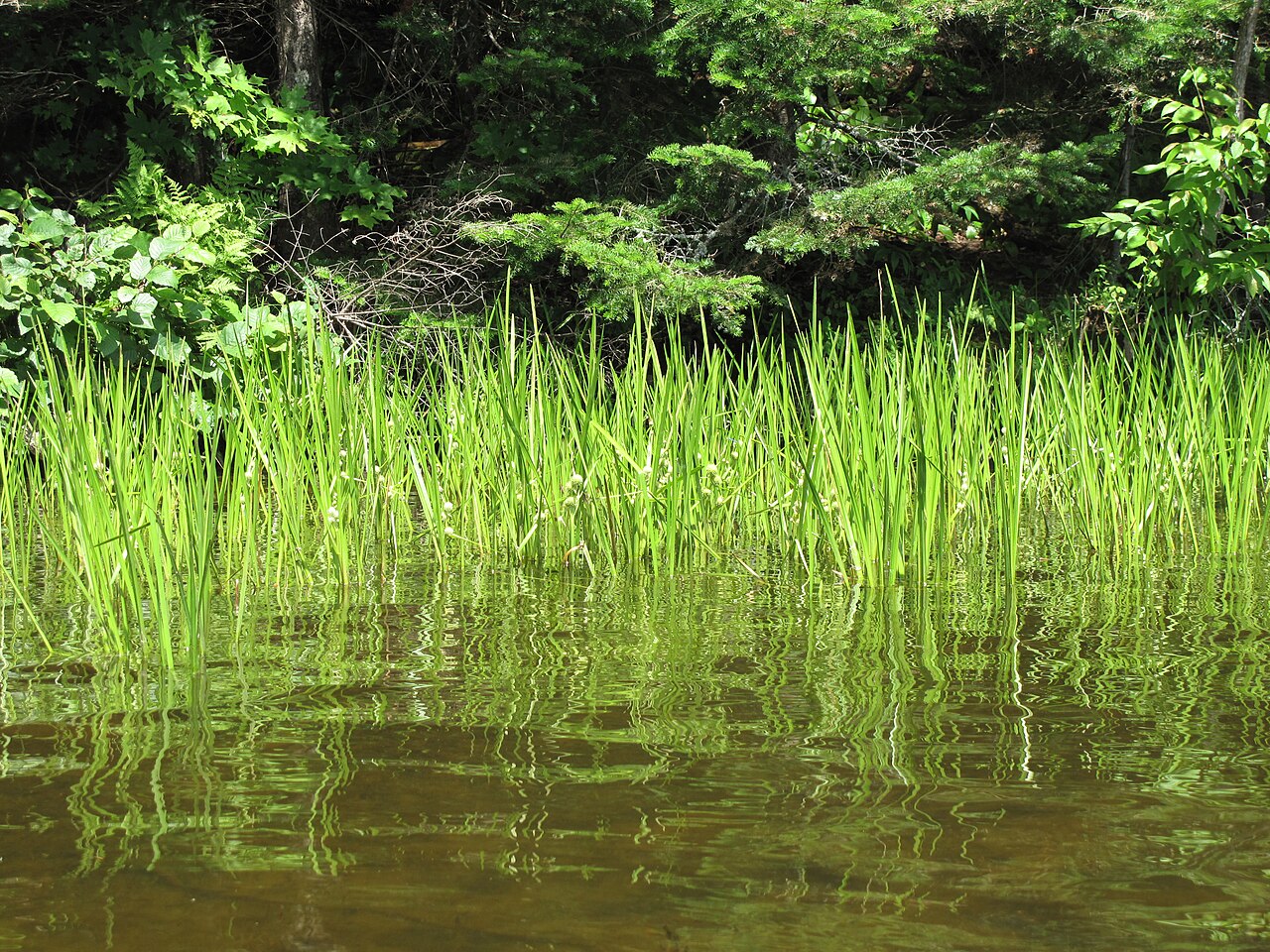
It is an erect, emergent perennial, usually 2 to 5 feet tall and occasionally up to about 8 feet, growing in shallow water or saturated mud. Stout rhizomes spread outward and produce new shoots, so plants form colonies and dense stands.
Leaves
The leaves are long, linear and spongy, up to 3 feet or more long and about 1/2 to 3/4 inch wide. They are flat toward the tips but distinctly keeled, almost triangular, toward the base, and they sheath the stem. Their spongy, air-filled tissue helps them stay upright in water.
Flowers
The flowering stem is branched, with each branch bending in a slight zigzag. Male heads, about 1/2 inch across, are crowded on the upper parts of the branches and look fluffy white when shedding pollen. Female heads sit lower down, one to a few per branch. Flowering is mainly from late May into August.
Fruit & Seeds
The female heads mature into dense, globe-shaped burs about 3/4 to 1 1/4 inches across. Each fruit is a hard, nutlike achene, broad and flattened at the top, usually ending in two short beaks from its two stigmas. The burs turn brown in late summer and fall and break apart, and the corky fruits float.
Look-alikes
American bur-reed (Sparganium americanum) is smaller, with narrower leaves and smaller burs of narrow, beaked fruits with a single stigma. Sweet flag, blue flag iris and young cattails have similar leaves, but none of them has round, spiky flower heads; sweet flag leaves smell spicy when crushed.
Quick Facts
| Scientific Name | Sparganium eurycarpum Engelm. |
| Family | Typhaceae (cattail family); formerly Sparganiaceae |
| Plant Type | Emergent aquatic perennial |
| Mature Height | 2–5 ft (occasionally to 8 ft) |
| Mature Spread | Spreads by rhizomes into colonies |
| Growth Rate | Fast |
| Sun Exposure | Full sun to part shade |
| Water Needs | Wet; saturated soil or water up to about 1 1/2 ft deep |
| Soil Type | Mucky, silty or sandy wetland soils |
| Soil pH | About 6.0–8.0 |
| Bloom Time | Late May–August |
| Flower Color | Greenish white (male heads white when in pollen) |
| Fall Color | Foliage turns tan to brown |
| Fruit | Round, spiky green bur of hard achenes, ripening brown |
| Deer Resistant | Moderately; muskrats and some waterfowl eat it |
| USDA Hardiness Zones | 3–9 |
Native Range
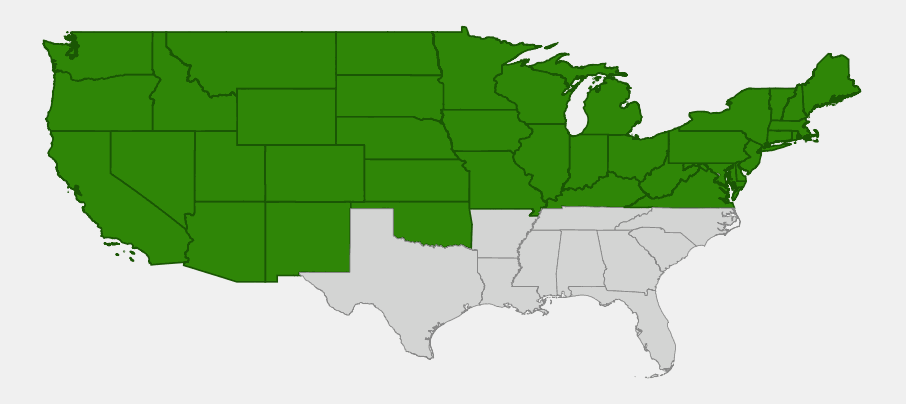
Big bur-reed is native across much of temperate North America. USDA PLANTS lists it as native in 38 states and across southern Canada from British Columbia to Newfoundland. In the United States it is widespread in the Northeast, the Great Lakes region, the northern Plains, the Rocky Mountains and the Pacific states, and it reaches south to Virginia, Kentucky, Missouri, Oklahoma, New Mexico, Arizona and California. It is absent from the Deep South and most of the Southeast Coastal Plain.
In the arid West it is confined to permanent wetlands, such as river marshes, spring-fed ponds and mountain lake margins, and becomes scattered and local. It is most abundant in the glaciated landscapes of the Upper Midwest and the Northeast, where marshes, ponds and slow streams are common.
It grows as an emergent plant in shallow water, usually up to about 1 1/2 feet deep, and on saturated mud along the edges of marshes, ponds, lakes, slow rivers, oxbows, ditches and wet meadows. It often forms dense, nearly pure stands in the shallow zone between deeper water and drier shore.
📋 Regional plant lists featuring Big Bur-Reed: New York, Pennsylvania & Northern New Jersey · Idaho, Eastern Oregon & Eastern Washington · Ohio & Indiana · Montana & Wyoming · Michigan, Wisconsin & Eastern Minnesota · Kentucky & Tennessee · Nebraska, Kansas & Eastern Colorado · Utah & Western Colorado · Connecticut, Massachusetts & Rhode Island · New Hampshire, Maine & Vermont · Maryland, Virginia & West Virginia · Delaware, Southern New Jersey & Long Island · Arizona & New Mexico · Illinois, Iowa & Missouri · North Dakota, South Dakota & Western Minnesota · Western Oregon & Western Washington · California & Nevada · Arkansas, Louisiana, Eastern Oklahoma & Eastern Texas
Growing & Care Guide
Big bur-reed is a vigorous, easy native for the shallow edges of ponds, stormwater basins and constructed wetlands. It fills in quickly, holds soft shorelines and feeds wildlife, but because it spreads by rhizomes it is best suited to larger water features rather than small garden ponds.
Light
It grows best in full sun and tolerates part shade. In heavy shade it grows thinner and flowers less.
Soil & Water
Plant it in mucky, silty or sandy soil that stays saturated or under water all season, from wet mud to water about 1 1/2 feet deep. It tolerates fluctuating water levels and some nutrient enrichment, but not long periods of drying out.
Planting Tips
Plant rhizome pieces or nursery plugs in spring, about 2 feet apart, pressing them into soft mud in water a few inches deep. In small ponds, grow it in a sunken pot or planting basket to keep the rhizomes in bounds. Combine it with pickerelweed, duck potato and blue flag iris for a varied shoreline planting.
Pruning & Maintenance
No routine pruning is needed. Leave the dead leaves and burs standing over winter for wildlife, or cut them back in early spring. In small ponds, lift and divide pot-grown plants every few years and remove rhizomes that escape their container.
Propagation
The easiest method is dividing rhizomes in spring. Seeds can be sown in fall in wet soil, or given several months of cold, wet stratification before spring sowing; keep them wet, since they lose viability if they dry out. Buy plants or seed from native wetland nurseries rather than collecting from wild stands.
Landscape Uses
- Pond and lake margins: a fast-growing emergent for shallow water
- Shoreline stabilization: dense rhizomes bind soft sediments and reduce wave erosion
- Constructed and stormwater wetlands: tolerates fluctuating water and nutrient-rich runoff
- Wildlife ponds: seeds and rhizomes for waterfowl and muskrats
- Wetland restoration: a widespread native emergent for marsh restoration
Wildlife & Ecological Value
Big bur-reed is an important food and cover plant in northern marshes, used by waterfowl, marsh birds, muskrats and many aquatic insects.
For Pollinators
Bur-reeds are mainly wind-pollinated, so they offer little nectar, though some bees and flies collect pollen from the male heads. The plants support many aquatic insects, such as midges and caddisflies, that live on the submerged stems and leaves.
For Birds
The hard seeds are eaten by ducks such as mallards, wood ducks and teal, and by geese, rails and some marsh songbirds, often after the burs break apart in fall. Dense stands provide nesting and escape cover for rails, bitterns, marsh wrens and red-winged blackbirds.
For Mammals
Muskrats eat the rhizomes and stems and use the leaves in their lodges. Deer and moose may browse the foliage in shallow water.
Ecosystem Role
Its dense rhizomes and stems trap sediment, slow water flow and protect shorelines from erosion, while taking up nutrients from the water. The submerged stems provide habitat for invertebrates and young fish, linking the plant to the wider wetland food web.
Cultural & Historical Uses
The genus name Sparganium comes from the Greek sparganion, from sparganon, a band or swaddling cloth, referring to the long, ribbon-like leaves. The species was described by the German-American botanist George Engelmann, who worked in St. Louis and named many plants of the Mississippi Valley and the West.
Some Native American peoples are reported to have eaten the starchy rhizome tubers of bur-reeds, and the plants were used, like cattails, for weaving and bedding. Today big bur-reed is more often planted than gathered, as a dependable native for wetland restoration.
In French, big bur-reed is called rubanier à gros fruits, “ribbon plant with large fruits”, a name that sums up both its ribbon-like leaves and its distinctive broad fruits.
Frequently Asked Questions
How do I tell big bur-reed from American bur-reed?
Big bur-reed is larger, with wider leaves and bigger burs made of broad, flat-topped fruits that usually have two stigmas. American bur-reed has narrower leaves and smaller burs of slender, single-beaked fruits.
Is big bur-reed invasive?
No. It is native across much of the United States and Canada. It spreads by rhizomes and can form dense stands, so in small ponds it is best grown in a container.
How deep can big bur-reed grow?
It grows in saturated mud and in water up to about 1 1/2 feet deep, and does best in a few inches to a foot of water.
What eats big bur-reed?
Ducks, geese and rails eat the seeds, and muskrats eat the rhizomes and stems. Dense stands also shelter marsh birds and aquatic insects.
When does big bur-reed bloom?
Mainly from late May into August. The spiky green burs follow in summer and turn brown in fall.

Looking for a nursery that carries Big Bur-Reed?
Browse our native plant nursery directory: Arizona · California · Colorado, Connecticut & Delaware · Idaho, Illinois, Indiana, Iowa & Kansas · Kentucky, Maine, Maryland, Massachusetts, Michigan, Minnesota, Missouri & Montana · Nebraska, Nevada, New Hampshire, New Jersey, New Mexico, New York, North Dakota, Ohio & Oklahoma · Oregon · Pennsylvania, Rhode Island, South Dakota, Utah, Vermont & Virginia · Washington · West Virginia, Wisconsin & Wyoming

