
Hartweg’s Wild Ginger (Asarum hartwegii)
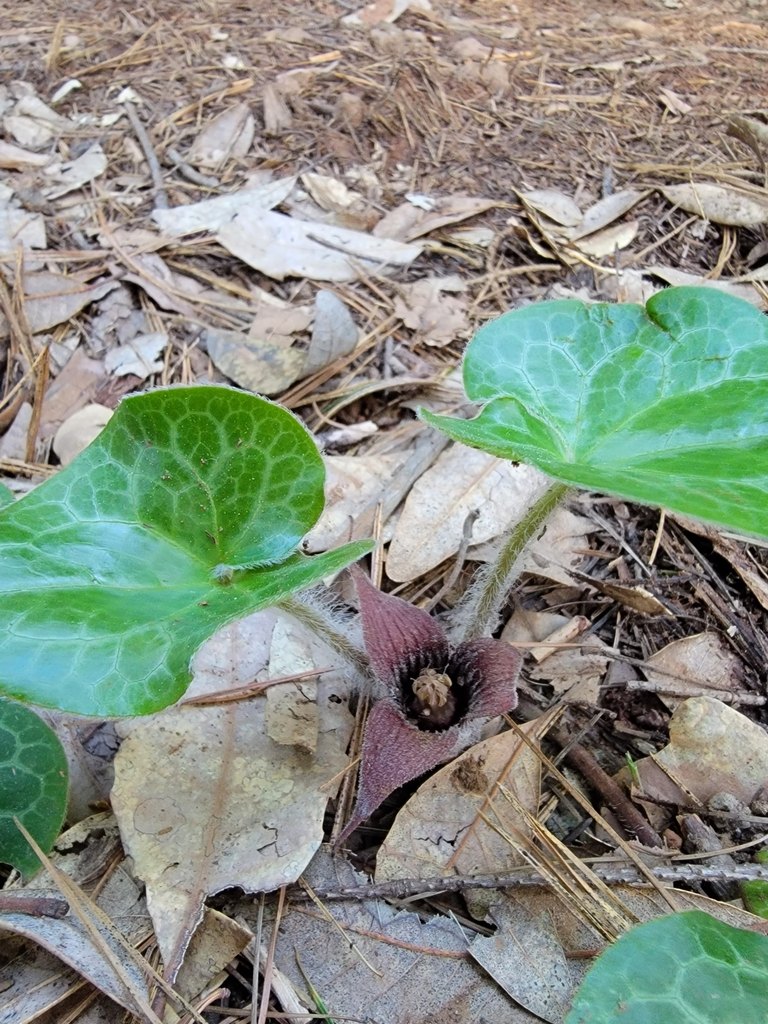
Asarum hartwegii, known as Hartweg’s Wild Ginger, Hartweg’s wildginger or Sierra wild ginger, is an evergreen groundcover of shady conifer and mixed forests in the mountains of northern and central California. Its heart-shaped, dark green leaves are boldly marbled with silver along the veins, and in spring and early summer it bears curious, hairy, maroon-brown flowers with three long-tailed lobes, hidden at ground level beneath the leaves.
It belongs to the birthwort family (Aristolochiaceae). It is a close relative of the more familiar western wild ginger (Asarum caudatum), which grows in moist coastal and Northwest forests, and of eastern wild ginger (Asarum canadense). Hartweg’s wild ginger is generally found in somewhat drier, more open forests, especially in the Sierra Nevada, southern Cascades and Klamath Mountains, and its striking silver-veined foliage sets it apart.
The leaves and rhizomes smell of ginger when crushed, but wild gingers are not related to culinary ginger and are not safe to eat, as they contain aristolochic acid. This guide covers how to identify Hartweg’s wild ginger, where it grows, how to grow it as a shade groundcover, and its role in forest ecosystems.
Identification
Hartweg’s wild ginger is easiest to recognize by its foliage: low, evergreen, heart-shaped leaves heavily mottled with silver along the veins, growing in loose patches on the shaded forest floor.
Growth Habit
It is a low, evergreen perennial that spreads by creeping rhizomes at or just below the soil surface, forming loose patches. Plants are usually 3 to 8 inches tall, with leaves arising in pairs along the rhizome.
Leaves
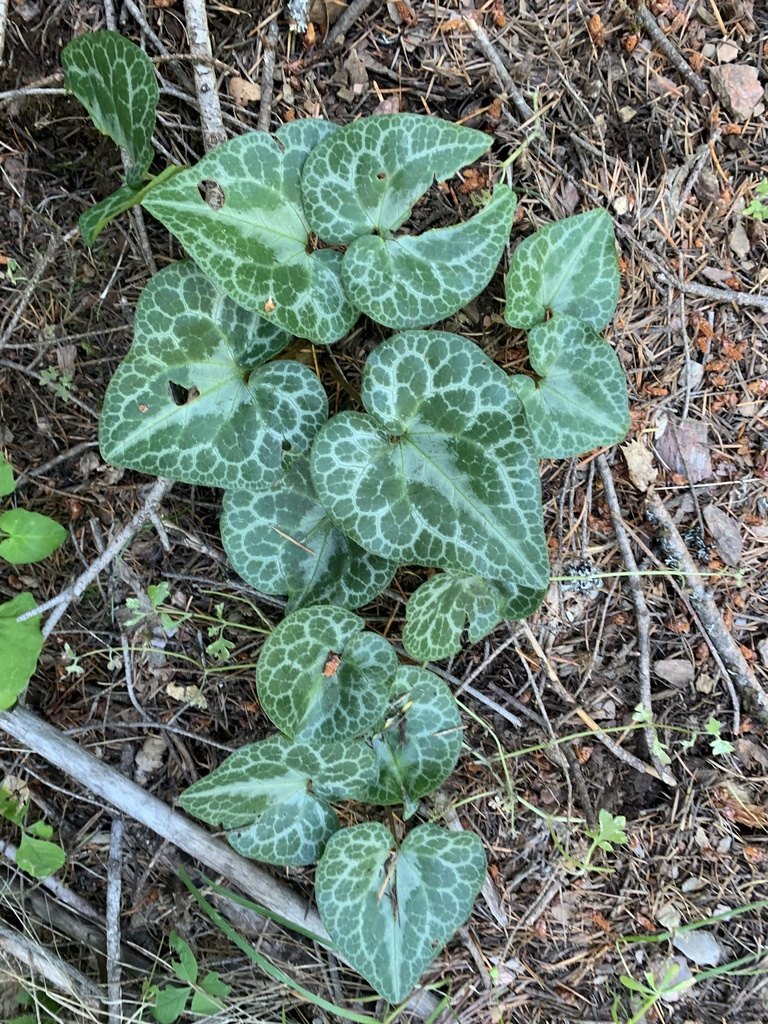
The leaves are heart-shaped to kidney-shaped, about 2 to 4 inches long, on long stalks. They are thick, dark green and usually strongly mottled or veined with silvery white, with fine hairs along the edges. They are evergreen, staying on the plant through winter, and give off a ginger-like scent when crushed.
Flowers
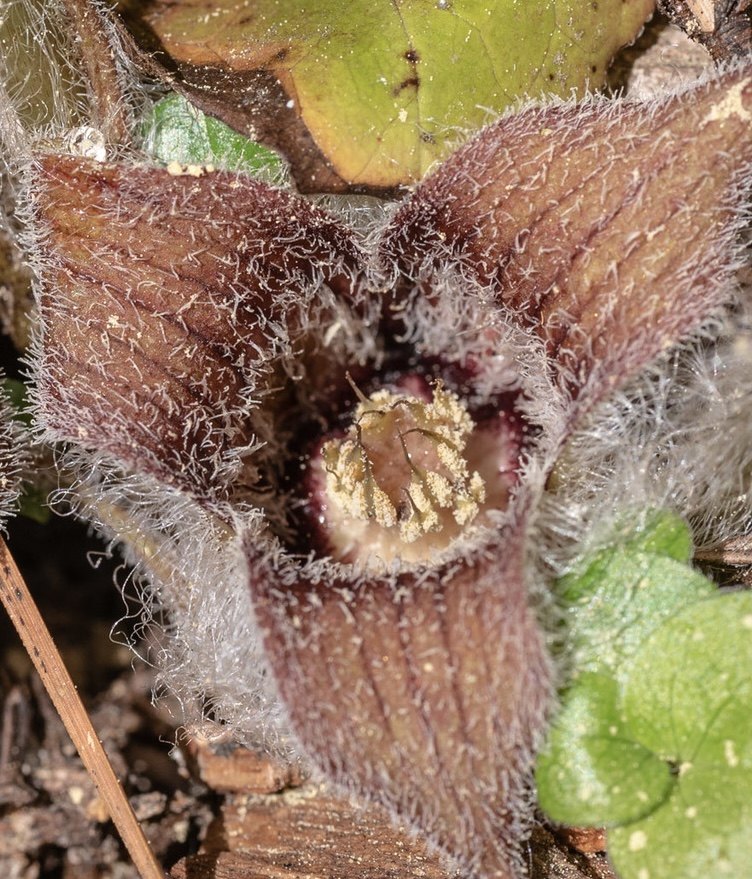
The flowers are produced singly at ground level between the leaf stalks, often hidden under the leaves or in the litter. Each is a cup-shaped calyx (there are no true petals) with three spreading, hairy lobes that taper to long, slender points, reddish-brown to maroon outside and paler inside. Bloom runs from about April to July, depending on elevation.
Fruit & Look-alikes
The fruit is a fleshy capsule at ground level containing seeds with oily appendages that attract ants. Western wild ginger (A. caudatum) has plain green or only faintly mottled leaves and grows in moister forests. Lemmon’s wild ginger (A. lemmonii) of Sierra streamsides has plain green leaves and short-lobed flowers. Marbled, silver-veined leaves in a dry-to-moist conifer forest point to Hartweg’s wild ginger.
Quick Facts
| Scientific Name | Asarum hartwegii S. Watson |
| Family | Aristolochiaceae (birthwort family) |
| Plant Type | Evergreen, rhizomatous groundcover perennial |
| Mature Height | 3–8 in |
| Mature Spread | 1–2 ft (slowly spreading) |
| Growth Rate | Slow to moderate |
| Sun Exposure | Part shade to full shade |
| Water Needs | Low to moderate; tolerates dry summer shade once established |
| Soil Type | Well-drained, humus-rich forest soils |
| Soil pH | About 5.5–7.0 |
| Bloom Time | April–July |
| Flower Color | Maroon to reddish-brown |
| Fall Color | Evergreen; silver-mottled leaves year-round |
| Fruit | Fleshy capsule with ant-dispersed seeds |
| Deer Resistant | Yes; aromatic foliage is seldom browsed |
| USDA Hardiness Zones | 6–9 |
Native Range
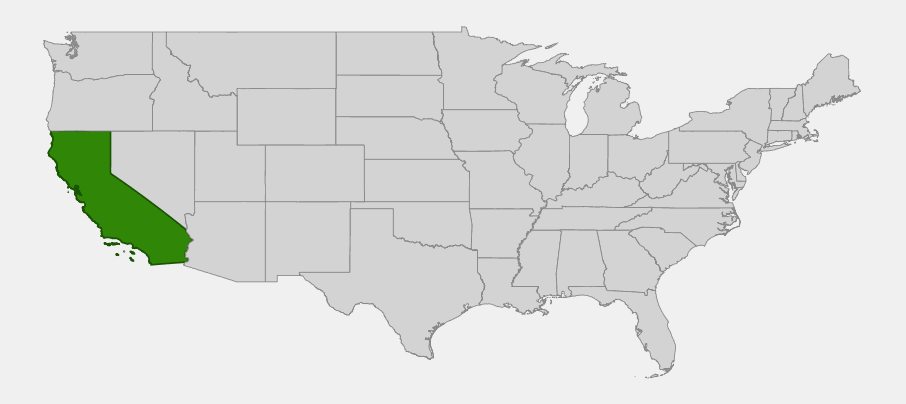
Hartweg’s wild ginger is native to California. USDA PLANTS lists it only from California, though some references also report it from adjacent southwestern Oregon. It ranges through the Sierra Nevada, the southern Cascade Range near Mount Shasta and Mount Lassen, the Klamath Mountains and the inner North Coast Ranges.
It grows in the shade of conifer and mixed forests, especially ponderosa pine, sugar pine, incense cedar, Douglas fir and black oak woodland, on slopes and benches with deep leaf litter. It tolerates drier sites than western wild ginger, often growing on well-drained slopes rather than in wet ravines, though it also follows shady streams.
It is found mainly at middle elevations in the mixed-conifer belt, where winters bring snow and summers are long and dry. Its evergreen leaves allow it to photosynthesize in spring and fall when the forest floor is moist.
📋 Regional plant lists featuring Hartweg’s Wild Ginger: California & Nevada
Growing & Care Guide
Hartweg’s wild ginger is an excellent evergreen groundcover for dry to moist shade in California gardens, especially under oaks and conifers. It is offered by some California native plant nurseries. It is slower to spread than western wild ginger, but its silver-veined leaves are more ornamental. Buy nursery-propagated plants and never dig them from the wild.
Light
Give it part to full shade. It thrives under trees and on the north side of buildings, and its leaves scorch in hot afternoon sun.
Soil & Water
Plant it in well-drained, humus-rich soil with a layer of leaf litter. Water regularly through the first summer; once established it tolerates dry summer shade far better than most wild gingers, though occasional deep summer watering keeps it looking its best. Avoid soggy soil.
Planting Tips
Plant in fall or early spring, spacing plants about 12 inches apart, with the rhizomes just at the soil surface. Mulch with leaf litter or fine bark. It pairs well with ferns, western trilliums, inside-out flower and other woodland natives in a shade garden. For a western wild ginger that likes wetter shade, see our western wild ginger guide.
Pruning & Maintenance
Little maintenance is needed. Remove tattered old leaves in late winter. Watch for slugs and snails, which can damage new leaves in moist gardens. Do not fertilize heavily.
Propagation
Divide established patches in fall or early spring by cutting rhizome sections with a few leaves and roots attached. Fresh seed can be sown immediately in a shaded pot of humus-rich mix; it germinates slowly and should not be allowed to dry out.
Landscape Uses
- Dry shade groundcover: evergreen cover under oaks and conifers where few plants grow
- Woodland gardens: silver-veined leaves brighten shady corners year-round
- Containers and borders: a striking foliage plant for shaded pots and edges
- Habitat restoration: for mixed conifer forest understories within its range
- Fire-wise plantings: low, evergreen foliage in shaded areas near homes
Wildlife & Ecological Value
Hartweg’s wild ginger is a small but distinctive member of the forest floor community in California’s mountains.
For Pollinators
Its ground-level flowers are thought to be visited mainly by flies, fungus gnats and other small insects that crawl through the leaf litter. The flowers can also self-pollinate.
For Birds
It is not an important bird food plant, but its evergreen cover shelters insects that ground-foraging birds such as towhees, thrushes and juncos eat.
For Mammals
Its aromatic, chemically defended foliage is rarely eaten by deer or rodents, which makes it useful in gardens with deer pressure.
Ecosystem Role
Its seeds carry oily appendages (elaiosomes) that attract ants, which carry the seeds to their nests, eat the appendages and discard the seeds, spreading the plant. Its evergreen leaves help hold soil and litter in place on shaded slopes.
Cultural & Historical Uses
The species honors Karl Theodor Hartweg, a German botanist and plant collector who traveled in Mexico, South America and California in the 1830s and 1840s for the Horticultural Society of London. Sereno Watson of Harvard described the species later in the nineteenth century.
Wild gingers have a long history of use as flavorings and folk medicines, and Native peoples in California used various wild gingers in traditional ways. However, modern research has shown that plants in the birthwort family contain aristolochic acid, which can cause serious kidney damage and is linked to cancer. Wild ginger should not be eaten, brewed or used as a substitute for culinary ginger.
Gardeners prize Hartweg’s wild ginger as one of the most attractive native foliage plants for dry shade in California, and it is a staple of woodland plantings at native plant gardens.
Frequently Asked Questions
Is Hartweg’s wild ginger edible?
No. Although it smells like ginger, it contains aristolochic acid, a compound that can cause kidney damage and is linked to cancer. Do not eat it or use it as a substitute for culinary ginger.
How is it different from western wild ginger?
Hartweg’s wild ginger has heavily silver-mottled leaves and grows in drier, inland mountain forests. Western wild ginger (Asarum caudatum) usually has plain green leaves and prefers moist, coastal and Northwest forests.
Does Hartweg’s wild ginger tolerate dry shade?
Yes, better than most wild gingers. Once established, it can handle dry summer shade under oaks and conifers, though occasional deep watering keeps it lush.
Where does Hartweg’s wild ginger grow?
In shaded mixed conifer and oak forests of the Sierra Nevada, southern Cascades, Klamath Mountains and inner North Coast Ranges of California, mostly at middle elevations.
Is Hartweg’s wild ginger deer resistant?
Yes. Its aromatic, chemically defended foliage is rarely eaten by deer, making it a good choice for deer-prone shade gardens.

Looking for a nursery that carries Hartweg’s Wild Ginger?
Browse our native plant nursery directory: California

