
Heartleaf Philodendron (Philodendron hederaceum)
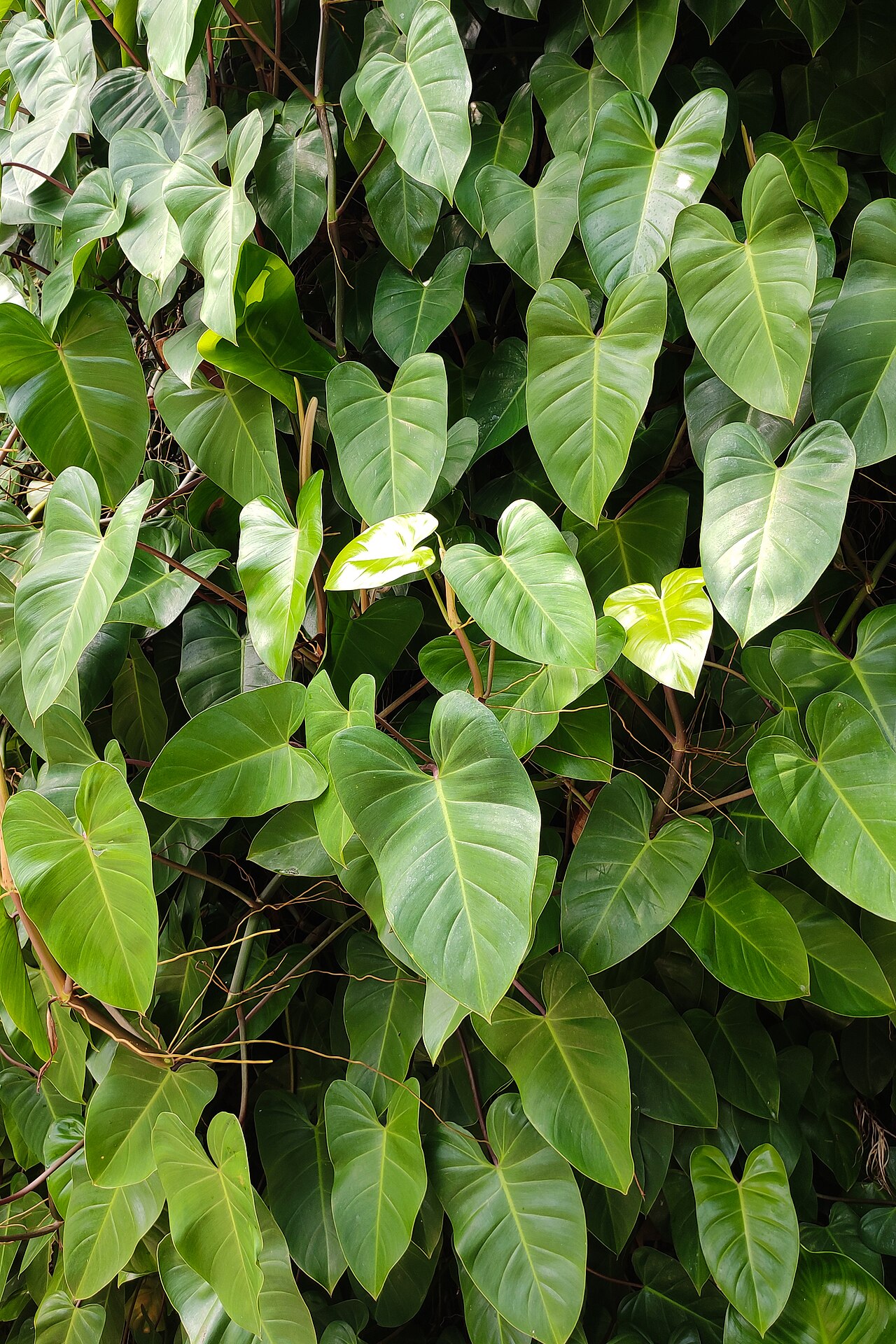
Philodendron hederaceum, the Heartleaf Philodendron, is one of the most widely grown houseplants in the world: the trailing vine with glossy, heart-shaped leaves that spills out of hanging baskets in homes, offices and shopping malls. Few people who grow it know that it is a wild plant of the American tropics, and that within the United States it is native to Puerto Rico and the U.S. Virgin Islands. It belongs to the arum family (Araceae), along with anthuriums, monsteras and the Puerto Rican giant philodendron.
Gardeners and nurseries know it under many names: sweetheart plant, heartleaf philodendron, and older scientific names such as Philodendron scandens, P. oxycardium and P. cordatum (a name that properly belongs to a different Brazilian species). The velvety, bronze-tinged plant sold as “Philodendron micans” is a juvenile form of the same species, and popular cultivars such as ‘Brasil’ (variegated) and ‘Lemon Lime’ (chartreuse) are selections of it. USDA PLANTS calls it vilevine.
In the wild, heartleaf philodendron is a climber of moist forests. It starts on the ground, creeps toward the dark base of a tree, and then climbs, clinging with aerial roots, its leaves growing much larger as it reaches the light. This guide covers how to recognize it, where it grows in Puerto Rico and beyond, how to grow it indoors and outdoors in zones 10–13, and the safety note every pet owner should know: all parts of the plant are toxic if chewed.
Identification
Heartleaf philodendron is often confused with golden pothos (Epipremnum aureum), a Pacific species that is not native to the Americas. The two look alike in hanging baskets, but the details of the leaves and new growth tell them apart.
Stems & Aerial Roots
The stems are slender, green, flexible and jointed, with a node every few inches. At each node the plant puts out aerial roots, which cling to bark, rock or a moss pole. In nature the vine can creep along the forest floor and then climb 10 to 20 feet or more into the trees. Indoors, trailing stems commonly reach 4 to 8 feet, and much longer on old plants.
Leaves
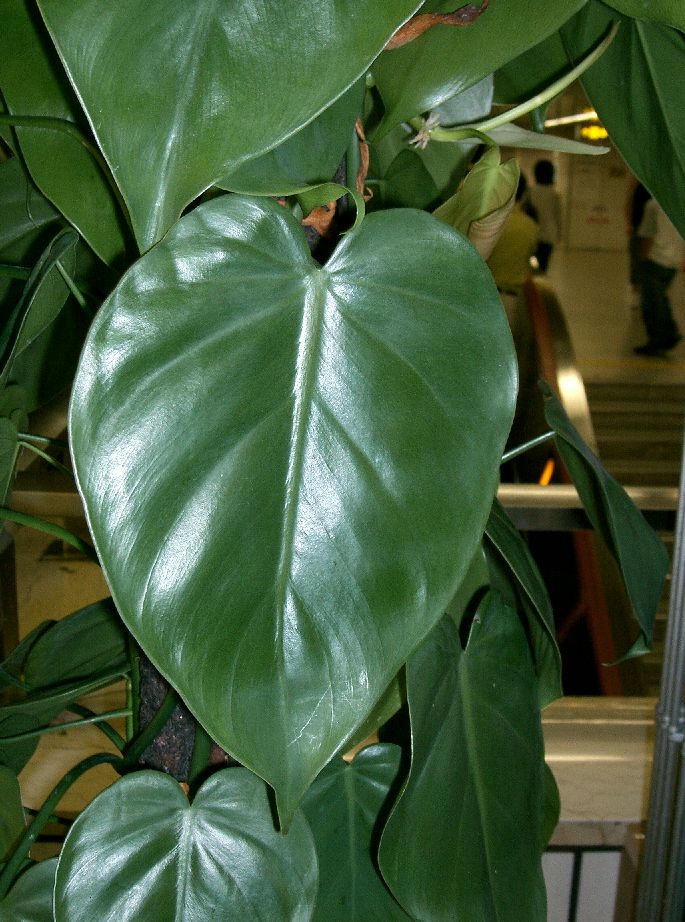
The leaves are heart-shaped (cordate) with a deep notch at the base and a narrow, drawn-out tip. On the common houseplant they are 2 to 5 inches long, smooth, glossy and medium to dark green. On plants climbing into good light in the wild, leaves can grow to a foot or more long. New leaves emerge from a thin sheath (a cataphyll), which dries and falls away. This is a good way to tell it from pothos, whose new leaves unroll from the previous leaf’s stalk and whose leaves are thicker, flatter at the base and usually streaked with yellow.
Juvenile leaves of some forms, sold as “micans,” have a velvety surface and a bronze or reddish sheen. Var. oxycardium, the classic houseplant, has smooth, plain green leaves.
Flowers
Like other aroids, heartleaf philodendron produces its tiny flowers on a fleshy spike (the spadix) wrapped in a leaf-like hood (the spathe). The spathe is greenish outside and often cream to reddish inside, and a few inches long. Female flowers sit at the bottom of the spadix, sterile flowers in the middle, and male flowers above. Mature plants in the wild flower regularly, but indoor plants, which stay in their juvenile form, almost never bloom.
Fruit
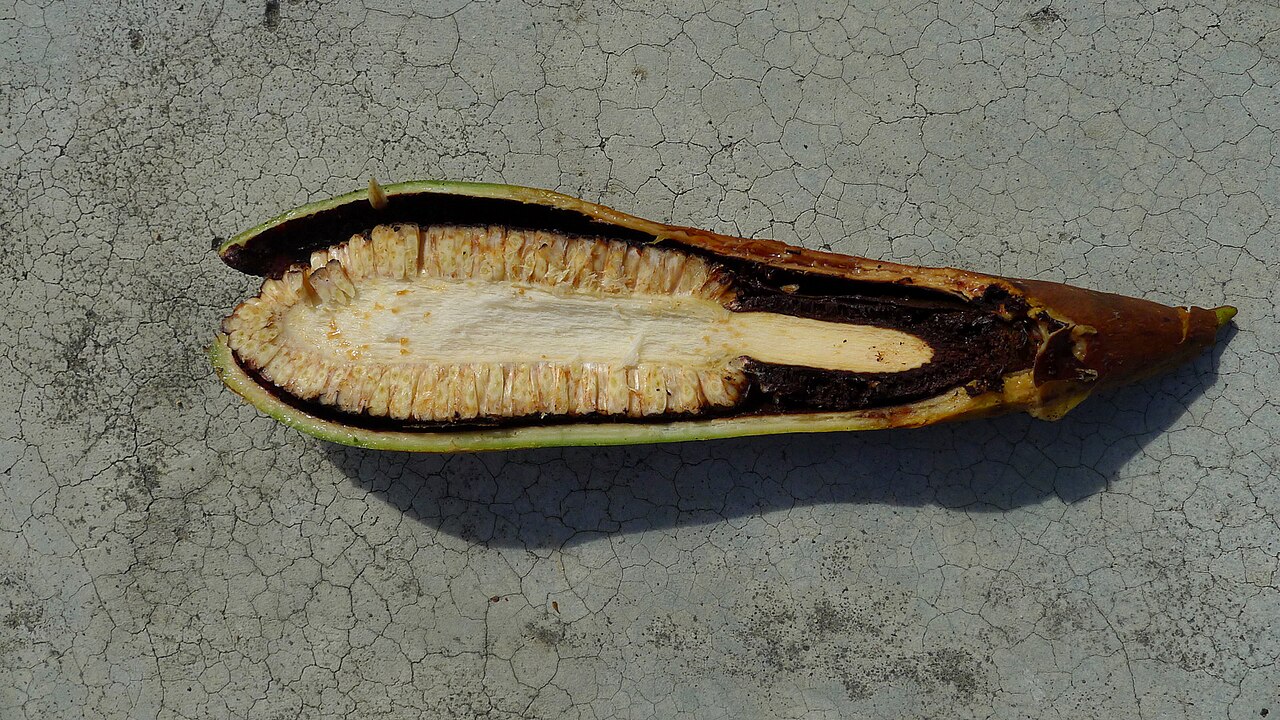
After pollination, the female part of the spadix ripens into a cluster of small, soft berries inside the spathe. Birds and other animals eat them and spread the seeds. Cultivated plants are propagated from cuttings rather than seed.
Quick Facts
| Scientific Name | Philodendron hederaceum (Jacq.) Schott (syn. P. scandens, P. oxycardium) |
| Family | Araceae (arum family) |
| Plant Type | Evergreen climbing or trailing vine (hemiepiphyte) |
| Mature Height | Indoors, trailing stems 4–8 ft or more; climbs 10–20 ft or more in the wild |
| Mature Spread | 1–3 ft in containers; spreads widely as a groundcover outdoors |
| Growth Rate | Fast |
| Sun Exposure | Part shade to full shade (bright, indirect light indoors) |
| Water Needs | Moderate; let the top inch of soil dry between waterings |
| Soil Type | Rich, loose, well-drained soil or potting mix high in organic matter |
| Soil pH | About 5.5–7.0 (slightly acidic to neutral) |
| Bloom Time | Irregular on mature wild plants; rarely flowers indoors |
| Flower Color | Greenish spathe, cream to reddish inside, around a cream spadix |
| Fall Color | None; evergreen |
| Fruit | Small, soft berries in a cluster on the spadix |
| Deer Resistant | Yes, generally; the calcium oxalate crystals deter browsing |
| USDA Hardiness Zones | 10–13 outdoors (damaged below about 50°F/10°C); houseplant everywhere |
Native Range
USDA PLANTS lists Philodendron hederaceum as native in Puerto Rico and the U.S. Virgin Islands and introduced in Florida and the Pacific island territories. Its wider native range covers the American tropics, from Mexico through Central America and the Caribbean islands to Bolivia and southeastern Brazil, making it one of the most widespread philodendrons in the wild. Several varieties are recognized across this range, and the familiar houseplant (var. oxycardium) originates from Mexico.
In Puerto Rico, heartleaf philodendron grows in moist and wet forests from the lowlands into the mountains. It scrambles over shady banks and rocks and climbs tree trunks, often with other aroids, ferns and bromeliads. It favors humid, sheltered spots such as ravines and stream valleys and is uncommon in the dry forests of the southwest.
In Florida, the plant persists and spreads from discarded cuttings in parts of the southern peninsula, where it is considered introduced. In Hawaii and the rest of the U.S., it is grown as a houseplant or as a landscape plant in frost-free gardens. Avoid dumping cuttings or old plants in natural areas, where it can root and spread.
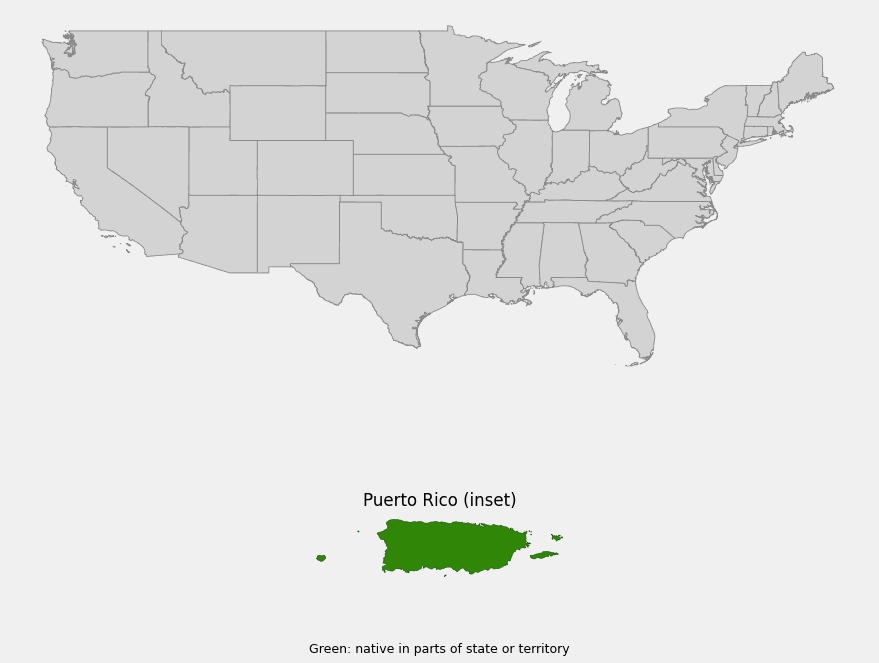
📋 Regional plant lists featuring Heartleaf Philodendron: Puerto Rico
Growing & Care Guide
Heartleaf philodendron has a reputation as one of the toughest houseplants, and it deserves it. It tolerates low light, irregular watering and dry indoor air better than most tropical plants. Outdoors in zones 10–13, including Puerto Rico, Hawaii and south Florida, it makes a vigorous groundcover or climber for shade. The main hazards are overwatering, cold, and pets or small children chewing the leaves.
Light
Indoors, give it bright, indirect light: near an east or north window, or a few feet back from a south or west window. It survives in low light, but growth becomes leggy with small leaves widely spaced along the stems. Direct afternoon sun bleaches or scorches the leaves. Outdoors, grow it in part to full shade, under trees or on the shady side of a building.
Soil & Water
Use a loose, well-drained potting mix rich in organic matter, such as a peat-free or peat-based mix with added bark and perlite, in a pot with drainage holes. Water when the top inch of soil is dry, and empty saucers so the roots never sit in water; root rot from overwatering is the most common way to kill it. Yellowing older leaves usually mean too much water, and curling, browning leaves mean too little. Feed lightly with a balanced houseplant fertilizer once a month in spring and summer. Keep it above about 55°F (13°C); cold drafts and temperatures near freezing damage the leaves.
Planting Tips
For a hanging basket, plant several rooted cuttings around the pot for a fuller look. For a climbing plant, give it a moss pole, a slab of bark or a trellis and tie young stems to it; climbing plants produce larger leaves than trailing ones. Outdoors in frost-free gardens, plant it at the base of a tree or a shady wall and let it climb, or let it run as a groundcover in moist shade. In Puerto Rico, choose locally sourced plants where possible.
Pruning & Maintenance
Pinch or cut back long, bare stems just above a leaf to make the plant bushier, and use the trimmings as cuttings. Wipe dusty leaves with a damp cloth. Repot every couple of years in spring when the roots fill the pot. Wear gloves if you have sensitive skin, because the sap can irritate, and wash your hands after pruning. Watch for mealybugs and scale insects on indoor plants.
Propagation
It is one of the easiest plants to propagate. Cut a stem piece with at least one or two nodes (the bumps where leaves and aerial roots grow), and root it in water or in moist potting mix. Roots appear within two to three weeks in warm conditions. Outdoors, stems that touch the ground root on their own. Do not discard cuttings in woods or wetlands, where they can establish outside the plant’s native range.
Landscape Uses
- Houseplant: hanging baskets, shelves, desks and low-light rooms; one of the easiest indoor plants to grow
- Climbing plant: on a moss pole or trellis indoors, or a shady tree trunk or wall outdoors in zones 10–13
- Shade groundcover: in moist, frost-free gardens in Puerto Rico, Hawaii and south Florida
- Native forest gardens in Puerto Rico: alongside ferns, anthuriums and palms in shady, humid plantings
- Terrariums and mixed planters: small cuttings stay compact for a long time in humid containers
Wildlife & Ecological Value
In the forests of Puerto Rico and the American tropics, heartleaf philodendron is part of the layer of vines and epiphytes that clothes tree trunks. Its leaves catch the dim light near the forest floor, and its spadix flowers and berries feed insects and birds.
For Pollinators
Philodendrons are pollinated mainly by beetles, especially scarab beetles. The inflorescence heats itself up and releases scent, typically in the evening. Beetles crowd into the spathe, feed on the sterile flowers and mate there, and leave the next night carrying pollen to another plant. Female flowers are receptive before the male flowers on the same spadix shed pollen, which favors cross-pollination.
For Birds
The small, soft berries are eaten by fruit-eating birds, which spread the seeds onto new trunks and forest floors.
For Mammals
Its calcium oxalate crystals make the leaves unpalatable to most mammals, so it is seldom browsed.
Ecosystem Role
As a hemiepiphyte, it roots in the soil but climbs into the canopy, adding structure and shelter for frogs, lizards and invertebrates on tree trunks. Its dense, overlapping leaves hold moisture and leaf litter on trunks and rocks, which helps mosses, ferns and other small plants to grow there.
Cultural & Historical Uses
The species was described by the Austrian botanist Nikolaus von Jacquin in the 18th century from the Caribbean, as Arum hederaceum; hederaceum means “ivy-like.” Heinrich Wilhelm Schott, who built the modern classification of aroids, moved it to Philodendron, a name from the Greek for “tree-loving.” Because the plant varies so much between its juvenile and adult forms, and from one part of its range to another, it was described under many names, and it took late 20th-century revisions of the genus to bring P. scandens, P. oxycardium and others together under one species.
Heartleaf philodendron became a mass-market houseplant in the United States in the mid-20th century, when Florida nurseries produced it in enormous numbers. Its tolerance for low light made it a staple of homes and offices. It is frequently mentioned in lists of air-purifying plants based on a 1989 NASA study, but later research found that houseplants have little measurable effect on indoor air quality in normal rooms. It is best grown for its beauty and toughness, not as an air filter.
For people in Puerto Rico, it is one of many wild aroids that are part of everyday forest scenery, and for people on the mainland it offers a simple connection to the tropical forests of the U.S. Caribbean. Growing it as a native plant in Puerto Rico, or as a houseplant elsewhere, is a reminder that many familiar houseplants are wild species with their own native ranges and ecology.
Frequently Asked Questions
Is heartleaf philodendron toxic to cats, dogs and children?
Yes. All parts contain needle-like calcium oxalate crystals. Chewing the leaves causes immediate pain, burning and swelling of the mouth, drooling, pawing at the mouth and sometimes vomiting. Serious poisoning is uncommon because the pain stops most animals and children quickly, but swelling can be dangerous. Keep plants out of reach of pets and small children, and contact a veterinarian, a doctor or Poison Control (1-800-222-1222 in the U.S.) if someone chews it.
Is Philodendron hederaceum native to the United States?
Yes, in Puerto Rico and the U.S. Virgin Islands, according to USDA PLANTS. It is not native to the mainland U.S. or Hawaii; in Florida it is an introduced escape from cultivation. Its native range extends from Mexico to Brazil and through the Caribbean.
How do I tell heartleaf philodendron from pothos?
Heartleaf philodendron has thinner, more strongly heart-shaped leaves with a drawn-out tip, slender stems, and new leaves that emerge from a papery sheath. Pothos has thicker, waxier leaves that are often streaked with yellow or white, a groove along the leaf stalk, and new leaves that unfurl directly from the previous leaf.
Why is my heartleaf philodendron leggy?
Long, bare stems with small, widely spaced leaves mean the plant needs more light. Move it to brighter, indirect light and cut the long stems back; the cuttings can be rooted and planted back in the same pot to make it fuller.
Can I grow heartleaf philodendron outdoors?
Yes, in frost-free climates (USDA zones 10–13), in part to full shade with moist, rich soil. In colder areas, move potted plants outside in summer to a shady porch and bring them in before night temperatures drop below about 55°F. Outside Puerto Rico and the Virgin Islands, keep it from spreading into natural areas.

Looking for a nursery that carries Heartleaf Philodendron?
Our nursery directory does not yet include Puerto Rico. Browse the native plant nursery directory by state: Alabama–Arkansas · California · Colorado–Hawaii · Idaho–Kansas · Kentucky–Montana · Nebraska–Oklahoma · Oregon · Pennsylvania–Virginia · Washington · West Virginia–Wyoming

