
Northern Ground-cedar (Lycopodium complanatum)
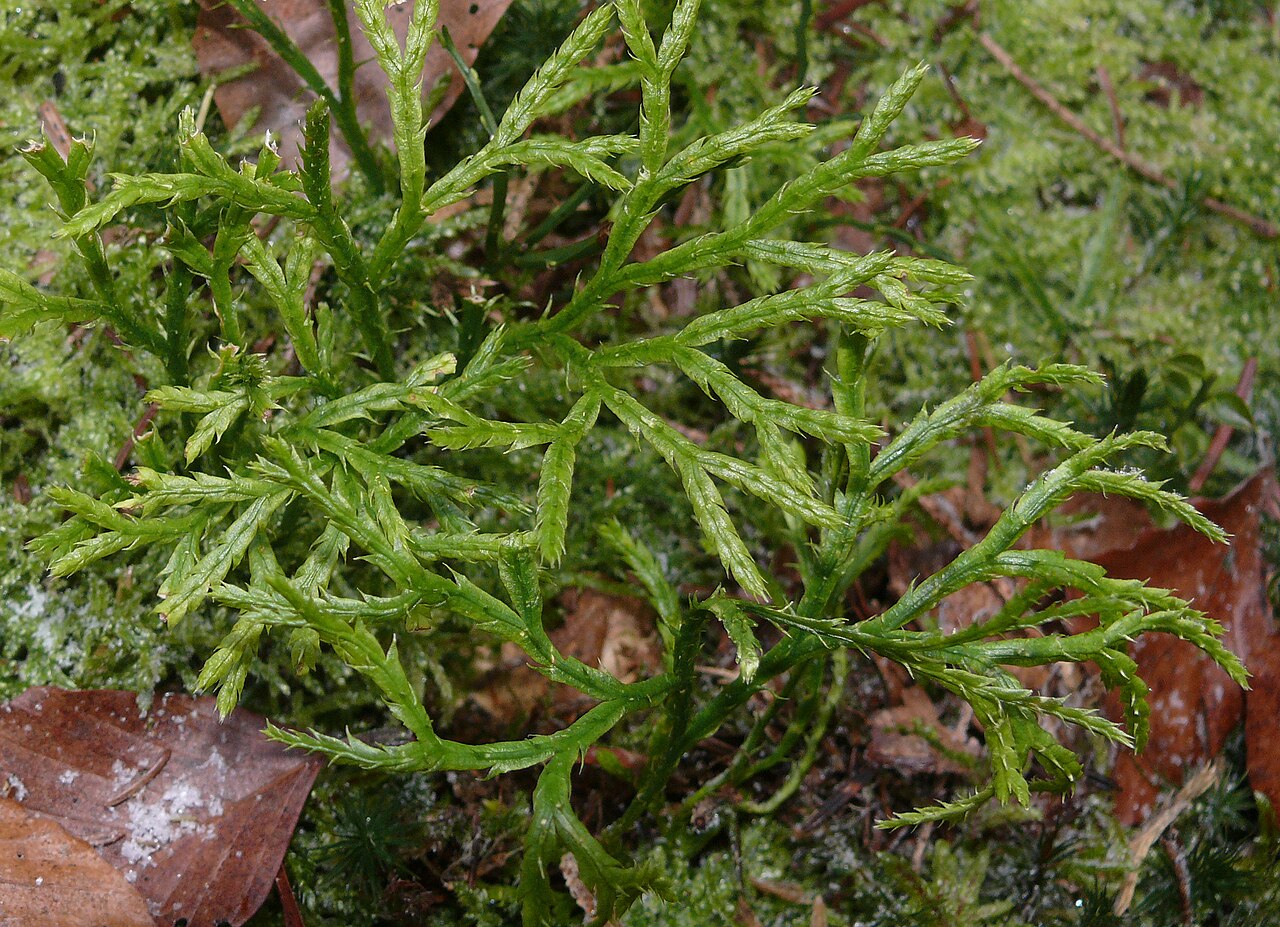
Lycopodium complanatum, the Northern Ground-cedar, is a low evergreen clubmoss of northern forests that looks like a carpet of miniature cedar sprigs. It is also called northern running-pine, running cedar, groundcedar and trailing clubmoss, and many current floras place it in the genus Diphasiastrum as Diphasiastrum complanatum. Its upright shoots branch into flat sprays of tiny scale leaves, and colonies spread over the forest floor on stems that creep along the surface.
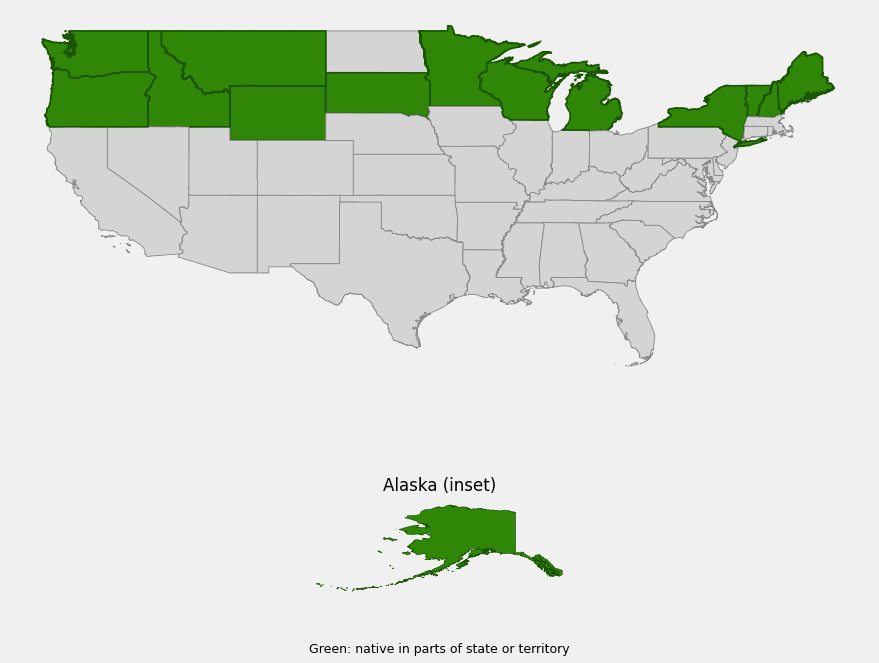
Clubmosses are not mosses and not conifers. They are spore-bearing vascular plants, the living descendants of a very old lineage whose tree-sized relatives formed much of the coal of the Carboniferous period. Northern ground-cedar is circumboreal, growing across northern Europe, Asia and North America. In the United States it is native from Alaska and the Pacific Northwest across the northern Rockies and upper Midwest to New York and northern New England.
This page is an identification and appreciation guide. Northern ground-cedar can’t be grown from nursery stock and does not transplant reliably, because its spores grow into tiny underground plants that depend on soil fungi and may take years to mature. Never dig it from the wild or collect it for holiday wreaths. Like other clubmosses it contains alkaloids and should not be eaten, and its dry spores are highly flammable.
Identification
Northern ground-cedar belongs to a small group of flat-branched clubmosses that are easy to confuse. The best clues are its narrow branchlets with yearly constrictions, the depth of its creeping stems and the number of cones on each stalk.
Stems
The main horizontal stems creep on the ground surface or just beneath the leaf litter and moss, sometimes for several feet, rooting at intervals. Upright shoots arise along them, usually 4 to 14 inches tall, and branch irregularly into flat, spreading sprays. Unlike the fan-shaped tops of Fan Clubmoss, the branching of northern ground-cedar is irregular and often looks untidy.
Leaves & Branchlets
The branchlets are flattened, about 1/16 to 1/8 inch wide, and covered in tiny scale-like leaves in four rows. They are green to yellow-green and stay green through winter. A key clue is the “waists”: each year’s growth begins with a visible constriction, so the branchlets look jointed or beaded at intervals. Fan clubmoss lacks these annual constrictions.
Spore Cones
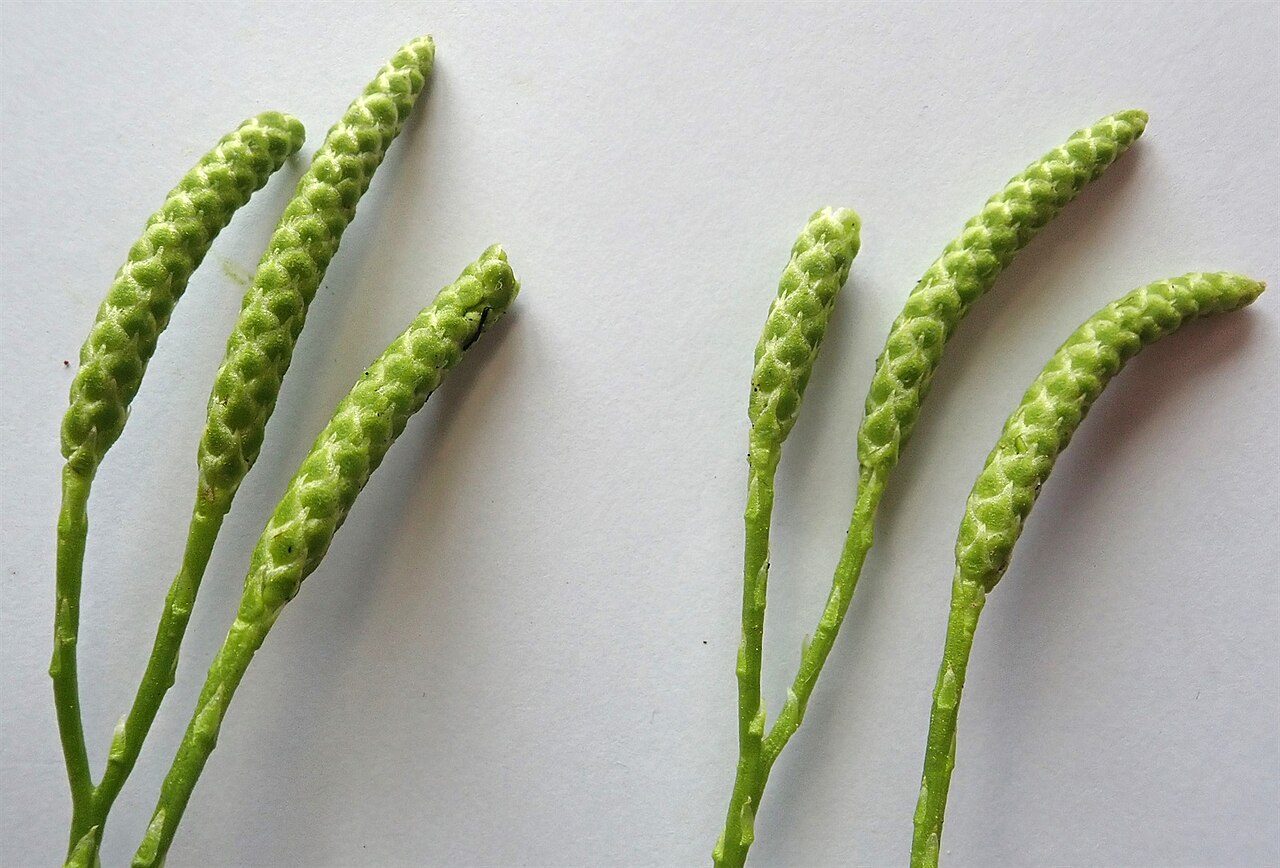
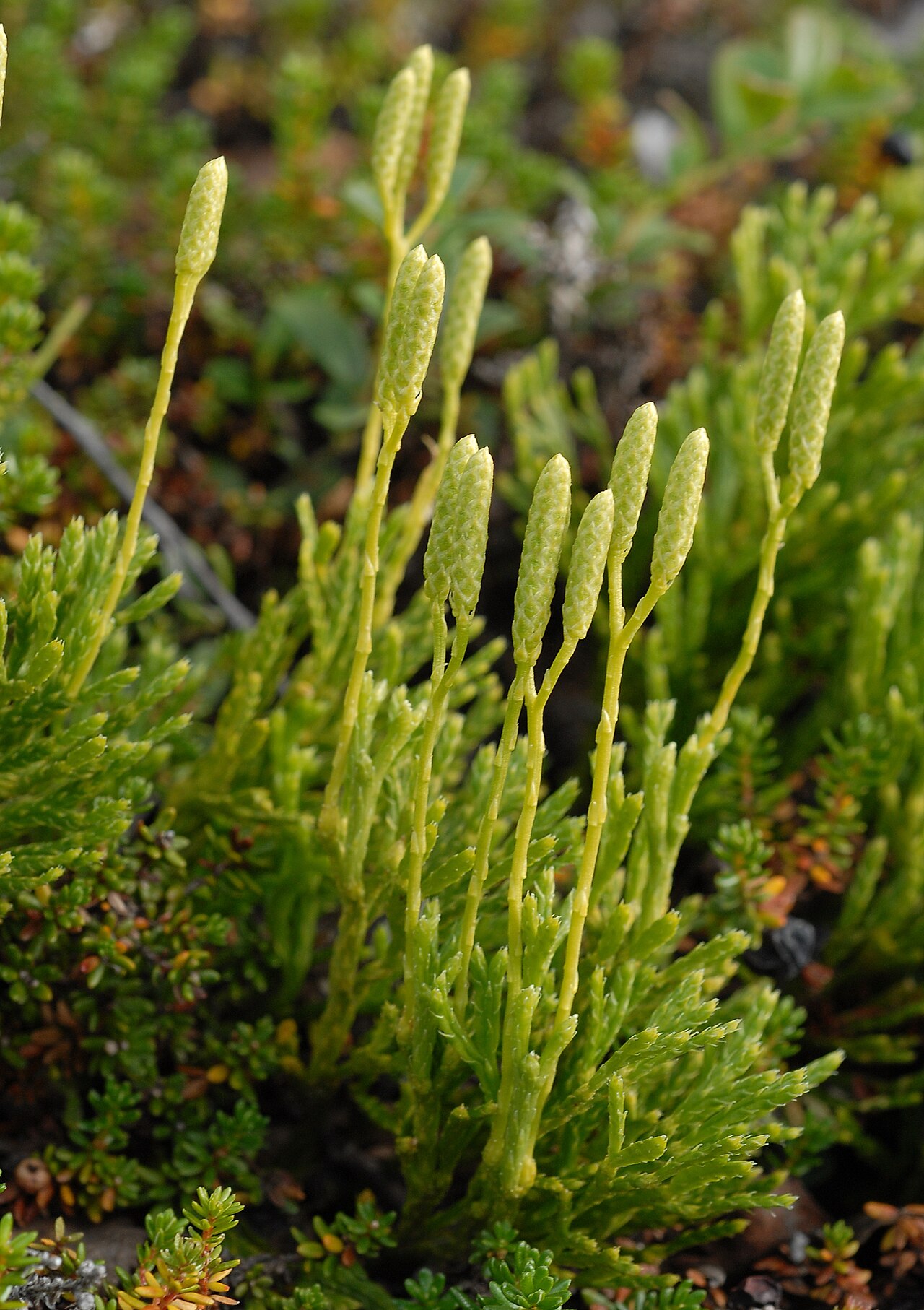
In summer, fertile shoots produce a slender stalk that ends in one or two (rarely up to four) narrow, cylindrical spore cones (strobili), each about 1/2 to 1 inch long. They ripen from green to yellow in late summer and fall and release clouds of fine yellow spores. Fan clubmoss typically has three or four cones held on a branched stalk.
Life Cycle
Like all clubmosses, it alternates between two very different stages. A spore that lands in suitable soil can grow into a tiny, carrot-shaped, non-green gametophyte that lives underground and gets its food from mycorrhizal fungi. It may take many years to mature and produce sperm and eggs. After fertilization a new green plant grows from it. Because this is so slow and uncertain, most colonies grow mainly by their creeping stems.
Similar Species
Look-alikes include Fan Clubmoss (southern running-pine), which has fan-shaped tops and no annual constrictions; blue ground-cedar (Diphasiastrum tristachyum), which is bluish green with stems running deeper in the soil; and Sitka clubmoss (Diphasiastrum sitchense) of alpine areas, with round, not flattened, branchlets. Hybrids among these species are common and can be hard to name. Bushier tree clubmosses such as Flat-branched Tree Clubmoss and Prickly Tree Clubmoss form little trees with stems running deep underground, while Running Clubmoss and Stiff Clubmoss have needle-like leaves on round stems.
Quick Facts
| Scientific Name | Lycopodium complanatum L. (syn. Diphasiastrum complanatum (L.) Holub) |
| Family | Lycopodiaceae (clubmoss family) |
| Plant Type | Evergreen clubmoss (spore-bearing ground cover) |
| Mature Height | 4–14 in |
| Mature Spread | Colonies spread several feet to many yards over decades |
| Growth Rate | Very slow |
| Sun Exposure | Part shade to fairly open sun |
| Water Needs | Medium; tolerates dry, sandy sites |
| Soil Type | Acid, nutrient-poor, sandy or rocky soil with leaf litter or moss |
| Soil pH | About 4.5–6.0 |
| Bloom Time | None (spores released late summer–fall) |
| Flower Color | None; yellow-green spore cones |
| Fall Color | None; evergreen |
| Fruit | None; spores in narrow cones on slender stalks |
| Deer Resistant | Yes; rarely browsed |
| USDA Hardiness Zones | 2–6 (not grown in gardens) |
Native Range
USDA PLANTS lists northern ground-cedar as native in Alaska, Washington, Oregon, Idaho, Montana, Wyoming, South Dakota, Minnesota, Wisconsin, Michigan, New York, Vermont, New Hampshire and Maine, as well as across Canada from Yukon and British Columbia to Newfoundland and Labrador. It is a northern plant: in the lower 48 it is most common in the upper Great Lakes, the Adirondacks and northern New England, and it becomes scattered and local in the West, where it grows in mountain forests of northern Idaho, northeastern Washington, Montana and the Black Hills.
It grows in dry to moist coniferous and mixed forests, open woods of jack pine, red pine, aspen and birch, forest edges, old clearings and rocky or sandy openings, usually in acid soils with a layer of moss or needles. In Oregon and Wyoming it is rare. Because the flat-branched clubmosses hybridize and are often misidentified, state records can differ between sources.
Outside North America it grows across northern and central Europe and northern Asia, which makes it one of the most widespread clubmosses in the Northern Hemisphere.
📋 Regional plant lists featuring Northern Ground-cedar: Alaska · Montana & Wyoming · North Dakota, South Dakota & Western Minnesota · Michigan, Wisconsin & Eastern Minnesota · New York, Pennsylvania & Northern New Jersey · Delaware, Southern New Jersey & Long Island · New Hampshire, Maine & Vermont
Can You Grow It?
Honestly, no. Northern ground-cedar is a plant to admire and protect where it already grows, not one to plant. It is not available as nursery-propagated stock, transplanted pieces almost always die, and growing it from spores is not practical, because the spores need specific soil fungi and the underground gametophytes can take many years to produce a new plant. Never dig it from the wild or harvest it for wreaths and garlands. The sections below describe the conditions it needs and how to care for a colony on your property.
Light
In the wild it grows in light to moderate shade under open pine, aspen and birch, and in partly sunny clearings and forest edges. Colonies thin out in deep shade under a dense canopy.
Soil & Water
It needs acid, nutrient-poor, well-drained soil, often sandy or rocky, with a natural layer of needles, leaves or moss. It handles dry spells once established, but not compacted, limed, fertilized or rich garden soil.
Planting Tips
Do not try to plant it. If a colony grows on your land, protect the area around it: avoid trampling, raking away the litter, mulching over it, or driving equipment across it, and keep it out of construction and logging disturbance. For a cultivated evergreen ground cover in similar shady, acid sites, try nursery-grown Checkerberry, Bunchberry or Kinnikinnik.
Pruning & Maintenance
No maintenance is needed. Don’t cut the shoots for decorations; heavy harvesting for Christmas greens has depleted clubmoss colonies in the past, and cut stems regrow very slowly. Removing invasive shrubs that crowd into a colony is helpful.
Propagation
It spreads naturally by creeping stems and, rarely, by spores. Researchers have grown clubmoss gametophytes in the lab, but this is slow, specialized work. For gardeners, propagation is not practical: leave wild plants in place.
Where to See It
- Northern forests: look for it in open pine, aspen and birch woods of the upper Midwest, Adirondacks and northern New England
- Forest edges and clearings: it often colonizes old logging roads, clearings and young forest on sandy, acid soil
- Western mountains: scattered in conifer forests of northern Idaho, northeastern Washington and Montana
- Winter walks: the evergreen sprays stand out when the ground is bare in late fall and early spring
- Alaska and Canada: common across the boreal forest from Alaska to Newfoundland
Wildlife & Ecological Value
Clubmosses do not flower or fruit, but their evergreen mats are part of the ground layer of northern forests.
For Pollinators
It has no flowers, nectar or usable pollen, so it offers nothing to pollinators. Its spores are dispersed by wind.
For Birds
The low mats give cover to ground-feeding birds and the insects and spiders they eat. Birds do not generally eat the plant.
For Mammals
Deer and other mammals rarely browse it, probably because of its tough texture and alkaloids. Small mammals, salamanders and invertebrates shelter under the mats.
Ecosystem Role
Its underground gametophyte stage lives in partnership with mycorrhizal fungi, linking it to the fungal networks of the forest soil. Colonies can persist for decades, and the evergreen shoots keep photosynthesizing in spring and fall when the canopy is bare.
Cultural & Historical Uses
Flat-branched clubmosses such as northern ground-cedar have long been gathered for Christmas wreaths and garlands, under names like running cedar and ground pine. Large commercial harvests in the 20th century depleted many colonies, and some states now restrict collecting clubmosses. Clubmoss spores, sold as lycopodium powder, were used for flash powder in early photography and in theatrical fireworks, as a coating for pills, and in laboratory demonstrations, because the fine powder ignites in a sudden flash when dusted into a flame.
Plants in this family have been used in folk medicine in Europe and North America, and some Indigenous peoples of northern North America used flat-branched clubmosses medicinally or as a dye. Lycopodium means “wolf’s foot,” from the shape of the shoots, and complanatum means “flattened,” for the branchlets. Some floras now separate the flat-branched species into the genus Diphasiastrum.
Safety note: clubmosses contain alkaloids, and some are toxic if eaten. Don’t eat or brew any part of northern ground-cedar, and keep it away from pets and children. The dry spores are extremely flammable and can flare up or explode as a dust cloud near a flame, so never handle large amounts near fire, and avoid inhaling the dust.
Frequently Asked Questions
Is northern ground-cedar the same as Diphasiastrum complanatum?
Yes. USDA PLANTS lists it as Lycopodium complanatum, while many floras now place the flat-branched clubmosses in Diphasiastrum, as Diphasiastrum complanatum. It is also called northern running-pine, running cedar and groundcedar.
Can I buy or transplant ground cedar?
No reliable source sells nursery-propagated plants, and transplanted clumps almost always die because the plant depends on specific soil conditions and fungi. Never dig it from the wild. Choose a nursery-grown evergreen ground cover such as checkerberry or bunchberry instead.
How do I tell northern ground-cedar from fan clubmoss?
Northern ground-cedar has irregular branching and narrow branchlets with visible yearly constrictions, and usually one or two cones per stalk. Fan clubmoss has neat, fan-shaped tops, no constrictions and three or four cones on a branched stalk. Hybrids between them occur.
Is ground cedar poisonous?
It should not be eaten. Clubmosses contain alkaloids, and some species are toxic. Keep it away from pets and children, and don’t use it for homemade teas or remedies.
Why are clubmoss spores flammable?
The spores are tiny, dry and oily, so a cloud of them burns almost instantly. This is why lycopodium powder was once used for flash photography and stage effects. Keep spore dust away from flames.

Looking for a nursery that carries Northern Ground-cedar?
Browse our native plant nursery directory: Alaska · Idaho · Maine, Michigan, Minnesota & Montana · New Hampshire & New York · Oregon · South Dakota & Vermont · Washington · Wisconsin & Wyoming

