
Prickly Tree-Clubmoss (Lycopodium dendroideum)
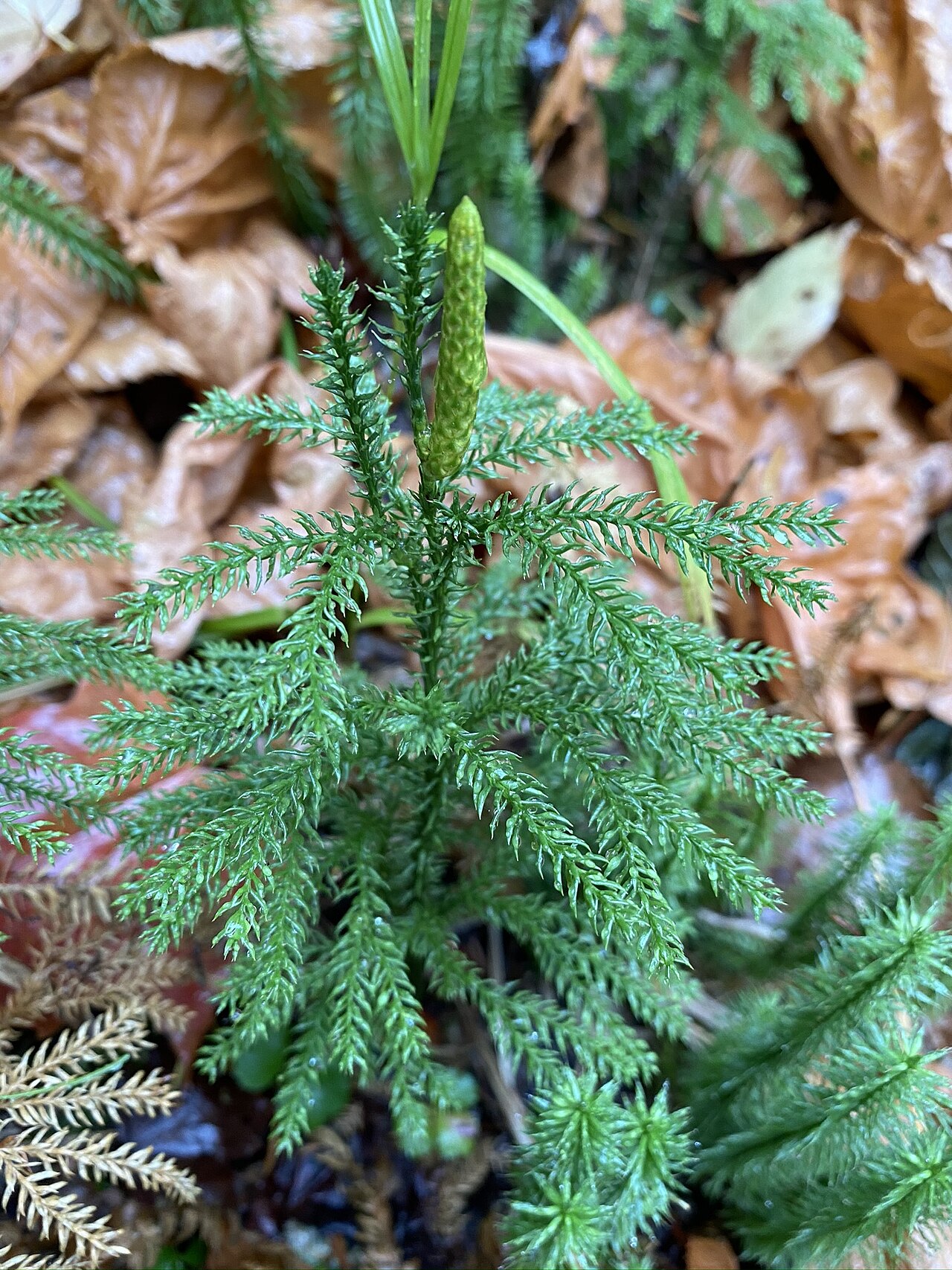
Lycopodium dendroideum, the Prickly Tree-Clubmoss, is a small evergreen plant that looks like a grove of tiny pine or spruce trees on the forest floor. Its upright shoots, usually 4 to 12 inches tall, branch into a bushy, tree-shaped crown and rise at intervals from stems that creep underground. It is also called tree groundpine (its USDA PLANTS name), ground pine and princess pine. Many current floras place it in the genus Dendrolycopodium, as Dendrolycopodium dendroideum.
It is one of three very similar tree-clubmosses. It is told apart from Flat-Branched Tree-Clubmoss (Lycopodium obscurum) by its round, not flattened, side branches and the spreading, prickly leaves on its main stem. Unlike that mostly eastern species, prickly tree-clubmoss ranges right across northern North America, from Newfoundland and New England to Alaska, Washington and the northern Rockies, and it also grows in northeastern Asia.
Clubmosses are not mosses but lycophytes, an ancient lineage of spore-bearing vascular plants. Like its relatives it depends on soil fungi during its slow underground life stage, it cannot be grown from nursery stock in any practical way, and dug plants almost never survive. This page is an identification and appreciation guide. Never dig it or cut it for decorations. Like other clubmosses it contains alkaloids and should never be eaten.
Identification
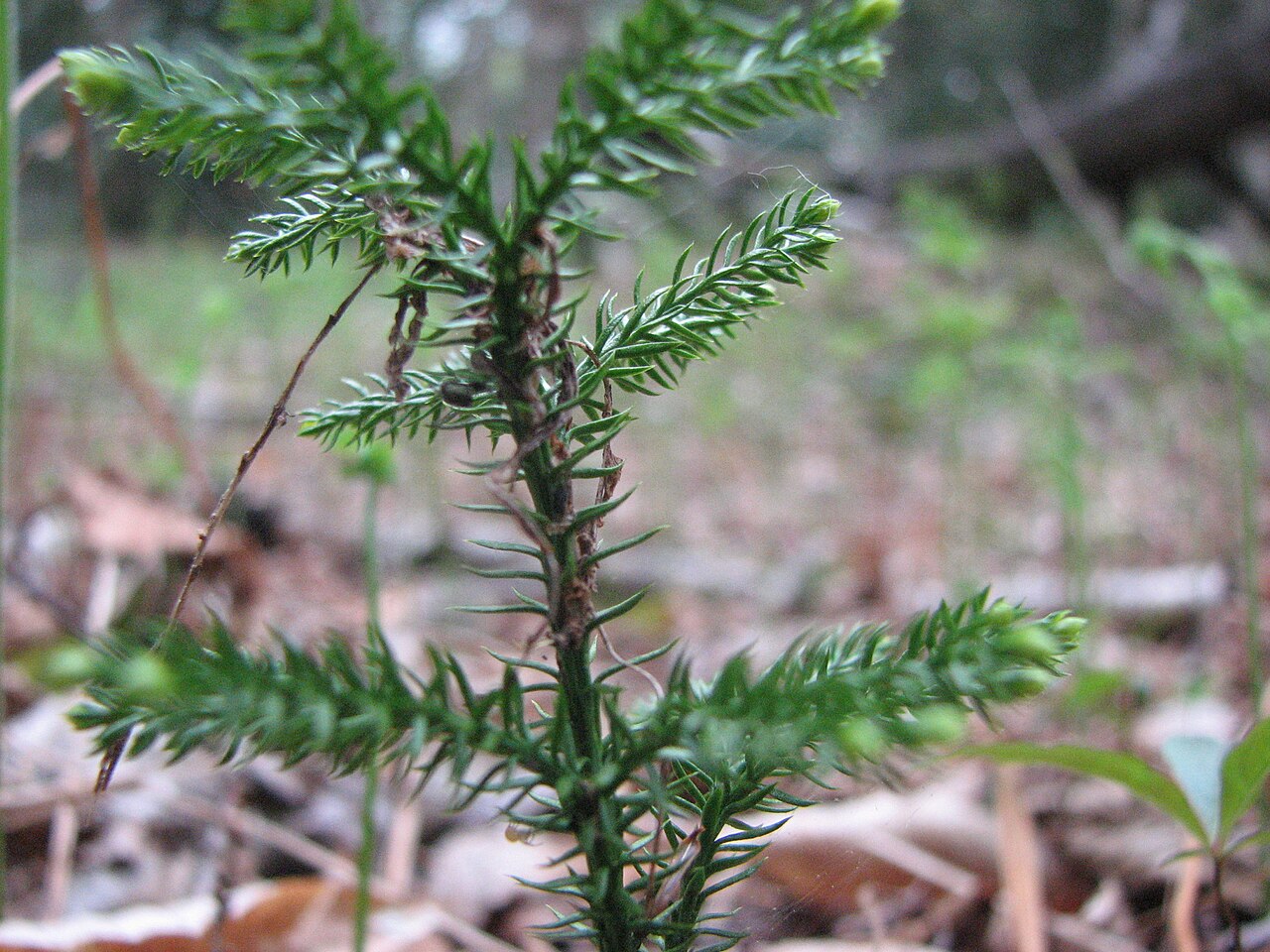
Look for a tree-shaped evergreen shoot whose main stem bristles with spreading, prickly leaves below the branches, and whose side branches are round in cross-section with leaves of equal size all around.
Growth Form
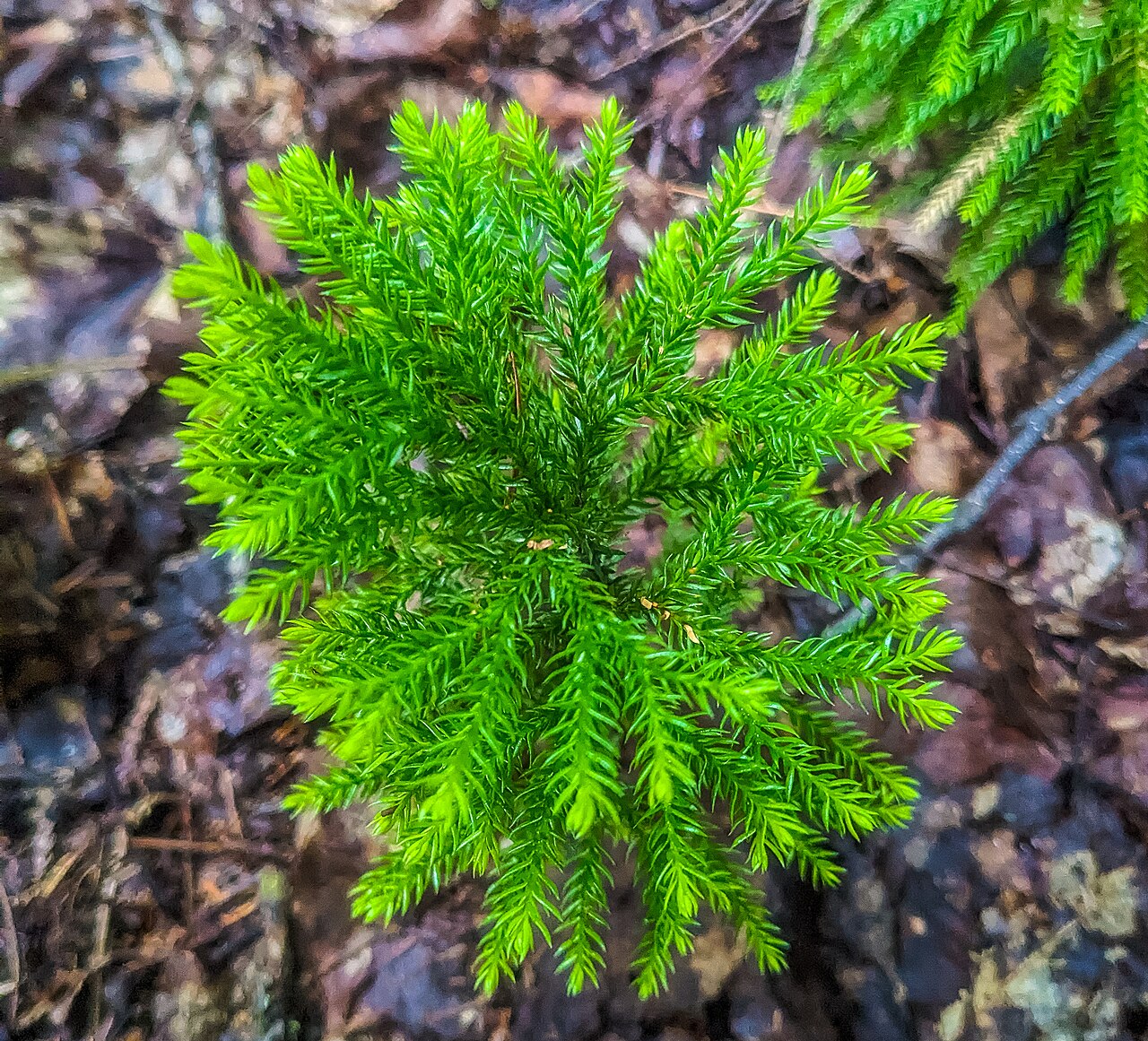
A horizontal stem runs several inches below the soil surface. Upright shoots rise from it at intervals, each with a single main stem that branches repeatedly into a bushy, tree-like crown about 4 to 12 inches tall. A colony, all linked underground, looks like a stand of evergreen seedlings.
Leaves & Branches
The leaves are small, narrow and needle-like, about 1/8 to 1/4 inch long. On the main stem below the branches they spread outward and feel prickly, the feature behind the name. The side branches are round in cross-section, with six ranks of leaves all about the same size, so they look like tiny bottlebrushes. The plant is deep green all year.
Spore Cones
In summer, one to several slender, yellowish spore cones (strobili), about 1 to 2 1/2 inches long, form directly at the tips of the upper branches, without a separate stalk. They release fine yellow spores in late summer and fall and may persist, dry and tan, into winter.
Look-alikes
Flat-Branched Tree-Clubmoss (Lycopodium obscurum) has leaves pressed flat against the lower main stem, so the stem looks smooth, and its side branches are flattened, with smaller leaves on the underside. Hickey's tree-clubmoss (Dendrolycopodium hickeyi) has round side branches like this species but smooth, appressed leaves on the main stem. Fan Clubmoss, Running Clubmoss and Stiff Clubmoss lack the tree-like shape, and the first two carry their cones on long stalks.
Life Cycle
Spores that land in suitable soil can grow into tiny underground gametophytes that lack chlorophyll and live on sugars supplied by soil fungi, sometimes for many years before producing a new green plant. Because this stage is slow and uncertain, most colonies spread by their underground stems.
Quick Facts
| Scientific Name | Lycopodium dendroideum (syn. Dendrolycopodium dendroideum) |
| Family | Lycopodiaceae (clubmoss family) |
| Plant Type | Evergreen lycophyte (clubmoss); reproduces by spores |
| Mature Height | 4–12 in |
| Mature Spread | Underground stems form colonies several feet to many yards across |
| Growth Rate | Very slow to establish; colonies spread slowly |
| Sun Exposure | Part shade to shade; tolerates open woods and clearings |
| Water Needs | Medium; moist but well-drained soil |
| Soil Type | Acid, humus-rich sandy or loamy forest soils |
| Soil pH | Acid (about 4.5–6.0) |
| Bloom Time | Does not flower; spores released late summer–fall |
| Flower Color | None; spore cones yellowish turning tan |
| Fall Color | None; evergreen |
| Fruit | None; stalkless spore cones (strobili) at the branch tips |
| Deer Resistant | Yes; rarely browsed |
| USDA Hardiness Zones | 2–7 |
Native Range
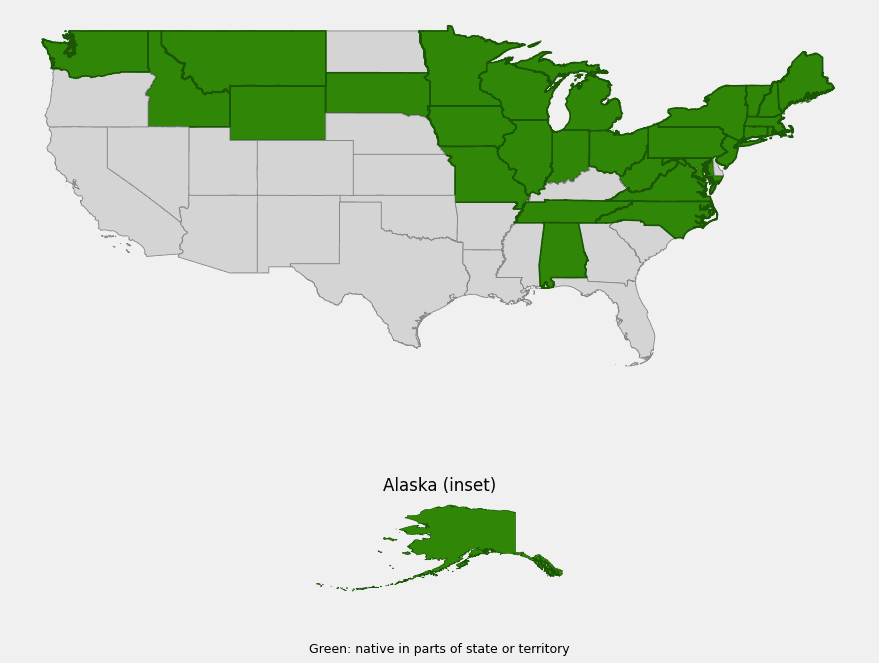
USDA PLANTS lists prickly tree-clubmoss as native in Alaska and 28 states of the lower 48, from Maine to Washington: Alabama, Connecticut, Idaho, Illinois, Indiana, Iowa, Maine, Maryland, Massachusetts, Michigan, Minnesota, Missouri, Montana, New Hampshire, New Jersey, New York, North Carolina, Ohio, Pennsylvania, Rhode Island, South Dakota, Tennessee, Vermont, Virginia, Washington, West Virginia, Wisconsin and Wyoming. In Canada it grows in every province and in the Yukon and Northwest Territories, and it also occurs in northeastern Asia.
It is most common in New England, New York, the northern Great Lakes states and Canada. Southward it follows the Appalachian Mountains to Tennessee, North Carolina and outlying records in Alabama, and its records in Iowa, Missouri and South Dakota are scattered and outlying. In the West it grows in Alaska, northern Idaho, Montana and Wyoming, and in Washington, including the west slope of the North Cascades.
It grows in moist to fairly dry acid woods: northern hardwood and mixed conifer forests, aspen and birch stands, pine and spruce woods, forest clearings and the edges of bogs. It often appears in young, regrowing forests and is somewhat more tolerant of open, sunny ground than flat-branched tree-clubmoss.
📋 Regional plant lists featuring Prickly Tree-Clubmoss: New York, Pennsylvania & Northern New Jersey · Idaho, Eastern Oregon & Eastern Washington · Ohio & Indiana · Montana & Wyoming · Michigan, Wisconsin & Eastern Minnesota · Kentucky & Tennessee · Connecticut, Massachusetts & Rhode Island · New Hampshire, Maine & Vermont · Maryland, Virginia & West Virginia · Delaware, Southern New Jersey & Long Island · Illinois, Iowa & Missouri · Alabama, Georgia & Mississippi · Alaska · North & South Carolina · North Dakota, South Dakota & Western Minnesota · Western Oregon & Western Washington
Can You Grow It?
Prickly tree-clubmoss is a plant to admire and protect, not to plant. Nursery-propagated stock is essentially unavailable, dug plants almost always die, and its life cycle depends on fungi in undisturbed forest soil. Never dig it from the wild or cut it for wreaths. The notes below describe the conditions it needs and how to look after colonies that already grow on your land.
Light
In the wild it grows in light to moderate shade under hardwoods and conifers, and in partly open clearings and young forests. Colonies decline under deep, dense shade or on fully exposed, dry ground.
Soil & Water
It needs acid, well-drained soil with a layer of decaying leaves or needles, usually sandy or loamy and low in nutrients, that stays moist for much of the season. Lime, fertilizer, soil compaction and the disturbed soil of garden beds work against it.
Planting Tips
This is not a garden plant. Dug clumps carry only a short section of the underground stem and almost always die within a year or two. If a colony grows on your property, protect it: keep foot traffic, digging and machinery away, leave the leaf litter in place, and do not mulch, lime or fertilize. For a planted evergreen ground cover in shade, consider Partridgeberry or Checkerberry instead.
Pruning & Maintenance
No maintenance is needed. Do not cut shoots for holiday decorations. Removing invasive plants that crowd into a colony is the most helpful thing a landowner can do.
Propagation
It spreads naturally by its underground stems and, rarely, by spores. Spores grow into underground gametophytes that need soil fungi and may take years to produce a new plant, so propagation is not practical. Leave wild plants in place.
Where to See It
- Northern woods: common in New England, the Great Lakes states and across Canada, often in young, regrowing forests
- Appalachian forests: in cool, acid woods of the mountains south to Tennessee and North Carolina
- Western forests: in northern Idaho, Montana, Washington and Alaska; look in moist conifer woods and clearings
- Winter walks: its deep green shoots stand out against snow and brown leaves
- Nature study: an easy-to-find example of the ancient lycophyte lineage and plant-fungus partnerships
Wildlife & Ecological Value
Prickly tree-clubmoss is not a food plant, but its evergreen shoots add year-round cover to the forest floor.
For Pollinators
Clubmosses do not flower and produce no nectar, so it has no value for pollinators. Its spores are spread by wind.
For Birds
Colonies give some cover to ground-feeding and ground-nesting birds and to the insects and spiders they eat.
For Mammals
Deer and other mammals rarely browse it, likely because of its tough texture and alkaloids. Small mammals, salamanders and invertebrates shelter among the shoots.
Ecosystem Role
Its underground gametophyte stage depends on mycorrhizal fungi, linking it to the fungal networks of forest soil. The evergreen shoots keep photosynthesizing in spring and fall when the canopy above is bare, and long-lived colonies help hold litter and soil in place.
Cultural & Historical Uses
The name Lycopodium means “wolf foot,” from the Greek words for wolf and foot, describing the furry-looking branch tips of some clubmosses. Dendroideum means “tree-like.”
Tree-clubmosses were once gathered in huge quantities for Christmas wreaths, garlands and decorations, which depleted colonies in parts of the Northeast. Because they recover so slowly, many conservation groups urge people never to collect them, and some states restrict commercial harvest.
The dry, oily spores of clubmosses, known as lycopodium powder, were once used for camera flash powder, fireworks and coating pills. Clubmosses contain alkaloids and are toxic if eaten.
Frequently Asked Questions
How do I tell prickly tree-clubmoss from flat-branched tree-clubmoss?
Check the main stem below the branches: prickly tree-clubmoss has spreading, prickly leaves there, while flat-branched tree-clubmoss has smooth, flat-lying leaves. The side branches of prickly tree-clubmoss are round, while those of flat-branched tree-clubmoss are flattened.
Is it a moss?
No. Clubmosses are lycophytes, vascular plants with true roots, stems and leaves that reproduce by spores. They belong to an ancient lineage that once included tree-sized plants of the coal-age forests.
Can I transplant it into my garden?
No. Dug plants almost never survive, because the plant depends on its long underground stems and on soil fungi. Protect colonies where they grow and choose a nursery-grown ground cover instead.
Is it safe to use in wreaths?
Please don’t. Colonies take many years to recover from harvest. Use cultivated greenery instead.
Is it poisonous?
Clubmosses contain alkaloids and should not be eaten. Handling the plant is not known to be harmful.

Looking for a nursery that carries Prickly Tree-Clubmoss?
Browse our native plant nursery directory: Alabama & Alaska · Connecticut · Idaho, Illinois, Indiana & Iowa · Maine, Maryland, Massachusetts, Michigan, Minnesota, Missouri & Montana · New Hampshire, New Jersey, New York, North Carolina & Ohio · Pennsylvania, Rhode Island, South Dakota, Tennessee, Vermont & Virginia · Washington · West Virginia, Wisconsin & Wyoming