
Dwarf Raspberry (Rubus pubescens)
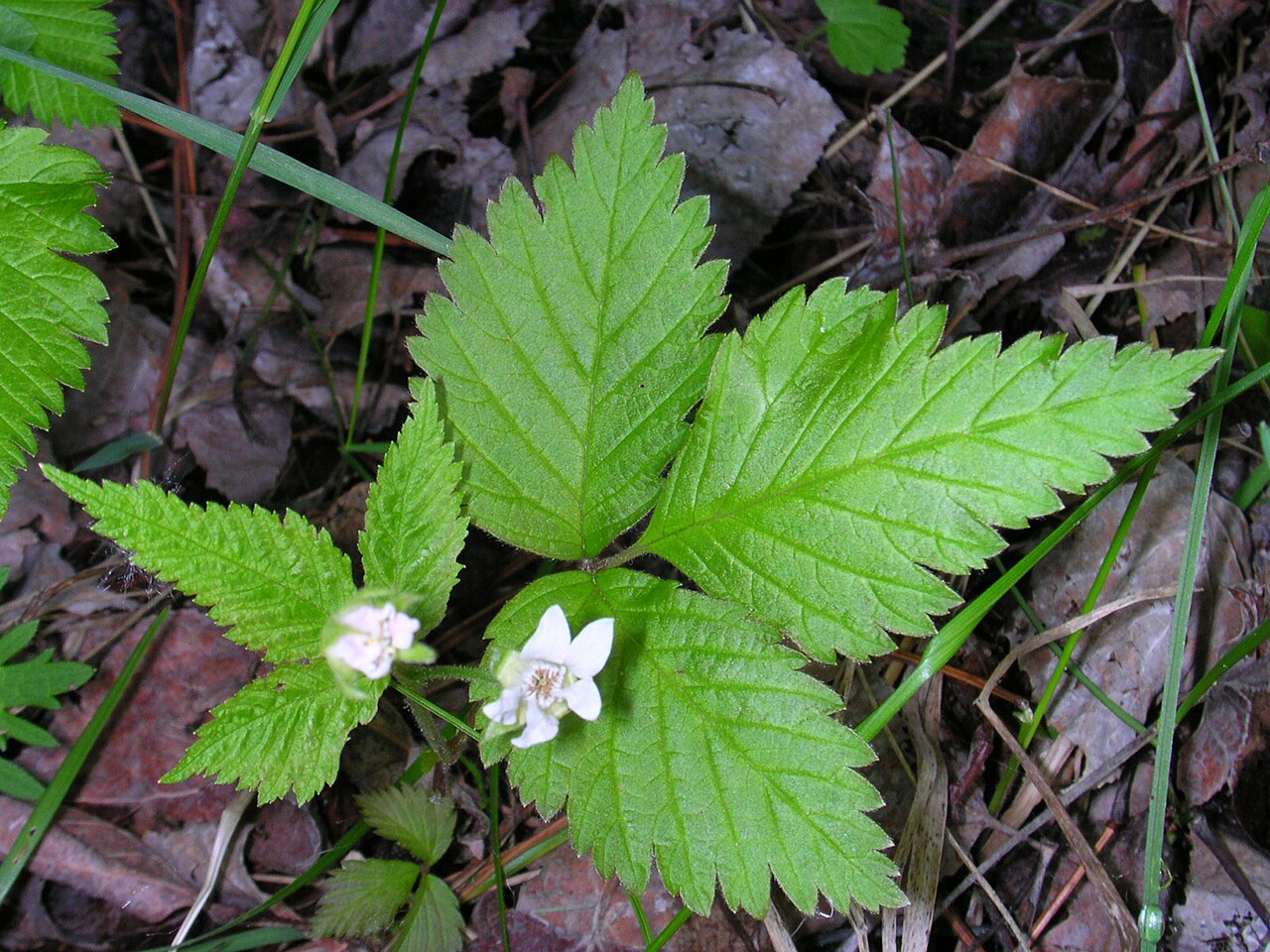
Rubus pubescens, known as Dwarf Raspberry or dwarf red blackberry, is a low, trailing, thornless bramble of cool, moist forests across Canada and the northern United States. Unlike its tall, prickly relatives, it has soft, slender stems that creep along the ground and root at the tips, sending up short leafy shoots only 4 to 12 inches tall. The leaves are divided into three sharply toothed leaflets, the small flowers are white, and the fruit is a bright red, glossy berry that is tart and edible.
Dwarf raspberry belongs to the rose family (Rosaceae). It grows in moist mixed and coniferous woods, cedar and spruce swamps, alder thickets, fens and stream banks, from Alaska and the Yukon east to Newfoundland, and south into the northern Rockies, the Great Lakes states and the Northeast. It often forms extensive patches with other northern woodland plants such as bunchberry, twinflower and Canada mayflower.
In gardens, dwarf raspberry makes an attractive, informal groundcover for moist, partly shaded sites in cold climates, and its berries are a small treat for people and wildlife. It is offered by a few native plant nurseries in the Upper Midwest and Northeast and spreads steadily by runners once established.
Identification
Look for a low, thornless, trailing plant on moist forest floors, with three-parted, sharply toothed leaves, small white flowers in late spring and single red raspberries in midsummer.
Growth Habit
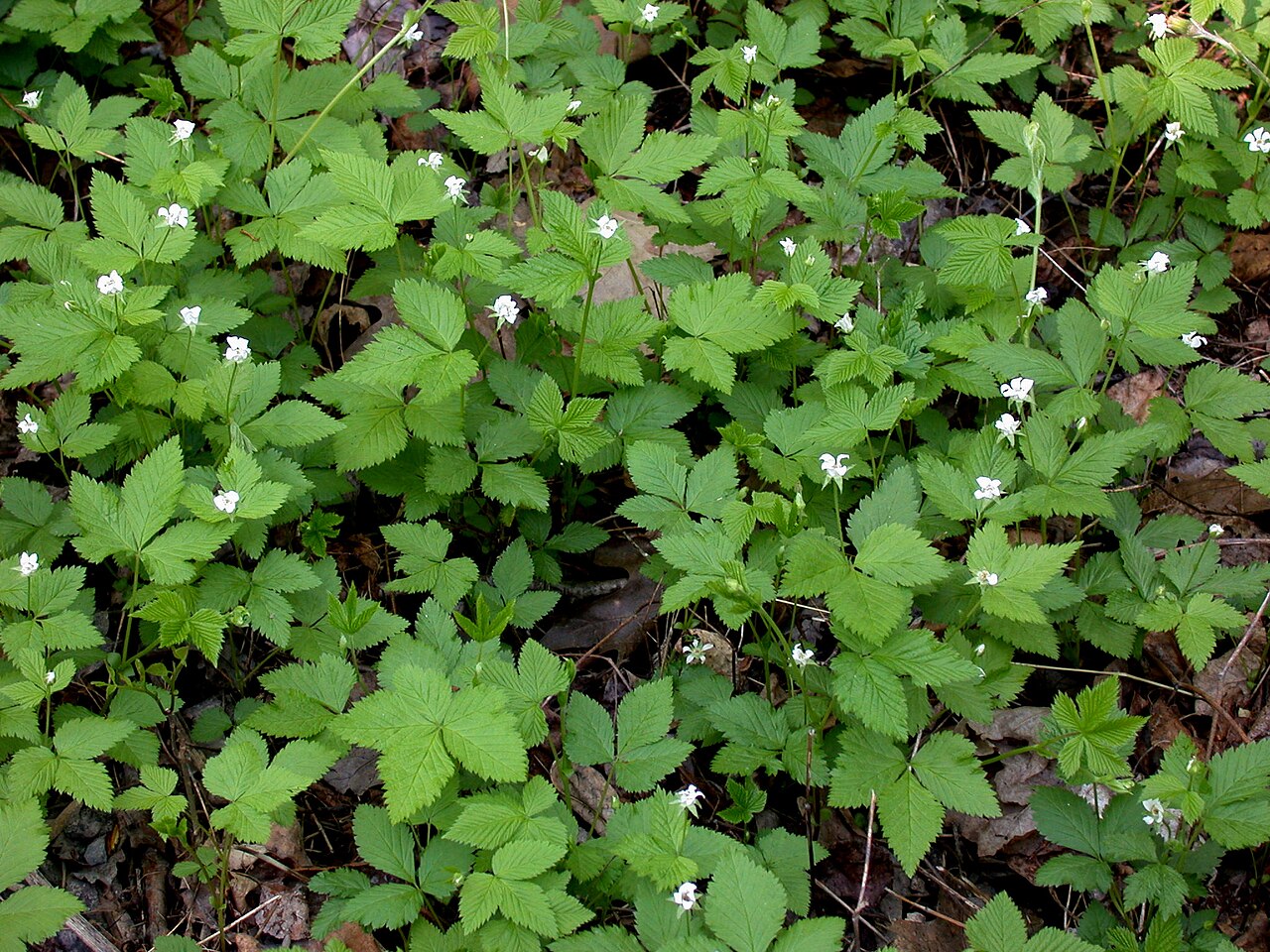
A perennial, trailing plant with soft, slender, mostly herbaceous stems. Long, leafy runners creep over the ground and moss, rooting at the tips to form new plants. Short, upright flowering shoots rise 4 to 12 inches. The stems lack the prickles typical of most raspberries and blackberries but are covered in fine, soft hairs, which give the species its name, pubescens (“downy”).
Leaves
The leaves are compound, usually with three leaflets (occasionally five on vigorous runners), each 1 to 3 inches long, oval to diamond-shaped, pointed, and coarsely and sharply double-toothed. They are thin, bright green, and only slightly hairy. Leaves die back in winter, although the base of the stems may persist.
Flowers
One to three flowers grow at the tip of each upright shoot in late spring and early summer, roughly May to July. They are about 1/2 to 3/4 inch across, with five white (occasionally pinkish) petals, a ring of many stamens and narrow, bent-back sepals.
Fruit
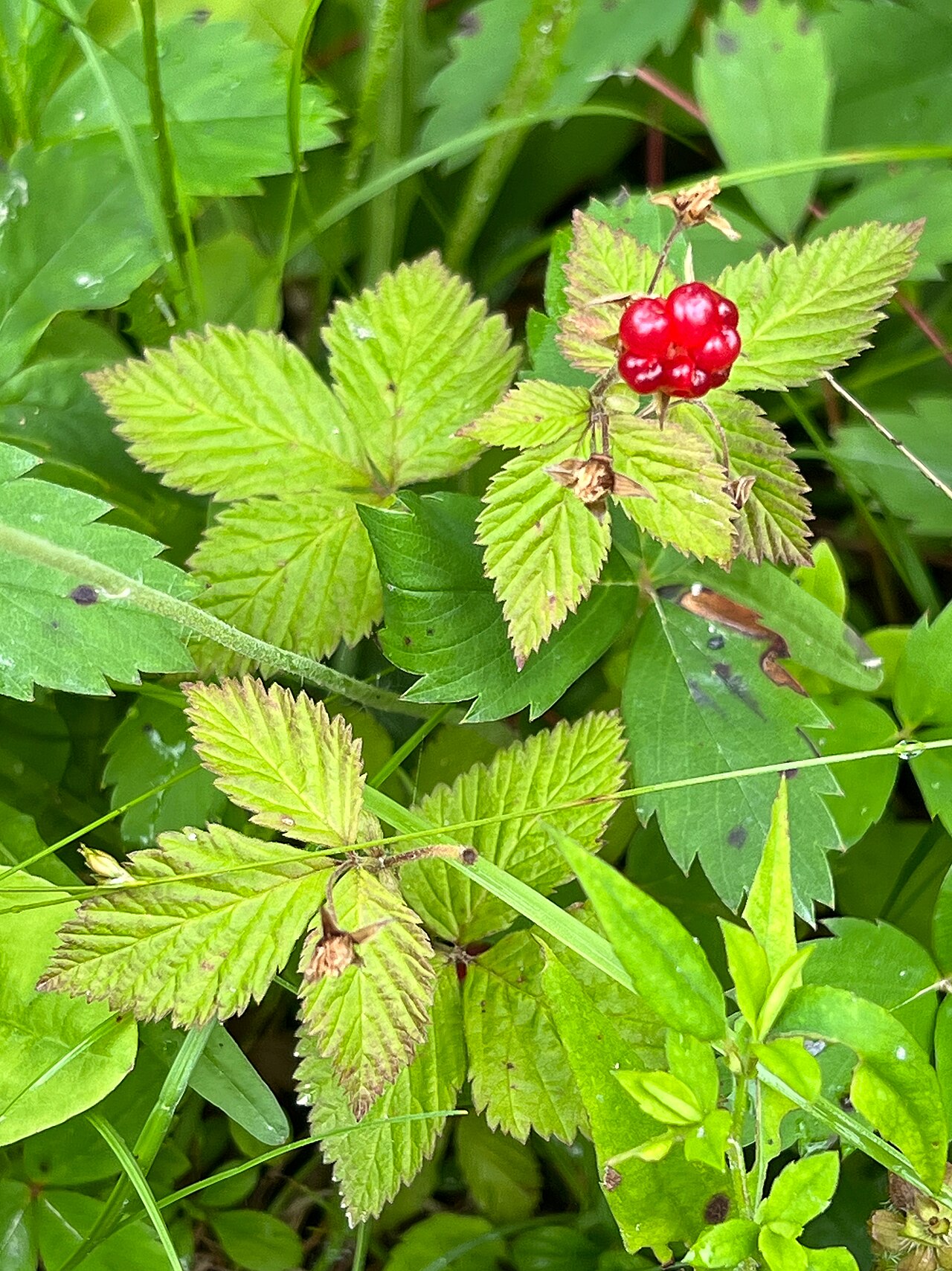
The fruit is a small, rounded aggregate of glossy, bright red to dark red drupelets, about 1/3 to 1/2 inch across, ripening in July and August. It is juicy, tart and edible, though usually produced in small numbers. Unlike a true raspberry, the fruit does not pull cleanly off as a hollow cap.
Look-alikes
Roughfruit berry (Rubus lasiococcus) of the Pacific Northwest mountains has rounder, lobed leaves and hairy fruits. Arctic raspberry (R. arcticus) has pink to rose flowers. Swamp dewberry (R. hispidus) has bristly stems, shiny, semi-evergreen leaves and black fruit, and northern dewberry has prickly stems and black fruit. Wild strawberries have three leaflets too, but their leaflets are blunter and their seeds sit on the surface of the fruit.
Quick Facts
| Scientific Name | Rubus pubescens |
| Family | Rosaceae (rose family) |
| Plant Type | Trailing, thornless perennial groundcover (subshrub) |
| Mature Height | 4–12 in |
| Mature Spread | 2–4 ft; spreads by runners |
| Growth Rate | Moderate |
| Sun Exposure | Part shade to shade |
| Water Needs | Medium to high; consistently moist |
| Soil Type | Moist, humus-rich loam, peat or mucky soil |
| Soil pH | Acidic to slightly alkaline (about 5.0–7.5) |
| Bloom Time | May–July |
| Flower Color | White, occasionally pinkish |
| Fall Color | Leaves turn yellow to reddish |
| Fruit | Red, glossy, edible aggregate berry (July–August) |
| Deer Resistant | No; browsed by deer |
| USDA Hardiness Zones | 2–6 |
Native Range
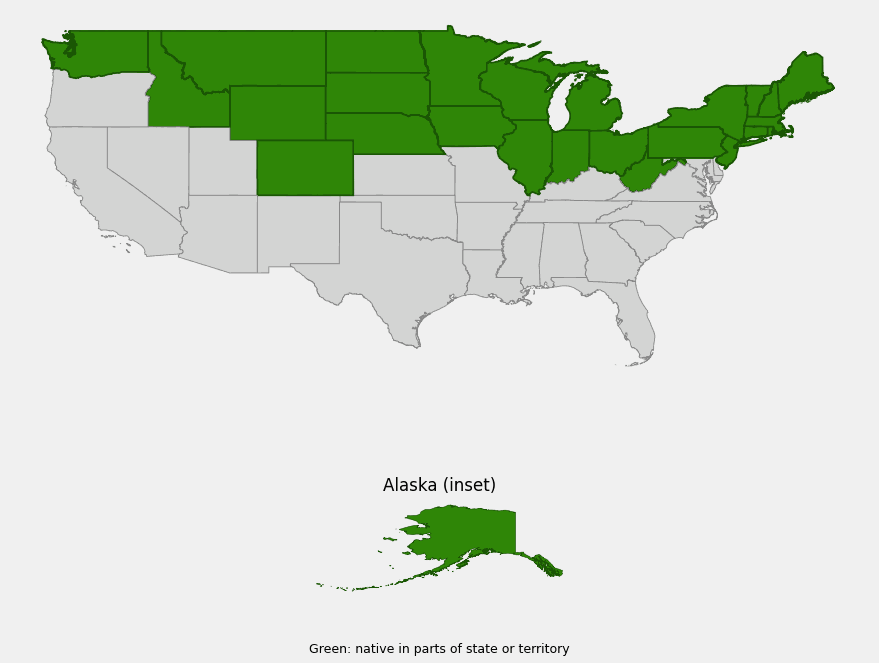
Dwarf raspberry is a boreal plant with one of the broadest ranges of any North American bramble. In Canada it grows in every province and territory except Nunavut, from Yukon and British Columbia to Labrador and Newfoundland. In the United States it is native in Alaska and across the northern tier, from Washington, Idaho and Montana east through the Dakotas and the Great Lakes states to New England, south to northern Iowa, Illinois, Indiana, Ohio, Pennsylvania and New Jersey. It reaches its southern limits as rare outlying populations in West Virginia, Colorado and the cool river valleys of northern Nebraska.
In the West it is found mainly in the northern Rocky Mountains and the Black Hills, and in northeastern Washington and northern Idaho, east of the Cascades. USDA PLANTS also lists Oregon, but no herbarium records support a native population there, so Oregon is not included on the range map.
Its habitats are cool and moist: coniferous and mixed forests, white cedar, tamarack and black spruce swamps, alder and willow thickets, fens, bog margins, wet meadows and shaded stream banks. It is most common in the Great Lakes region and the boreal forest of Canada.
📋 Regional plant lists featuring Dwarf Raspberry: New York, Pennsylvania & Northern New Jersey · Idaho, Eastern Oregon & Eastern Washington · Ohio & Indiana · Montana & Wyoming · Michigan, Wisconsin & Eastern Minnesota · Nebraska, Kansas & Eastern Colorado · Connecticut, Massachusetts & Rhode Island · New Hampshire, Maine & Vermont · Maryland, Virginia & West Virginia · Delaware, Southern New Jersey & Long Island · Illinois, Iowa & Missouri · Alaska · North Dakota, South Dakota & Western Minnesota
Growing & Care Guide
Dwarf raspberry is an easy, low-maintenance groundcover for cool, moist, shady gardens in the North. It is thornless and soft to the touch, so it is pleasant to garden around, and it fills in gradually by rooting runners. It does poorly in hot, dry summers and in the South.
Light
Part shade to full shade. It grows best in dappled light under trees and tolerates more sun where the soil stays moist and summers are cool.
Soil & Water
Moist to wet, humus-rich soil, from loam to peat. It tolerates seasonally saturated soil and acidic to slightly alkaline conditions. Do not let it dry out, especially in its first year; a leaf-litter or shredded-bark mulch helps keep the soil cool and moist.
Planting Tips
Plant in spring or early fall, spacing plants about 1 to 2 feet apart for groundcover. It suits woodland gardens, shaded rain gardens, pond edges and the margins of swampy areas. Pair it with ferns, bunchberry, twinflower, goldthread and other northern woodland plants.
Pruning & Maintenance
Very little care is needed. Remove dead stems in spring if desired. The runners can be trimmed or redirected if it spreads beyond where you want it, but it is not aggressive in the way tall brambles can be.
Propagation
Easiest by rooted runners, which can be cut from the parent plant and replanted in spring or fall. It also grows from seed cleaned from ripe fruit and sown in fall for cold stratification; germination can be slow and irregular.
Landscape Uses
- Woodland groundcover: a soft, thornless carpet for moist shade
- Edible landscaping: small, tart red berries in midsummer
- Rain gardens and pond edges: tolerates wet, shaded soils
- Wildlife gardens: fruit for birds and small mammals
- Restoration: for swamp, fen and moist forest plantings in the North
Wildlife & Ecological Value
Dwarf raspberry is a common part of the low layer of northern forests and swamps, offering flowers, fruit and cover close to the ground.
For Pollinators
Its white flowers are visited by small bees, including bumble bees and mining bees, and by flies and other insects in late spring and early summer.
For Birds
The red fruits are eaten by ground-foraging and shrub-dwelling birds such as thrushes, grouse and sparrows, which help spread the seeds.
For Mammals
Deer and moose browse the leaves, and the fruit is eaten by chipmunks, mice, foxes, black bears and other mammals. Its leafy runners provide cover for small animals on the forest floor.
Ecosystem Role
As a creeping, rooting groundcover, it helps hold soil on stream banks and in swamp margins and adds to the diverse herb layer of boreal and northern mixed forests.
Cultural & Historical Uses
The fruits of dwarf raspberry have long been eaten by Indigenous peoples across the boreal forest, usually as a seasonal snack where they grow in quantity. Because each plant bears only a few berries, they are rarely gathered in large amounts.
The species name pubescens means “downy,” referring to the fine, soft hairs on the stems and leaves. Its French Canadian name, ronce pubescente, has the same meaning. Other common names include dwarf red blackberry and trailing raspberry.
Although it belongs to the same genus as commercial raspberries and blackberries, dwarf raspberry has never been grown as a fruit crop. Its value lies in its role in northern forests and as a hardy, thornless native groundcover for cold-climate gardens.
Frequently Asked Questions
Are dwarf raspberry fruits edible?
Yes. The red berries are tart, juicy and edible, though each plant usually produces only a few.
Does dwarf raspberry have thorns?
No. Its stems are soft and finely hairy, without the prickles of most raspberries and blackberries.
Is dwarf raspberry a good groundcover?
Yes, in moist, partly shaded sites in cold climates. It spreads by rooting runners and forms a low, leafy carpet.
Where does dwarf raspberry grow?
In cool, moist forests, swamps and fens across Canada, Alaska and the northern United States, south to the Great Lakes, the Northeast and the northern Rockies.
How is it different from wild strawberry?
Both have three leaflets, but dwarf raspberry has sharply pointed, double-toothed leaflets and a red raspberry-like fruit, while wild strawberry has blunter leaflets and a fruit with seeds on the surface.

Looking for a nursery that carries Dwarf Raspberry?
Browse our native plant nursery directory: Alaska · Colorado & Connecticut · Idaho, Illinois, Indiana & Iowa · Maine, Massachusetts, Michigan, Minnesota & Montana · Nebraska, New Hampshire, New Jersey, New York, North Dakota & Ohio · Pennsylvania, Rhode Island, South Dakota & Vermont · Washington · West Virginia, Wisconsin & Wyoming