Northern Dewberry (Rubus flagellaris)
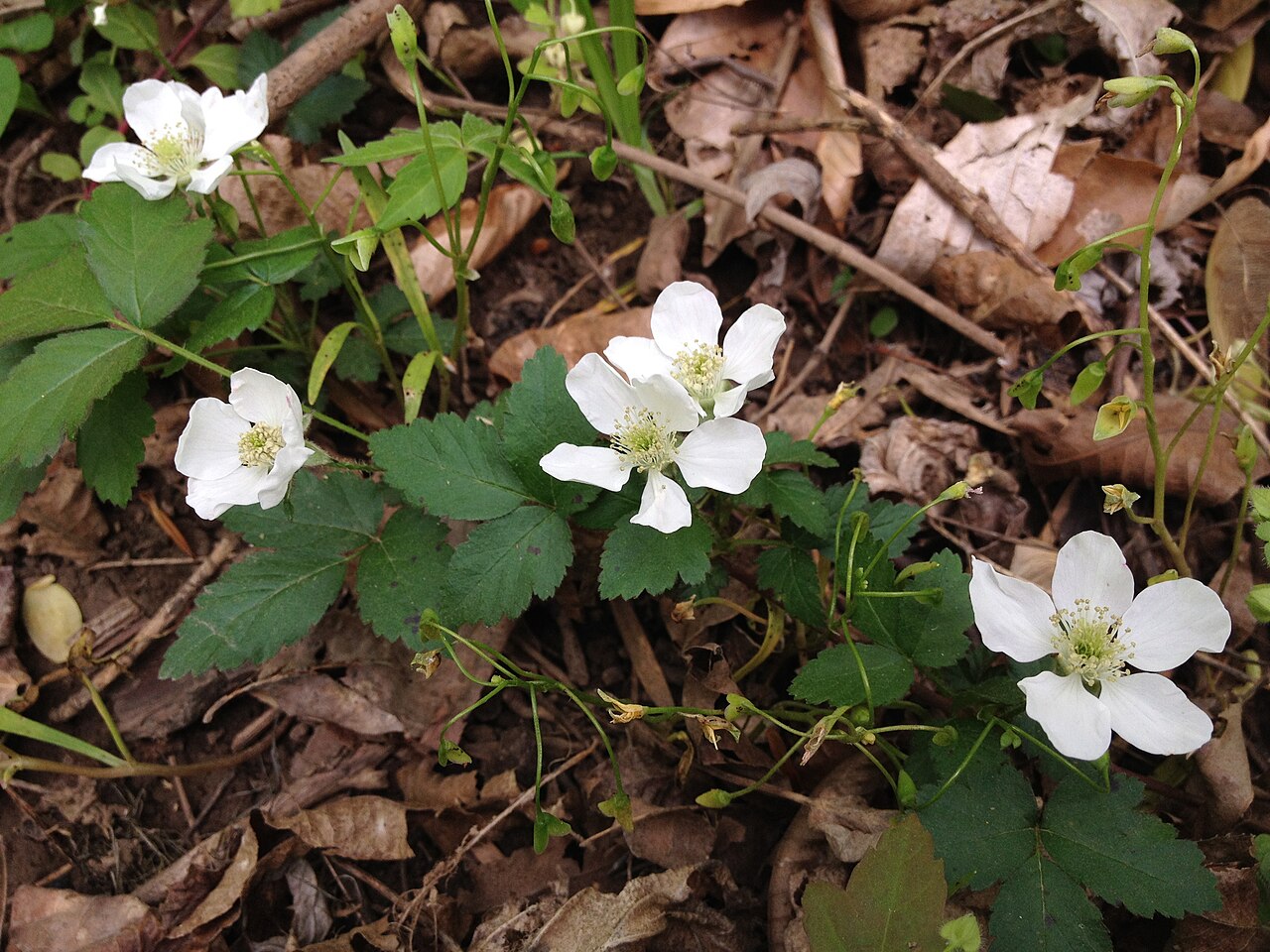
Rubus flagellaris, the Northern Dewberry, is a low, trailing bramble that hugs the ground instead of growing upright like its blackberry and raspberry relatives. Its thin, prickly canes creep along the soil, root wherever a tip touches down, and form loose mats a few inches tall but many feet wide. In late spring the trailing stems are dotted with white, five-petaled flowers, followed in early summer by shiny black, blackberry-like fruit that ranks among the best wild brambles for eating out of hand.
Northern dewberry is one of the most widespread native brambles in the eastern United States, common from New England and the upper Midwest south to the Gulf Coast and west to the edge of the Great Plains. It thrives in exactly the disturbed, sunny, well-drained sites that give most gardeners trouble: old fields, roadsides, open woodland edges, sandy barrens and dry slopes, where little else grows as reliably.
Because it trails rather than arches, dewberry is less useful as a hedge or screen than upright brambles, but it earns a place as a tough, low groundcover for a sunny, well-drained bank or naturalized meadow edge, especially where a thornier, denser bramble would be unwelcome. Site it carefully, though, since the canes do carry small recurved prickles and will root and spread wherever they touch bare soil.
Identification
Northern dewberry grows as a low, trailing shrub rather than an upright cane bramble. Its stems lie along or just above the ground, rooting at the tips, so a single plant can cover a surprisingly wide patch while staying under a foot tall.
Stems
The trailing canes are round to slightly angled, reddish to green-brown, and armed with small, scattered, recurved prickles rather than the dense, straight thorns of some blackberries. First-year canes (primocanes) run along the ground and root at the tip; second-year canes (floricanes) produce the flowers and fruit before dying back.
Leaves
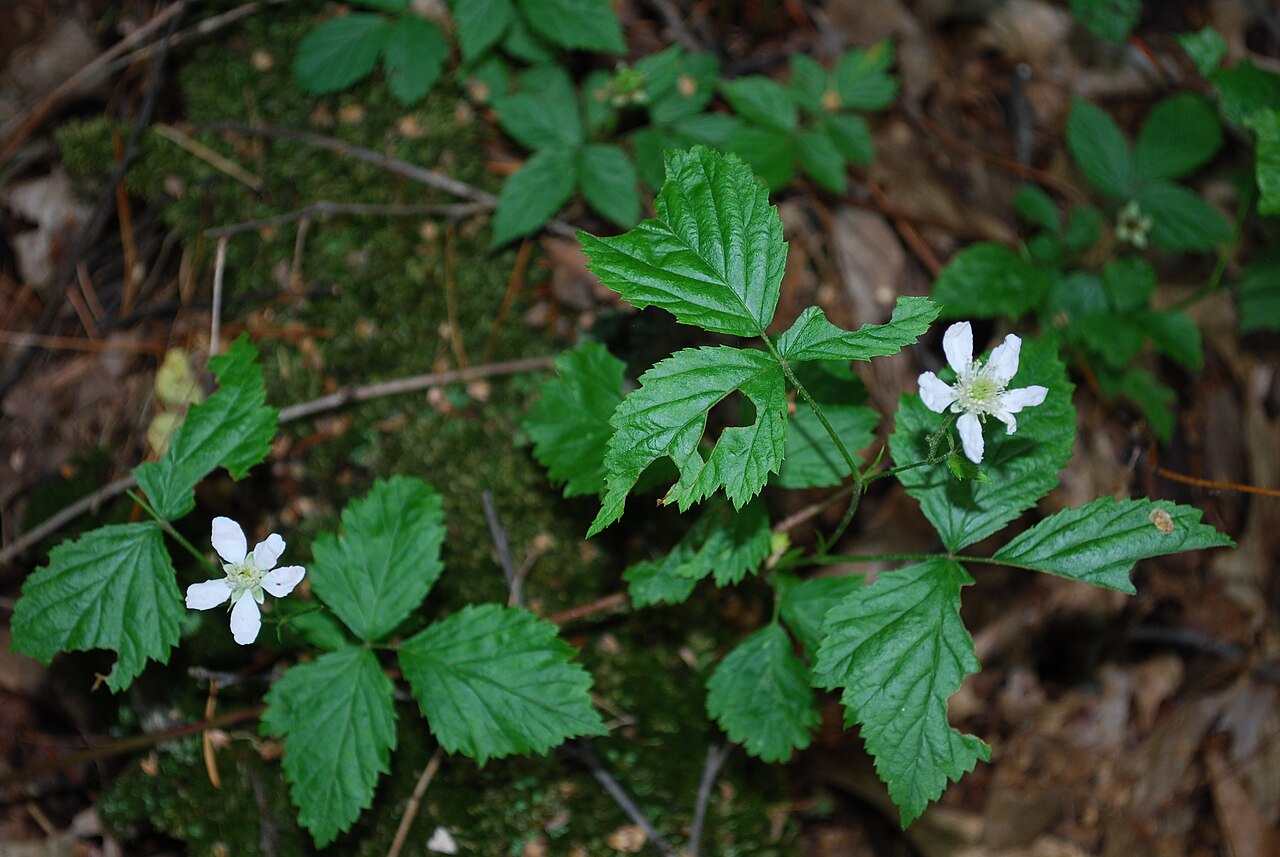
Leaves are compound, usually divided into three (occasionally five) toothed, pointed leaflets 1 to 3 inches long, dark green above and paler beneath. They are semi-evergreen in the milder parts of the range, often persisting through a mild winter before new growth replaces them in spring.
Flowers
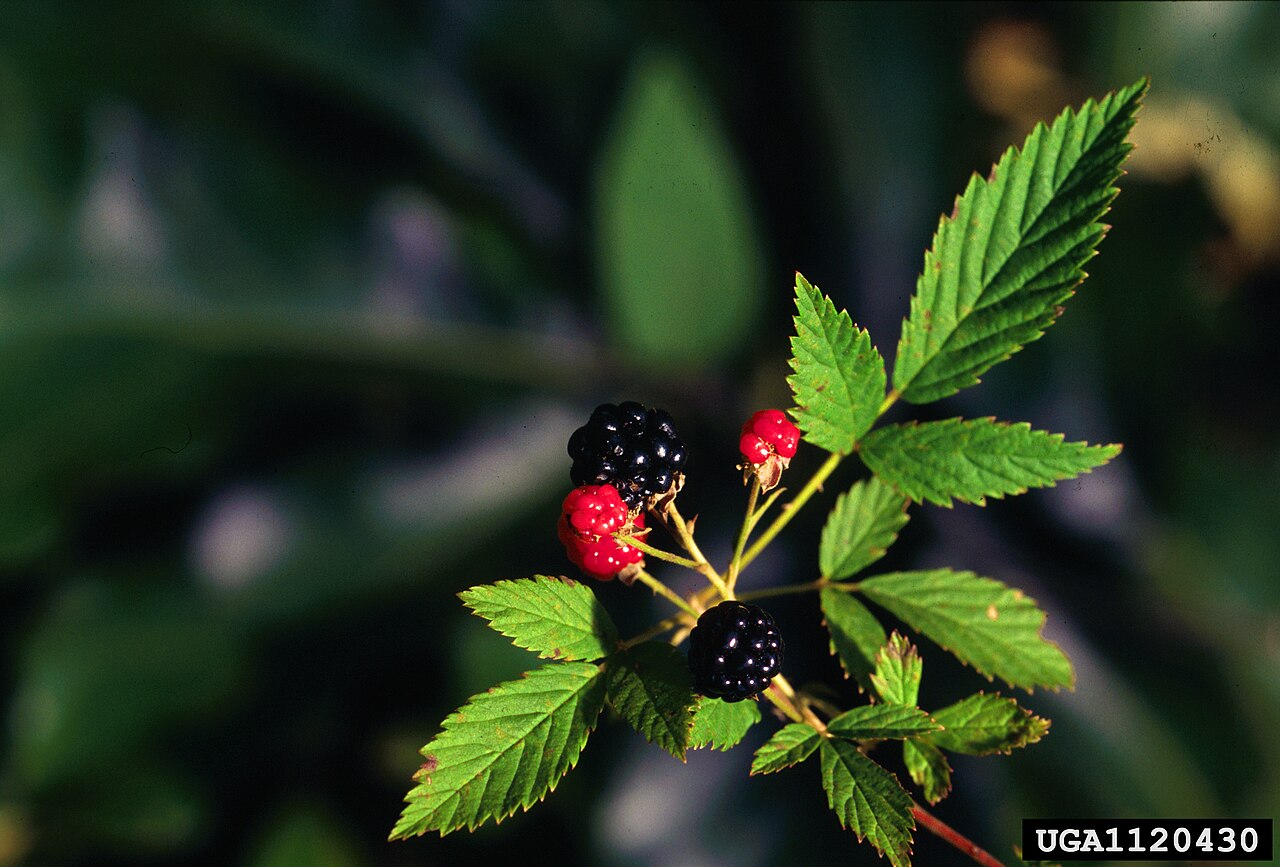
Flowers open in mid- to late spring, before most blackberries, in small clusters of one to a few blooms along the floricanes. Each flower has five white petals around a center of numerous yellow stamens, typically 1 to 1.5 inches across, larger than the flowers of many upright blackberries.
Fruit & Seeds
The fruit is a compound drupelet, shiny black when ripe, oval to round, and usually a bit smaller than a cultivated blackberry. It ripens in early to midsummer, earlier than most upright blackberries, and separates cleanly from its stem (unlike a true raspberry, where the core stays on the plant), confirming it as a blackberry relative rather than a raspberry.
Quick Facts
| Scientific Name | Rubus flagellaris |
| Family | Rosaceae (Rose) |
| Plant Type | Trailing, semi-evergreen bramble (subshrub) |
| Mature Height | 6–12 in |
| Mature Spread | 3–8 ft or more per plant as canes trail and root |
| Growth Rate | Fast once established |
| Sun Exposure | Full Sun to Part Shade |
| Water Needs | Average; drought tolerant once established |
| Soil Type | Dry to average, well-drained sand, loam or rocky soil |
| Soil pH | Acidic to neutral (about 5.5–7.0) |
| Bloom Time | April – June |
| Flower Color | White |
| Fall Color | Leaves often bronze-red; semi-evergreen in mild winters |
| Fruit | Shiny black compound drupelets, edible, ripening early summer |
| Deer Resistant | Somewhat (prickly stems discourage browsing) |
| USDA Hardiness Zones | 4–9 |
Native Range
Northern dewberry is native across most of the eastern United States, from New England and the Great Lakes south through the Appalachians and Southeast to the Gulf Coast, and west through the Mississippi Valley and Ozarks onto the eastern Great Plains. It drops out west of about the 100th meridian, where the dry shortgrass prairie and high plains of the western Dakotas, western Nebraska, western Kansas and most of Colorado no longer suit it.
Across this broad range, dewberry favors open, disturbed or naturally sparse ground: old fields and pastures, roadsides, sandy barrens, open woodlands, dunes and rocky or sandy slopes. It is one of the first brambles to colonize cleared or burned ground, and it tolerates poor, dry, acidic soils that discourage many other plants.
Northern dewberry’s close relatives make identification tricky in places, since several other trailing dewberry species overlap its range and hybridize readily within the genus; local floras and county extension offices are the best resource for sorting out dewberry species in a given area.
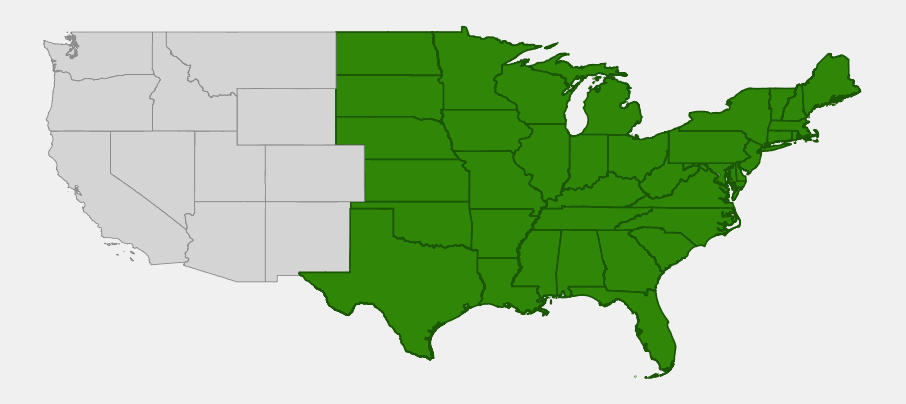
📋 Regional plant lists featuring Northern Dewberry: New Hampshire, Maine & Vermont · Connecticut, Massachusetts & Rhode Island · New York, Pennsylvania & Northern New Jersey · Delaware, Southern New Jersey & Long Island · Maryland, Virginia & West Virginia · North Carolina & South Carolina · Georgia, Alabama & Mississippi · Arkansas, Louisiana, Eastern Oklahoma & Eastern Texas · Kentucky & Tennessee · Ohio & Indiana · Illinois, Iowa & Missouri · Michigan, Wisconsin & Eastern Minnesota · North Dakota, South Dakota & Western Minnesota · Nebraska, Kansas & Eastern Colorado
Growing & Care Guide
Northern dewberry is an easygoing, low-maintenance native for a sunny spot with so-so soil, but its trailing, rooting habit means it needs room to spread and a site where that habit is welcome rather than a nuisance.
Light
Give dewberry full sun for the heaviest flowering and fruiting. It tolerates part shade along woodland edges, but plants in more shade flower and fruit more sparsely and spread less vigorously.
Soil & Water
Dewberry is unfussy about soil, thriving in dry, sandy or rocky ground that would stress most garden plants, and it also grows well in average, well-drained loam. It needs little supplemental water once established and is naturally drought tolerant, reflecting its preference for old fields and dry barrens in the wild. It does not tolerate consistently wet or poorly drained soil.
Planting Tips
Give dewberry open ground to spread into, since trailing canes root at the tips and a single plant can cover several feet within a season or two. Because of this spreading habit, it is best used in naturalized areas, slopes or meadow plantings rather than small, tidy beds, and it is not a good choice directly next to walkways or lawns where its prickly, rooting stems can become a nuisance.
Pruning & Maintenance
Little pruning is required. Cut back or thin old floricanes after fruiting if a tidier look is wanted, and pull or cut errant canes that root beyond the intended planting area to keep the patch contained. Wear gloves when working with it, since the recurved prickles catch skin and clothing.
Propagation
Dewberry propagates itself readily by tip-rooting, where the growing end of a trailing cane roots into the soil and forms a new plant. Gardeners can speed this along by pinning a cane tip to bare soil, or by digging and transplanting an already-rooted tip in early spring or fall.
Landscape Uses
- Erosion control on dry, sunny banks and slopes where its rooting stems help hold soil
- Naturalized meadow and prairie-edge plantings alongside black raspberry and native grasses
- Wildlife and pollinator gardens, where its spring flowers and early summer fruit support a wide range of animals
- Restoration of sandy barrens or old-field sites, where it is already adapted to colonize disturbed ground
- Companion groundcover with Virginia creeper on a difficult dry bank
Wildlife & Ecological Value
Northern dewberry punches above its low-growing stature as a wildlife plant, offering food and cover across most of the eastern United States.
For Pollinators
The spring flowers, among the earliest bramble blooms in their range, are visited by a wide range of native bees, honey bees and other pollinating insects for both nectar and pollen.
For Birds
Many songbirds, including towhees, thrashers and catbirds, eat the ripe fruit and often nest or forage low in the tangled stems. The dense, prickly mat also provides ground-level cover for birds that nest or forage near the soil surface.
For Mammals
Rabbits, foxes, raccoons and white-tailed deer all eat dewberry fruit, foliage or stems depending on the season, and the low, thorny tangle offers cover for rabbits and other small mammals. Deer browse the foliage, though the prickly stems make it a lower preference than many softer plants.
Ecosystem Role
As an early colonizer of open and disturbed ground, dewberry helps stabilize soil on bare slopes and old fields while other, slower-growing plants establish. Its early fruiting season also fills a food gap for wildlife before many summer-ripening fruits are ready.
Cultural & Historical Uses
Dewberries have long been gathered as a wild fruit across their range, valued by Indigenous peoples and later by rural households for fresh eating, pies, jams and homemade wine, much like other native brambles. Because the fruit ripens earlier than most blackberries, it was often the first wild bramble fruit available each summer.
Historically, dewberry patches along fence rows, pastures and abandoned fields were a familiar part of the rural landscape, and “going dewberrying” was a common early-summer activity in many parts of the South and Midwest. The plant’s tendency to colonize cleared and disturbed ground also made it a familiar, if sometimes unwelcome, presence in old pastures and right-of-ways.
Unlike many showier native shrubs, dewberry was valued mainly for its fruit rather than for ornament, and it remains better known today among foragers and naturalists than in the nursery trade.
Frequently Asked Questions
Can you eat northern dewberries?
Yes, the ripe black fruit is edible and tastes similar to a wild blackberry, often picked fresh for eating out of hand, baking or preserves. Only harvest fruit you can confidently identify as northern dewberry.
How is dewberry different from blackberry?
The main difference is growth habit: dewberry canes trail along the ground and root at the tips, while most blackberries grow upright or in arching canes that reach several feet tall. Dewberry fruit and flowers are otherwise similar to many blackberries, since both belong to the genus Rubus.
Will dewberry take over my garden?
It can spread aggressively in open, sunny ground, since trailing stems root wherever they touch soil. It is best suited to naturalized areas, slopes or meadow plantings with room to spread, rather than small, tidy garden beds.
Does northern dewberry have thorns?
Yes, its trailing stems carry small, recurved prickles, fewer and less stout than some upright blackberries but still sharp enough to catch skin and clothing, so gloves are a good idea when working near it.
Is dewberry good for wildlife?
Very much so. Its early spring flowers feed pollinators, its early-summer fruit feeds songbirds and mammals, and its low, prickly tangle offers ground-level cover, making it a valuable, low-maintenance addition to a wildlife garden.

Looking for a nursery that carries Northern Dewberry?
Browse our native plant nursery directory: Alabama & Arkansas · Connecticut, Delaware, Florida & Georgia · Iowa, Illinois, Indiana & Kansas · Kentucky, Louisiana, Massachusetts, Maryland, Maine, Michigan, Minnesota, Missouri & Mississippi · North Carolina, North Dakota, Nebraska, New Hampshire, New Jersey, New York, Ohio & Oklahoma · Pennsylvania, Rhode Island, South Carolina, South Dakota, Tennessee, Texas, Virginia & Vermont · Wisconsin & West Virginia