
Northern Black Currant (Ribes hudsonianum)
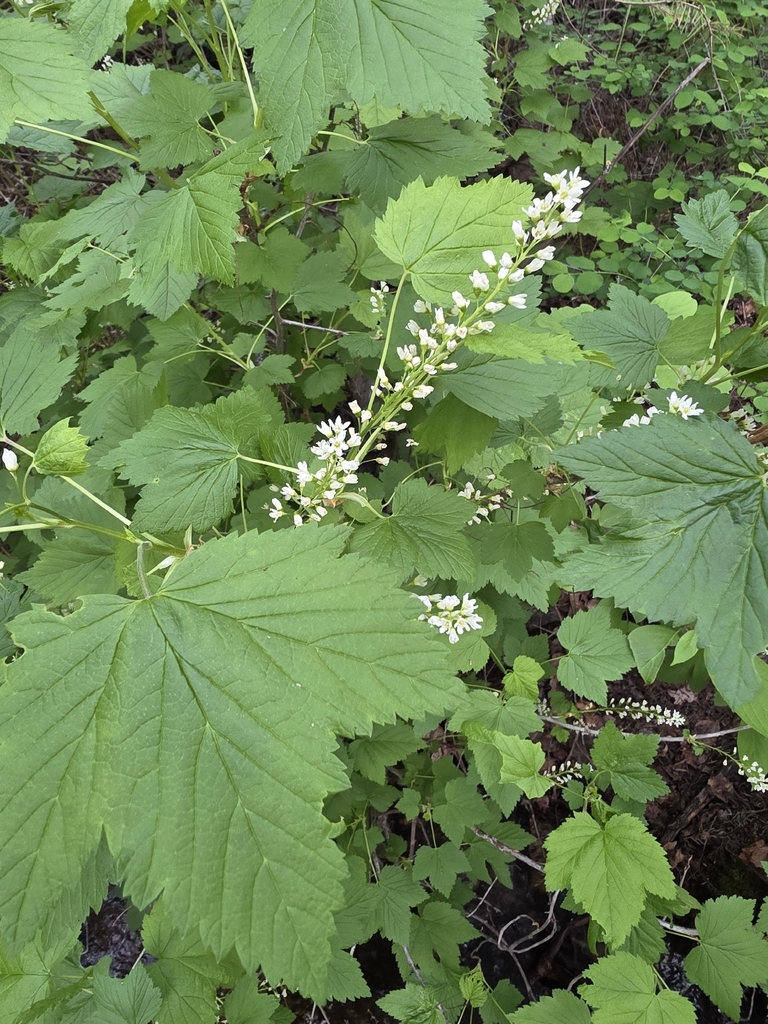
Ribes hudsonianum, the Northern Black Currant (also called Hudson Bay currant, and in the West, western black currant), is a thornless native shrub of wet woods, stream banks and swamps across boreal and western North America. It ranges from Alaska and across Canada to Hudson Bay, south through the Rocky Mountains and the Cascades to California, Nevada and Utah, and into the northern Great Lakes states of Minnesota, Wisconsin and Michigan.
It is a medium-sized shrub with broad, maple-like leaves that are dotted underneath with tiny yellow resin glands and give off a strong, musky odor when crushed. In late spring it bears upright clusters of small white flowers, followed by black, glandular-dotted berries in summer. The fruit is edible but bitter and strong-flavored, and it was eaten by several Indigenous peoples.
Northern black currant is easy to confuse with the related American Black Currant (Ribes americanum), a different species with drooping clusters of yellowish, tubular flowers. This guide covers how to tell them apart, where northern black currant grows, how to grow it in a wet, shady spot and its value to wildlife.
Identification
Northern black currant is an unarmed (spineless) shrub with resin-dotted, strongly scented leaves and upright clusters of white, open flowers. The upright flower clusters and white, saucer-shaped flowers are the quickest way to tell it from American black currant.
Stems & Leaves
It grows 3 to 6 feet tall (occasionally taller) with several upright to spreading stems and no spines or prickles. Young twigs are light brown and dotted with resin glands; older bark is gray to dark brown. The leaves are alternate, broadly rounded and maple-like, about 1½ to 4 inches wide, with three to five shallow, toothed lobes. The undersides are sprinkled with tiny, shiny yellow resin glands, and the crushed leaves have a strong, musky or “catty” smell.
Flowers
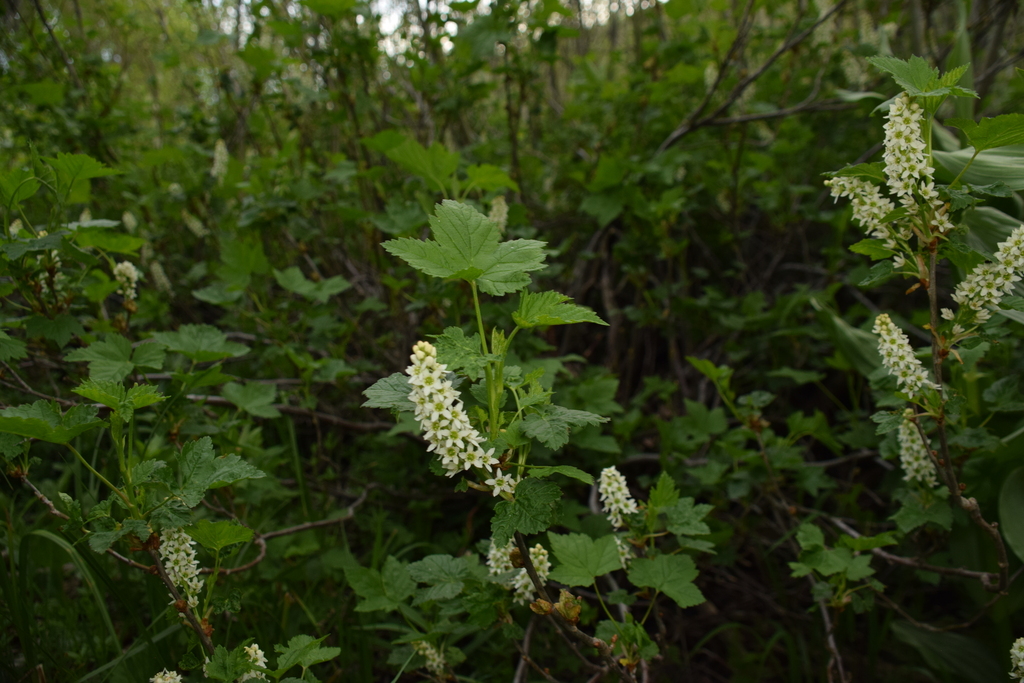
From May to July, the shrub produces erect racemes, 2 to 4 inches long, of six to forty or more small flowers. The flowers are white, saucer- or bell-shaped and about ⅓ inch across, with spreading, hairy white sepals that look like petals and tiny white petals inside.
Fruit
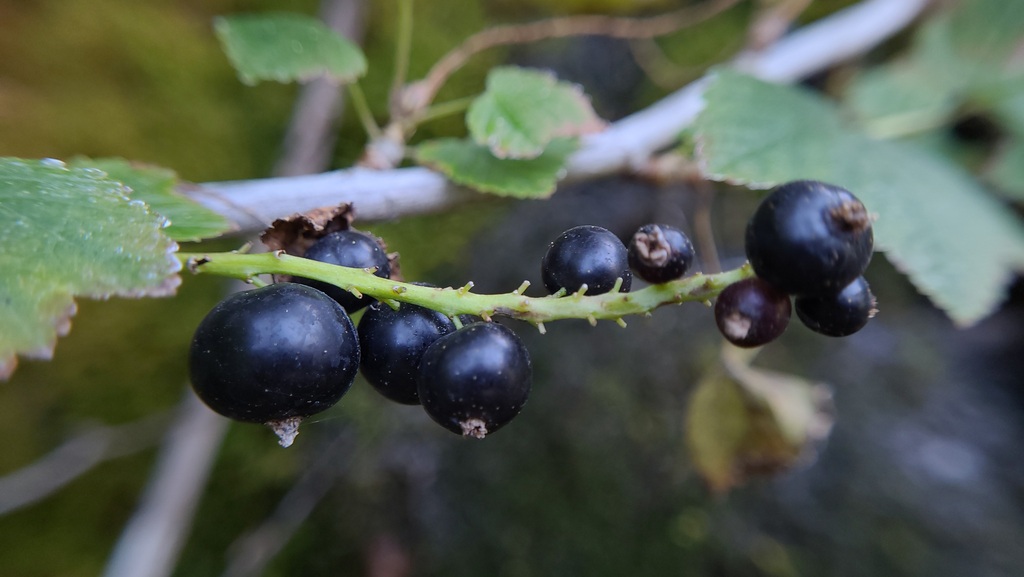
The berries are round, about ⅓ inch across, black (sometimes with a slight bloom) and dotted with small resin glands. They ripen from July to August. They are edible but usually bitter, with a strong, resinous flavor.
Look-alikes
American Black Currant (R. americanum) has drooping clusters of yellowish to greenish-white, tubular flowers, sharper-tipped leaf lobes and resin dots on both leaf surfaces. Western forms of northern black currant were once treated as a separate species, Ribes petiolare (western black currant), which has larger leaves and longer flower clusters. Domestic black currant (R. nigrum), introduced from Europe, has drooping clusters and sweeter fruit. Other native currants such as Golden Currant and Wax Currant have yellow or pink tubular flowers.
Quick Facts
| Scientific Name | Ribes hudsonianum Richardson (incl. var. petiolare) |
| Family | Grossulariaceae (currant and gooseberry family) |
| Plant Type | Deciduous shrub |
| Mature Height | 3–6 ft (occasionally to 9 ft) |
| Mature Spread | 3–5 ft |
| Growth Rate | Moderate |
| Sun Exposure | Partial shade to full sun |
| Water Needs | Wet to moist; does not tolerate drought |
| Soil Type | Moist to wet loam, peat, silt, gravelly stream banks |
| Soil pH | About 5.5–7.5 |
| Bloom Time | May–July |
| Flower Color | White |
| Fall Color | Yellow to reddish |
| Fruit | Black, glandular-dotted berry; edible but bitter |
| Deer Resistant | Low; browsed by deer, elk and moose |
| USDA Hardiness Zones | 2–6 |
Native Range
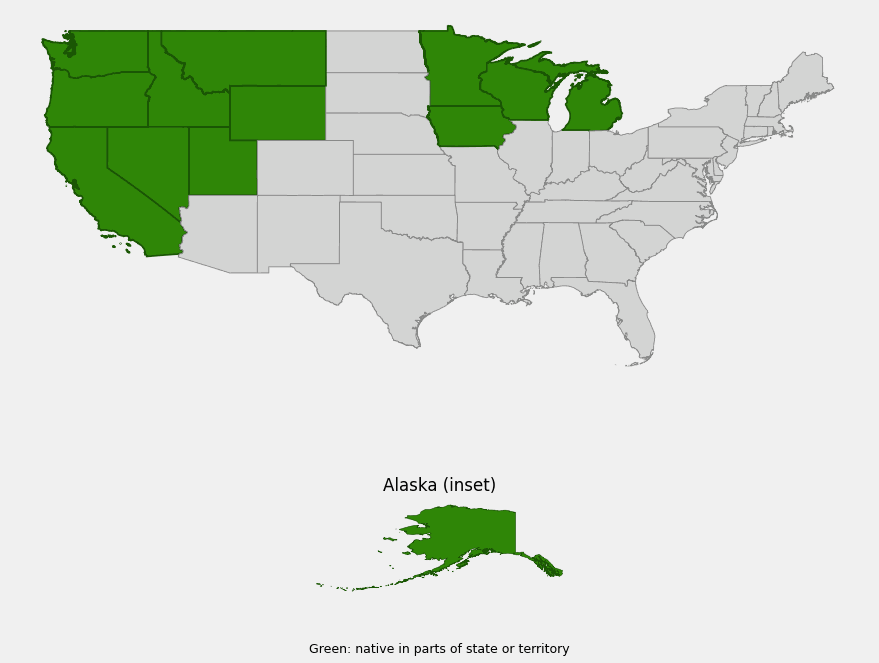
Northern black currant has a wide northern and western range. USDA PLANTS lists it in Alaska, Washington, Oregon, California, Nevada, Idaho, Montana, Wyoming and Utah in the West, and in Minnesota, Wisconsin, Michigan and Iowa in the upper Midwest. In Canada it grows from Yukon, the Northwest Territories and Nunavut across British Columbia, the Prairie Provinces and Ontario to Quebec and the shores of Hudson Bay, for which it is named.
In the upper Midwest it is a plant of northern swamps, alder thickets and boreal forests, mostly in northern Minnesota, Wisconsin and Michigan’s Upper Peninsula, with rare outlying stations farther south. In the West, the form often called western black currant (var. petiolare) grows along mountain streams, in wet meadows and in aspen and spruce woods, mostly east of the Cascade crest and in the Rocky Mountains and Great Basin ranges, south to the mountains of northern California, Nevada and Utah.
Across its range it grows where the soil stays wet or moist: stream banks, seeps, swamps, bogs and fens, wet thickets, floodplains and moist coniferous and mixed forests. It is often found with willows, alders and red-osier dogwood along streams.
📋 Regional plant lists featuring Northern Black Currant: Idaho, Eastern Oregon & Eastern Washington · Montana & Wyoming · Michigan, Wisconsin & Eastern Minnesota · Utah & Western Colorado · Illinois, Iowa & Missouri · Alaska · California & Nevada · North Dakota, South Dakota & Western Minnesota · Western Oregon & Western Washington
Growing & Care Guide
Northern black currant is offered by some native nurseries in the West and upper Midwest, especially for wetland and streambank restoration. It is a good choice for a wet, partly shaded corner where few other shrubs thrive. Check local rules before planting: all Ribes species can host white pine blister rust, a disease of five-needle pines, and some states and localities restrict planting currants and gooseberries near white pines.
Light
Partial shade is ideal, as along wooded streams. It tolerates full sun if the soil stays consistently moist, and fairly deep shade, where it flowers and fruits less.
Soil & Water
It needs constantly moist to wet soil and tolerates seasonal flooding, saturated soils and peat. It does poorly in dry soil and hot, dry summers, so in drier gardens place it near a pond, rain garden or downspout.
Planting Tips
Plant in spring or fall, 3 to 5 feet apart, in wet, organic soil. Group several plants along a stream or pond for a natural thicket. Keep it away from white pines, and plant at least two plants for better fruit set.
Pruning & Maintenance
Remove a few of the oldest stems at ground level every few years in late winter to keep the shrub vigorous, since currants fruit best on younger wood. Little else is needed. Watch for powdery mildew and aphids in dry, crowded conditions.
Propagation
Take hardwood cuttings in late fall or winter, or softwood cuttings in early summer; currants root easily. Layering also works. Seeds need a warm period followed by 3 to 4 months of cold, moist stratification and may take two seasons to germinate.
Landscape Uses
- Streambank and wetland restoration: roots help stabilize wet banks
- Rain gardens and pond edges: thrives in wet, partly shaded soil
- Wildlife gardens: early nectar and summer berries for birds
- Edible landscape: bitter fruit, best cooked in jams or mixed with sweeter berries
Wildlife & Ecological Value
Northern black currant is an important shrub of northern and mountain wetlands, providing flowers in spring and fruit in summer to many animals.
For Pollinators
The white flowers produce nectar and pollen for early bees, including bumble bee queens, as well as flies and other insects. Currants are host plants for the caterpillars of several moths and of the gray comma butterfly.
For Birds
Thrushes, robins, waxwings, grosbeaks and grouse eat the berries, and the dense, streamside thickets provide nesting and cover for warblers and other songbirds.
For Mammals
Black and grizzly bears, chipmunks and other small mammals eat the fruit, and moose, elk and deer browse the twigs and leaves.
Ecosystem Role
As a shrub of stream banks and wetland edges, it helps hold soil, shades streams and adds leaf litter that feeds aquatic insects. Like all currants, it is an alternate host for white pine blister rust, which must spend part of its life cycle on Ribes before it can infect five-needle pines.
Cultural & Historical Uses
John Richardson, the Scottish naturalist and surgeon on John Franklin’s Arctic expeditions, described Ribes hudsonianum in 1823 from plants collected in the Hudson Bay region, which gave it its name. The western plants were described separately as Ribes petiolare and are now usually treated as a variety of the same species.
Several Indigenous peoples of Canada, Alaska and the western United States ate the berries fresh, dried or mixed with other foods, though they were generally considered less desirable than other currants because of their strong, bitter flavor.
In the 20th century, foresters tried to control white pine blister rust by removing wild currants and gooseberries from forests, and some states restricted planting them. Many of those restrictions have been relaxed, but it is worth checking local regulations before planting any Ribes near white pines.
Frequently Asked Questions
Are northern black currant berries edible?
Yes, but they are usually bitter and strongly flavored. They were eaten by Indigenous peoples and can be cooked into jams or mixed with sweeter fruit. Be sure of the identification before eating any wild berry.
How do I tell northern black currant from American black currant?
Northern black currant has upright clusters of white, saucer-shaped flowers. American black currant has drooping clusters of yellowish, tubular flowers and sharper-tipped leaf lobes. Both are spineless and have resin-dotted leaves.
Why do the leaves smell?
The tiny yellow resin glands on the leaves and twigs release aromatic oils when crushed, giving a strong, musky odor typical of black currants.
Can I plant northern black currant near white pines?
It is best not to. All currants can host white pine blister rust, which damages five-needle pines, and some areas restrict planting currants for this reason. Check local regulations.
Where does northern black currant grow?
In wet woods, stream banks, swamps and thickets from Alaska across Canada to Hudson Bay, south through the Rockies, eastern Cascades and Great Basin mountains, and in the northern Great Lakes states.

Looking for a nursery that carries Northern Black Currant?
Browse our native plant nursery directory: Alaska · California · Idaho & Iowa · Michigan, Minnesota & Montana · Nevada · Oregon · Utah · Washington · Wisconsin & Wyoming

