
Moa Nahele (Psilotum complanatum)
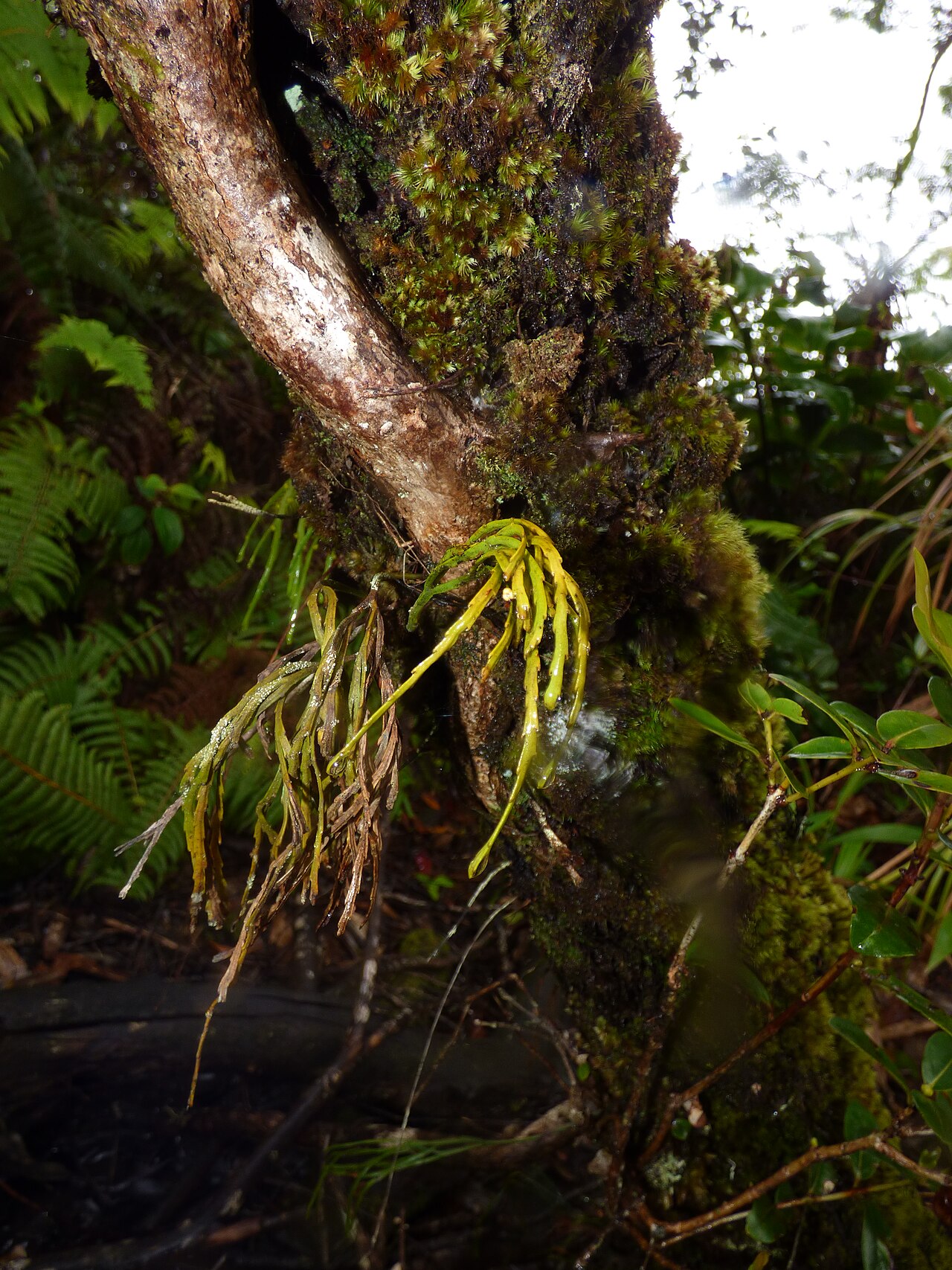
Psilotum complanatum, called Moa Nahele or pipi in Hawaiian and the flat fork fern or flat-stemmed whisk fern in English, is one of the oddest plants in Hawaiian forests. It has no true leaves and no roots. The whole plant is a tuft of flat, green, ribbon-like stems that fork again and again and hang from tree trunks, tree fern trunks and mossy branches in wet forest.
It is a close relative of the more familiar Whisk Fern (Psilotum nudum), known in Hawaiian simply as moa. For a long time whisk ferns were seen as living fossils that resembled the earliest land plants. DNA studies now show they are true ferns that have lost their leaves and roots, related to the adder’s-tongue and moonwort ferns. Either way, they are among the simplest-looking vascular plants alive.
Moa nahele is indigenous to Hawaiʻi; it also grows in tropical Asia, Australia, Pacific islands, Mexico and Central and South America. It is an epiphyte with exacting needs, which makes it hard to grow outside its forest habitat. This guide covers how to recognize it, where it grows in Hawaiʻi, and what it takes to grow it.
Identification
Hawaiʻi has two native Psilotum species, and they are easy to tell apart once you look at the shape of the stems.
Growth Habit
Moa nahele grows as a clump of hanging or arching stems, usually 4 to 30 inches long (10 to 75 cm), from a creeping, branched rhizome buried in moss, bark or humus. The rhizome has no true roots; instead it absorbs water and nutrients through fine, brownish, hair-like rhizoids, with help from symbiotic fungi.
Stems
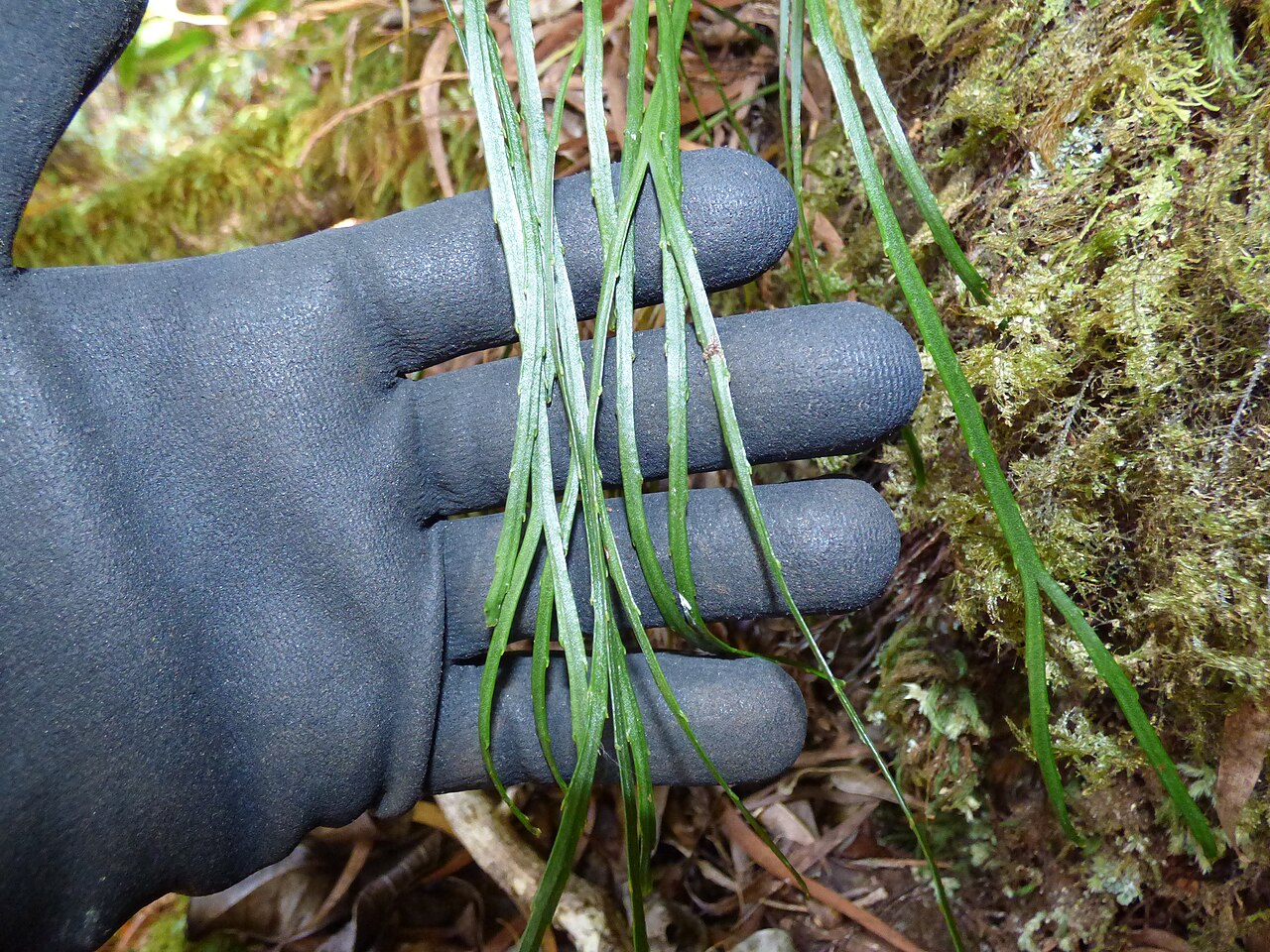
The stems are flat and strap-like, up to about 5 mm wide at the base and 1.5 to 2 mm wide in the branches, and they fork in pairs (dichotomously) several times along their length. They are green and do the plant’s photosynthesis. Tiny scale-like appendages, much smaller than true leaves, sit in two rows along the flattened stems.
Sporangia & Spores
There are no flowers. Fertile stems carry small, rounded, yellowish spore capsules (synangia, each made of fused sporangia) in the axils of tiny forked scales. They release bean-shaped spores. The spores germinate underground into tiny, non-green gametophytes that live with fungi, so young plants are almost never seen.
Similar Species
Moa or whisk fern (P. nudum) is the other native species. It is more upright and broom-like, with narrow, three-angled stems and conspicuous yellow sporangia, and it grows on the ground, on rocks and lava and in garden pots as often as on trees. Moa nahele has flat, drooping stems and is almost always epiphytic in wet forest. Hybrids between the two are known.
Quick Facts
| Scientific Name | Psilotum complanatum Sw. (flat-stemmed plants are sometimes now called P. flaccidum) |
| Family | Psilotaceae (whisk fern family) |
| Plant Type | Epiphytic fern ally (leafless fern); indigenous to Hawaiʻi |
| Mature Height | Hanging stems 4–30 in long |
| Mature Spread | 6–18 in clumps |
| Growth Rate | Slow |
| Sun Exposure | Part shade to shade |
| Water Needs | Medium to high; constant humidity |
| Soil Type | None as an epiphyte; moss, tree fern fiber, bark or humus |
| Soil pH | Acidic, about 4.5–6.5 |
| Bloom Time | None (spore-bearing); sporangia form through much of the year |
| Flower Color | None |
| Fall Color | None; evergreen |
| Fruit | None; yellowish spore capsules on fertile stems |
| Deer Resistant | Yes; rarely browsed |
| USDA Hardiness Zones | 10–12 (frost-free) |
Native Range
Moa nahele is indigenous to Hawaiʻi: it is native here and also in other tropical regions. USDA PLANTS lists Hawaiʻi as its only U.S. native range. Elsewhere it grows in the Malay region and tropical Asia, northern Australia, Pacific islands such as Fiji, Mexico, Central America, the Caribbean and South America, usually in moist evergreen forests.
In Hawaiʻi it is found on the main islands, mostly in mesic to wet forest, where it grows on the trunks of ʻōhiʻa and other trees and on the fibrous trunks of hāpuʻu tree ferns, often among mosses and other epiphytes. Plants have been photographed in places such as the Kīpahulu Forest Reserve and the forests above Haʻikū on Maui and in the Waiʻanae Mountains on Oʻahu. It is less common and much less often noticed than Psilotum nudum.
Moa nahele is not federally listed. Because it is uncommon and grows on old, mossy trees, it depends on intact native forest and is sensitive to logging, feral pigs (which damage tree fern trunks) and invasive plants. Never strip it from trees in the wild.
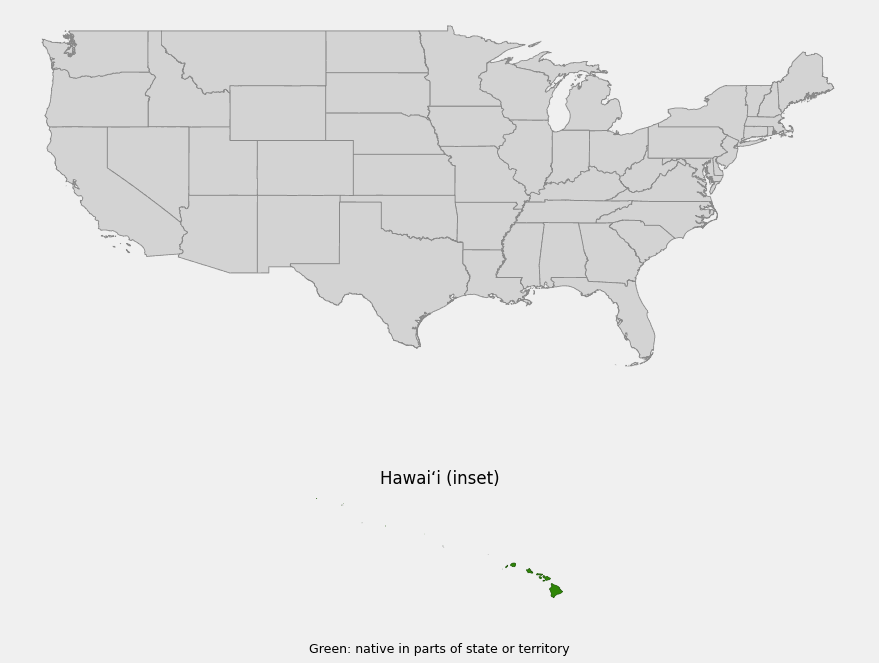
📋 Regional plant lists featuring Moa Nahele: Hawaii
Growing & Care Guide
Moa nahele is hard to grow outside its forest habitat and is mainly a plant for botanical gardens and dedicated fern growers. It needs constant humidity, shade, an airy organic substrate and stable, frost-free temperatures, and it cannot be raised easily from spores. If you want to grow it, look for divisions from Hawaii native plant nurseries or botanical gardens and never strip plants from trees in the wild. Its relative, the whisk fern, is far easier.
Light
Give bright shade or filtered light, like the dappled light under a forest canopy. Direct sun dries and bleaches the stems.
Soil & Water
Grow it on a slab of tree fern fiber or cork, or in a basket or pot of coarse epiphyte mix (tree fern fiber, bark, sphagnum and some charcoal). Keep the substrate evenly moist but never soggy, and keep humidity high by misting or growing it in a shade house, greenhouse or large terrarium. Use rainwater or low-mineral water if possible.
Planting Tips
Attach a clump with its rhizome and surrounding moss to the mount and keep it shaded and humid until it is established; this can take months. In Hawaiʻi, it can be tried on the trunk of a tree fern in a wet upland garden. It does not tolerate frost, drying winds or dry indoor air. Hawaiʻi restricts bringing plants in from other states, so source Hawaiian material locally.
Pruning & Maintenance
Cut away only stems that have fully died back. Feed very lightly, if at all, with a quarter-strength orchid or fern fertilizer. Avoid repotting more than necessary, because the brittle rhizomes and their fungal partners are easily disturbed.
Propagation
Division of the rhizome is the only practical method. Spores germinate underground into tiny gametophytes that need fungal partners and darkness, and raising plants from spores is a specialist task. Whisk ferns also sometimes appear on their own in pots of established plants, carried in with soil or bark.
Landscape Uses
- Botanical collections: a living example of an ancient-looking, leafless fern lineage
- Shade-house epiphyte displays: for specialists with high humidity
- Tree fern plantings: can colonize hāpuʻu trunks in wet upland gardens
- Education: shows how simple a vascular plant can be
- Forest restoration: part of the epiphyte community of restored wet forest
Wildlife & Ecological Value
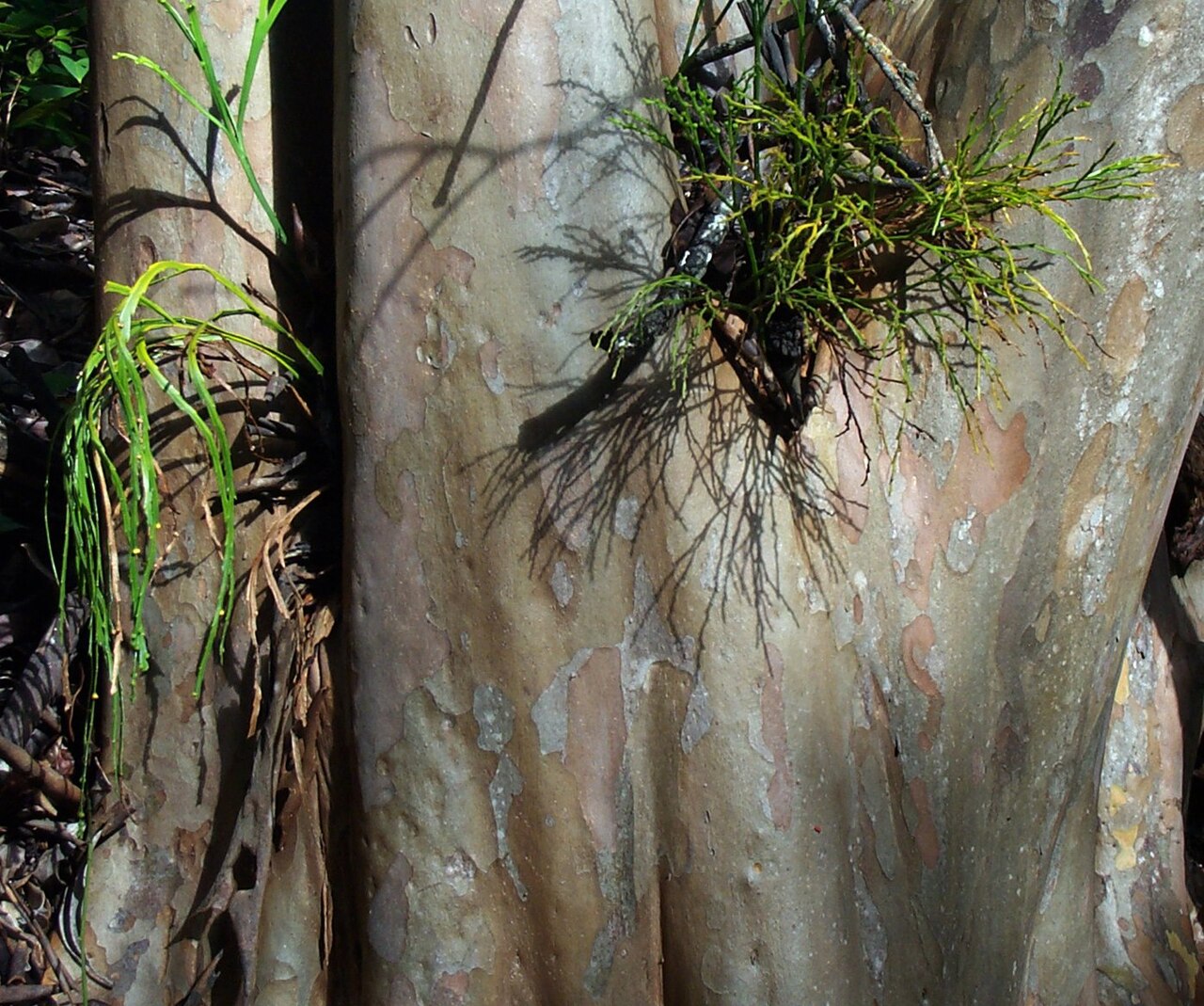
Moa nahele is a small part of the rich epiphyte community of Hawaiian wet forests, where mosses, ferns and lichens cover trunks and branches.
For Pollinators
As a spore-bearing plant, moa nahele has no flowers and offers nothing to pollinators.
For Birds
Native forest birds forage for insects and other invertebrates on epiphyte-covered trunks and branches where moa nahele grows.
For Mammals
Hawaiʻi’s only native land mammal, the Hawaiian hoary bat, hunts insects in the forests where this plant grows. Feral pigs harm it indirectly by toppling and eating the tree ferns it often grows on.
Ecosystem Role
Moa nahele lives in close partnership with soil fungi: its underground gametophytes get all their nutrition from fungi, and the rhizomes of mature plants also host fungal partners. Along with other epiphytes, it helps hold moisture and organic matter on tree trunks.
Cultural & Historical Uses
In Hawaiian, Psilotum plants are called moa, a word that also means chicken, and moa nahele can be read as “forest moa.” Hawaiian children played a game with moa stems, hooking two forked stems together and pulling until one broke, and whisk fern was also used in traditional medicine. Most recorded uses refer to the more common P. nudum.
Psilotum fascinated nineteenth- and twentieth-century botanists, who saw it as a survivor of the first vascular land plants because it lacks leaves and roots. Molecular studies have since placed whisk ferns among the true ferns, as close relatives of the adder’s-tongue ferns (Ophioglossum), and their simplicity is now seen as a loss of features rather than a primitive state.
The name Psilotum complanatum was published by the Swedish botanist Olof Swartz in 1801. A 2024 study found that Swartz’s type specimen was actually a hybrid between the flat-stemmed species and P. nudum, so some botanists now call the flat-stemmed species Psilotum flaccidum, a name from 1831. You may see either name in recent sources.
Frequently Asked Questions
Is moa nahele a fern?
Yes. Although it has no leaves or roots, DNA studies show that whisk ferns (Psilotum) are true ferns, closely related to the adder’s-tongue ferns. They were once thought to be a separate, much older group of “fern allies.”
How is moa nahele different from whisk fern?
Moa nahele (P. complanatum) has flat, ribbon-like, drooping stems and grows as an epiphyte in wet forest. The whisk fern or moa (P. nudum) has narrow, angled stems in an upright, broom-like clump and grows on the ground, rocks and trees.
Is moa nahele native to Hawaiʻi?
Yes. It is indigenous, native to Hawaiʻi and also to other tropical regions of Asia, Australia, the Pacific and the Americas.
Can I grow moa nahele?
It is difficult. It needs shade, very high humidity and an epiphytic setup on tree fern fiber or bark. Botanical greenhouses grow it, but for a home garden the whisk fern (P. nudum) is a much easier choice.
Why is it sometimes called Psilotum flaccidum?
In 2024, researchers found that the original specimen of P. complanatum was a hybrid. Some botanists therefore use P. flaccidum for the flat-stemmed species, while many databases, including USDA PLANTS, still use P. complanatum.

Looking for a nursery that carries Moa Nahele?
Browse our native plant nursery directory: Hawaii

